
Tuna
Scientific Name:
Thunnus spp. / Katsuwonus pelamis
Scope
Covers tunas in family Scombridae, tribe Thunnini, with emphasis on commercially exploited species: skipjack (Katsuwonus pelamis), yellowfin (Thunnus albacares), bigeye (Thunnus obesus), albacore (Thunnus alalunga), Atlantic bluefin (Thunnus thynnus), Pacific bluefin (Thunnus orientalis), and Southern bluefin (Thunnus maccoyii). All three exploitation systems are covered: industrial and small-scale wild capture fisheries, tuna ranching (fattening of wild-caught juvenile bluefin in sea cages), and emerging closed-cycle aquaculture. Populations are primarily wild free-ranging; no fully domesticated tuna breeds exist in the conventional livestock sense, and selective breeding is limited to early-stage closed-cycle research programmes. Excludes non-tuna scombrids (true mackerels, bonitos not marketed as tuna), billfishes, and purely recreational angling contexts without supply chain connection.
Species differ substantially in ecological role, commercial volume, stock status, and exploitation system. Skipjack dominates global catch volume (~57% of commercial tuna in 2023); bluefin species account for approximately 1% of catch volume but are the primary target of high-value ranching operations and the historically most overexploited tuna group.
Species Context
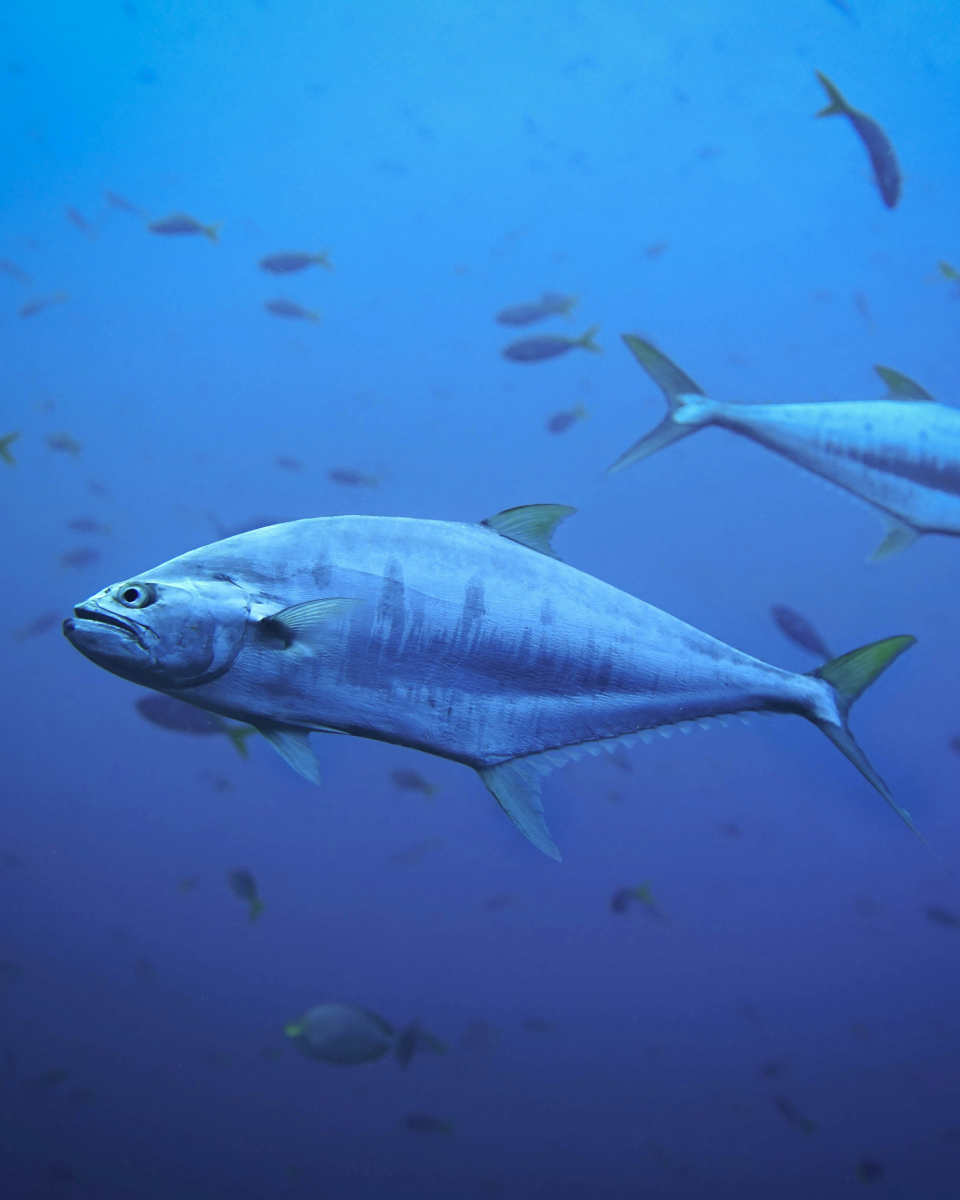
Photo by James Thornton
Tunas are large, fast-swimming, endothermic pelagic fishes with fusiform bodies, high aerobic metabolic capacity, and retia mirabilia (counter-current heat exchangers) that maintain muscle temperature significantly above ambient water — a physiological adaptation unique among teleosts to this degree. This thermal regulation supports sustained high-speed swimming across broad ocean ranges. Skipjack and yellowfin inhabit tropical-subtropical waters; albacore and bluefin species range into cooler temperate zones.
Many tuna species form size- and species-structured schools, often associated with floating objects, marine predator aggregations, or conspecifics. This schooling behaviour is the biological basis of susceptibility to purse seine fisheries and Fish Aggregating Device (FAD) exploitation: tunas aggregate under FADs predictably, enabling efficient encirclement. Environmental requirements include well-oxygenated open-ocean water, large spatial ranges for foraging and spawning, and species-specific thermal optima; confinement in sea cages represents a significant departure from natural movement patterns for a species adapted to continuous high-speed locomotion across ocean scales.
Neuroendocrine stress responses are well-characterised: tuna show elevated cortisol, catecholamines, and lactate under capture, crowding, and handling. Acute capture stress in purse seine operations is documented as a primary driver of mortality in ranching supply chains, with fish dying during crowding and towing before reaching farm sites. Evidence for fish sentience and nociception is reviewed in the Salmon and Trout records; the same scientific consensus applies to tunas as teleosts, while specific tuna-focused pain research is limited relative to salmonid studies. Peer-reviewed reviews document avoidance learning, social recognition, and flexible spatial navigation in fish including pelagic species.
Lifecycle Summary
Total commercial tuna landings reached approximately 5.2 million tonnes in 2023: skipjack approximately 2.95 million tonnes, yellowfin approximately 1.60 million tonnes, bigeye approximately 0.35 million tonnes, albacore approximately 0.20 million tonnes, and bluefin species approximately 0.13 million tonnes combined. FAO-linked data including tuna-like species exceeds 6.4 million tonnes. Tuna is one of the most economically significant capture fisheries globally and is the most internationally governed wild animal exploitation system in this database — managed under five Regional Fishery Management Organisations (RFMOs): ICCAT (Atlantic and Mediterranean), IOTC (Indian Ocean), WCPFC (Western and Central Pacific), IATTC (Eastern Pacific), and CCSBT (Southern Bluefin).
Ranching — the fattening of wild-caught juvenile and subadult bluefin in sea cages — constitutes a secondary system valued at approximately USD 1.8 billion globally in 2024, with European operations (Spain, Malta, Croatia) holding approximately 38% of market share alongside Australia, Mexico, and Japan. Closed-cycle aquaculture of Pacific bluefin, pioneered by Kindai University (formerly Kinki University) Japan, achieved commercial production from the early 2010s and represents the first fully captive-bred tuna supply chain; it remains small in volume relative to wild capture.
Industrial tuna fleets operating in the Pacific are documented sites of severe labour rights abuses including forced labour, debt bondage, and crew abandonment, with cases linked to vessels supplying major global canned tuna brands. This is the most specifically documented labour exploitation context associated with any aquatic animal record in this database.
Lifespan (Natural vs Exploited)
Natural lifespans by species: skipjack typically up to approximately 10–12 years; yellowfin commonly 5–7 years with maximum approximately 10 years; bigeye approximately 10–12 years; albacore average approximately 12 years; Atlantic and Pacific bluefin up to 15–20+ years with maximum recorded ages approximately 26–30 years.
High fishing mortality truncates age structure across all commercially fished species. Many skipjack and yellowfin are harvested within a few years of recruitment — well below their potential maximum lifespan. Bluefin entering purse seine and longline fisheries are often taken at juvenile to subadult stages; Southern bluefin entering ranching operations are commonly 2–5 years old at capture.
In ranching: wild-caught bluefin juveniles or subadults are held in sea cages for typically 3–12 months before slaughter; total lifespan is wild age at capture plus fattening duration, far below potential natural lifespan. In closed-cycle aquaculture: broodstock are retained for multiple years; grow-out animals are slaughtered at commercially defined target weights.
Exploitation Systems
Tuna exploitation operates across three systems that differ fundamentally in their relationship to wild populations and in the welfare conditions they produce.
Industrial purse seine capture fisheries. The dominant system by volume. Large vessels deploy circular nets hundreds of metres in length and depth around schools of tuna identified visually, acoustically, or through FAD positioning systems. The net is pursed (closed at the bottom) and progressively hauled, concentrating fish into increasingly dense crowding conditions until brailed or pumped aboard. FAD-associated purse seining deploys floating objects — purpose-built steel and netting structures or natural flotsam — to aggregate tuna schools for efficient encirclement; FAD-associated sets produce higher bycatch of non-target species including juvenile tuna of non-target sizes, sharks, rays, and sea turtles relative to free-school sets. The Western and Central Pacific Ocean accounted for approximately 1.55 million tonnes skipjack and 0.68 million tonnes yellowfin in 2023; significant production also comes from the Indian Ocean, Eastern Pacific, and Atlantic, governed by respective RFMOs.
Longline, pole-and-line, and handline fisheries. Longlines deploy thousands of baited hooks on mainlines extending tens to hundreds of kilometres; individual fish are brought aboard after variable fight durations. Primary targets are higher-value sashimi-grade yellowfin, bigeye, and bluefin. Pole-and-line and handline fisheries — common in artisanal, small-scale, and some industrial Pacific operations — catch individual fish sequentially; these methods generate lower bycatch relative to purse seines and support niche “pole-and-line” and “FAD-free” certification labels.
Tuna ranching. Wild-caught juvenile or subadult bluefin — primarily captured by purse seine — are transferred to large towing cages and transported at slow speed over days to weeks to coastal farm sites in the Mediterranean (Spain, Malta, Croatia), Australia (Southern Bluefin), Mexico (Pacific Bluefin), and Japan. Ranching operations fatten fish on high-energy diets of small pelagic fish to increase intramuscular fat content for the premium sashimi market; duration is typically 3–12 months. Ranching exerts additional wild capture pressure beyond the direct catch of ranched fish, as substantial volumes of forage fish are required for feed. Capture-to-cage towing mortality is a documented production loss and welfare concern; fish may die during crowding at capture, during extended towing, or on arrival at farm sites.
Closed-cycle aquaculture. Research and early commercial operations breeding tuna fully in captivity — hatching larvae in land-based tanks, rearing to juvenile stage, then growing out in sea cages. Pacific bluefin closed-cycle production pioneered by Kindai University Japan is the most advanced commercially; Atlantic bluefin closed-cycle programmes are in active development in Spain and other Mediterranean countries. Larval and juvenile rearing involves high mortality from nutritional deficiencies, cannibalism, and collision with tank walls; full-cycle tuna aquaculture remains technically demanding and small in volume relative to wild capture. Genetic selection programmes for growth, survival, and reproduction are in early stages.
By-product and downstream flows. Processing generates heads, frames, viscera, and trimmings rendered into fishmeal, fish oil, and pet food. Tuna oil is processed into omega-3 nutraceutical capsules. Collagen and skin from processing are used in biomedical and cosmetic applications. Canned tuna — primarily skipjack — is the largest single product format by volume, processed in canneries in Thailand, Ecuador, Spain, and other major processing countries that receive raw material from distant-water fleets.
Living Conditions Across Systems
Wild capture — pre-kill crowding. Purse seine operations concentrate schooling fish into progressively smaller net volumes over the course of a set, reaching high biomass densities in the final stages of pursing. Fish are brailed or pumped aboard, a process that involves physical trauma, crowding, and air exposure. This constitutes the primary welfare event for the majority of tuna killed globally.
Towing cages. Bluefin transferred from purse seine capture to towing cages — typically 20–40 m in diameter — are held at lower density during the days-to-weeks tow to farm sites. Towing speed is kept slow to minimise mortality; welfare during towing is influenced by initial capture stress, cage geometry, stocking density, water quality, and journey duration. Towing mortality is documented as a significant source of production loss for Mediterranean ranching operations.
Ranching sea cages. Offshore circular or rectangular net pens with diameters typically 40–60 m and depths exceeding 20 m to accommodate bluefin swimming behaviour. Stocking densities are constrained by the swimming requirements of obligate ram-ventilating fish — tunas must swim continuously to maintain oxygen flow across their gills and cannot stop moving. Welfare assessments for farmed tuna note specific concerns around collision with cage structures (a documented mortality cause), limited space for high-speed continuous swimming, and the abrupt transition from open-ocean ranging behaviour to confinement.
Closed-cycle hatchery and juvenile systems. Early life in land-based tanks or smaller cages with controlled temperature, oxygen, and lighting. High larval and juvenile mortality is characteristic; cannibalism and collision injuries in confined conditions are documented. Juvenile bluefin are particularly prone to injury from light confusion and wall collisions.
In all captive systems, the sensory environment — vessel noise, cage structures, artificial feeding events, sometimes artificial lighting — differs substantially from the open-ocean conditions for which tunas are biologically adapted.
Lifecycle Under Exploitation
Genetic Selection
No genetic selection programme exists in wild capture fisheries; exploitation can impose unintended selective pressure on growth rate, maturation timing, and school behaviour through size-selective harvest. In ranching, indirect selection occurs through choice of capture size and condition class. In closed-cycle aquaculture, active broodstock selection for growth, survival, and spawning performance is in early development, primarily in Kindai University Pacific bluefin and Mediterranean Atlantic bluefin programmes.
Reproduction
Wild stocks: natural spawning in open ocean, managed through RFMO quota systems, size limits, and seasonal closures targeting known spawning grounds and periods. Ranching: reproduction is not part of the production cycle; ranches receive only wild-caught juveniles. Closed-cycle: induced or controlled spawning in large tanks or sea cages using hormonal cues (gonadotropin-releasing hormone analogues) and environmental manipulations of temperature and photoperiod.
Birth & Early Life
Wild capture and ranching systems: birth and early life occur entirely in wild populations; industry engagement begins when fish reach harvestable or ranchable size. Closed-cycle: egg fertilisation, hatching, and larval rearing in land-based facilities using standardised protocols for live feed (rotifers, Artemia), microdiets, water quality management, and density control; high mortality at larval stage is the primary technical constraint.
Growth & Rearing
Wild populations grow under natural conditions until capture. Ranching: wild-caught bluefin (typically 10–30 kg) transferred to cages and fed high-energy diets of small pelagic fishes (sardines, mackerel, herring) to increase body weight and intramuscular fat content; growth is monitored through periodic sampling and visual estimation; fattening duration ranges from approximately 3 to 12 months depending on target market size and fat grade requirements. Growth Acceleration through intensive feeding is the central operational objective of ranching. Closed-cycle: rearing from juveniles in sea cages with formulated feeds, with research focus on optimising feed conversion and reducing dependence on wild forage fish inputs.
Production
Main outputs: muscle (loins, fillets) for sashimi and sushi markets from premium-grade bluefin and yellowfin; skipjack and lower-grade tuna for canning and processed products; roe and by-products. Quality control in ranching targets intramuscular fat content and muscle pH; sashimi-grade grading determines price tiers at auction.
Transport
Live transport of bluefin juveniles via towing cage from capture site to ranch — the most distinctive transport event in this database for any aquatic species, involving days to weeks of oceanic towing. Processed tuna is shipped globally as chilled fresh product (air-freighted for premium sashimi markets) or super-frozen (approximately −60°C) for Japanese auction markets; super-freezing preserves flesh quality for months during transit.
End of Life
Purse seine capture: most fish die during crowding and brailing from asphyxia, physical trauma, or exhaustion; onboard slaughter of larger tuna uses spiking (ikejime — brain destruction by spike insertion through the skull, followed by spinal cord destruction with a wire), percussive stunning, shooting, or clubbing depending on species size and market requirements. Ikejime is the most welfare-considerate available method and produces premium flesh quality by preventing catecholamine-driven post-mortem biochemical deterioration; its use is more prevalent in premium longline and ranching contexts than in high-volume purse seine operations. Longline: fish brought aboard individually after variable fight duration; methods include spiking, clubbing, or asphyxia. Ranching: individual fish killed at cage by harpoon, firearm, or spiking; improper technique results in prolonged death.
Processing
Primary: bleeding, gutting, heading, and chilling or super-freezing at sea or on-shore; grading, loin and fillet cutting. Secondary: canning (cooking, canning, sterilisation — primarily skipjack); smoking; ready-to-eat product manufacture. Trimmings, heads, frames, and viscera rendered into fishmeal, fish oil, and pet food.
Chemical Medical Interventions
Wild capture fisheries involve no pharmaceutical interventions in the animals; onboard chemical use is confined to cleaning agents, refrigerants, and fuels.
Ranching and aquaculture operations use veterinary medicines including antibiotics and chemotherapeutics to treat bacterial and parasitic diseases; specific substance patterns vary by country and are not consolidated in public tuna-specific pharmacological literature. No standardised global vaccination protocol for farmed tuna has been established. Anaesthetics including tricaine methanesulfonate (MS-222) may be used in hatchery and research handling, though tuna-specific dosing data are limited relative to other farmed fish species.
Hormonal interventions in closed-cycle systems use gonadotropin-releasing hormone analogues (GnRH-a) to induce spawning and synchronise maturation in broodstock; environmental manipulation of temperature and photoperiod supports reproductive programming. These interventions are currently confined to research and early commercial closed-cycle operations.
Regulatory frameworks governing veterinary drug use in tuna aquaculture are embedded in national marine aquaculture regulations (EU, Japan, Australia, Mexico); specific substance approvals vary by jurisdiction. Detailed public reporting of antibiotic and chemotherapeutic use specifically in tuna ranching and aquaculture is sparse.
Slaughter Processes
The welfare profile of tuna slaughter varies substantially across system type and species.
Purse seine fisheries — the dominant system by volume — produce the largest number of individual deaths under conditions that involve prolonged crowding, physical trauma, and air exposure as fish are concentrated in the net and brailed or pumped aboard. Large fish may receive individual killing (spiking, shooting, clubbing) for quality purposes; smaller tuna and bycatch species commonly die through asphyxia and crushing during the brailing and chilling process. This is effectively mass kill by crowding and asphyxia at industrial scale, without pre-kill stunning for the majority of animals.
Longline fisheries: fish are brought onboard individually after a fight of variable duration — minutes to hours — that itself constitutes a severe physiological stress event. Methods at vessel include spiking (ikejime), percussive blows, or asphyxia in fish holds. For premium sashimi markets, ikejime is applied immediately at boatside to preserve flesh quality; this method produces rapid unconsciousness and is the most welfare-governed kill method in commercial tuna fishing.
Ranching harvest: individual bluefin killed at cage by harpoon, firearm shot to the brain, or spiking. The cage environment creates challenges for accurate shot placement because fish are in continuous motion. Improper technique results in prolonged injury without immediate unconsciousness. Harvest mortality from crowding and handling before individual kill is documented.
A 2024 peer-reviewed Frontiers in Animal Science paper on tuna welfare identifies crowding during capture and towing, collisions with cage infrastructure, suboptimal water quality in cages, and slaughter without effective pre-stun as the primary welfare concerns across tuna exploitation systems, and calls for species-specific welfare indicators and standards.
No religious slaughter framework applies to tuna in any major producing or consuming jurisdiction.
Slaughterhouse Labour Impact
Industrial tuna fleets — particularly distant-water vessels operating in the Pacific and Indian Oceans — are documented contexts for severe labour rights abuses. Cases of forced labour, debt bondage, wage theft, physical abuse, and crew abandonment have been documented on vessels supplying major global canned tuna brands, including vessels operating under flags of convenience. Reports by Greenpeace, Seafood Watch, the Environmental Justice Foundation, and the Guardian’s investigative series on Pacific fishing labour conditions have documented these practices; the International Labour Organization’s Work in Fishing Convention (C188) addresses but has not resolved the governance gap. This labour context is structurally connected to the supply chain producing the majority of global canned tuna consumed in high-income markets.
Onboard occupational risks include entanglement in fishing gear, falls on wet decks, lacerations from handling sharp fish and tools, heavy lifting during net and catch operations, and exposure to cold and wet conditions during extended voyages. Tuna-specific injury rate statistics are not disaggregated from broader commercial fishing sector data. Processing plant workers in Thailand, Ecuador, and Spain — the primary canned tuna processing centres — face the standard seafood processing occupational risk profile: repetitive motion injury, lacerations, cold environment exposure, and ergonomic strain from high-volume line work.
The combination of distant-water fleet labour conditions and concentration of processing in export-oriented manufacturing centres means the tuna supply chain spans multiple regulatory jurisdictions with significant enforcement gaps, particularly for vessel-based labour occurring in international waters.
Scale & Prevalence
Total commercial tuna catch 2023: approximately 5.2 million tonnes (ISSF/atuna.com industry data). By species: skipjack approximately 2.95 million tonnes (57%); yellowfin approximately 1.60 million tonnes (31%); bigeye approximately 0.35 million tonnes (7%); albacore approximately 0.20 million tonnes (4%); bluefin species collectively approximately 0.13 million tonnes (~1%). FAO-linked data including tuna-like species: exceeds 6.4 million tonnes.
Regional distribution: Western and Central Pacific accounts for the largest share — approximately 1.55 million tonnes skipjack and 0.68 million tonnes yellowfin in 2023 (WCPFC area); significant landings also from Indian Ocean (IOTC), Eastern Pacific (IATTC), and Atlantic/Mediterranean (ICCAT).
Ranching: global production approximately 40,000 tonnes in 2007 (the most recently cited consolidated figure; current figures are fragmented across industry and RFMO reports). Ranching market valued at approximately USD 1.8 billion in 2024 (market research estimate; Europe ~38% share). Major ranching regions: Mediterranean (Spain, Malta, Croatia), Australia, Mexico, Japan.
Closed-cycle aquaculture: small volume relative to wild capture; Kindai University supplies premium Pacific bluefin to Japanese markets; commercial scale is not publicly reported in consolidated figures.
Stock status: ISSF (2025) reports approximately 87% of global tuna catch from stocks at “healthy” abundance levels; approximately 2% of catch comes from overfished stocks. These assessments are method- and threshold-dependent and come from an industry-associated body; some stocks with limited data may carry higher assessment uncertainty.
Directional trend: overall tuna catches have plateaued with slight year-to-year fluctuations; 2023 total was approximately 1% lower than 2022. Canned tuna trade increased approximately 28% in 2024 by quantity relative to 2023. Atlantic and Southern bluefin populations are rebuilding under revised RFMO quotas after historical overexploitation; Pacific bluefin remains under active recovery management.
Ecological Impact
Bycatch is the most significant immediate ecological impact of tuna fisheries. FAO-linked datasets estimated approximately 154,000 tonnes of elasmobranch bycatch in 2023 across tuna fisheries globally — sharks, rays, and related species caught incidentally. Sea turtles, seabirds, and non-target finfish are also documented bycatch of purse seine and longline gear. FAD-associated purse seining generates substantially higher bycatch per set than free-school seining, including juvenile tuna of non-target species, juvenile sharks, and other aggregating species; FAD-free certification is a market response to this differentiation.
Historical stock depletion of bluefin species is the most severe documented case of targeted overexploitation of any species in this database: Atlantic bluefin was reduced to approximately 15% of its 1950s biomass by the early 2010s before ICCAT catch quota reductions began achieving partial recovery; Southern bluefin was similarly severely depleted before CCSBT intervention. These depletion events represent documented system-scale collapses driven by commercial tuna fishing.
Tuna fisheries are fuel-intensive due to large vessels, long search distances, and high-speed transit; lifecycle assessments indicate significantly higher greenhouse gas emissions per tonne for air-freighted fresh sashimi tuna compared with canned tuna shipped by sea, though comparative figures vary by study and transport mode.
Ranching operations impose a secondary ecological impact through their feed requirements: fattening bluefin on small pelagic fish at high feed conversion ratios creates additional fishing pressure on forage fish populations (sardines, mackerel, herring) beyond the direct capture of ranched fish. Local environmental effects around ranching cages include nutrient enrichment from uneaten feed and faecal deposition and benthic organic loading.
Climate-driven shifts in ocean temperature and productivity are documented as altering tuna distribution ranges — particularly for temperature-sensitive species like Atlantic bluefin, whose Mediterranean spawning habitat is experiencing warming — and are increasingly incorporated into RFMO stock assessment models.
Language & Abstraction
Tuna governance operates almost entirely through population-level metrics: “stock,” “biomass,” “TAC” (Total Allowable Catch), “MSY” (Maximum Sustainable Yield), and “fishing mortality rate” are the analytical units of RFMO management. Individual fish are absent from these frameworks. The shift from individual-level welfare language to population-level resource management language is the most complete in any record in this database — tuna are formally managed as shared global resources to be allocated, not as animals to be treated. The welfare implications of specific gear types, kill methods, and confinement conditions are not integrated into RFMO management frameworks.
“FAD-free” and “dolphin-safe” are certification labels that describe what the production system does not target rather than what it does. “Dolphin-safe” emerged in response to the documented bycatch of eastern tropical Pacific dolphins in yellowfin purse seining through the 1970s–1980s; it describes the absence of a specific bycatch species rather than the conditions or welfare of the target tuna. “FAD-free” describes the absence of floating aggregation devices; it signals lower bycatch of non-target species but says nothing about the treatment of target fish. Both labels function as proxy welfare and sustainability signals that abstract from the underlying capture and kill processes.
“Ranching” positions the fattening of wild-caught bluefin as a farming activity rather than a fishing-plus-feeding activity. Its adoption in regulatory and trade contexts allows the final processing stage to be governed by aquaculture frameworks while the supply of raw animals remains governed by fisheries quota systems. The same fish that would be reported as a wild capture landing in a fisheries context is reported as a ranching input in an aquaculture context; the boundary between the two regulatory regimes is a classification decision rather than a biological one.
“Sashimi grade” and tuna auction grading terminology — which assess intramuscular fat content (toro), colour, and muscle texture — describe premium tuna quality as a biochemical profile achieved through management of pre-slaughter stress, fattening duration, and kill method. Ikejime is the kill method that produces the highest sashimi grade by preventing catecholamine release; it is thus framed in processing and market contexts primarily as a quality management intervention rather than as the most welfare-considerate kill method available, which it also happens to be.
Terminology
Tuna, skipjack, yellowfin, bigeye, albacore, bluefin, Atlantic bluefin, Pacific bluefin, Southern bluefin, Thunnus, Katsuwonus, highly migratory species, tuna and tuna-like species, stock, biomass, quota, TAC, MSY, purse seine, longline, pole-and-line, handline, troll, gillnet, FAD, drifting FAD, anchored FAD, FAD-free, dolphin-safe, observer program, bycatch, discards, ranching, farming, closed-cycle farming, hatchery, broodstock, juveniles, subadults, ongrowing, fattening, harvest, grading, sashimi grade, loin, fillet, steak, canned tuna, light tuna, chunk tuna, solid pack, tuna flakes, fishmeal, fish oil, tuna oil, by-product, rendering, processing plant, super-frozen, auction, quota trading, RFMO, ICCAT, IOTC, WCPFC, IATTC, CCSBT, certification, eco-label, ISSF, tuna ranch, towing cage, sea cage, net pen, feed conversion ratio, forage fish, small pelagics.
Within The System
Developments
Report a development: contact@systemicexploitation.org
Notice an inaccuracy or omission?
If you believe information on this page is incorrect, incomplete, or missing important context, you may submit a suggested correction for review.