
Tigers
Scientific Name:
Panthera tigris
Scope
Covers Panthera tigris across all currently recognised extant subspecies: Bengal (P. t. tigris), Amur/Siberian (P. t. altaica), Indochinese (P. t. corbetti), Malayan (P. t. jacksoni), Sumatran (P. t. sumatrae), and the South China tiger (P. t. amoyensis), which is functionally extinct in the wild and survives only in captivity. Includes wild free-ranging populations subject to poaching and trophy hunting; captive populations in accredited zoos and conservation breeding programmes; tigers in commercial tourism venues and circuses; and tigers in commercial breeding facilities — tiger farms — used to supply body-part trade, meat, live animal trade, and display. Excludes extinct subspecies (Bali, Caspian, Javan); other large felids; captive hybrid animals (ligers, tigons) except where referenced for context; and symbolic or purely cultural uses not involving live animals or physical body parts. Tigers are not domesticated; all captive populations retain wild-type biology and behavioural repertoire without multigenerational domestication selection comparable to livestock.
Species Context
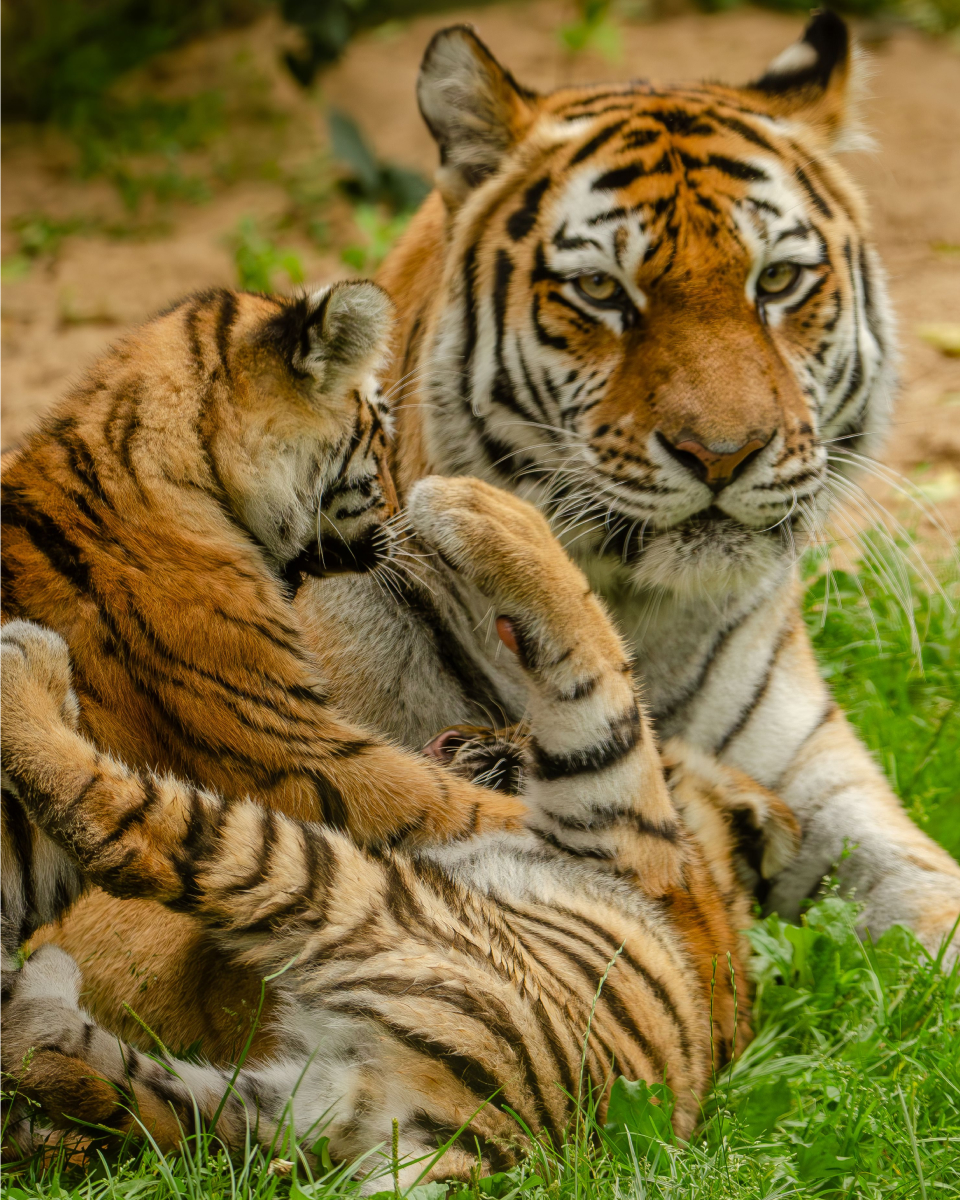
Photo by Leon Aschemann
Panthera tigris is the largest living felid. Adult body mass ranges from approximately 90 kg in Sumatran females to over 300 kg in male Amur tigers; body length with tail typically 2.5–3.9 m. Marked sexual dimorphism is consistent across subspecies. Tigers are obligate carnivores and apex predators, specialising in medium- to large-bodied ungulates across diverse forest, grassland, and wetland habitats.
Social structure is largely solitary. Adults maintain exclusive or overlapping home ranges — commonly 100 km² or more — with males overlapping several female territories. Contact between adults occurs primarily during mating; females rear cubs without male involvement over an approximately 18-month dependency period. Cubs disperse at 2–3 years.
Natural habitat requirements include cover for stalking, access to prey, and water; tigers are strong swimmers and will cross rivers as part of routine ranging. Current wild range is fragmented, with core populations in India, Russia, Nepal, Indonesia, Thailand, Bhutan, Bangladesh, and Malaysia. Cambodia, Laos, and Vietnam are considered to have no remaining viable wild tiger populations.
Stress responses in captive conditions are well-characterised. Pacing stereotypies are among the most documented behavioural indicators in captive tigers and other large felids. A peer-reviewed study documented that adding 19–46 m² of connected trail space to existing enclosures measurably increased exploratory and active behaviour and reduced pacing and inactivity — demonstrating the species’ sensitivity to spatial restriction and environmental complexity at even modest scale changes.
Cognition and sentience are supported by evidence of spatial memory, individual recognition, problem-solving, and complex sensory communication via olfactory marking, vocalisations, and visual signals. Individual tigers are identifiable by unique stripe patterns; this individual distinctiveness has been applied in both field population monitoring and trade enforcement forensics.
White tigers are not a distinct subspecies — they are the product of a recessive gene variant expressed through inbreeding of closely related Bengal tigers. All known captive white tigers are descended from a single wild-caught individual; the inbreeding programmes sustaining white tiger lines for commercial display produce documented genetic defects including cross-eyes, immune dysfunction, and skeletal deformities alongside the commercially valued coat variant.
Lifecycle Summary
Tigers enter exploitation systems through wild populations subject to poaching and illegal trade, and through captive populations bred and managed across multiple commercial uses. In commercial tiger farming — concentrated in China, Laos, Thailand, and Vietnam — animals are bred in rows of concrete enclosures via Selective Breeding, reared under Intensive Confinement with Environmental Deprivation, and killed for bones, skins, and meat, with carcasses processed into tiger bone wine, skins, and other derivatives. In tourism and circus systems, Conditioning and Training and Captive Display structure the operational lifecycle, with Premature Weaning and Separation producing animals tractable for human contact from an early age. Zoos manage populations under studbook coordination using Selective Breeding for genetic diversity and Reproductive Cycle Manipulation for population control. Captive tiger populations across farming, tourism, and private facilities exceed estimated wild tiger numbers globally.
Lifespan (Natural vs Exploited)
Wild tigers typically live 8–15 years; 10–15 years is the commonly cited range. Approximately 50% of cubs do not survive past 2 years; of those reaching independence, approximately 40% successfully establish a territory and reproduce. Primary wild mortality causes are infanticide, starvation, intraspecific conflict, disease, and human-related killing including poaching and retaliatory killing.
In accredited zoos, tigers commonly reach 16–20 years, with maximum documented ages around 24–26 years, supported by controlled nutrition, veterinary care, and absence of predation and territorial competition. Chronic degenerative disease, neoplasia, gastrointestinal syndromes, and systemic bacterial infections are documented causes of death in captive zoo tigers.
In commercial tiger farms, lifespans are determined by the point at which body mass maximises the value of the carcass for body-part harvest. Age-at-death distributions for farmed tigers are not published in any primary statistical source; documentation of killing is primarily from undercover investigations rather than regulatory records.
In tourism and circus systems, operational lifespan depends on tractability and commercial utility; tigers no longer manageable for public interaction may be transferred, sold into trade, or killed. Systematic age-at-death data for this sector are not published.
Exploitation Systems
Commercial tiger farming for body parts and products. Large-scale breeding facilities in China, Laos, Thailand, Vietnam, and South Africa maintain tigers in rows of concrete enclosures for the primary purpose of harvesting bones, skins, meat, and derivative products. Tiger bones are processed into tiger bone wine — soaked in alcohol to produce a prestige tonic product — and into other preparations used in traditional medicine markets. Skins are tanned and sold as rugs, wall mounts, and taxidermied displays. Meat is sold as exotic cuisine in facility-associated restaurants, with the Golden Triangle Special Economic Zone in Laos documented as a specific site of tiger meat sale. All international commercial trade in wild-sourced tiger parts is prohibited under CITES Appendix I. Captive-bred specimens can be traded commercially where CITES Management Authority certification is issued; this provision creates the channel through which tiger farms generate legal cover for trade, and through which captive-bred animals and parts may be laundered into broader illegal trade networks. NGO investigations estimate more than 8,600 tigers in farm-type facilities across China, Laos, Thailand, Vietnam, and South Africa — a captive population exceeding estimated global wild tiger numbers.
Tourism and entertainment. Direct-contact tourist facilities — concentrated in Thailand and Southeast Asia — offer tiger selfie sessions, cub petting, lion-walk equivalents, and performance shows. Assessments of 34 Thai tiger facilities documented high prevalence of direct human-animal contact, limited enclosure complexity, and management conditions characterised by Conditioning and Training for tractability and Captive Display as the primary operational output. Circuses use tigers for performance routines, historically transporting animals between venues in travel cages. Multiple jurisdictions have enacted bans on wild animal circus use; Thailand’s Tourism Authority of Thailand and associated certification schemes have introduced standards for tourist facilities, though coverage and enforcement are variable.
Zoos and conservation breeding. Accredited zoos hold tigers under regional and global studbook coordination (e.g., AZA Species Survival Plans, EAZA EEPs), managing populations for genetic diversity and subspecies representation. The South China tiger (P. t. amoyensis) survives only in captivity; breeding programmes in Chinese zoos and South African rewilding projects constitute the sole remaining population. Zoo tigers serve display, conservation narrative, and research functions. Surplus management in zoo systems may involve contraceptive control or Selective Culling in regions where culling is a permitted management tool.
Poaching and illegal wild trade. Wild tigers are killed for skins, bones, and other parts entering illegal trade networks supplying traditional medicine markets. Poaching is documented across the range — India, Russia, Indonesia, and Myanmar among primary source countries. Tiger farms are implicated in laundering illegal wild-sourced parts through legal captive-bred product channels.
Research. Tigers are used in zoo-based and field research contexts — disease surveillance, reproductive physiology, immobilisation pharmacology, and population genetics. No dedicated tiger laboratory colonies are documented.
Living Conditions Across Systems
Accredited zoos. Minimum enclosure standards vary substantially by jurisdiction: cited figures range from approximately 37 m² per animal in California and some UK guidance, to 111.5 m² per pair in Switzerland, 200 m² in some US sanctuary standards, and 1,000 m² in Sweden. Typical zoo enclosures include outdoor and indoor areas, water features, climbing structures, substrate variation, and hiding spaces. Social groupings consist of single animals, mating pairs, or mothers with cubs; males are typically separated outside mating periods.
Commercial tourism venues. Assessments of 34 Thai facilities identified limited enclosure size, limited environmental complexity, and constrained opportunity for species-typical behaviour as prevalent across the sector. During public interaction periods, tigers may be tethered or confined to small concrete areas for photo sessions and contact. Stocking densities in tourism facilities are not systematically published.
Circuses. Travel cages of a few square metres per animal are documented for transport and off-exhibit holding; daily access to performance rings provides additional space but under high-stimulation conditions — noise, lighting, crowds. Repeated transport between venues is structurally inherent to the circus system.
Commercial tiger farms. Undercover investigations describe rows of concrete enclosures, frequently barren and without access to naturalistic outdoor areas, housing animals at high densities. Specific enclosure dimensions per animal are not reported in peer-reviewed or government sources; documentation is primarily from investigative footage and NGO reports. Conditions are characterised by absence of the spatial, complexity, and social conditions that zoo welfare literature identifies as relevant to reducing stereotypies in captive tigers.
Lifecycle Under Exploitation
Genetic Selection
In commercial facilities, Selective Breeding targets coat colour (including white tiger lines, maintained through inbreeding), body size, and tractability for handling. No formal genetic improvement programmes comparable to livestock breeding are documented; structured genetic management is absent from farm systems. In accredited zoos, Selective Breeding follows studbook coordination targeting genetic diversity and demographic management objectives. Inbreeding of white tigers is documented to produce genetic defects — cross-eyes, immune dysfunction, skeletal deformities — as correlated outcomes of the coat gene selection.
Reproduction
Natural mating via co-housing is the standard method across commercial, tourism, and zoo systems. Artificial insemination is used in some zoo and conservation programmes but is not documented as a routine commercial practice. In commercial facilities, intensive breeding is pursued by cycling females repeatedly; Reproductive Cycle Manipulation via hormonal contraceptives is used in zoo systems for population control. Premature Weaning and Separation of cubs induces faster return to oestrus in females managed for high output.
Birth & Early Life
Gestation is approximately 104 days; litters typically contain 2–4 cubs. In tourism and cub-petting facilities, Premature Weaning and Separation occurs within weeks of birth to produce hand-reared animals habituated to human contact and available for tourist interactions continuously. In accredited zoos, cubs are reared by the mother unless maternal care fails; hand-rearing occurs for management reasons rather than commercial throughput.
Growth & Rearing
In tourism and circus systems, Conditioning and Training using behavioural cues, food reinforcement, and aversive stimuli shapes tractability for handling and performance. Environmental Deprivation characterises holding enclosures in commercial farms and many tourism facilities. Intensive Confinement and Caging structure the rearing environment across farm and circus systems. In zoo systems, enrichment provision and social management during rearing vary by institution and national standards.
Production
In tiger farm systems, the operational endpoint is carcass yield — bones, skin, and meat — reached when body mass is maximised. In tourism facilities, the operational output is visitor interactions via Captive Display — petting sessions, photo operations, and performances — sustained by Conditioning and Training. In circus systems, the output is performance. In zoo systems, public display and conservation function are the operational outputs.
Transport
Live Transport occurs between facilities, across borders in live animal trade, and between venues in circus systems. Zoo transfers are relatively infrequent and follow institutional transport protocols with chemical sedation. Cross-border illegal live tiger movements are documented along trafficking routes in Southeast Asia. Circus transport is structurally repetitive — animals move between venues by road in travel cages throughout the touring season.
End of Life
In tiger farm systems, animals are killed on-site for carcass processing; documented methods include shooting and associated procedures, with specific slaughter protocols not published in peer-reviewed or regulatory sources. In zoo and sanctuary contexts, end of life occurs via barbiturate overdose under veterinary supervision, applied for age-related disease, injury, or surplus management. In tourism and circus facilities, animals no longer commercially viable may be transferred, sold, or killed; documentation of end-of-life practices in this sector is sparse.
Processing
In tiger farm systems, carcasses are processed into skins (tanned for rugs and mounts), bones (macerated or soaked in alcohol for wine and tonic products), and meat (sold fresh or processed). In zoo and research contexts, post-mortem examination, pathology sampling, and genetic profiling occur before carcass disposal. Seized trade items are subjected to DNA profiling via databases such as TigerBase for enforcement purposes.
Chemical Medical Interventions
Chemical immobilisation is the primary pharmacological intervention specific to tiger management across all captive systems. Standard protocols for large felids include combinations of an alpha-2 agonist (medetomidine or xylazine) with ketamine or tiletamine-zolazepam, delivered by dart. Risks include respiratory depression and hypoxaemia, requiring monitoring during procedures; reversal agents (atipamezole, naltrexone) are administered post-procedure. Tiger-specific pharmacokinetic datasets are limited; protocols are primarily derived from broad large-felid zoo medicine literature.
Reproductive management in zoo systems uses progestin-based contraceptives and GnRH analogues to suppress or time breeding; specific products and dosing schedules vary by institution. Side-effect data specific to tigers are limited.
Vaccines administered in zoo populations include feline panleukopenia, feline calicivirus, feline herpesvirus, and canine distemper virus products; rabies vaccination is applied in some regions. All protocols are adapted from domestic carnivore schedules; no tiger-specific licensed vaccines are commercially available. SARS-CoV-2 infection in zoo tigers has been documented; off-label or experimental animal COVID-19 vaccines were administered at some facilities.
Anthelmintics and antibiotics are used for routine parasite control and bacterial infection treatment. Salmonellosis from raw meat diets is a documented recurrent health issue in captive zoo tigers, managed with antibiotics and dietary modification. Chronic gastrointestinal syndromes documented in captive tigers — sometimes described as “tiger disease” in zoo medicine literature — are managed with anti-inflammatories, dietary modification, and supportive care; the aetiology is not fully characterised.
No evidence supports the use of hormonal growth promoters or feed-based growth acceleration in tigers; body size is managed through genetics and nutrition rather than exogenous pharmacological agents.
Declawing — surgical removal of distal phalanges — and tooth modification (filing or extraction) are documented in some circus and private facilities to reduce handler injury risk. These practices are widely discouraged in professional zoo and veterinary literature and prohibited in some jurisdictions; systematic global prevalence data are not published.
Slaughter Processes
In tiger farm systems, tigers are killed on-site for body-part harvest. Documented methods include shooting; specific protocols — whether animals are chemically immobilised prior to killing, what firearms or captive bolt equipment is used, and what exsanguination procedures follow — are not described in peer-reviewed or government sources. Documentation is primarily from undercover investigative footage, which captures outcomes rather than standardised procedures. No quantitative data on stun failure rates, time to death, or throughput per facility are published. Killing in farm systems operates outside formal meat inspection and slaughter regulatory frameworks in all documented producing countries.
In zoo and sanctuary contexts, tigers are killed via barbiturate overdose — typically pentobarbital sodium — administered intravenously under veterinary supervision, frequently following prior sedation. This is applied for age-related or incurable disease; some European zoos extend this to surplus management.
Religious slaughter frameworks do not apply to tigers in any documented commercial context. Trade in tiger parts operates primarily under CITES permit frameworks and national wildlife legislation rather than any religious regulatory structure.
Species-specific occupational health and injury data for workers in tiger exploitation systems — farms, tourism facilities, circuses, zoos — are not published as systematic statistical datasets. Documented risks include severe bite and claw trauma; fatalities and serious maulings in zoo and circus contexts appear in case reports and incident records but are not compiled as species-specific epidemiological datasets. Psychological impact literature for workers specifically in tiger farm, circus, or tourism facility contexts does not exist as a published body of research; the data absence is confirmed and general sector statistics are not substituted.
Slaughterhouse Labour Impact
Species-specific occupational health data for workers in tiger exploitation systems are not published as systematic datasets. Risks of severe bite and claw trauma during handling are documented through case reports from zoo, circus, and tourism venue contexts; fatalities are recorded in incident reports but are not compiled into species-disaggregated epidemiological records. Psychological impact literature for workers specifically in tiger farm processing, circus, or tourist interaction facility contexts does not exist as a published body of research. General occupational health findings for captive wild animal workers apply structurally but are not substituted here; the species-specific data gap is confirmed.
Scale & Prevalence
Wild populations. IUCN assessments estimate approximately 3,726–5,578 wild tigers globally in recent years. India holds the largest national population — 3,682 individuals estimated in the 2022 national census, representing approximately 65–70% of the global wild total. Other significant wild populations include Russia (approximately 580–750 Amur tigers), Indonesia (approximately 355–600 Sumatran tigers), Nepal (approximately 220–400), Thailand (approximately 145–189), Bhutan (approximately 89–151), Bangladesh (approximately 89–146), and Malaysia (under 200). China has approximately 20 confirmed wild tigers. Cambodia, Laos, and Vietnam are considered to have no remaining viable wild populations. After a historic low of approximately 3,200 wild tigers in 2010, global wild numbers have trended upward to an estimated 4,500–5,500 by the mid-2020s, driven primarily by recovery in India.
Captive and farmed populations. NGO investigations estimate more than 8,600 tigers held in commercial farm-type facilities across China, Laos, Thailand, Vietnam, and South Africa — exceeding the estimated global wild population. These figures are compiled by the Environmental Investigation Agency and associated investigative bodies; they are not from national statistical agencies or FAO, and the range of facilities accessible to investigators introduces uncertainty. Documented expansion of specific facilities — including tiger populations at Golden Triangle Special Economic Zone complexes in Laos — has been reported through successive investigation periods. Global zoo and private collection populations are not centrally catalogued; regional studbooks track hundreds of individuals, and private holder populations in some countries (notably the United States) are estimated in the low thousands.
Directional trend. Wild populations are increasing modestly from a historic low, with India’s population roughly doubling since 2006. Captive and farmed populations are expanding in commercial farming contexts despite CITES Conference of Parties decisions calling for phase-out of tiger farming.
Ecological Impact
Wild tigers function as apex predators with documented regulatory effects on prey populations, influencing ungulate abundance, distribution, and behaviour. Their presence contributes to trophic cascade effects — indirect effects on vegetation structure and species composition via herbivore behaviour modification — analogous to those documented for other apex predators. Poaching, retaliatory killing, and habitat loss have extirpated wild tigers from multiple range countries, including Cambodia, Laos, and Vietnam, with associated disruption to local predator-prey dynamics.
Tiger farms require land, water, and feed inputs — typically meat from livestock — linking tiger farm operations to the upstream environmental footprints of those supply industries. Quantitative life cycle assessment data specific to tiger farming are not published.
The relationship between tiger farming and demand for wild tiger parts is contested in conservation policy literature. One position holds that farmed supply reduces pressure on wild populations by substituting for wild-sourced material; the opposing position holds that farming sustains and potentially expands consumer demand while providing laundering channels for illegal wild-sourced parts, net increasing pressure on wild populations. CITES COP decisions have reflected the latter position in calling for phase-out of tiger farming.
Facilities integrating tiger farms with tourism infrastructure — notably the Golden Triangle SEZ — link tiger exploitation to broader land development and infrastructure investment in ecologically sensitive areas on the borders of range countries.
Language & Abstraction
“Tiger bone wine” names a product by species origin and claimed functional property — bone-derived strength and vitality — while encoding both the killing of a CITES Appendix I species and the illegality of the international commercial trade in that species’ parts. The product name is simultaneously a marketing claim and, in most international contexts, a declaration of a prohibited transaction. That the name circulates openly in trade documents, menus, and promotional materials at documented facilities reflects the gap between the legal prohibition and its enforcement.
“Captive-bred specimens” is the CITES regulatory category that distinguishes tigers born in captivity from wild-caught individuals, enabling commercial trade under Appendix I where Management Authority certification is issued. The term functions as a laundering mechanism in regulatory language: it creates a legal category that facility operators can exploit by producing captive-born animals from wild-caught breeding stock, or by misclassifying wild-sourced animals as captive-bred. The phrase “captive-bred” absorbs the conditions of captive breeding — concrete enclosures, inbreeding, commercial throughput — into a regulatory status label that carries no information about those conditions.
“Stock,” “inventory,” and “captive population” are the standard administrative terms for groups of tigers in farm and trade documentation. These terms apply the same abstraction documented for other farmed species — aggregating individual animals into enumerable units — to a species whose individual distinctiveness (unique stripe patterns) is simultaneously exploited for forensic identification in trade enforcement.
White tigers in commercial display are marketed as a rare natural phenomenon — the product framing emphasises extraordinary appearance and implied scarcity. The biological reality is that white tigers are produced through deliberate inbreeding and carry predictable genetic defects as correlated outcomes of the coat gene selection. The “rare” framing inverts the actual process: rarity here is manufactured through a breeding programme that is uncommon precisely because the genetic mechanism producing the coat also produces welfare-relevant defects.
“Harvest,” “processing,” and “utilisation” in farm and trade discourse apply the same operational neutralisation documented in the livestock slaughter register to the on-site killing of a protected species in a context that is illegal under CITES international trade law. The vocabulary of production management — with its implication of routine, regulated, quality-controlled operations — is applied to a system that operates outside formal regulatory oversight.
“Enrichment,” “naturalistic enclosure,” and “modern exhibit design” in zoo and tourism facility marketing describe management interventions and physical features in terms of what they add relative to a baseline rather than what the baseline is. A naturalistic enclosure is naturalistic in comparison to a concrete pen; it is not documentation of the species’ spatial and behavioural needs being met in any quantified sense. The vocabulary of enrichment frames the gap between captive conditions and the species’ requirements as a management variable to be optimised rather than a structural feature of captivity.
Terminology
Panthera tigris, Bengal tiger, Amur tiger, Siberian tiger, Sumatran tiger, Indochinese tiger, Malayan tiger, South China tiger, white tiger, tiger cub, sub-adult, breeder female, breeding stock, captive-bred specimen, CITES Appendix I, tiger farm, wildlife farm, tiger reserve, tourist venue, tiger interaction facility, tiger selfie, cub petting, walk with tigers, exhibit animal, performance animal, exotic animal, stock, inventory, captive population, tiger bone wine, tiger bone glue, tiger bone paste, exotic meat, skin, rug, trophy mount, taxidermy, harvest, processing, utilisation, culling, euthanasia, humane euthanasia, surplus animal, live specimen, seized specimen, confiscated specimen, enrichment, naturalistic enclosure, modern exhibit design, studbook, Species Survival Plan, TigerBase, DNA profiling, stripe pattern database, sedation, immobilisation, dart, reversal agent, live transport, inbreeding, colour morph
Within The System
Developments
Report a development: contact@systemicexploitation.org
Notice an inaccuracy or omission?
If you believe information on this page is incorrect, incomplete, or missing important context, you may submit a suggested correction for review.