
Sea Bream
Scientific Name:
Sparus aurata
Scope
Covers gilthead sea bream, Sparus aurata (Linnaeus 1758), family Sparidae — the primary commercial “sea bream” species in Mediterranean aquaculture and fisheries. Includes farmed populations in marine sea-cage systems, coastal pond and lagoon systems, and land-based hatchery and recirculating systems; wild-caught S. aurata populations in the Mediterranean, Black Sea, and adjacent Atlantic; and selectively bred farm strains developed in Mediterranean breeding programmes, which remain within S. aurata and are not designated separate subspecies. Excludes other species referred to as “sea bream” — including Pagrus major, Acanthopagrus spp., Dentex dentex — ornamental sparids, and inland freshwater bream (family Cyprinidae). Key producing countries include Turkey, Greece, Egypt, Tunisia, Spain, and Italy.
Species Context
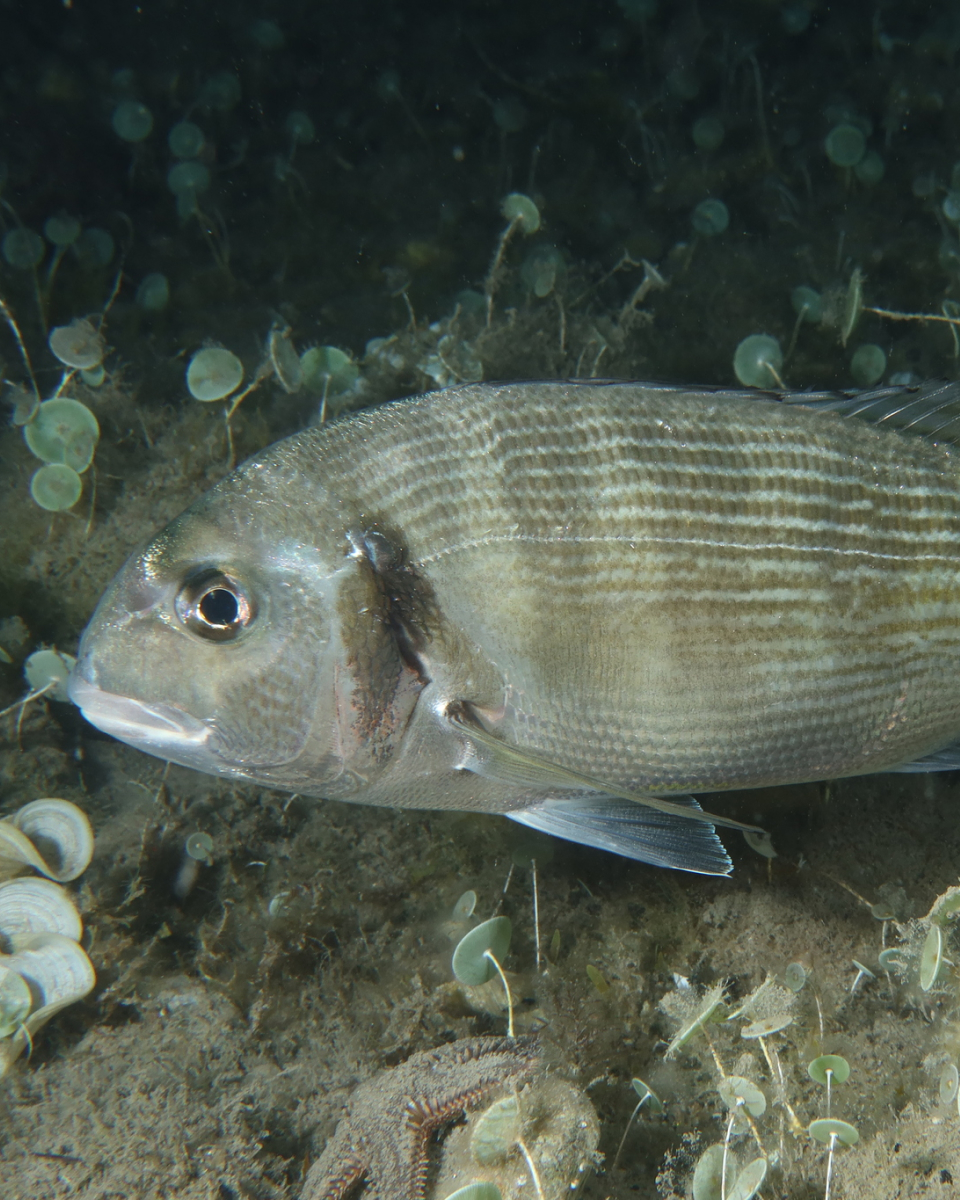
Photo by Julien Renoult
Sparus aurata is a demersal, euryhaline marine fish inhabiting coastal waters, seagrass beds, and lagoons, typically at 0–150 m depth and tolerating salinities from brackish to full-strength seawater. A biologically distinctive characteristic is protandrous hermaphroditism: individuals mature first as males at approximately 2 years and subsequently change sex to female at 3–4 years depending on growth conditions and population dynamics. This sex-change sequence affects broodstock management and population biology in both wild and farmed contexts.
In wild conditions, sea bream form loose shoals and use structured benthic habitats for foraging on molluscs, crustaceans, and echinoderms. Farmed populations show pronounced schooling responses to stocking density and dissolved oxygen availability, with changes in swimming activity and spatial distribution documented across densities of 8.5–25 kg/m³. Welfare studies document stress responses via plasma cortisol, glucose, lactate, and immune and antioxidant parameters under handling, high density, low oxygen, and suboptimal water quality.
Sea bream demonstrate associative learning and behavioural plasticity in conditioning to feeding signals and environmental enrichment — comparable to other intensively farmed marine teleosts. Welfare reviews for sea bream and sea bass explicitly treat the species as capable of negative and positive affective states, consistent with the broader teleost sentience literature, in justifying slaughter and husbandry recommendations.
Lifecycle Summary
Gilthead sea bream aquaculture is one of the largest Mediterranean marine finfish production systems, with global production estimated at approximately 259,000 tonnes in 2019 and growing from around 87,000 tonnes in 2000 — a threefold expansion driven primarily by Turkish production growth. Turkey accounts for approximately 38.5% of global production, Greece 21.4%, and Egypt 13.9%. Approximately 78% of global production is from marine sea-cage systems. Farmed fish are harvested at 18–30 months of age at 300–600 g, representing a reduction from a wild potential lifespan of 10–11 years. Wild capture supply is minor relative to aquaculture. Live chilling in ice slurry is the most widely used commercial killing method despite welfare guidance recommending pre-stun protocols; electrical and percussive stunning are used in a minority of operations. Feed production — particularly fishmeal and fish oil inputs — is the dominant contributor to greenhouse gas emissions and environmental impact per kilogram of product.
Lifespan (Natural vs Exploited)
Wild S. aurata can reach 10–11 years, with maximum reported ages slightly above this in Mediterranean stocks. Common capture ages in wild fisheries are lower due to fishing pressure.
In intensive sea-cage aquaculture, market harvest typically occurs at 18–30 months at 300–600 g, with some production extended to 1–2 kg over 30–36 months. Broodstock in hatcheries can be maintained for multiple spawning cycles over 5–7 years or longer, exceeding grow-out ages but rarely reaching maximal wild lifespan.
Mortality in culture arises from early larval mortality and malformations in hatcheries, weaning stress, crowding and low oxygen during grow-out, handling during grading and transport, parasitic infection — particularly the monogenean gill parasite Sparicotyle chrysophrii — bacterial disease including vibriosis and photobacteriosis, and slaughter losses. In lagoon and sea-ranching systems, seasonal harvest occurs at 2–4 years, with mortality additionally driven by environmental fluctuations, predation, and escapes.
Exploitation Systems
Sea bream exploitation operates across three aquaculture system types, with wild capture as a minor supplementary source.
Marine sea-cage aquaculture. The dominant system globally, accounting for approximately 78% of production. Floating cages — typically circular, 16–40 m diameter, 10–20 m depth — are moored offshore or in coastal waters across the Mediterranean. Hatchery-produced juveniles are stocked into cages and fed formulated extruded pellets until harvest at market size. The system relies on ambient seawater flow through cage netting for oxygen supply and waste dispersion. Feed composition has shifted progressively from high fishmeal and fish oil inputs toward higher plant-based protein and oil components in many operations, driven by cost and sustainability pressure.
Coastal pond and lagoon systems. Traditional extensive and semi-intensive systems in North Africa — particularly Egypt and Tunisia — and parts of Southern Europe. Brackish ponds and coastal lagoons with fertilisation and supplemental feeding allow sea bream to exploit natural productivity alongside provided feed. Stocking densities are substantially lower than cage systems. These systems are regionally significant but represent a smaller share of global production volume.
Land-based hatchery and recirculating systems. Used principally for hatchery and nursery stages across all producing regions, and in limited niche grow-out operations. Tanks with mechanical and biological filtration, controlled temperature, salinity, oxygen, and photoperiod support larval rearing and early juvenile development before transfer to sea cages or ponds.
Wild capture fisheries. Wild S. aurata are taken using trammel nets, longlines, trawls, and other gears in Mediterranean and adjacent Atlantic coastal fisheries. Wild catches represent a minor fraction of total supply relative to aquaculture output; the large majority of global sea bream supply is now farmed. Wild capture is documented here for completeness but is not the primary exploitation system for this species.
Downstream product flows are dominated by whole fresh or chilled fish sold gutted or ungutted. Filleting is less common due to small body size and market preference for whole presentation. Processing by-products — heads, frames, and viscera — are rendered into fishmeal, fish oil, and pet food ingredients. Collagen and gelatin extraction from skin and bone is documented in value-chain literature.
Living Conditions Across Systems
Marine sea-cage grow-out. Commercial stocking densities typically range 10–20 kg/m³ for fish above 150 g, with welfare concerns reported above approximately 20–30 kg/m³ in experimental studies; some operations reach 36–44 kg/m³ during on-growing phases. Dissolved oxygen is ideally maintained above 70–80% saturation; in flow-through systems this depends on ambient current and site hydrodynamics rather than active management. Temperature and salinity are determined by site conditions. Large shoals of thousands to tens of thousands of individuals per cage exhibit schooling behaviour, with stocking density influencing spatial distribution, access to feed, and fin condition. Sensory conditions include continuous exposure to sounds from feeding systems, maintenance vessels, and environmental noise; artificial lighting is sometimes applied to control photoperiod and growth; minimal structural enrichment is present in standard cages. Both very high and very low stocking densities can negatively affect feeding, growth, and tissue condition; studies consistently show that effects interact with oxygen availability, feeding regime, and group dynamics rather than density alone.
Coastal pond and lagoon systems. Lower biomass per unit area than cage systems — often below 5–10 kg/m³ in extensive configurations. Fish can disperse across larger shallow areas with natural substrate and vegetation, and access natural prey in addition to supplemental feed. Temperature, salinity, and oxygen variability is higher than in cage systems, with less management control. Risk of eutrophication increases with supplemental feeding intensity.
Hatchery and nursery conditions. Larval stages in tanks at high numbers per litre; nursery stages at 5–20 kg/m³ with increases during grading and weaning. Controlled parameters — temperature typically 18–22°C, salinity, oxygen above 85% saturation, photoperiod — support development. Live feeds (rotifers, Artemia enriched with essential fatty acids) precede gradual weaning to microdiets and then dry pellets. Smooth tank walls with controlled lighting and minimal physical structure characterise the sensory environment.
Lifecycle Under Exploitation
Genetic Selection
Broodstock selection targets growth rate, feed conversion ratio, body shape, disease resistance, and sometimes fillet yield, using family-based or genomic selection approaches. Selective Breeding programmes operate at company or national breeding-centre level, maintaining pedigrees and using controlled mating across multiple Mediterranean producing countries. The protandrous hermaphroditism of the species introduces complexity in broodstock management — sex composition and the timing of sex change must be accounted for in breeding programme design.
Reproduction
Broodstock are held in land-based tanks or sea cages. Reproduction is controlled by photoperiod and temperature manipulation; GnRH analogues and other hormonal agents may be used under veterinary supervision for broodstock spawning induction and synchronisation — Reproductive Cycle Manipulation. Fertilisation typically occurs by stripping eggs and milt and mixing in controlled conditions, followed by egg incubation in upwelling or flow-through tanks.
Birth & Early Life
Eggs hatch into larvae reared in tanks of 3–30 m³, initially feeding on yolk sac and then on enriched rotifers and Artemia, followed by gradual weaning onto microdiets. Environmental parameters are tightly controlled. Early mortality and developmental malformations are key constraints on hatchery output; larval survival rates are a primary determinant of production economics.
Growth & Rearing
Juveniles are weaned fully to dry pellets and progressively graded by size to reduce cannibalism and growth heterogeneity. Transfer from hatchery or nursery to sea cages or ponds typically occurs at 2–15 g. Fish are tagged or batch-marked where required for breeding programme participation or research tracking. Selective Culling via grading removes undersized or abnormal individuals at this and subsequent stages.
Production
In sea cages, fish are fed commercial extruded diets via automatic blowers or hand feeding. Husbandry practices include periodic grading, vaccination where used, parasite monitoring, net cleaning, and biomass estimation using sampling and underwater camera systems. The production cycle to market size of 300–600 g runs 18–30 months. Growth Acceleration through formulated high-energy diets and optimised feeding regimes is the central operational mechanism.
Transport
Juveniles are moved from hatcheries to sea cages by well-boats or tanks with oxygenated water, sometimes with anaesthetics or sedatives to reduce handling stress. Market-size fish are typically pumped or brailed directly from sea cages to slaughter facilities adjacent to or near farms; well-boat live transport over longer distances also occurs.
End of Life
Live chilling in ice slurry — transfer of fish from cages into ice-water mixtures until death — is the most widely used commercial killing method for sea bream and remains widespread despite welfare guidance recommending pre-stun protocols. Electrical stunning — fish exposed to a specified electric field in water to induce immediate loss of consciousness, followed by ice slurry or bleeding — is recommended in welfare guidance and used in a proportion of operations. Percussive stunning — manual or mechanical blow to the head, sometimes combined with prior anaesthesia and followed by bleeding or chilling — is used in some plants. Asphyxia in air and CO₂ exposure without prior effective stunning are still practiced in some operations against welfare recommendations. Welfare-relevant differences between methods are documented in studies comparing ATP degradation and flesh quality indices, with ice slurry and percussive methods generally producing better freshness scores than CO₂; electrical and ice slurry methods produce comparable flesh quality when electrical parameters are properly controlled.
Processing
Operations include descaling, heading, gutting, and packing as whole fish on ice, in modified atmosphere, or vacuum packaging; filleting where specific markets require it. By-products are collected for rendering, fishmeal, fish oil, and collagen or gelatin extraction. Freshness is tracked using K-value (ATP degradation index) and related indicators.
Chemical Medical Interventions
Antibiotics authorised for Mediterranean sea bream aquaculture include oxytetracycline, florfenicol, and potentiated sulfonamides, used for bacterial infections including vibriosis (Vibrio spp.) and pasteurellosis (Photobacterium damselae subsp. piscicida). EU maximum residue limits and withdrawal period requirements apply to authorised compounds in member states; non-EU producers operating under different regulatory frameworks may have varying authorised compounds and enforcement capacities.
Antiparasitic treatments for the monogenean gill parasite Sparicotyle chrysophrii and other ectoparasites include formalin baths, hydrogen peroxide, and other nationally authorised agents. S. chrysophrii infestations are a documented and significant cause of production losses in Mediterranean sea bream cage farms.
Commercial and experimental vaccines target Vibrio spp. and Photobacterium damselae subsp. piscicida, administered by injection, immersion, or oral routes. Vaccine trials also investigate gut microbiota modulation and immune status enhancement.
GnRH analogues and other hormonal agents are used under veterinary supervision for broodstock spawning induction and synchronisation. Standard commercial production does not routinely manipulate sex change pharmacologically, though the protandrous hermaphroditism of the species means sex ratio in broodstock is managed through other means.
Anaesthetics and sedatives — clove oil (eugenol) and synthetic agents including MS-222 where permitted by national regulation — are used in experimental settings and in some commercial operations for handling, vaccination, and slaughter. Regulatory approvals differ by jurisdiction.
Functional feeds incorporating immunostimulants, probiotics, prebiotics, and plant extracts are used in some operations to enhance disease resistance and growth, with variable evidence of efficacy.
Slaughter Processes
Live chilling in ice slurry — transfer of fish into ice-water mixtures at typical ratios of 1:2 to 3:1 ice to water and left until death — is the most widely practiced commercial slaughter method for sea bream. This method is widely criticised in welfare literature as causing prolonged time to loss of consciousness and aversive cold shock responses; welfare guidance increasingly recommends effective stunning before killing, but adoption across the commercial sector remains partial.
Electrical stunning — exposure to a specified voltage, frequency, and duration electric field in water — is intended to induce immediate loss of consciousness before killing by ice slurry or bleeding. Where used, effective electrical parameters that prevent recovery of consciousness before death are required; incomplete stunning from inadequate current density is identified as a recognised risk in welfare reports, though quantitative failure rate data specific to sea bream are scarce.
Percussive stunning — manual or mechanical blow to the head — is used in some plants and research trials, sometimes combined with prior anaesthesia using clove oil or MS-222.
Asphyxia in air and CO₂ exposure without prior effective stunning remain in use in some operations, against the recommendations of welfare guidance organisations including Compassion in World Farming.
Industrial cage harvests involve large numbers of fish per batch; specific hourly line rates are not consistently published for sea bream. The method used at harvest has documented effects on flesh quality — K-value, ATP degradation — creating a partial commercial incentive for pre-stun methods independently of welfare rationale.
Religious slaughter frameworks are not documented as a significant factor for sea bream.
Slaughterhouse Labour Impact
Processing of marine finfish including sea bream in Mediterranean aquaculture operations is associated with the general occupational hazard profile of seafood processing: repetitive-motion injuries, cuts and lacerations, slips and falls, cold exposure, and musculoskeletal strain from handling and processing tasks. Sea-cage harvesting operations additionally involve physically demanding work at sea, exposure to weather conditions, and the handling of heavy biomass volumes during crowding and pumping operations.
Workforce demographics in Mediterranean aquaculture include local workers and migrant labour, with seasonal employment peaks at harvest. Species-specific occupational health and psychological impact data for sea bream slaughter and processing workers are not disaggregated from general marine aquaculture sector data in available published literature.
Scale & Prevalence
Global gilthead sea bream aquaculture production was approximately 258,754 tonnes in 2019 and approximately 280,000–282,000 tonnes in 2020, representing around 3–3.5% of global aquaculture fish production. Production expanded from approximately 87,000 tonnes in 2000, a threefold increase over two decades driven primarily by Turkey, which accounted for approximately 38.5% of global production in 2019, followed by Greece at 21.4% and Egypt at 13.9%, with additional significant production in Tunisia, Spain, and Italy.
Approximately 78% of global production derives from marine sea-cage systems; the remainder is from brackish and freshwater pond and lagoon systems. In EU member states, nearly 99% of production is marine. Wild capture of S. aurata occurs across Mediterranean and adjacent Atlantic fisheries but represents a minor fraction of total supply; the majority of global sea bream in commerce is farmed.
The trend is sustained expansion, concentrated in Turkey and non-EU Mediterranean producers; Greek production stabilised during the 2010s while other countries increased. FAO and industry production figures for years beyond 2020 are not consistently available and should be treated as approximate for trend analysis.
Ecological Impact
Life-cycle assessments consistently identify feed production — fishmeal, fish oil, and plant protein and oil ingredients — as the dominant contributor to greenhouse gas emissions, cumulative energy demand, and most other environmental impact categories for sea bream farming. Environmental performance per kilogram of product varies substantially between farms based on feed formulation, feed conversion ratio, site conditions, and technology; sea bream’s LCA profile is broadly comparable to other intensive marine carnivorous finfish systems.
Sea-cage farms release uneaten feed and faeces directly into the water column, contributing to localised organic enrichment and elevated nutrient loads in the depositional footprint beneath and around cages. Studies at Mediterranean cage sites document changes in sediment chemistry, macrofaunal community structure, and benthic oxygen dynamics, with effects varying by site hydrodynamics, water depth, and farm biomass load. Impacts on seagrass beds in the depositional zone are identified as a risk in some site assessments.
Farm escapes create potential for genetic introgression with wild S. aurata populations and ecological competition; specific quantified impacts are less extensively documented for sea bream than for Atlantic salmon, but the risk is recognised in aquaculture impact assessments.
Marine cage systems occupy comparatively small footprints of sea space; freshwater use is primarily indirect via feed ingredient production and hatchery operations. Pond and lagoon systems can contribute to eutrophication where nutrient inputs from supplemental feeding are not managed.
Language & Abstraction
The species is sold under market names — “gilthead seabream,” “sea bream,” “dorada,” “dorade” — rather than the scientific name, with market name selection varying by country and consumer context. The “sea bream” category encompasses multiple species in different markets, creating taxonomic ambiguity at the point of sale. Product descriptions — “whole fresh,” “gutted,” “head-on,” “head-off,” “MAP packed” — identify product format and handling status without reference to species, origin, or production system type.
Production terminology frames animals as production inputs: “biomass,” “stocking density,” “biomass per cage,” “stock,” “FCR,” “grading.” Developmental stage terms — “fry,” “fingerlings,” “juveniles,” “on-growing fish,” “market size fish” — organise individual animals by their production status rather than their biological age or condition. “Harvest” replaces killing as the operative lifecycle term; “processing” absorbs slaughter, dressing, and packaging into a single operational phase.
Welfare-oriented industry materials use terms such as “stocking density optimisation,” “stress reduction,” “humane slaughter,” and “improved welfare at slaughter” that partially acknowledge welfare as a concern while embedding it within product quality and regulatory compliance rationales. “Live chilling” describes ice slurry killing in language that foregrounds the product handling method — temperature reduction — rather than the killing mechanism or its welfare implications. The persistence of live chilling as standard practice despite its characterisation as welfare-problematic in guidance documents reflects the gap between terminology and practice that welfare framing alone does not close.
Terminology
Gilthead seabream, sea bream, Sparus aurata, dorada, dorade, fry, fingerlings, juveniles, on-growing fish, market size fish, broodstock, biomass, stocking density, sea cages, offshore cages, coastal cages, ponds, lagoons, sea ranching, grow-out, hatchery, nursery, live haul, harvest, slaughter, stunning, electrical stunning, percussive stunning, live chilling, ice slurry, asphyxia in air, CO₂ stunning, grading, vaccination, functional feeds, FCR, feed conversion ratio, fillets, whole fresh, gutted, head-on, head-off, MAP packed, by-products, fishmeal, fish oil, rendering.
Within The System
Developments
Report a development: contact@systemicexploitation.org
Notice an inaccuracy or omission?
If you believe information on this page is incorrect, incomplete, or missing important context, you may submit a suggested correction for review.