
Pigs
Scientific Name:
Sus scrofa domesticus
Scope
Covers domestic pigs (Sus scrofa domesticus), the selectively bred subspecies of wild boar (Sus scrofa) used at industrial and smallholder scale in meat, breeding, and biomedical systems. Includes intensively and extensively farmed domestic pigs across all production roles: breeding sows and boars, suckling and weaned piglets, and growing and finishing pigs reared for meat and derived products. Includes downstream biomedical and pharmaceutical uses where pigs or pig-derived materials function as production inputs.
Excludes uncaptured wild Sus scrofa populations managed solely as wildlife. Hybrid feral-domestic populations may overlap with domestic figures in some datasets and are noted where relevant. Excludes other Sus species.
Species Context
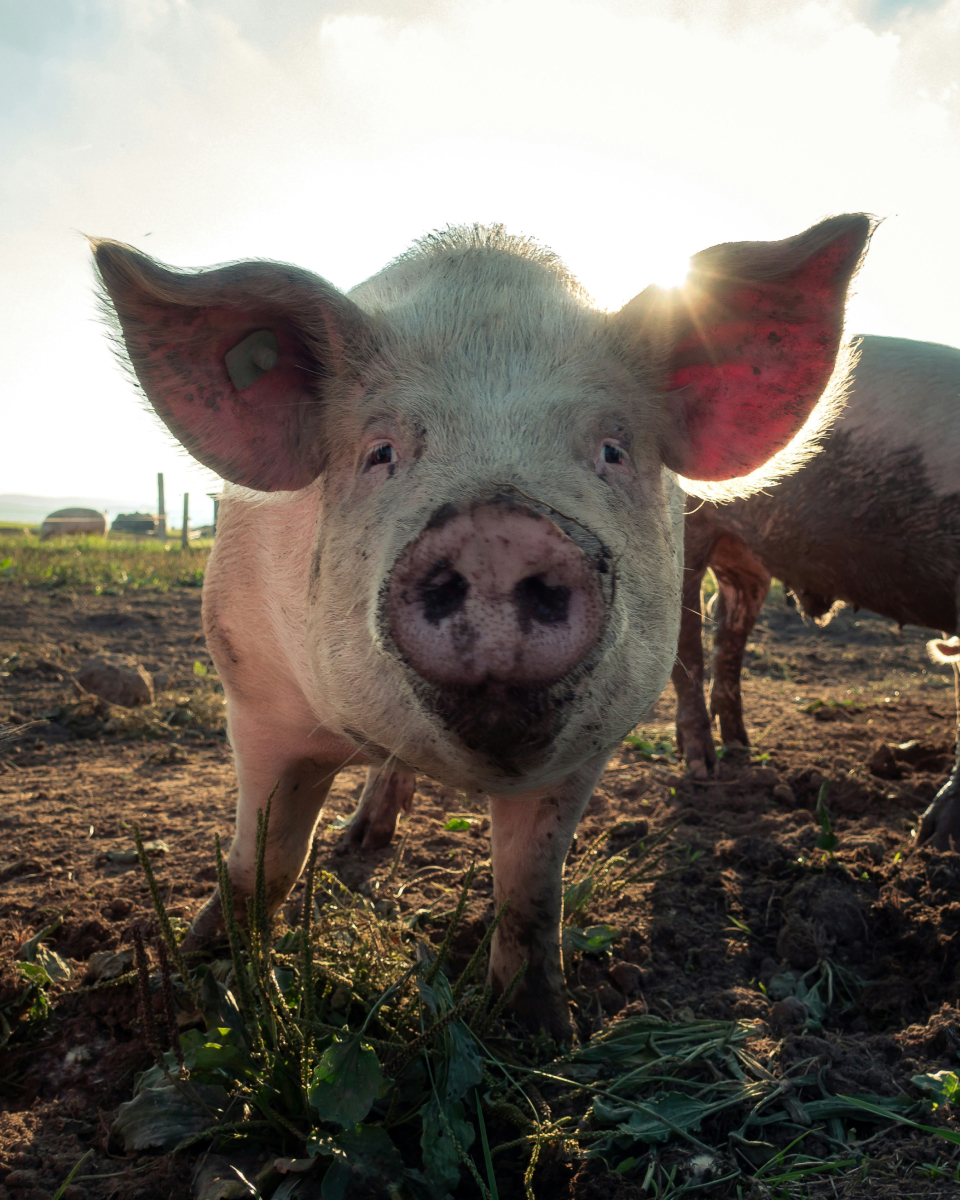
Photo by Pascal Debrunner
Pigs are omnivorous even-toed ungulates with adult weights ranging from 50–350 kg depending on breed and management. They are highly social animals that form stable dominance hierarchies and maintain long-term affiliative bonds with familiar conspecifics and humans. In naturalistic conditions pigs engage in extended rooting and foraging behaviour, dustbathing, nesting before farrowing, and exploration across large home ranges.
Pigs demonstrate advanced learning, spatial memory, and problem-solving abilities comparable to some primates. Scientific evidence supports the capacity for affective states including fear, frustration, and positive anticipation, and studies document tactical use of social information and individual recognition of conspecifics and humans. These findings underpin scientific consensus that pigs are sentient mammals with complex cognitive and emotional repertoires (Held & Špinka, 2011; Marino & Colvin, 2015).
Stress responses in pigs include elevated cortisol, stereotypies such as bar-biting and rooting on barren surfaces, tail-biting, and aggression associated with social instability, crowding, and barren environments. Environmental needs include rooting substrate, nesting material, stable social grouping, sufficient space for locomotion and lying, and temperature regulation — needs that are systematically unmet in intensive confinement systems.
Lifecycle Summary
Pig exploitation systems are structured around controlled reproduction — primarily through Artificial Insemination and confinement in farrowing and gestation systems — and high-throughput meat production in which pigs reach slaughter weight at 5–7 months. Sows are cycled through successive pregnancies and culled after 2–4 litters when reproductive performance declines. Routine physical modifications including Tail Docking, Teeth Clipping, and Castration are applied in early life across most intensive systems. All production pigs — finishing pigs, culled sows, and culled boars — enter industrial slaughter lines. By-products including blood, skin, bones, and organs supply pharmaceutical, cosmetic, and rendering industries.
Lifespan (Natural vs Exploited)
Sus scrofa in semi-wild or protected conditions can reach 15–20 years, with some individuals surviving beyond 20 years in non-exploitation settings.
Commercial finishing pigs are slaughtered at 5–7 months of age (approximately 150–210 days), corresponding to live weights of approximately 100–120 kg depending on region and market.
Breeding sows are culled significantly earlier than their biological maximum. In intensive systems, sows are typically removed after 2–4 litters, with average age at culling around 2–3 years. Primary culling causes are lameness, reproductive failure, and poor body condition. Boars used for semen collection are culled when fertility declines or genetic lines are rotated.
Exploitation Systems
Pig exploitation operates across industrial meat production, smallholder and subsistence farming, controlled breeding, and biomedical systems.
Pork production. The dominant system globally. Pigs reared in intensive indoor confinement or, less commonly, in extensive and outdoor systems for fresh pork, cured products (ham, bacon), and processed pork products (sausage, charcuterie). Carcasses yield primal cuts, offal, lard, and rendered by-products.
Breeding sector. Nucleus, multiplier, and commercial tier herds produce and distribute genetic lines and breeding stock. Artificial insemination dominates reproduction. Sows are cycled through repeated pregnancies, typically producing 2–3 litters per year in intensive systems averaging 12–14 piglets per litter.
By-products and biotech. Slaughter produces blood, skin, bones, and organs channelled into pharmaceuticals (heparin from intestinal mucosa, porcine insulin), cosmetics, gelatin, and rendering. Pig heart valves are used in cardiac surgery. Pigs are also used as biomedical models in neuroscience, metabolic disease research, and xenotransplantation development, involving laboratory housing and experimental procedures.
Smallholder and subsistence systems. Small-scale pig keeping integrated into mixed farming or village economies, prevalent across sub-Saharan Africa, Southeast Asia, and parts of Latin America. Conditions and management vary widely; these systems are not well captured in global production statistics.
Living Conditions Across Systems
Intensive confinement — finishing pigs. Indoor housing on slatted or partially slatted concrete floors with limited or no access to rooting substrate, outdoor space, or environmental enrichment. Stocking densities in many jurisdictions exceed 1 m² per 100 kg live weight. Group sizes are large and often unstable due to regrouping at transfers between production phases. Barren environments with restricted space are directly associated with tail-biting, which in turn drives the routine application of Tail Docking as a preventive measure.
Gestation housing — sows. Individual gestation crates restrict sows to enclosures of approximately 0.6–0.7 m wide and 2.0–2.2 m long, preventing turning and severely limiting locomotion. Associated with stereotypies, muscle atrophy, and poor bone density. Gestation crates are banned or restricted in the EU, UK, and several other jurisdictions, but remain in use in major producing countries including the United States and China.
Farrowing housing — sows. Farrowing crates confine sows to enclosures of approximately 0.6 m × 2.2 m with an adjacent piglet area, preventing turning and limiting maternal behaviour. Crates are used to reduce piglet crushing but restrict nest-building and maternal mobility. They are the near-universal farrowing system in intensive production globally.
Outdoor and extensive systems. Sows and growing pigs in paddock or range systems with access to rooting and foraging areas, straw bedding, and greater spatial freedom. Welfare outcomes are generally higher than intensive confinement; however, management quality and infrastructure vary widely and these systems represent a small share of global production.
Alternative indoor systems. Deep-bedded systems with straw or other substrates provide rooting opportunity and reduce stereotypies. Some certified welfare schemes require straw bedding, minimum space allowances above legal minimums, and intact tails.
Lifecycle Under Exploitation
Genetic Selection
Selective Breeding within commercial hybrid lines targets rapid growth rate, high lean meat yield, and large litter size. Modern commercial hybrids reach 100 kg in 150–180 days. Sow lines are selected for prolificacy, with intensive systems achieving averages of 12–14 piglets per litter.
Reproduction
Sows are maintained on controlled feeding and lighting regimes to manage oestrus cycling and reproductive output. Artificial Insemination is the dominant reproductive method, with successive inseminations around oestrus followed by pregnancy confirmation. Sows are housed in gestation systems — crates or group housing depending on jurisdiction — through the approximately 115-day pregnancy.
Birth & Early Life
Piglets are born in farrowing crates or farrowing pens. In intensive systems, early weaning occurs at 18–28 days, significantly earlier than the natural weaning period of 12–17 weeks. Iron injection at a few days of age compensates for low iron content of sow’s milk and barren floor environments. Tail Docking and Teeth Clipping are applied within days of birth in most intensive systems. Premature Weaning and Separation structures early-life detachment across all intensive pathways.
Growth & Rearing
Weaned piglets move to nursery units and then finishing barns, fed high-energy concentrate rations across 8–24-week phases. Castration is performed in the first weeks of life in many producing regions to prevent boar taint in meat; performed without anaesthesia in most contexts. Identification Marking via ear notching or tagging is applied. Tail Docking, where not performed at birth, may occur in this phase.
Production
Breeding sows and boars are maintained in repeated reproductive cycles. Sows farrow 2–3 times per year in intensive systems and are moved between gestation, farrowing, and service areas on a production schedule. Finishing pigs grow to target slaughter weight on ad libitum concentrate rations. Lighting Control is used to manage reproductive cycling in breeding herds.
Transport
Live Transport moves pigs between production stages — from breeding units to nurseries, nurseries to finishing barns, and farms to slaughter plants. Transport involves catching, loading, vehicle transit, and lairage at the slaughter facility. Transport-related stress, injury, and mortality are documented and vary by journey length, stocking density during transport, climate, and regulatory framework.
End of Life
Slaughter at processing plants terminates the productive cycle for finishing pigs at target weight and culled breeding stock. On-Farm Slaughter occurs for animals unfit for transport. Selective Culling removes non-productive, injured, or diseased animals throughout the production cycle.
Processing
Carcasses are eviscerated, scalded, dehaired, and chilled before being broken into primal cuts, offal, and by-products. Blood, intestinal mucosa, and skins are channelled into pharmaceutical, rendering, and leather processing streams.
Chemical Medical Interventions
Antibiotics are used across pig production systems for disease treatment, prophylaxis, and — in jurisdictions where permitted — growth promotion. Documented classes include tetracyclines, penicillins, and macrolides. Regulatory frameworks vary significantly: the EU has progressively restricted prophylactic and growth-promoting antibiotic use; more permissive use continues in parts of Asia and the Americas.
Metal-based additives including zinc oxide and copper sulfate are used at supra-nutritional levels in piglet diets to support gut health and growth. EU regulations have phased out high-dose zinc oxide use in piglets due to environmental accumulation concerns; use continues in other jurisdictions.
Vaccines are used across commercial systems for porcine reproductive and respiratory syndrome (PRRS), porcine circovirus type 2 (PCV2), Mycoplasma hyopneumoniae, and other respiratory and enteric pathogens. Vaccination schedules and products vary by region and system.
Castration is performed in the first weeks of life in most intensive producing regions to prevent boar taint. It is performed surgically, typically without anaesthesia or analgesia in many contexts, though some jurisdictions now require or incentivise pain control. Immunocastration via Improvac (GnRH vaccine) is an alternative used in some markets. EU regulations require anaesthesia and/or analgesia for castration above a specified age.
Iron injection (iron dextran) is administered at a few days of age in intensive systems where piglets have no access to soil. Tail Docking and Teeth Clipping are routinely performed in early life without anaesthesia; both are legally restricted in the EU but widely practised under derogation. Ear notching for identification is applied in some systems.
Slaughter Processes
Electrical stunning and carbon dioxide gas stunning are the two dominant methods in industrial pig slaughter. Electrical stunning applies current head-only or head-to-body to induce unconsciousness before exsanguination. CO₂ gas stunning exposes pigs in groups to high-concentration CO₂ — typically 80–90% — in a gondola or pit system. EU-level data indicate approximately two-thirds of pigs are stunned using CO₂-based systems, with the remainder using electrical methods.
CO₂ stunning at high concentrations is aversive: pigs display vigorous escape behaviour, vocalisation, and signs of respiratory distress during the induction phase before losing consciousness. Research has established that CO₂ at concentrations required for effective stunning causes pain and distress prior to unconsciousness. Alternative gas mixtures using lower CO₂ concentrations or inert gases are under development but not yet in widespread commercial use.
Electrical stunning, when applied correctly, induces rapid unconsciousness. Failure rates from mis-positioning or insufficient current are documented but not consistently reported across jurisdictions. Head-only electrical stunning produces temporary unconsciousness requiring immediate exsanguination; inadequate bleed-out before recovery is a documented risk.
Religious slaughter under halal and kosher certification may omit pre-slaughter stunning depending on jurisdictional rules and certifying body requirements. The proportion of pigs slaughtered without prior stunning is lower than for cattle and sheep given religious dietary restrictions on pork consumption in Islam and Judaism, but halal-certified pork production occurs in some markets with post-cut or simultaneous stunning.
Industrial pig slaughter lines operate at high throughput. Line speed pressures affect stunning reliability and bleed-out verification.
Slaughterhouse Labour Impact
Pig slaughter and processing are high-throughput, physically demanding operations associated with elevated rates of musculoskeletal injury, repetitive-strain disorders, and documented psychological stress among workers. Line work involves sustained repetitive cutting and handling tasks at speed, and conditions in large processing facilities are consistently linked to high injury incidence across producing countries.
Workforce demographics in pig processing facilities typically involve high proportions of migrant or low-income workers. Labour sourcing patterns including temporary agency work and contract arrangements are documented across major producing countries including the United States, Germany, Brazil, and Spain. Union presence and regulatory enforcement vary significantly by country and facility.
Quantified injury rate data specific to pig processing comparable to published poultry sector figures are not consistently available across jurisdictions. Available evidence reflects documented patterns from facility-level studies and occupational health literature rather than harmonised national statistics.
Scale & Prevalence
Global pig stocks are estimated at approximately 780 million to 1 billion head, with significant variation between sources depending on methodology and year. China accounts for approximately 40–50% of the global total, followed by the United States, Brazil, Spain, and other countries across Asia, Europe, and the Americas (FAO; Statista).
Asia dominates both population and pork production, representing approximately 57% of global pig numbers and a comparable share of global pig-meat output. Europe and North America together account for roughly one-third of production.
Global pig-meat production has grown overall since the 1990s, reaching approximately 110–125 million tonnes annually in the early 2020s. African swine fever outbreaks — particularly the 2018–2020 epidemic in China — caused significant episodic reductions in Asian pig populations and global pork output, with partial recovery since.
The overall production trajectory is expansion, with growth concentrated in Asia and the Americas. Intensification — higher output per animal and per facility — is the dominant trend in established commercial systems.
Ecological Impact
Pig production contributes to land-use change through feed-crop cultivation — principally maize and soy — nutrient runoff from manure management, and greenhouse gas emissions from enteric fermentation, manure decomposition, and energy use across the production chain.
Life-cycle assessment studies indicate that 70–80% of a pig farm’s carbon footprint is attributable to feed production, with imported soy from deforestation-risk regions — particularly Brazil and Argentina — identified as a major driver. Per-unit emissions vary significantly by system and feed composition; UK-based research documented sector-wide reductions in per-unit carbon footprint over two decades attributable to feed efficiency improvements and genetic selection.
Intensive systems concentrate manure outputs on small land areas, increasing local eutrophication and water quality risks from nitrogen and phosphorus loading. Ammonia emissions from pig housing and manure storage contribute to atmospheric nitrogen deposition. Extensive systems spread environmental impacts over larger landscapes but at lower per-unit productivity.
Ecological impact figures from life-cycle assessments are model- and input-specific. Regional variation in feed composition, energy mix, and land-use change assumptions produces a wide range of per-kg estimates across studies.
Language & Abstraction
Pigs within commercial systems are classified by production role and lifecycle stage — finishing pig, grower, weaner, sow, gilt, boar, breeder — framing animals as interchangeable functional units within a production hierarchy. Terms such as “production sow,” “breeding herd,” and “head of stock” aggregate individual animals into inventory categories, erasing behavioural complexity and individual variation.
“Litter size,” “farrowing rate,” and “piglets per sow per year” measure reproductive output as production metrics, abstracting sow reproduction from the physiological and behavioural demands it places on individual animals. “Culling” frames the removal of breeding animals whose performance has declined as a routine operational decision rather than a mortality event.
“Pork,” “bacon,” “ham,” and “charcuterie” are product nomenclature that dissociates finished goods from the living animal, a dissociation reinforced by the complete physical transformation of the carcass through processing. “Lard,” “by-product,” and “rendering” further abstract the animal into material inputs for downstream industries.
“Tail docking” and “teeth clipping” frame routine physical modifications in technical husbandry language, while “boar taint management” frames castration as a product quality intervention rather than a surgical procedure performed on a sentient animal. “Depopulation” and “stamping out” are used in disease-control contexts to describe mass killing of entire pig populations, absorbing the scale of killing into biosecurity terminology.
Terminology
Pig, swine, hog, stock, head, finishing pig, grower, weaner, suckling, piglet, sow, gilt, boar, breeder, breeding herd, production sow, farrow, litter, farrowing crate, gestation crate, pen, barn, shed, confinement, intensive system, extensive system, free-range, outdoor, deep-bedded, finishing unit, nursery, slaughter, stun, bleed, scald, dehair, eviscerate, carcass, primal cut, pork, bacon, ham, sausage, offal, lard, skin, blood, bones, by-product, rendering, animal by-product, feed, concentrate, feed ration, antibiotic, growth promoter, zinc oxide, copper sulfate, castration, docking, teeth clipping, ear notch, tag, RFID, transport, lairage, slaughterhouse, line, throughput.
Within The System
Developments
Operation Carne Fraca meatpacking corruption
Health of Animals Regulations transport amendments
SAG Decrees implementing welfare regulations
Investigation into livestock auction market conditions
Regulation for scaled livestock & poultry farms
Environmental closure of pig farms in ban-zones
Farm Animal Confinement Initiative
Mandatory CCTV in slaughterhouses
National Pork Producers Council v. Ross
Ban on livestock exports for slaughter
African swine fever second wave
Report a development: contact@systemicexploitation.org
Notice an inaccuracy or omission?
If you believe information on this page is incorrect, incomplete, or missing important context, you may submit a suggested correction for review.