
Kangaroos
Scientific Name:
Osphranter rufus / Macropus giganteus / Macropus fuliginosus / Osphranter robustus
Scope
Covers four large macropod species subject to commercial and non-commercial killing in Australia: red kangaroo (Osphranter rufus), eastern grey kangaroo (Macropus giganteus), western grey kangaroo (M. fuliginosus), and common wallaroo (O. robustus). All exploited populations are free-living wild animals; there is no industrial domestication or captive production system equivalent to livestock farming. Included exploitation systems: commercial wildlife harvest under state management plans for meat, skins, and pet food; non-commercial damage mitigation culling under destruction permits; government-authorised culls in conservation areas; and licensed recreational shooting. Excluded: other macropod species not listed under commercial harvest plans, purely conservation translocations, and captive holdings in zoos and wildlife parks except where referenced for biological comparison.
A defining structural characteristic of this record: the entire exploitation system operates on free-living wild animals in their natural habitat. There is no confinement phase, no selective breeding, no pharmaceutical management of production animals, and no infrastructure equivalent to livestock housing. Welfare considerations are concentrated at a single point — the killing event and its immediate consequences — rather than distributed across a lifecycle of managed conditions.
Species Context
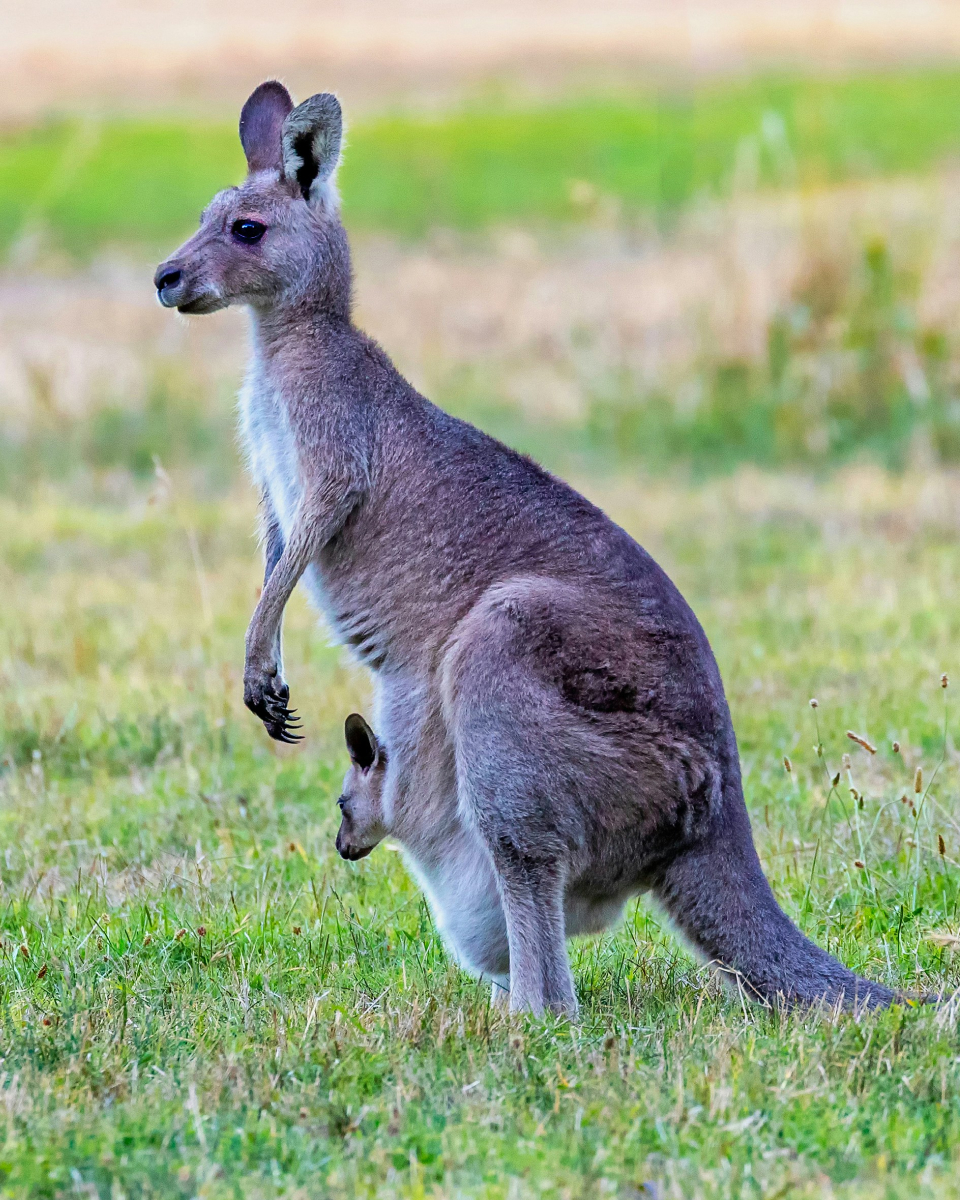
Photo by John Torcasio
Red kangaroos are the largest marsupials alive, with body mass up to approximately 90 kg in large males; eastern and western greys reach approximately 40–60 kg; common wallaroos are intermediate at approximately 17–50 kg. All are hindgut fermenters adapted to arid and semi-arid rangelands and temperate grasslands, with saltatory locomotion (hopping) and high energetic efficiency at range. They exploit heterogeneous landscapes across home ranges of hundreds to thousands of hectares, adjusting movement patterns to rainfall cycles and vegetation dynamics.
Social structure is characterised by fission-fusion dynamics — mobs form and dissolve repeatedly over the course of a day — with evidence of long-term social associations and preferential relationships particularly among females in eastern grey populations (documented in UNSW research, 2023). Females have overlapping reproductive cycles with embryonic diapause: a female can simultaneously carry an embryo in diapause, a pouch young nursing from one teat, and a young-at-foot still associating with her and nursing from a different teat. This reproductive system means that killing a lactating female simultaneously terminates multiple dependent offspring at different developmental stages.
Cognitive evidence is substantive. Wild, non-domesticated kangaroos demonstrate intentional communication with unfamiliar humans — using gaze alternation and behavioural signals to solicit assistance in problem-solving tasks (University of Sydney, 2020; published in Animal Cognition). Lateralised brain function (consistent handedness preference) is documented (Current Biology). Long-term individual social relationships distinct from kin associations are documented in eastern greys. These capacities are consistent with flexible cognition and social awareness in wild animals with no history of domestication or training.
Stress and affect: observational and care-context research documents behavioural and physiological markers consistent with distinct affective states — separation distress, relaxation — and vulnerability to stress from human approach, handling, and sudden disturbance. Kangaroos are prey animals with acute vigilance responses; their stress response to the nocturnal spotlight and vehicle approach used in commercial harvesting is not systematically quantified.
Lifecycle Summary
Australia operates the world’s largest commercial wild land mammal harvest. Annual commercial quotas in major states are in the hundreds of thousands to over a million animals per state: New South Wales set a commercial quota of approximately 1.85 million animals in 2023; South Australia’s actual commercial harvest in 2023 was approximately 100,000 animals against a quota of approximately 634,000; Western Australia set a quota of approximately 125,000 western grey kangaroos across several zones at a proposed 17% harvest rate. Australia exports approximately 4,000 tonnes of kangaroo meat annually to more than 60 countries, with export values in the tens of millions of Australian dollars per year. The commercial system operates under Wildlife Trade Management Plans approved under the Commonwealth Environment Protection and Biodiversity Conservation Act 1999, which frames commercial killing as ecologically sustainable resource use and positions it within a conservation regulatory structure rather than a livestock production framework.
The killing method — free-bullet rifle shooting at night from vehicles using spotlights — is unique in this database. The National Code of Practice for Humane Shooting of Kangaroos and Wallabies mandates a single accurate brain shot for target animals. When shot females are lactating, the Code prescribes specific killing methods for dependent joeys — blunt trauma, decapitation, or shooting — at the kill site. Studies of chiller carcasses suggest that a substantial proportion of animals in some samples were neck-shot rather than brain-shot; the precise compliance rate with brain-shot requirements is contested and method-dependent.
Lifespan (Natural vs Exploited)
Large kangaroos can reach 15–20 years in free-living populations not subject to heavy harvest pressure, though many individuals die earlier from drought, vehicle collision, predation by dingoes, and disease. In heavily harvested zones, age structures are skewed by preferential removal of adult animals; the proportion of older individuals in the population is reduced relative to unharvested populations.
Under commercial harvest and culling, animals are shot as free-living adults or subadults, typically well below maximum potential lifespan. Annual removal rates of approximately 10–20% of estimated population are typical under quota settings, though actual harvest often falls substantially below quota.
Individual age-at-death data are not reported in commercial harvest statistics; ages are inferred from body size and sex classes recorded in quota reports.
Exploitation Systems
Kangaroo exploitation operates across three systems with different regulatory frameworks.
Commercial wildlife harvest. Licensed field shooters operate under state commercial kangaroo management plans — currently approved as Wildlife Trade Management Plans under the EPBC Act 1999 for export-eligible harvest. Shooters work at night from vehicles using spotlights and centrefire rifles, targeting animals meeting size and sex criteria specified in management plans. Carcasses are transported to registered field chillers, then to processing facilities licensed under Australian export control and food safety legislation. Products flow into three markets: human food (retail cuts, mince, processed products sold domestically and exported); pet food (lower-grade meat, trimmings, and offal); and leather (hides tanned for footwear, sporting goods, and apparel). Rendered products (meal and fat) enter animal feed chains. Australia exports approximately 4,000 tonnes of kangaroo meat annually to more than 60 export markets.
Non-commercial damage mitigation and culling. Landholders, land managers, and government agencies kill kangaroos under destruction permits or formal government cull programmes to reduce grazing pressure on crops and pastures, or to manage population density in conservation reserves where overabundance is assessed as impacting vegetation or native species. Methods mirror commercial harvesting (spotlighting, rifles) but documentation requirements, regulatory oversight, and shooter training standards can be less stringent than under commercial programs. Carcasses may be left in the field, disposed of, or occasionally redirected to meat or pet food channels.
Licensed recreational shooting. State wildlife regulations in some jurisdictions permit licensed recreational shooters to kill kangaroos for private consumption or pest control, with variable utilisation of carcasses. This system is the least systematically monitored of the three.
Living Conditions Across Systems
Pre-kill conditions. All commercially and non-commercially harvested kangaroos live as free-ranging wild animals in native or modified rangelands across landscape-scale home ranges. There is no confinement infrastructure, no managed housing, and no welfare provisions applicable to living conditions. The welfare context — the conditions experienced by these animals during their lives — is determined by the natural rangelands environment, seasonal conditions, and human-modified landscapes rather than by exploitation system design.
At the kill site. Commercial shooting occurs at night under spotlighting conditions; target animals must be stationary and clearly visible per the National Code of Practice. The sensory environment at kill — artificial light in darkness, vehicle presence, and the approach sequence — constitutes a stress event whose welfare implications are not systematically quantified in the harvest literature. Animals not killed instantaneously by a brain shot may flee or remain mobile while incapacitated.
Chiller and processing. After shooting, carcasses are bled and hung in mobile field chillers before transport to fixed processing facilities. All welfare provisions in the cold chain address meat hygiene and temperature management, not living animal conditions.
Lifecycle Under Exploitation
Genetic Selection
No genetic selection programme exists. Exploited animals are wild-born with natural genetic variation. Commercial harvest may impose incidental selective pressure — preferential removal of larger adults or specific sexes alters the age-sex structure of exploited populations, which over time can affect population genetics and life-history traits. This is a population-level effect of harvest intensity, not a managed breeding programme.
Reproduction
Reproduction occurs entirely in wild populations without direct human management. Population density and reproductive rates respond to rainfall, vegetation availability, and harvest pressure. Density reduction through culling may increase per-capita reproductive rates through compensatory reproduction, which is one mechanism cited in harvest management documents to support sustainability claims.
Birth & Early Life
Joeys are born at a highly altricial stage and develop in the maternal pouch for approximately 8–11 months before permanent emergence; young-at-foot continue to associate with the mother and occasionally nurse for months beyond permanent pouch exit. This extended maternal dependency means that shooting an adult female terminates not only her life but the lives of all her dependent offspring. The National Code of Practice (2020) addresses this directly: if a shot female is found to carry a pouch young, prescribed killing methods are blunt trauma to the head, decapitation, or shooting; young-at-foot that cannot escape may be shot. The total number of dependent young killed annually as a consequence of adult female harvest is not reported in official harvest statistics and is not systematically monitored.
Growth & Rearing
Growth occurs in natural habitats without human management. Nutritional status and growth rates are shaped by rainfall, pasture availability, and competition with livestock and other native herbivores. There is no feedlot, supplemental feeding, or managed rearing phase.
Production
In exploitation terms, “production” is the accumulation of body mass and hide quality in free-living animals across their natural life trajectory. There is no on-farm production phase. The productive unit is the individual wild animal at the point of capture-killing.
Transport
Primary transport is of chilled carcasses from field locations to processing facilities; live transport does not occur in commercial systems. Carcass transport is governed by food safety, cold-chain, and export certification requirements.
End of Life
Commercial harvest: licensed shooters locate animals at night using spotlights, identify target animals meeting size and sex criteria, and discharge a single rifle shot aimed at the brain. Immediately following the kill, the carcass is bled (throat cut or chest cavity opened) and field-dressed; the head and hide may be removed in the field. If dependent young are present, the Code requires their immediate killing by prescribed methods. Non-commercial culling and recreational shooting follow broadly similar methods with varying levels of oversight.
Processing
Carcasses progress from field chillers to licensed processing establishments where they are eviscerated, inspected under export or domestic food safety requirements, cut into retail and bulk portions, and directed to human food, pet food, and rendering streams. Hides are removed and sent to tanneries. Inedible material is rendered or disposed of as waste.
Chemical Medical Interventions
No chemical or pharmaceutical interventions are applied to commercially harvested kangaroos. Animals are not vaccinated, medicated, or supplemented as part of the harvest system. There are no growth promoters, hormones, or prophylactic antibiotics because kangaroos are not managed in a controlled production environment.
Veterinary drugs are used on kangaroos held in captivity for rehabilitation, zoo, or research purposes — sedatives (tiletamine-zolazepam combinations), analgesics, antiparasitics, and antibiotics under species-appropriate dosing protocols — but these applications are entirely separate from the commercial harvest system and affect a small number of animals relative to commercial kill volumes.
Kangaroos in the commercial harvest zone may be exposed to agricultural chemicals (pesticides, herbicides) through shared rangeland landscapes with livestock, but this is not a directed intervention.
Slaughter Processes
Commercial kangaroo slaughter is rifle-based field shooting — structurally unlike any other food animal slaughter system in this database. The National Code of Practice for Humane Shooting of Kangaroos and Wallabies (2020) requires a single accurately placed shot to the brain for target animals; the Code specifies that animals must be stationary, clearly visible, and standing upright at the time of the shot, and prohibits shooting from moving vehicles. The intended outcome is immediate unconsciousness and rapid death from traumatic brain injury without a pre-stun or stun-and-bleed sequence.
A peer-reviewed 2025 PMC study examining welfare outcomes in commercial kangaroo harvesting reviewed evidence on shot placement compliance. Studies examining chiller carcasses have reported that a substantial proportion of animals in some samples — estimates from specific studies range up to approximately 40% in some datasets — were neck-shot or body-shot rather than brain-shot, which would not produce immediate unconsciousness. The research file notes that subsequent commentary has highlighted interpretive limitations, including the difficulty of conclusively verifying shot placement when the head and neck are removed in the field. The precise field compliance rate remains contested and is not monitored in real time across harvest operations.
Dependent young killing at the kill site — by blunt trauma, decapitation, or shooting as specified in the Code — is an integral component of the commercial kill event rather than a separate processing step. Pouch young are killed physically; young-at-foot that cannot escape are shot. The Code positions these as welfare requirements rather than waste disposal.
No pre-stunning infrastructure exists because the killing occurs in field conditions without fixed facilities. There is no equivalent to the lairage, shackling, stun box, or kill line infrastructure of abattoir systems. The welfare profile of the kill event is entirely determined by shooter skill, shot placement, and compliance with Code requirements.
Religious slaughter frameworks are not applicable to the kangaroo harvest system.
Slaughterhouse Labour Impact
Commercial kangaroo harvesting is performed by licensed field shooters — typically small businesses or sole operators — working in remote and rural areas, predominantly at night. Occupational risks include firearms handling in variable terrain and visibility conditions, vehicle operation at night over rough and unfamiliar ground, exposure to extreme temperatures in arid and semi-arid environments, and the physical handling and cold-chain management of large carcasses. Species-specific national injury rate datasets for kangaroo harvesters are not available in publicly accessible form.
Downstream processing plant workers face the standard meat processing occupational risk profile — knife work, cold environment exposure, repetitive motion injuries, musculoskeletal strain — applicable across all food animal processing sectors.
Peer-reviewed literature on psychological outcomes for kangaroo shooters specifically is sparse. The welfare debate literature notes concern about potential desensitisation effects associated with repeated killing of large, cognitively complex wild animals, including the killing of dependent young, but systematic epidemiological data for this workforce segment have not been published.
Scale & Prevalence
Australian state monitoring describes large, fluctuating macropod populations in commercial harvest zones, with total abundances ranging from tens of millions in high-rainfall years to substantially lower in drought conditions; population estimates drive annual quota setting.
Documented quota and harvest figures: NSW commercial quota approximately 1.85 million animals in 2023 (NSW DCCEEW 2023 quota report); SA actual commercial harvest approximately 100,000 animals against a quota of approximately 634,000 in 2023 (SA 2025 Quota Report); WA quota of approximately 125,000 western grey kangaroos across monitored zones at a proposed 17% harvest rate (WA DBCA). Actual harvest typically falls substantially below quota — in the SA example, approximately 16% of quota was achieved.
Australia exports approximately 4,000 tonnes of kangaroo meat annually to more than 60 countries; export values are in the tens of millions of Australian dollars per year (Australian Department of Agriculture). The domestic pet food market consumes a substantial additional volume; total domestic and export volumes combined are not reported in a single publicly accessible consolidated figure.
The directional trend is variable: harvest volumes fluctuate with population estimates, drought cycles, market demand, and changes in export market access. Some export markets have imposed or threatened restrictions on kangaroo products on animal welfare grounds; Russia suspended imports in 2009. The commercial harvest is periodically assessed against EPBC Act sustainability requirements.
Ecological Impact
Kangaroos are significant native herbivores whose grazing contributes to total grazing pressure in rangelands alongside sheep and cattle. In landscapes where surface water and pasture have been expanded through agricultural development, kangaroo populations can increase beyond their pre-agricultural density in some zones; management documents and technical reviews describe some areas as experiencing “overabundance” relative to modified landscape carrying capacity.
Commercial harvest and damage mitigation culling are the primary tools used to manage kangaroo numbers and reduce their contribution to total grazing pressure. The ecological relationship between kangaroo density, rainfall, vegetation biomass, and livestock production outcomes is complex; technical reviews emphasise the need for improved understanding of these dynamics before strong harvest impact conclusions can be drawn.
Kangaroos are generally considered to exert lower greenhouse gas and water burdens per kilogram of meat than domesticated ruminants, due to differences in digestive physiology (hindgut vs foregut fermentation producing less methane per unit of feed) and the absence of production infrastructure land and water use. Published lifecycle assessments comparing kangaroo meat to beef or lamb are limited and vary in system boundaries; this comparison should be treated as indicative rather than established.
In conservation reserves, high kangaroo density following exclusion of predators has been linked to vegetation degradation and impacts on native fauna using similar habitat. Government culls in these contexts are framed as biodiversity management rather than production-oriented killing.
The commercial harvest system does not introduce new species, modify habitat, or create novel ecological pressures; its ecological effect is the removal of wild animals from a population whose size is otherwise determined by natural and agricultural landscape dynamics.
Language & Abstraction
The regulatory architecture of the Australian commercial kangaroo harvest is the most sophisticated example of legal-conservation framing in this database. The system operates under Wildlife Trade Management Plans rather than livestock industry regulations; killing is described as “harvest,” “take,” “sustainable use,” and “commercial wildlife management.” The EPBC Act framework positions the commercial kill as conservation management — an activity that requires demonstration of ecological sustainability and conservation benefit rather than simply food safety and animal welfare compliance. This framing fundamentally differentiates the kangaroo system from livestock production in Australian law, public discourse, and international trade negotiations, regardless of the material similarity of the outputs (meat, skins, pet food).
“Total grazing pressure” is the key ecological management concept that integrates kangaroos into a shared category with livestock. The term positions kangaroos and sheep or cattle as equivalent units of grazing impact on shared rangelands, enabling arguments that commercial harvest of kangaroos reduces agricultural pressure and may benefit pastoral production. The framing simultaneously positions kangaroos as a resource competing with domestic animals and as a wild species managed through the conservation system.
“Humane shooting” in the National Code of Practice describes the technical parameters of the kill event — shot placement, animal visibility requirements, dependent young protocols — within a compliance framework. The term “humane” is applied to a field-shooting system operating at night at range, without verification of individual shot outcomes except through post-hoc carcass inspection of commercial samples. “Humane” functions as a quality standard descriptor for the kill method rather than as a description of the welfare experience of the individual animal or its dependent young.
“Pouch young” and “young-at-foot” as regulatory categories define dependent joeys in terms of their developmental location — in the pouch or outside it — which determines which killing method is prescribed under the Code. The categories embed the dependent young killing requirement within a welfare compliance framework using developmental stage descriptors rather than terms that foreground the killing of offspring as a consequence of commercial harvest.
“Overabundant” as a management descriptor positions kangaroos in conservation and agricultural management documents as animals whose population density exceeds a carrying capacity threshold defined in relation to modified landscapes. The threshold is not a fixed ecological baseline but a management objective determined by agricultural production values and conservation goals; “overabundant” normalises population reduction as a management response to the presence of native animals at numbers determined by agricultural land use decisions.
Terminology
Harvest, commercial harvest, non-commercial cull, destruction permit, damage mitigation, population control, quota, special quota, harvest rate, wildlife trade management plan, total grazing pressure, resource use, game meat, carcass, chiller, field chiller, edible kangaroo meat, pet food, meat meal, by-product, kangaroo leather, skin, hide, pouch young, young-at-foot, euthanasia, humane shooting, head shot, body shot, neck shot, shooter competency, harvest zone, management plan, overabundant species, sustainable use, wildlife trade operation.
Within The System
Developments
Report a development: contact@systemicexploitation.org
Notice an inaccuracy or omission?
If you believe information on this page is incorrect, incomplete, or missing important context, you may submit a suggested correction for review.