
Ducks
Scientific Name:
Anas platyrhynchos domesticus / Cairina moschata domestica
Scope
Covers domesticated ducks in commercial exploitation systems, primarily Pekin-type ducks derived from Anas platyrhynchos domesticus and Muscovy ducks (Cairina moschata domestica) and their sterile hybrid — the mule duck — used in meat, egg, foie gras, and feather/down systems. Includes intensive indoor meat and egg production, foie gras production using forced feeding (gavage), breeder flocks supplying hatcheries, down and feather harvesting as primary and by-product systems, and integrated rice-duck and fish-duck agro-ecosystems. Wild Anatidae are referenced for biological baseline comparison only; wild duck hunting is acknowledged but not detailed as an exploitation system. Excludes geese and other waterfowl, ornamental duck keeping without commercial output, and conservation captive programmes.
Species Context
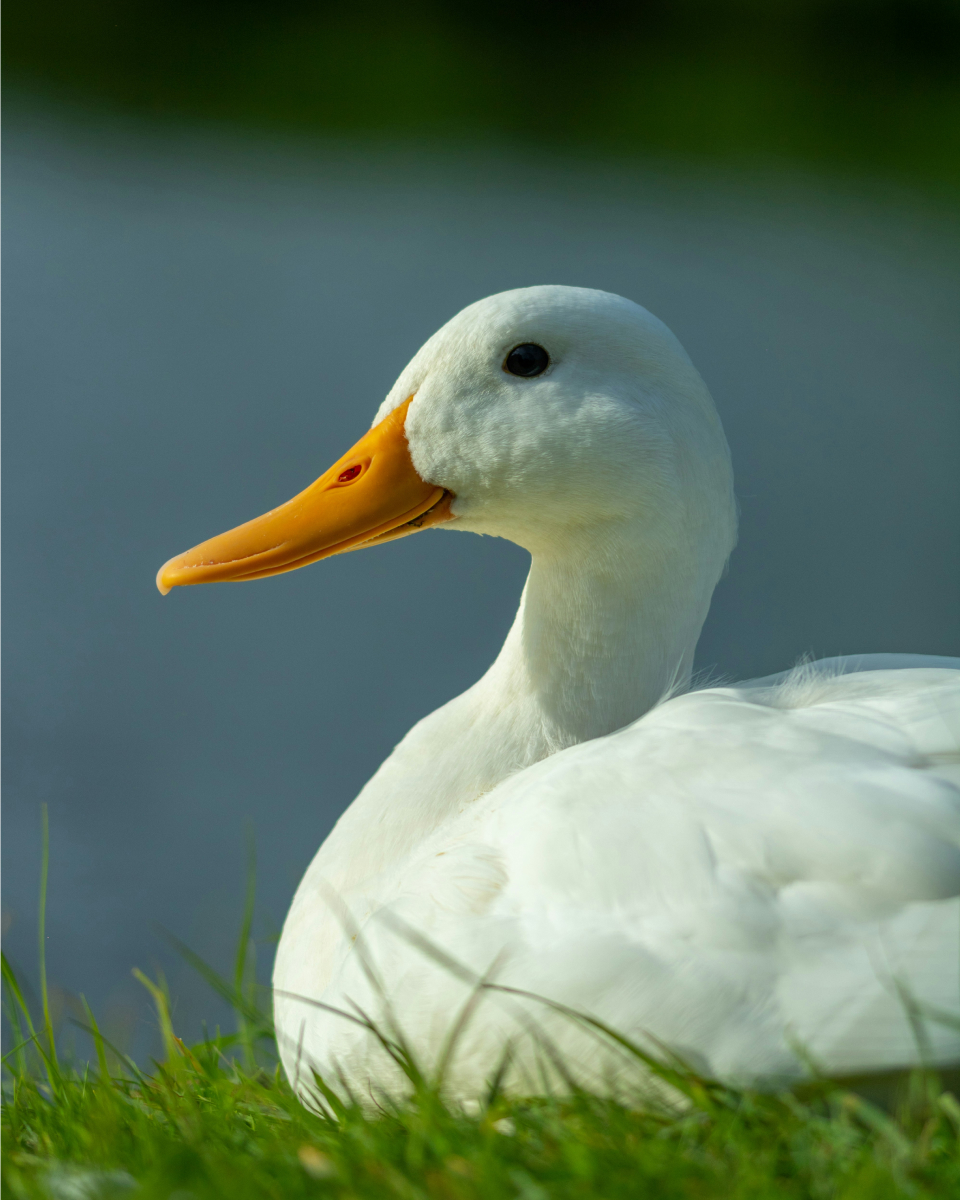
Photo by Kai Dahms
Domesticated ducks are derived from semi-aquatic birds with webbed feet, waterproof plumage maintained through preen gland oil, and bills specialised for filter-feeding and dabbling. Both Pekin-type and Muscovy ducks retain these physiological characteristics in domestication. Ducks are gregarious, exhibiting flocking behaviour, social hierarchies, and coordinated movement; welfare studies link elevated stocking densities in Pekin ducks to increased competition for feeders and drinkers, altered resting behaviour, poorer litter conditions, and higher rates of leg problems and plumage damage.
Water access is a species-specific need with no equivalent in chickens or turkeys. Ducks use water for bill rinsing, nostril clearing, eye washing, and feather maintenance; scientific consensus treats access to open water — sufficient to immerse the head, if not to swim — as a welfare requirement for this species. Standard intensive commercial production meets only drinking water requirements via nipple or bell drinkers; this deprivation of species-appropriate water use is documented as a welfare gap specific to duck systems.
Ducks demonstrate learning, memory, and complex perceptual abilities. They are treated as sentient vertebrates capable of experiencing negative states — fear, distress, pain — within avian cognition and sentience consensus frameworks. Corticosterone levels, reduced activity, and altered social interactions under high stocking densities are documented physiological and behavioural stress indicators.
Lifecycle Summary
Duck exploitation operates across three primary systems with different species, lifespans, and operational logics. Meat production — dominated by Pekin-type ducks — is the largest system globally by volume; China alone produces approximately 3 million tonnes of duck meat annually and accounts for the majority of global output. Commercial meat ducks are slaughtered at 6–8 weeks, a fraction of their potential 8–12 year lifespan. Foie gras production involves the most extensively documented biological disruption of any practice applied to poultry in this database: gavage induces hepatic steatosis characterised by up to ten-fold liver enlargement, documented impairment of lipid metabolism, and mortality rates in the final production phase documented at 1–5% in published studies. A structural welfare issue unique to ducks relative to other poultry systems is water access: ducks are semi-aquatic with strong species-specific motivation to immerse bills and heads for preening, thermoregulation, and feeding, yet standard intensive production denies access to open water, providing only nipple or bell drinkers.
Lifespan (Natural vs Exploited)
Wild mallards have a typical lifespan of approximately 5–10 years, with high juvenile mortality; domesticated ducks in low-density non-commercial conditions can reach 8–12 years and occasionally 15–20 years.
Commercial meat ducks (Pekin-type) are slaughtered at 6–8 weeks of age — less than one year of age against a potential lifespan exceeding a decade. Foie gras ducks — mule and Muscovy — are slaughtered at approximately 10–14 weeks following a 10–21 day force-feeding phase. Egg-laying ducks are maintained for approximately 72–80 weeks before culling due to declining egg production. Breeder flocks supplying hatcheries are retained for one to two laying cycles — typically one to two years — before culling due to decreased fertility, leg problems, or productivity decline.
Primary causes of mortality in intensive systems include early duckling culling, avian influenza and other infectious disease, leg disorders associated with rapid growth or high stocking density, and planned culling at end of productive life.
Exploitation Systems
Duck exploitation operates across three primary systems and one secondary system.
Meat production. The dominant global system, concentrated overwhelmingly in Asia. Pekin-type ducks are raised in intensive indoor sheds from hatchery placement to slaughter at 6–8 weeks, with high-protein starter, grower, and finisher diets formulated for rapid growth and feed conversion. China accounts for the large majority of global duck meat production; Vietnam, France, Germany, and Hungary are secondary producers. Carcasses supply fresh, frozen, and processed meat products including confit, smoked products, and parts. International duck meat trade is relatively limited at less than 130,000 tonnes annually compared with chicken, with China as a primary exporter to EU and other markets.
Foie gras production. A geographically concentrated system — France and Hungary produce the large majority of European foie gras; smaller volumes are produced in parts of China and Bulgaria. Mule ducks (sterile Muscovy × Pekin hybrid) are the dominant foie gras species in France, using hybrid vigour for liver yield; Muscovy ducks are used in some systems, particularly in Hungary and parts of Asia. After an initial grow-out phase, ducks enter the gavage (force-feeding) period of 10–21 days during which large quantities of energy-dense feed — predominantly cooked corn — are delivered directly to the oesophagus two to three times daily using a funnel-tipped tube or pneumatic pump. This regime induces hepatic steatosis — fatty liver disease — causing the liver to enlarge to approximately 6–10 times its normal size. The enlarged liver is processed as foie gras; the remaining carcass is sold as duck meat and the fat rendered for cooking. During the gavage phase, ducks are typically confined individually or in small groups in barn-style pens or individual cages with limited movement.
Egg production. Layer ducks — Khaki Campbell and specialised commercial strains — are housed in sheds or semi-intensive systems for table egg and processed egg product output. Duck eggs are used in direct table consumption and in processed egg products (powdered, liquid). Some layer duck systems operate in integrated agro-ecosystems — rice-duck co-culture — where ducks provide weed and pest control, nutrient cycling, and bioturbation in rice paddies while producing eggs and occasional meat.
Down and feather harvesting. Feathers and down are collected as slaughter by-products from meat ducks across the production system. In Hungary and some Chinese operations, live-plucking is documented: feathers are removed from live ducks before slaughter and the ducks are returned to production; this practice is opposed by certification schemes but its prevalence in commercial supply chains is not fully mapped. Down and feathers supply bedding, clothing, and outdoor equipment industries. Down from ducks is marketed alongside goose down; without supply chain traceability, live-plucked and slaughter by-product down enter the same commercial channels.
Living Conditions Across Systems
Intensive meat duck housing. Enclosed sheds with artificial lighting, mechanical or natural ventilation, and litter floors (straw or wood shavings). Nipple or bell drinkers are standard; open water for swimming is not provided. Stocking density in conventional Pekin systems commonly ranges from approximately 22–25 kg/m² (approximately 7 ducks/m²); some operations report densities up to 46 kg/m². The UK Duck Assurance Scheme permits up to 25 kg/m²; welfare certification schemes such as Certified Humane limit densities to approximately 17 kg/m². At higher stocking densities, peer-reviewed studies document reduced eating and drinking time, increased competition for resources, changes in resting behaviour, and poorer litter conditions with implications for leg health and plumage cleanliness.
Foie gras systems. Initial grow-out in barn or pen housing on litter, transitioning to individual or small-group confinement pens or individual cages during the gavage phase. Movement is restricted during force-feeding. Access to open water is typically not provided during the gavage period.
Egg-laying systems. Layer ducks are housed indoors on litter or in barns with partial outdoor runs, or in integrated rice-duck systems where outdoor access is inherent. Space allowances and group sizes vary widely; some certification schemes specify indoor stocking densities comparable to or lower than meat systems, with requirements for nest boxes and water provision.
Transport and slaughter holding. Ducks are loaded into crates or modules for road transport to slaughter facilities; journey durations and crate stocking densities are governed by national and EU transport regulations where applicable. At slaughter plants, ducks are shackled upside down on conveyor lines for electrical waterbath stunning, creating a period of inversion and close confinement prior to killing.
Lifecycle Under Exploitation
Genetic Selection
Breeding companies maintain closed lines of Pekin-type ducks selected for rapid growth rate, feed conversion efficiency, carcass yield, and meat quality. Muscovy lines are selected for liver size and liver lipid content in foie gras applications. Mule ducks are produced as a first-generation hybrid between Muscovy males and Pekin-type females — hybrids are sterile and must be produced anew each generation. Layer duck lines are selected for annual egg output and shell quality. Selective Breeding applies to all commercial production streams.
Reproduction
Breeder flocks are managed under controlled photoperiod regimes to regulate onset of sexual maturity and sustain peak laying. Artificial Insemination is used in Muscovy and mule duck production systems due to size incompatibility between Muscovy males and Pekin-type females in natural mating. Reproductive Cycle Manipulation via light management and feeding protocols governs laying performance in all commercial breeder systems.
Birth & Early Life
Fertile eggs from breeder flocks are transferred to commercial hatcheries for artificial incubation under controlled temperature and humidity — Hatchery Incubation. Ducklings hatch, are sexed where needed (for layer and breeder flocks), vaccinated according to local disease protocols, and transported to grow-out facilities, typically within 24–48 hours of hatch. Male ducklings from layer-focused breeds have no commercial value in egg production systems and may be culled at hatch.
Growth & Rearing
Meat duck grow-out: ducklings are placed in sheds with supplemental brooding heat and high-protein starter diets; temperature is reduced progressively as birds feather. Stocking density increases as ducks grow toward target slaughter weight of approximately 3–3.5 kg reached at 6–8 weeks. Layer and breeder duck rearing: female ducklings are raised in rearing houses with controlled photoperiods to delay onset of lay until optimal body weight is achieved. Growth Acceleration via formulated high-energy, high-protein diets and controlled lighting is central to meat duck production.
Production
Meat ducks proceed continuously through grow-out to slaughter weight; in some systems — and in higher-welfare certification schemes — outdoor range access is provided. Foie gras ducks complete an initial grow-out phase before entering the gavage period: Forced Feeding delivers cooked corn directly to the oesophagus two to three times daily for 10–21 days, causing progressive hepatic steatosis. Liver mass increases from approximately 60–80 g at gavage start to 400–600 g or more at slaughter. Layer ducks produce eggs continuously under stable photoperiod regimes; eggs are collected manually or mechanically and graded for table or processing use. Egg Collection is the defining production practice for laying ducks.
Transport
Ducks are caught manually or by mechanical harvester, loaded into stacked crates or modules, and transported by road to slaughter or processing facilities. Journey durations vary from short local trips to several hours depending on slaughter facility proximity. Heat stress, overcrowding in crates, and handling injuries are documented transport welfare risks.
End of Life
At commercial slaughter plants, ducks are shackled upside down on moving conveyor lines and passed through electrical waterbath stunners before manual or automated neck cutting and exsanguination. Electrical waterbath stunning of ducks presents species-specific challenges: ducks have a breath-holding capability that can allow them to avoid full immersion or to recover from low-current exposures; electrical parameters must be sufficient to induce epileptiform activity rather than electro-immobilisation alone, and suboptimal parameters risk producing paralysis without loss of consciousness. Controlled atmosphere stunning using high CO₂ concentrations (greater than 70%) or inert gas mixtures is technically applicable to ducks but requires longer exposure and higher concentrations than for chickens; it is less widely deployed in duck-specific facilities. Spent layers and breeders may be depopulated via slaughter plants or on-farm gas killing during flock replacement. During disease outbreaks — particularly avian influenza — Depopulation via mass destruction methods is applied to entire flocks.
Processing
After bleeding, ducks are scalded in hot water tanks, defeathered mechanically, eviscerated, and chilled. Down and feathers removed during defeathering enter the feather processing chain for commercial sale — Feather Harvesting. Carcasses are cut into parts or further processed into confit, smoked, and other value-added products. Duck fat is rendered for cooking; offal, bones, and blood enter pet food, rendering, and feed ingredient streams. Foie gras livers are extracted for specialised processing and sale; the remainder of the foie gras carcass enters standard duck meat channels.
Chemical Medical Interventions
Vaccines used in commercial duck production target duck-specific and general avian pathogens: duck viral hepatitis, duck plague (duck enteritis virus), duck Tembusu virus (DTMUV), and avian influenza. Recent peer-reviewed research has developed mRNA-based vaccines against DTMUV demonstrating higher antibody titres than existing live attenuated vaccines in challenge trials, representing a current area of vaccine development for this species. Avian influenza vaccination protocols vary by country and disease status.
Antibiotics are used therapeutically and, in some jurisdictions, prophylactically to control bacterial infections including colibacillosis; growth-promoting antibiotics are banned in the EU and some other markets but may remain in use in high-production regions with less restrictive veterinary drug frameworks. Antiparasitic agents and routine disinfectants are applied in line with broader poultry biosecurity practice.
Nutritional interventions include high-energy diets with coccidiostats, vitamins, and mineral supplementation for growth, bone development, and egg production. In foie gras systems, specially formulated or cooked corn-based diets are used at very high daily ration levels during gavage to maximise hepatic lipid accumulation.
Beak Trimming — partial removal of the upper beak tip — is used in some duck systems to reduce feather pecking; it is less routinely applied in ducks than in chickens and is absent from or restricted within some higher-welfare certification frameworks. Wing clipping may be applied in management contexts where flight control is required.
Artificial Insemination is used in Muscovy and mule duck breeding programmes due to the physical size differential between Muscovy males and Pekin-type females making natural mating unreliable at commercial scale.
Slaughter Processes
Commercial slaughter uses electrical waterbath stunning as the dominant method. Ducks are shackled by their legs, inverted on a conveyor, and moved through an electrified water bath before neck cutting. Two welfare concerns are specific to this species relative to other poultry: first, the breath-holding response — ducks can lift their heads to avoid full-body immersion, particularly at conveyor entry, creating risk of partial stunning or missed exposure; second, the distinction between electro-immobilisation and effective stunning — low-current or poorly calibrated waterbath parameters may produce muscular paralysis without inducing loss of consciousness, which is not detectable through visual inspection of the shackled bird. Welfare assessments identify both risks as structurally linked to the waterbath line configuration and electrical parameter specification rather than exceptional failures.
Controlled atmosphere stunning using CO₂ concentrations above 70% or inert gas mixtures is technically applicable to ducks but requires higher concentrations and longer exposure durations than those effective in chickens due to breath-holding capability. Controlled atmosphere systems specifically designed for duck slaughter scale are less widely deployed than in chicken processing.
After neck cutting and exsanguination, ducks are scalded for feather loosening and defeathered mechanically. Line speeds at large integrated processing plants in China and Europe are determined by plant design and regulatory throughput limits.
Religious slaughter exemptions for ducks — permitting pre-stun omission for halal and kosher supply chains — apply in jurisdictions where general religious slaughter exemptions exist; the extent to which these are exercised specifically for ducks is not separately reported from poultry overall.
On-farm mass culling during disease outbreaks uses CO₂ gas, ventilation shutdown modification (VSM), or foam application depending on jurisdiction and available equipment; the Australian DAFF independent welfare assessment of mass destruction methods for poultry documents relative welfare outcomes across these methods.
Slaughterhouse Labour Impact
Duck-specific slaughter and processing occupational health data are not separately reported from broader poultry processing sector data. Poultry slaughter and processing generally is associated with elevated rates of musculoskeletal injuries — repetitive strain, lacerations, and cumulative upper limb disorders from line speed and knife work — exposure to biological hazards, and cold and wet working environments. In large integrated duck processing operations in China and France, workforce demographics typically include significant proportions of migrant or low-wage workers on processing lines; duck-specific labour demographics are not publicly documented.
The psychological impact of high-volume, repetitive killing and processing work is documented in the broader slaughterhouse literature; duck-specific data are not available.
Scale & Prevalence
China is the dominant global duck producer by substantial margin, with estimated output of approximately 3 million tonnes of duck meat annually; Vietnam, France, Germany, and Hungary are the next largest producers. Asia as a region accounts for the large majority of global duck and waterfowl meat production, with European production representing a substantially smaller share. Duck production in China has expanded at approximately 4% annually in the early twenty-first century; European growth has been slower at approximately 1.7% per year, with some countries experiencing contraction following avian influenza disruptions.
International trade in duck meat is limited relative to chicken, with less than 130,000 tonnes traded annually; China exports processed duck meat products principally to EU markets. Foie gras production is geographically concentrated in France and Hungary, with France accounting for the majority of EU output; foie gras trade flows primarily within and between EU member states and to select export markets.
Global counts of ducks in production systems at any given time are not reliably disaggregated from goose and other waterfowl data in FAO statistics. System-type breakdown between intensive indoor, integrated, and smallholder production is not available from public global data sources.
The directional trend is expansion, particularly in Asia, with continued growth in intensive Pekin duck systems.
Ecological Impact
Intensive duck production contributes to land use for feed crop production, water use for drinking, cleaning, and litter management, and greenhouse gas and ammonia emissions from manure management. Specific life cycle assessment data for duck production are less extensive than for chicken systems; environmental profiles are broadly comparable within the poultry category, with manure nitrogen and phosphorus loading on local water bodies a documented local impact from concentrated operations.
Integrated rice-duck co-culture has a distinct ecological profile. A peer-reviewed LCA published in Engineering in the Earth’s Health Sciences (2024) documents reduced on-site methane emissions from rice paddies in rice-duck systems due to increased oxygenation and enhanced methane oxidation, offset by increased nitrous oxide emissions from altered soil nitrogen cycling. The system also reduces pesticide and herbicide use relative to conventional rice monoculture by utilising duck foraging for weed and pest control.
Avian influenza is an ecological intersection between wild waterfowl and commercial duck production: commercial ducks can serve as intermediate hosts for avian influenza strains circulating in wild bird populations, and high-density production systems create conditions for viral amplification and spread. Multiple HPAI H5N1 and H5Nx outbreak cycles have involved commercial duck operations as epidemiological nodes, triggering mass depopulation events that simultaneously affect both the production system and surveillance of wild bird reservoirs.
Down and feather supply chains — particularly where live-plucking is practiced — generate welfare and traceability concerns that are structurally connected to broader biodiversity and sustainability certification systems for down products.
Language & Abstraction
Production role terms — “meat-type duck,” “broiler duck,” “layer,” “breeder,” “foie gras duck” — classify ducks by their productive output and lifecycle function rather than by species, suppressing the distinction between Pekin, Muscovy, and mule hybrid animals within a unified production-role taxonomy. The term “broiler duck” directly transposes the chicken industry’s dominant classification onto ducks, framing both species within the same production logic regardless of species-specific characteristics — including the water access needs that broiler systems structurally deny.
“Foie gras” — French for “fatty liver” — names the product by its biochemical characteristic, positioning hepatic steatosis as a culinary attribute rather than a pathological state. The liver enlargement to 6–10 times normal size is a consequence of progressive hepatic lipidosis induced by force-feeding; “foie gras” abstracts the disease process into a premium food product term. “Gavage” — the French term for force-feeding — is the standard industry and regulatory term for the procedure, used in production guidelines, welfare assessments, and ban discussions. “Gavage” frames the practice within its technical delivery mechanism rather than its biological effect.
“Depopulation” in disease control and flock replacement contexts positions mass killing within biosecurity management language, applying the same term to voluntary flock replacement at end of production life and to emergency culling of millions of birds during disease outbreaks. The same procedural label covers both routine production management and emergency response, normalising mass killing events as operationally equivalent to scheduled management activities.
“Down” as a product term names a by-product by its physical characteristics — the fine underplumage — without reference to the animal it came from, the conditions of its production, or whether it was removed from a live or slaughtered bird. Down certification schemes (Responsible Down Standard, Global Traceable Down Standard) represent attempts to reintroduce supply chain information into what is otherwise an entirely decontextualised material commodity.
Water access in certification scheme language appears as “environmental enrichment” or “open water provision” — positioning a species-specific physiological and behavioural need within the discretionary enrichment framework used for all poultry species rather than as a baseline welfare requirement specific to semi-aquatic birds.
Terminology
Pekin duck, Muscovy duck, mule duck, meat-type duck, broiler duck, table duck, foie gras duck, breeder duck, parent stock, grandparent stock, layer duck, laying flock, duckling, hatchling, grower duck, finisher duck, spent duck, flock depopulation, mass destruction, depopulation, hatching eggs, table eggs, duck meat, duckling meat, duck liver, foie gras, duck fat, duck confit, duck down, duck feathers, feather meal, duck offal, grow-out, brooding, finishing, force-feeding, gavage, waterbath stunning, electrical stunning, controlled atmosphere stunning, shackling, bleeding, evisceration, processing plant, rendering, integrated rice-duck system, fish-duck system, stocking density, space allowance, environmental enrichment, assurance scheme.
Within The System
Developments
Report a development: contact@systemicexploitation.org
Notice an inaccuracy or omission?
If you believe information on this page is incorrect, incomplete, or missing important context, you may submit a suggested correction for review.