
Common Carp
Scientific Name:
Cyprinus carpio
Scope
Covers common carp (Cyprinus carpio Linnaeus, 1758) in aquaculture and freshwater fisheries contexts. Includes domesticated and selectively bred strains used in food production — approximately 30–35 recognised domesticated strains in Europe and multiple Chinese domesticated races — and wild populations exploited for food and recreational fisheries. Ornamental koi (C. carpio var. koi), though taxonomically the same species, are excluded from this record as they are not produced in food aquaculture systems. Other carp-like cyprinids reported separately in FAO statistics — grass carp (Ctenopharyngodon idella), silver carp (Hypophthalmichthys molitrix), bighead carp (H. nobilis) — are excluded; these species are frequently co-farmed with common carp in polyculture systems but are analytically distinct. The record’s scope encompasses the full range of production intensities for common carp: extensive polyculture pond systems, semi-intensive ponds, intensive monoculture ponds, cage systems, and integrated agriculture-aquaculture operations.
Species Context
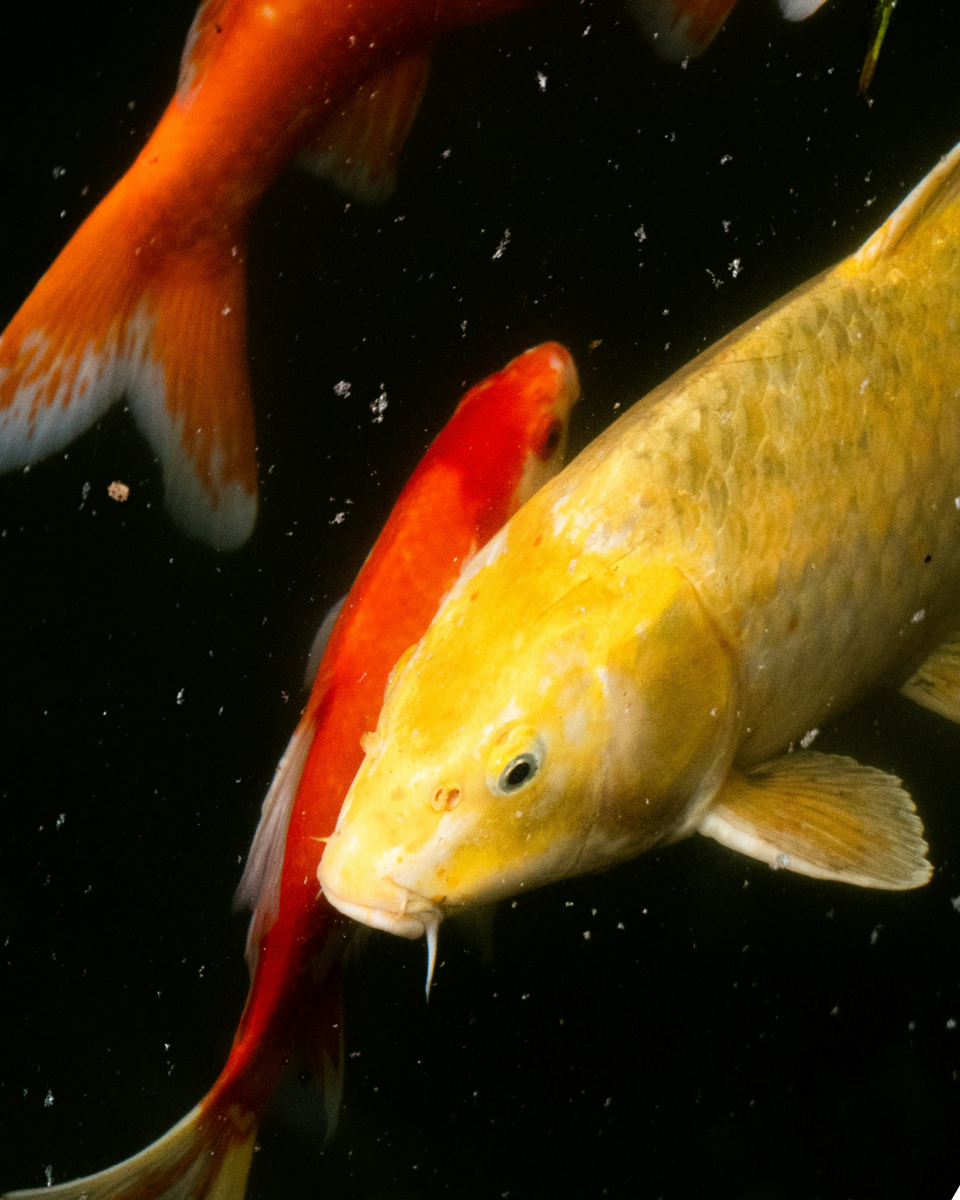
Photo by Sergio Li
Cyprinus carpio is a large freshwater cyprinid with exceptional environmental tolerance: temperature range from near freezing to above 30°C, with optimal growth at approximately 23–30°C; salinity tolerance to approximately 5‰; capacity to survive hypoxic conditions that would be lethal to many other freshwater fish. These characteristics underlie carp’s global dominance as a farmed species — it can be produced in a wide range of water bodies and climate zones with minimal infrastructure.
Common carp are omnivorous bottom feeders, utilising aquatic vegetation, detritus, molluscs, insects, and zooplankton; in ponds they forage actively by rooting in substrate. They are socially gregarious, forming loose shoals particularly during feeding and overwintering. Wild carp can live 13–20 years, with some individuals documented at 38–47 years under favourable conditions.
Evidence for teleost sentience and nociception documented in the Salmon and Trout records applies to carp as a similarly structured vertebrate. Carp possess nociceptors and endogenous opioid systems; experimental evidence on carp-specific nociception is less extensive than for salmonids but is consistent with the broader fish welfare consensus. The distinctive finding from 2025 research — that domestication has reduced the chronic cortisol baseline in farmed carp relative to wild conspecifics — does not indicate reduced capacity for acute pain or stress responses; it indicates a modified regulatory set-point that may complicate welfare assessment in farmed populations.
Lifecycle Summary
Common carp is the most produced farmed vertebrate on Earth by mass. FAO data indicate production of approximately 28.8–28.9 million tonnes of farmed common carp in 2015–2018, representing approximately 37–38% of total global aquaculture production at that time. At an estimated average harvest weight of approximately 1–2 kg, this implies approximately 15–29 billion individual common carp slaughtered annually — the highest individual kill count of any farmed vertebrate in this database by a substantial margin. China accounts for the overwhelming majority of global production; India, Bangladesh, Myanmar, and Indonesia are the next largest producers.
Despite this scale, common carp occupies a structurally anomalous position in global food systems and welfare governance: it is produced in enormous quantities, primarily for domestic Asian and Central/Eastern European markets with limited export trade, and receives substantially less regulatory attention and welfare research investment than salmon, trout, or tilapia, which are produced in far smaller volumes but are more present in high-income export markets.
A 2025 peer-reviewed study documented that domesticated carp show significantly lower chronic cortisol levels in scales compared with wild carp — direct evidence that selective breeding over generations has physiologically altered the hypothalamic-pituitary-interrenal stress axis. This is a structurally significant finding: the production system has modified the species’ own stress response through selective pressure, with implications for welfare assessment that apply uniquely to carp in this database.
Lifespan (Natural vs Exploited)
Wild C. carpio: typical lifespan 13–20 years; some wild individuals documented at 38–47 years under low-predation, stable conditions; these extreme maximum figures are from single specimens and should be treated as upper bounds rather than typical wild longevity.
Farmed carp: most market-sized fish are slaughtered after 1–4 growing seasons (approximately 1–4 years) at target weights of 0.5–6 kg depending on market and system. In temperate European systems, fish reach approximately 250–600 g after 1–2 seasons; in tropical systems growth is faster. Extensive polyculture and rice-fish integrated systems may carry fish for several years. Maximum slaughter age in commercial systems is typically below 10 years.
Primary causes of mortality in production: disease events (Spring Viraemia of Carp, Koi Herpesvirus disease, bacterial and parasitic infections), poor water quality including hypoxia from overstocking, and handling and transport stress pre-harvest.
Exploitation Systems
Common carp exploitation operates almost entirely through freshwater aquaculture, across a broader range of production system types than any other farmed fish in this database.
Extensive pond polyculture. The historically dominant and numerically largest system by pond area globally. Earth ponds with muddy bottom, shallow depth (typically 1–2 m), eutrophic water, and low stocking density. Carp are frequently co-farmed with grass carp, silver carp, bighead carp, and crucian carp in Chinese polyculture systems that exploit different trophic niches simultaneously — an ecological efficiency strategy with no equivalent in other farmed fish records. In this system, carp utilise benthic and pelagic foraging zones with access to natural food sources; the system relies on natural pond productivity with minimal supplementary inputs.
Semi-intensive and intensive ponds. Higher stocking densities with supplementary feeds — agricultural by-products, cereals, compounded pellets — and active aeration and water management. Semi-intensive systems use manure or fertiliser to maintain plankton productivity alongside supplementary feeding. Intensive monoculture ponds using compounded pellet feeds dominate in higher-output commercial operations.
Integrated agriculture-aquaculture systems. A structurally distinctive feature of carp production with no parallel in other records: carp-rice, carp-duck, carp-poultry, and sequential fish-crop-legume-rice rotation systems where carp utilise manure from adjacent livestock as pond fertiliser, consume pest insects, and in turn provide nutrient-rich water for crop irrigation. These circular production systems are particularly significant in China and Southeast Asia and represent one of the oldest integrated land-use systems in agricultural history.
Cage and net-pen systems. Common carp reared in floating cages in reservoirs, lakes, and irrigation structures; standard in parts of Asia where suitable water bodies are available for cage installation. Higher biomass densities than open pond systems; exposure to ambient water conditions but local water quality effects around cages.
Recirculating aquaculture systems (RAS). High-density, land-based closed systems with controlled water quality; used for some intensive carp production in higher-income contexts. Small-scale relative to pond production globally.
Aquaculture-based fisheries. Fingerlings stocked into reservoirs, rivers, and lakes to support recreational and subsistence capture fisheries; common in parts of Europe and Asia. In this system, carp are produced in hatcheries and released into open water, with harvest occurring through angling or commercial netting rather than farm-site slaughter.
By-product streams. Processing generates fishmeal and oil from waste fractions; offal, bones, and carcass remains used in fertiliser and animal feed. Whole fish dominates retail in Asia and Central/Eastern Europe; filleting and value-added products are a smaller proportion of total production relative to salmon or tuna.
Living Conditions Across Systems
Extensive ponds: stocking at approximately 200,000 fry per hectare during nursery, with final densities for market-sized fish much lower and governed by pond productivity. Fish have access to natural substrate, benthic foraging zones, and variable pond structure; water quality fluctuates naturally.
Semi-intensive ponds: supplemental feeding and partial water exchange support higher densities; welfare literature notes that crowding, low dissolved oxygen, and poor waste management in more intensive configurations increase disease susceptibility and chronic stress.
Intensive ponds: 4,000–6,000 fish per hectare with cereal feeds; up to approximately 20,000 per hectare with compounded pellets. Cage systems: high stocking densities in confined volumes; specific density figures vary by cage type and producer; overcrowding-related stress and disease risk are documented.
Environmental conditions across all open system types are determined by ambient weather, seasonal temperature cycles, and natural light; fish are not maintained under controlled environmental conditions as in RAS or indoor aquaculture. Behavioural deprivation in extensive systems is substantially lower than in intensive cage or tank systems; the welfare profile is more complex across systems than for monoculture species like Atlantic salmon.
The finding that domesticated carp have lower chronic cortisol baselines than wild carp applies across captive system types; this modification may reduce some indicators of chronic stress relative to wild-derived comparisons while not eliminating acute pain and fear responses during handling, transport, and slaughter.
Lifecycle Under Exploitation
Genetic Selection
Selective Breeding programmes across approximately 30–35 domesticated European strains and multiple Chinese domesticated races target growth rate, feed conversion efficiency, disease resistance, and body conformation for market purposes. Selection has been ongoing for centuries in European carp culture; Chinese carp domestication predates European selective programmes significantly. The cumulative effect of multi-generational selection includes documented changes to stress physiology, body morphology, and pigmentation distinguishing farmed from wild forms.
Reproduction
Two primary reproductive approaches: natural pond spawning on aquatic weeds or submerged vegetation in shallow dedicated spawning ponds, with fry collected after approximately 4–5 days; and hatchery-based artificial reproduction involving broodstock conditioning, hormonal induction using pituitary extracts or GnRH analogues with dopamine antagonists, dry-method fertilisation, and incubation in Zoug-type upwelling jars. Reproductive Cycle Manipulation via temperature and photoperiod management extends spawning season in some operations. Hormonal induction is widely used in Central/Eastern European and Asian hatcheries to control spawning timing and increase egg yield per broodstock female.
Birth & Early Life
Nursery ponds are stocked at up to approximately 100–400 fry per m²; fry feed on zooplankton-based nursery pond productivity and supplementary meals for 3–4 weeks, yielding approximately 0.2–0.5 g fry. Tank-based nursing at hundreds of fry per m² with intensive feeding and aeration is used where predation pressure is high. Hatchery Incubation in Zoug jars under controlled flow and temperature conditions is standard in managed hatcheries.
Growth & Rearing
Fingerling production at 50,000–200,000 nursed fry per hectare in temperate polyculture systems, with survival rates of approximately 40–50%. Ongrowing at 4,000–6,000 fish per hectare with cereal-based feeding or up to approximately 20,000 fish per hectare with compounded pellet feeds. Growth Acceleration through high-protein formulated feeds and selective genetics drives faster attainment of market weight than natural growth trajectories.
Production
Fish are fed at approximately 2–4% of body weight per day in managed systems. Market size in temperate European systems is typically approximately 250–600 g after 1–2 growing seasons; in Chinese and tropical systems, larger sizes of 1–3 kg or more may be targeted. Broodstock operations run in parallel with grow-out to supply fry for subsequent cohorts.
Transport
Live transport in aerated tanks with fish-to-water ratios of approximately 1:2; duration up to several hours for domestic market delivery. Transport in crowded, aerated containers is the standard for live fish markets in Asia and Central/Eastern Europe — a defining feature of the carp supply chain absent for most export-oriented farmed fish species. Elevated stress markers are documented post-transport.
End of Life
Most carp reach end-of-life through farm harvest; a proportion through aquaculture-based fishery capture. Stocking of open waters for recreational fisheries creates a population of fish killed by angling — catch-and-release in some contexts, consumption-oriented in others — which is outside the primary scope of this record.
Processing
Post-slaughter: bleeding, gutting, scaling, and preparation as whole fish or fillets. Whole fish dominates in Asian and Central/Eastern European retail and live-market contexts. Value-added processing — fillets, smoked carp, carp roe — is a smaller proportion relative to whole-fish trade.
Chemical Medical Interventions
Antimicrobials used in carp culture include oxytetracycline, furazolidone (now banned in EU and many markets), neomycin, and sulphonamides, applied in feed or via bath treatments. Use varies substantially by jurisdiction and is increasingly restricted in European and regulatory-advanced markets; reliance on antibiotics remains higher in some Asian production contexts with less stringent oversight.
Chemical disinfectants and parasiticides include formalin (water bath), copper sulphate (blue vitriol), potassium permanganate, and organophosphates including trichlorfon (Neguvon/Dipterex) and Malathion for ecto- and endoparasite control. Malachite green — highly effective against a broad range of fungal and ectoparasite conditions — is restricted or banned in the EU and many other markets due to carcinogenicity concerns; it continues to be used illegally or informally in some producing regions, representing a food safety and regulatory compliance issue.
Praziquantel is used for endoparasite control (tapeworms, flukes) in farmed and ornamental carp.
Vaccines are recommended for Spring Viraemia of Carp (SVC) and Koi Herpesvirus disease (KHVd) in high-risk production contexts; vaccine development programmes for carp pox and other viral diseases are ongoing. Vaccination uptake in carp aquaculture is lower than in salmon production, partly because the low unit value of carp relative to the cost of vaccination makes population-level prevention economics different.
Hormonal induction for spawning uses pituitary extract from hypophysated donor carp (requiring sacrifice of donor fish), or synthetic GnRH analogues combined with dopamine antagonists. The use of pituitary extract — which requires harvesting pituitary glands from sacrificed donor fish — is a species-specific veterinary procedure not documented for any other farmed fish in this database.
Regulatory variation: the EU bans malachite green for food fish and tightly restricts antibiotic classes; GnRH analogues are licensed veterinary products in EU member states. Many Asian producing countries have less comprehensive regulatory coverage of veterinary drug use in aquaculture, with monitoring reliant substantially on self-reported compliance.
Slaughter Processes
Slaughter methods for common carp in commercial production are more specifically documented in European data than for any other major farmed fish outside salmonids.
A peer-reviewed European field survey (PMC, 2018) found: approximately 18% of farms use only percussive stunning; approximately 23% use only electrical stunning; approximately 59% use electrical-then-percussive combination. Of carp stunned by electrical-then-percussive combination, 92.6% showed no signs of consciousness, indicating the combination method as the most effective documented approach. This is the most specific stun-efficacy dataset for any farmed fish species outside salmonids in the database.
Percussive stunning uses club or hammer blows to the cranial vault; mishits that strike the skull without reaching the brain require re-stunning. Electrical stunning in water bath applies defined current parameters; carp-specific electrical parameters for reliable unconsciousness induction have been studied but are not universally standardised.
Ice slurry and asphyxia (exposure to air) are also practised, particularly in smaller operations and for live market fish; these methods are classified by current welfare guidance as poor welfare outcomes due to prolonged conscious periods.
Gill-cut exsanguination is standard post-stun kill; live carp are sometimes sold in markets and killed by the consumer, a cultural practice particularly common in Central Europe for Christmas carp traditions.
No religious slaughter framework applies specifically to carp.
Slaughterhouse Labour Impact
No large-scale, carp-specific occupational health dataset exists. European fish-processing facilities handling carp report common hazards including repetitive motion injury, cold environment exposure, and cut and puncture injuries from handling large fish and sharp processing tools. Psychological stress is associated with high-throughput, monotonous kill-and-processing lines, consistent with other food animal processing sectors.
The live market trade for carp — in which fish are sold alive to consumers who kill them at home or in market facilities — distributes the kill event away from professional processing workers, creating a consumer-level killing context unique in this database for a farmed species at commercial scale.
Workforce demographics in major Asian producing and processing countries include significant proportions of rural and migrant workers in both pond operation and processing; species-specific data are not available.
Scale & Prevalence
Global aquaculture production of Cyprinus carpio: approximately 28.8 million tonnes in 2015 and approximately 28.9 million tonnes in 2018, representing approximately 37–38% of total global finfish aquaculture by volume. Common carp is the most produced farmed vertebrate on Earth by mass. China accounts for the overwhelming majority of global production; India, Bangladesh, Myanmar, and Indonesia are the next largest producers in descending order. Europe produces carp primarily for domestic markets and recreational stocking, with limited intra-EU trade and minimal global export.
Individual count estimate: at 28.9 million tonnes and an estimated average harvest weight of approximately 1 kg, approximately 29 billion individual common carp are slaughtered annually; at 2 kg average, approximately 14.5 billion. Both figures represent the highest individual vertebrate kill count associated with any single farmed species in this database, exceeding even chickens in total production mass and likely in individual numbers depending on average weight assumptions.
Production has stabilised or grown slowly in recent decades; FAO notes that the primary growth has been in Asian systems with limited export trade expansion. The majority of production serves domestic food security and regional markets rather than international commodity flows.
Recreational fisheries using hatchery-stocked carp are significant in Europe, where carp are the primary recreational angling target species in many countries.
Ecological Impact
Common carp introduced to non-native freshwater systems in Australia and North America constitute a major freshwater invasive species. In Australia’s Murray-Darling Basin, carp are estimated to constitute a significant proportion of total river fish biomass; their foraging behaviour — bottom-rooting and sediment disturbance — increases water turbidity, reduces aquatic macrophyte cover, and degrades spawning habitat for native fish species that require clean gravel or aquatic vegetation for reproduction. Clean Lakes Alliance and PestSmart documentation confirms that carp can dominate biomass in impacted rivers and alter fish assemblage composition over time.
The Australian Department of Agriculture’s Carp Biological Control Program has investigated the deliberate release of Cyprinid herpesvirus 3 (CyHV-3 — Koi Herpesvirus) as a biocontrol agent for invasive carp in Australian waterways. This proposed development represents a policy decision of unusual complexity: deliberate release of a pathogen to cause mass disease-mediated mortality in invasive carp would reduce a documented ecological exploitation (wild invasive carp as an unmanaged population impacting native ecosystems) while raising substantial concerns about the welfare of billions of individual fish dying of viral disease, potential non-target impacts on other fish species, and irreversibility of pathogen release into open water systems. This development has not been implemented as of the current record date.
Farmed carp pond systems generate nutrient loading from uneaten feed and manure inputs; without adequate effluent management, nitrogen and phosphorus discharge can contribute to eutrophication of receiving waterways. Integrated agriculture-aquaculture systems — carp-rice-duck and related circular systems — are specifically designed to minimise this through nutrient cycling; these systems can reduce external input requirements and associated discharge relative to monoculture.
Koi Herpesvirus (KHVd) — first confirmed in European carp in 1996–1998 and now globally distributed — was spread significantly through the ornamental koi trade before controls were implemented. KHVd causes mortality rates of up to 80–100% in naive populations and is a notifiable disease in many countries; its global distribution through trade is the most significant carp disease event in the aquaculture record.
Language & Abstraction
Common carp’s position as the world’s most produced farmed vertebrate exists with minimal public visibility in high-income countries. In Western European and North American food systems, carp is an afterthought of fish culture — associated with invasive species management, Christmas tradition in Central Europe, and recreational angling — rather than a prominent food animal. The industry producing more farmed vertebrate mass than any other operates largely outside the welfare and sustainability discourse that surrounds salmon, tuna, and tilapia in high-income export markets.
“Biomass producers” and “feed-converting machines” are documented framings in aquaculture and policy documents for carp; these terms foreground the input-output relationship of intensive production while backgrounding the biological and welfare characteristics of the animal. The same abstraction operates for all farmed fish through “biomass” and “mortality rate” metrics, but carp’s status as a low-unit-value, high-volume, domestically consumed species means the framing is less contested than for higher-profile export species.
Integrated agriculture-aquaculture terminology — “carp-duck system,” “fish-rice rotation,” “combined livestock-fish farming” — describes production relationships at the system level, with individual animals positioned as components of a nutrient-cycling network. The individual carp’s welfare experience within the system is structurally absent from this framing, even as these systems are promoted in development literature as environmentally progressive.
“Christmas carp” in Central European cultural contexts — the tradition of purchasing a live carp for home slaughter at Christmas — positions carp as a culturally significant food animal whose killing occurs in domestic rather than industrial settings. The consumer-performed kill is simultaneously a cultural practice and a welfare event; it distributes the killing responsibility into household contexts without the professional training or equipment that characterises slaughterhouse practice. This is structurally unique in this database: a farmed species where a significant fraction of slaughter is performed by consumers rather than processing workers.
“Stocking” as a term for releasing hatchery-produced fingerlings into open water systems frames deliberate introduction of domesticated fish as fisheries management rather than as a form of exploitation; “enhancement” and “aquaculture-based fisheries” describe the same practice in neutral management terminology that elides the production system, the selective breeding, and the subsequent kill event.
Terminology
Common carp, Cyprinus carpio, domesticated carp, carp strain, broodstock, spawn, egg, fry, fingerling, one-year-old carp, market-sized carp, pond-raised carp, cage-grown carp, intensive carp, semi-intensive carp, polyculture carp, integrated carp, bio-carp, organic carp, slaughter carp, filleted carp, smoked carp, carp fillet, carp steak, carp roe, carp-based feed, carp by-products, aquaculture carp, wild-stocked carp, recreational carp, angling carp, koi carp, ornamental carp.
Within The System
Developments
Report a development: contact@systemicexploitation.org
Notice an inaccuracy or omission?
If you believe information on this page is incorrect, incomplete, or missing important context, you may submit a suggested correction for review.