
Chinchillas
Scientific Name:
Chinchilla lanigera
Scope
Covers the genus Chinchilla across populations subject to exploitation systems. Commercial fur farming, companion animal breeding, laboratory, and zoo populations are almost exclusively derived from domesticated Chinchilla lanigera (long-tailed chinchilla) lines. Chinchilla chinchilla (short-tailed chinchilla) is a critically endangered wild species not used in commercial production and is excluded except where referenced as a wild comparator. Includes intensive cage-based fur farms, small-scale and backyard fur operations, companion animal breeding and trade, laboratory and biomedical research use, and zoo and educational display. Excludes non-commercial wild populations and conservation-only breeding programmes.
Species Context
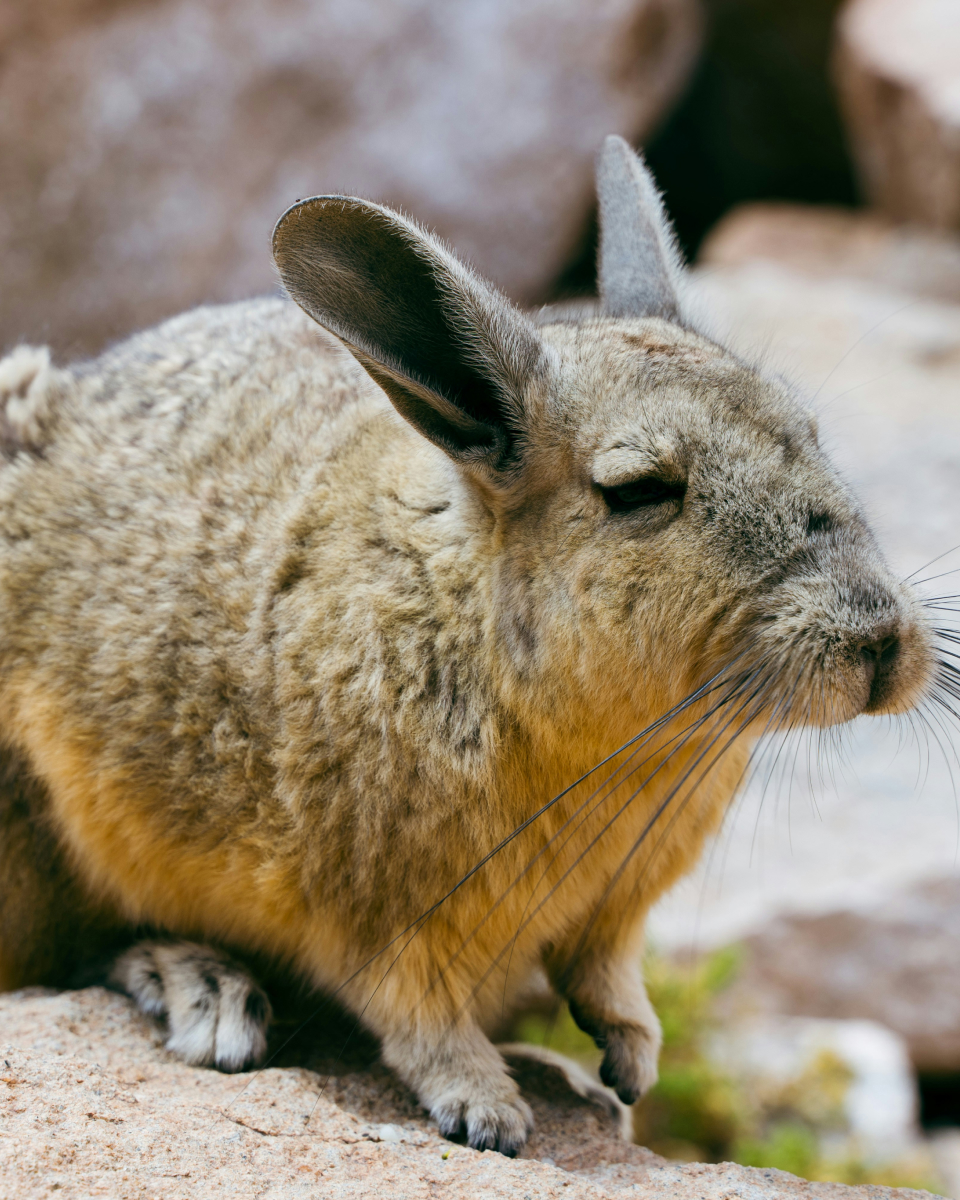
Photo by Mark Kuiper
Chinchillas are medium-sized hystricomorph rodents, adapted to cool, semi-arid Andean rocky slopes at 3,000–5,000 m elevation. Adult body mass in captivity is typically 400–800 g. They are crepuscular to nocturnal, with strong jumping and climbing ability, reliance on rock crevices and burrows as refuge, and a requirement for regular dust-bathing to maintain fur and skin condition. Heat stress and high humidity are significant morbidity risk factors — conditions above approximately 25°C are associated with heat stroke, and high humidity with fungal skin disease.
Wild chinchillas form colonies with smaller family groups. Captive recommendations advise compatible pair or small group housing, as solitary housing is associated with elevated stress indicators. Chronic stress in farmed and laboratory chinchillas is associated with stereotypic behaviours including bar-gnawing, pacing, and fur-chewing, and with reproductive problems. As prey species, behavioural stress responses include freezing, flight, and hiding.
Chinchillas are used extensively in auditory, vestibular, and otitis media research due to their large bullae and accessible middle ear anatomy, implying well-developed sensory processing capacities. Captive chinchillas demonstrate place preferences, environmental preferences, and operant learning, consistent with standard scientific assumptions of mammalian sentience and basic cognitive capacities. Research on rodent cognition broadly supports nociception, aversive learning, and affective state processing in this taxon.
Lifecycle Summary
Chinchilla exploitation operates across four systems: fur farming (primary), companion animal trade, laboratory and biomedical research, and zoo display. Fur farming is the dominant commercial system and the context for most population-scale mortality. Commercial fur farm animals are killed at approximately 8–12 months of age when pelt quality reaches target values. Breeding stock may be retained longer but are culled when reproductive performance declines. The global chinchilla fur industry is in marked contraction: legal bans and declining demand have eliminated chinchilla farming across most of Europe, and the few remaining producing countries are subject to ongoing phase-out legislation. Romania, one of the last significant European producers, legislated a phase-out with approximately 15,000 chinchillas remaining on farms as of late 2024. No industrial food processing chain exists — carcasses are disposal outputs. The companion animal and laboratory systems involve live animals maintained for different purposes, with end-of-life pathways of veterinary euthanasia rather than commercial slaughter.
Lifespan (Natural vs Exploited)
Wild chinchillas have a reported potential lifespan of up to approximately 10–11 years, though documented maximum in wild field studies is approximately 6 years.
In zoo and research colonies, average recorded lifespan is approximately 4 years, with documented maximum of 7 years; exceptional experimental colony individuals have reached 15 years.
In companion settings, husbandry literature cites typical lifespans of 8–10 years, with some individuals reaching 15–20 years under optimal care.
In fur farming, animals are killed at approximately 8–12 months of age for pelt production. Breeding stock may be maintained for multiple years but are culled when productivity declines. No centralised quantitative lifespan data from commercial farms are available in accessible literature.
In laboratory use, lifespan is determined by study design; most auditory and otitis media studies use animals at 3–12 months and euthanise at protocol end.
Primary mortality causes under exploitation include infectious disease — notably Pseudomonas aeruginosa outbreaks on fur ranches and in laboratory colonies — gastrointestinal disorders including enteritis, bloat, and diarrhoea, dental malocclusion, heat stroke, trauma, and perinatal losses.
Exploitation Systems
Chinchilla exploitation operates across four systems.
Fur farming. The primary commercial system. Domesticated C. lanigera lines are maintained in wire-mesh cage systems for pelt production. System types range from intensive cage farms with rows of individual or paired cages in dedicated sheds, to small-scale backyard operations. The chinchilla fur industry is in advanced contraction globally: legal bans have eliminated farming across most of Western and Northern Europe, and remaining producers are concentrated in a shrinking set of countries including Poland, Hungary, and parts of South America. Romania legislated a phase-out, with a 2024 Four Paws assessment estimating approximately 15,000 chinchillas remaining on farms pending implementation by 2027. Global pelt volume is not systematically reported in FAO or major industry statistics, which aggregate chinchillas into “other fur animals” dominated by mink, fox, and raccoon dog figures.
Companion animal trade. Breeding of domesticated chinchillas for sale as pets through breeders, pet shops, and online markets. Selection targets coat colour morphs — white, beige, black velvet, and others — and temperament. This system operates at small to medium scale globally and is not systematically quantified.
Laboratory and biomedical research. Chinchillas are used as experimental models for otitis media, auditory and vestibular research, and respiratory disease vaccine testing — including pathogens such as Moraxella catarrhalis and Streptococcus pneumoniae. Their large bullae and accessible middle ear anatomy make them the preferred model for middle ear infection research. Biological samples — middle ear tissues, respiratory mucosa, blood — are collected post-mortem for histological and molecular analysis, contributing data to human vaccine development. Laboratory use involves individual or pair housing in barrier or SPF conditions under institutional animal care frameworks.
Zoo and educational display. Chinchillas are kept in zoo collections and educational facilities as representative Andean rodents. Scale and population are not systematically reported.
Living Conditions Across Systems
Fur farm cage systems. Standard commercial housing uses individual or pair wire-mesh cages. Documented cage dimensions vary significantly by country and operator standard. Commonly reported farm cage size is approximately 50 × 50 × 50 cm; Polish breeders’ association minimum is 0.40 × 0.45 × 0.34 m; Canadian industry guidelines reference approximately 0.04 m³ per animal. In contrast, the German Veterinary Association recommends group housing systems of at least 3 m³ for two animals plus 0.5 m³ per additional animal, and Council of Europe recommendations specify a minimum 0.50 m³ per individual — substantially larger than common farm provision. This range reveals significant divergence between national standards and between industry practice and independent welfare guidance.
Cages are commonly barren with wire floors, a nest box or shelter, feeder, and nipple drinker. Dust baths are typically provided intermittently — daily or several times per week — primarily to protect fur quality rather than as a welfare provision. Social grouping in fur systems uses singly housed adults or pairs; breeding configurations use polygynous harems with one male connected to several female cages.
The sensory environment in fur farm sheds involves artificial lighting, variable noise from ventilation and machinery, and restricted opportunity for the jumping and climbing behaviours central to the species’ natural repertoire. EFSA’s fur animal welfare review identifies persistent welfare problems in chinchillas on fur farms related to confinement, lack of environmental complexity, injuries, and stereotypic behaviours.
Companion and pet housing. Pet care recommendations advise multi-level enclosures over 1 m in height with solid resting platforms, hiding places, exercise wheels, and daily dust baths. Social housing in compatible pairs is recommended where feasible. Temperature must be maintained below approximately 25°C to prevent heat stress.
Laboratory housing. Individually or pair-housed in solid-bottom or wire-bottom cages with bedding and nesting material, under controlled temperature (approximately 18–22°C), humidity, and light-dark cycles consistent with laboratory rodent standards.
Lifecycle Under Exploitation
Genetic Selection
In fur farming, Selective Breeding targets high-density, long, uniform fur, specific coat colours, and reproductive performance within closed lines derived from a limited founder population — all C. lanigera founder animals entered farming from a single Chilean importation in the early twentieth century. In the companion animal sector, selection targets colour morphs and temperament, with some crossover from former fur lines. In laboratory use, selection prioritises health status and suitability for experimental protocols, including ear anatomy and susceptibility to otitis media, sometimes using outbred stocks.
Reproduction
Sexual maturity occurs at 7–10 months; breeding on fur farms typically begins at 8–12 months. Fur farm breeding uses polygynous harems — one male accessing several females in adjacent connected cages — or monogamous pairs, timed to produce pelts ready for target market seasons. Gestation is approximately 111 days, producing litters of 1–3 precocial young, fully furred and with eyes open at birth. Companion breeders use smaller-scale pair or harem systems, often limiting litters per female per year.
Birth & Early Life
Kits are precocial and remain with the dam; weaning occurs at approximately 6–8 weeks. Perinatal mortality on fur farms is linked to dystocia, maternal neglect, and infectious disease. Post-weaning kits are moved to individual or pair cages on fur farms; juveniles sold into the pet trade are typically transferred at 8–12 weeks.
Growth & Rearing
Fur farm animals grow on commercial pelleted feeds formulated for chinchillas or other fur rodents, supplemented with hay and water via nipple drinkers. Growth is managed to reach target pelt quality and size at approximately 8–12 months. Pet trade juveniles continue growth in home settings; laboratory animals are reared under barrier or SPF conditions with standardised diets and health monitoring.
Production
In fur farming, the productive phase consists of coat development through the first autumn and winter. There is no ongoing product extraction — no milking, no egg collection, no fibre harvesting. Animals are killed when pelt quality and size reach commercial target values. In laboratory systems, production consists of participation in experimental procedures — infection, surgery, auditory testing — and provision of biological samples. In the companion animal sector, production consists of breeding and sale of live animals; does may be bred repeatedly until reproductive output declines.
Transport
Fur farm animals are transported where slaughter occurs at facilities separate from farms, and for export of breeding stock. Transport uses small crates or carriers under national fur animal transport regulations where these exist. Pet trade juveniles are shipped from breeders and wholesalers to retailers and consumers in ventilated carriers. Laboratory animals are shipped between breeding colonies and research institutions under laboratory animal transport standards including temperature control and documentation.
End of Life
On fur farms, animals are killed on-farm using electrocution, CO₂ gassing, or cervical dislocation. Electrocution applies electrodes to the ear and tail or other configurations to induce cardiac arrest and is documented as a method used specifically for chinchillas. CO₂ gassing allows group killing with reduced handling but is associated with aversion and delayed latency to unconsciousness. Cervical dislocation is used for smaller numbers. Quantitative failure-rate data specific to chinchillas are not available; AVMA guidance does not provide chinchilla-specific recommendations for some of these methods, creating practical ambiguity in best-practice standards across producing countries.
In laboratory use, euthanasia follows institutional guidelines using injectable anaesthetic overdose, inhalant anaesthetics, or CO₂ with a secondary method. Pet chinchillas are euthanised via veterinary barbiturate overdose when indicated.
Processing
Chinchilla carcasses are skinned after killing; pelts are cleaned, salted, dried, tanned, and finished before sale to garment manufacturers. Tanning involves chemical processes including chromium compounds and solvents that contribute to local environmental waste streams. Carcasses after skinning are rendered, composted, incinerated, or disposed of as regulated waste; by-product flows from chinchilla carcasses are poorly documented. Laboratory carcasses and tissues are used for further analysis or disposed of as biological waste.
Chemical Medical Interventions
Pseudomonas aeruginosa vaccination is the most distinctive pharmaceutical intervention in chinchilla fur farming. Multicomponent vaccines — containing formalin-killed bacteria, endotoxin-associated proteins, and toxoids — are used on fur ranches to reduce mortality from P. aeruginosa outbreaks, which represent a significant mortality risk in dense cage populations. Immunity is strain-limited and lasts approximately 6–8 months; local injection reactions at the vaccination site are documented.
Antimicrobials used for bacterial infections include fluoroquinolones (enrofloxacin), third-generation cephalosporins, aminoglycosides (gentamicin), and topical polymyxin B, primarily targeting P. aeruginosa. Antiprotozoals and anthelmintics including metronidazole, albendazole, and fenbendazole are used for giardiasis and intestinal parasites.
Standard pet and laboratory care guidelines note that chinchillas do not require routine vaccination programmes; preventive parasite treatments are generally not recommended for pet animals. Practices on fur farms — where disease pressure in dense cage systems is substantially higher — differ accordingly.
Castration of males is performed from approximately 4 months of age to prevent unwanted reproduction or reduce fighting, using standard small mammal surgical protocols. Dental procedures — molar trimming and tooth extraction — are required for dental malocclusion in pet and colony animals; malocclusion is a significant morbidity concern in the species.
No specific authorised growth promoters for chinchillas are described in major veterinary references. Data on off-label hormonal or growth-promoting agent use in fur farming are not available in accessible literature.
Slaughter Processes
Chinchilla killing on fur farms uses three documented methods. Electrocution applies electrodes to the ear and tail — or other configurations — to induce cardiac arrest; it is documented as an efficient method for killing multiple animals and is specifically described for chinchillas in fur production contexts. CO₂ gassing is widely used across fur animal species and permits group killing with reduced individual handling, but welfare literature identifies aversion and latency to unconsciousness under CO₂ as concerns that apply to chinchillas as to other small mammals. Cervical dislocation is used for smaller numbers; some sources note risk of fur damage during the procedure.
AVMA guidelines do not provide chinchilla-specific recommendations for all three methods, and the research literature’s ambiguity about electrocution’s applicability to very small animals creates practical divergence in standards across producing countries. Quantitative failure-rate data specific to chinchilla killing are not available.
Religious slaughter frameworks are not applicable to chinchillas; the species does not enter food supply chains governed by halal or kosher requirements.
Individual farm throughput ranges from a few hundred to a few thousand animals; standardised throughput data per facility are scarce in publicly accessible literature.
Slaughterhouse Labour Impact
Chinchilla-specific occupational health data from fur farm or slaughter operations are not available. Workers in chinchilla fur operations share structural occupational risks with other small animal fur farming: exposure to sharp tools during skinning and processing, repetitive motions in cage maintenance and feeding, cold environments in open-sided farm sheds, bioaerosols and zoonotic pathogens from dense rodent housing, and chemical exposure during pelt tanning. The psychological burden of routine killing and animal handling documented in broader slaughter and fur farm workforce literature applies structurally to this context, though chinchilla-specific data are absent.
Chinchilla farms are typically smaller-scale operations than mink or fox farms. Workforce demographics — including the extent of rural, seasonal, or family labour — are not reported in accessible literature specific to this species.
Scale & Prevalence
Chinchilla fur production is not consistently reported in FAO or major industry global statistics, which focus on mink, fox, and raccoon dog and aggregate chinchillas into “other fur animals.” Country-level data illustrate scale at the national level: Romania reported approximately 30,000 chinchilla pelts annually in 2013, declining to approximately 7,500 in more recent years before a legislative ban decision, with approximately 15,000 animals estimated on Romanian farms as of late 2024 pending a phase-out by 2027. Other European states — including Italy, and several Nordic and Western European countries — have closed their last chinchilla fur farms through broader fur farming bans or market contraction.
Historical production was concentrated in Chile and Argentina in South America and in Poland, Hungary, Romania, and the Baltic and Nordic countries in Europe. Current active production is concentrated in a diminishing number of jurisdictions. Global pelt volumes cannot be reliably quantified from available public sources.
The directional trend is marked contraction: legal bans and declining consumer demand have reduced chinchilla fur farming across Europe, and campaign and policy reports indicate the same trajectory globally. The speed of this contraction distinguishes chinchilla fur from mink or fox, where significant production continues in surviving jurisdictions.
Chinchilla numbers in companion animal, laboratory, and zoo contexts are not systematically reported in any global database.
Ecological Impact
Historic over-exploitation of wild Chinchilla lanigera and C. chinchilla for the international fur trade from the late nineteenth century contributed to severe population declines and near-extinction of wild populations across the Andes. Both species are now listed under CITES and national protections. Farmed populations are geographically separated from remnant wild populations; escaped farm chinchillas have not been identified as establishing feral populations or posing invasive species risks comparable to mink escapes in Europe.
Chinchilla fur farms use predominantly plant-based feeds — commercial pelleted rations and hay — rather than the fishmeal-based diets used in carnivorous fur farming. The persistent organic pollutant contamination pathways documented for mink farms are therefore not a primary concern for chinchilla operations. The main localised environmental concerns are nutrient pollution from manure, ammonia emissions from concentrated cage systems, and chemical waste from pelt processing — particularly chromium compounds and solvents used in tanning.
Greenhouse gas emissions, land use, and water use from chinchilla fur farming are not separately quantified in available literature; they are subsumed into broader fur industry assessments dominated by mink and fox data. The plant-based feed profile suggests a lower direct ecological footprint per pelt from feed production than for carnivorous fur species, but no chinchilla-specific LCA has been published.
Language & Abstraction
Industry and legal texts classify chinchillas under generic categories — “fur animals,” “furbearers,” “small fur-bearing mammals” — grouping them with mink, foxes, and raccoon dogs into a homogeneous production class. This classification obscures species-specific behavioural needs: chinchillas are Andean high-altitude rodents with temperature, humidity, and substrate requirements structurally incompatible with the housing conditions normalised for Northern European carnivore fur species.
“Ranch” and “chinchilla ranch” frame production operations in agricultural pastoral language; “pelting,” “harvest,” and “culling” describe killing and skinning in production-neutral terms that position these as routine management actions rather than killing events. “Breeding stock,” “young stock,” “kits,” and “replacement stock” identify animals by their function and productivity value within a turnover cycle.
Product nomenclature — “chinchilla fur,” “chinchilla pelt,” “natural chinchilla” — dissociates finished goods from production conditions and species identity. Marketing of chinchilla fur as a luxury material references texture and prestige; it does not reference the small-cage confinement, polygynous harem breeding systems, or electrocution killing methods that characterise commercial production.
The wild-farmed species distinction carries a weight in this record that it does not in most others: chinchillas in production are C. lanigera, while C. chinchilla is a critically endangered wild species whose near-extinction was directly caused by the fur trade. Product labels do not distinguish between species or acknowledge this history.
Terminology
Chinchilla, Chinchilla lanigera, Chinchilla chinchilla, fur animal, furbearer, ranch chinchilla, ranch-raised chinchilla, breeding stock, breeder female, breeder male, stud male, harem system, harem cage, kit, young stock, weaner, grower, replacement stock, cull, pelting, pelt, raw pelt, dressed pelt, finished fur, chinchilla coat, chinchilla trim, fur garment, fur accessory, ranch, fur farm, chinchilla ranch, cage block, production unit, stock density, breeding season, kindling, harvest, culling, slaughter, dispatch, euthanasia, electrocution, CO₂ gassing, cervical dislocation, transport crate, holding cage, experimental animal, laboratory chinchilla, model animal.
Within The System
Developments
Report a development: contact@systemicexploitation.org
Notice an inaccuracy or omission?
If you believe information on this page is incorrect, incomplete, or missing important context, you may submit a suggested correction for review.