
Buffalo
Scientific Name:
Bubalus bubalis
Scope
Covers domestic water buffalo (Bubalus bubalis) in all major exploitation systems: dairy production, meat production, draft and traction work, and hide and leather production. Includes both primary subtypes: river buffalo (breeds including Murrah, Nili-Ravi, Surti, Jafarabadi, Mediterranean/Italian) which dominate intensive dairy and meat systems in South Asia, the Middle East, and Europe; and swamp buffalo which are used primarily in extensive mixed crop-livestock and draft systems in Southeast Asia and southern China. Excludes wild Asian water buffalo (Bubalus arnee) except where they enter slaughter chains; African wild buffalo (Syncerus caffer); North American bison (Bison bison); and feral buffalo populations (e.g. northern Australia) except where managed for commercial slaughter. Taxonomic note: “buffalo” in this record refers exclusively to Bubalus bubalis; North American usage of “buffalo” for bison is a misnomer and outside this record’s scope.
Species Context
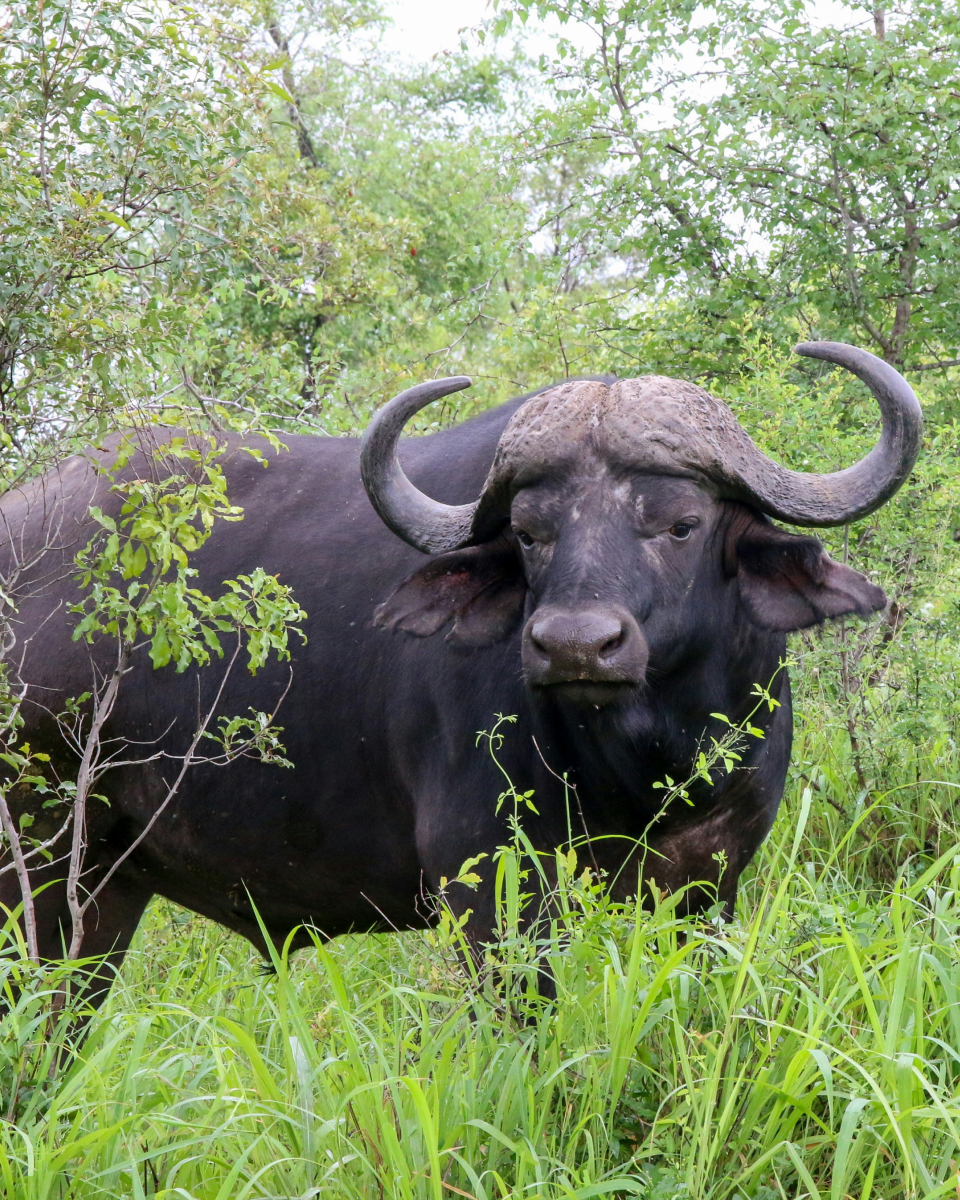
Photo by Glen Carrie
Bubalus bubalis is a large ruminant (adult body mass approximately 400–700 kg in females, 600–1,000+ kg in males depending on breed and system) with two anatomically and ecologically distinct domestic forms. River buffalo are morphologically closer to the wild ancestor, with a more curved horn set, and are adapted to river and lowland environments across South Asia and the Mediterranean. Swamp buffalo are stockier, with swept-back horns, and are adapted to flooded paddies and swamp environments in Southeast Asia and southern China.
Social behaviour is gregarious; buffalo form stable social groups with dominance hierarchies and express strong affiliative behaviour and social buffering comparable to cattle. A species-specific thermoregulatory need distinguishes buffalo from cattle: buffalo have lower sweat gland density than cattle and rely heavily on wallowing in mud or water for thermoregulation and ectoparasite control. Performance indicators — milk yield, feed intake, reproductive function — and physiological stress markers (cortisol, respiration rate) deteriorate significantly under high ambient temperatures without shade, water immersion, or effective cooling infrastructure. This requirement is incompletely met by shower and sprinkler systems that substitute for wallows in intensive dairy facilities.
Studies on space allowance in intensive housing document increased cortisol, restlessness, reduced lying time, and elevated aggression at higher stocking densities, consistent with crowding stress. Welfare reviews conclude that intensive buffalo housing designs transposed from cattle systems without species-specific adaptation frequently compromise these thermoregulatory and behavioural needs.
Water buffalo are sentient mammals. They demonstrate individual recognition, memory for handling experiences and handlers, and conditioning to management routines. OIE and EU animal welfare frameworks treat buffalo cognitive-affective capacities as comparable to cattle; scientific consensus on vertebrate sentience applies fully.
Lifecycle Summary
The global domestic water buffalo population is approximately 200–205 million head, making it the fifth most numerous domestic animal globally after cattle, sheep, goats, and pigs. More than 96% of the global population is in Asia; India holds over half the world total. Buffalo produce approximately 15% of the world’s milk supply despite comprising a smaller share of global ruminant populations than cattle, reflecting their high milk fat content (7–9% compared to approximately 3.5% in Holstein cattle) and the importance of buffalo dairy to South Asian food systems. India accounts for approximately 71.9% of global buffalo milk production and Pakistan approximately 22%.
Buffalo’s structural position in this database is as a secondary bovid record alongside Cows (*Bos taurus / Bos indicus*). Exploitation systems — dairy, meat, draft, hides — are analogous to those documented in the Cows record but with species-specific characteristics that distinguish the two records: the wallowing requirement for thermoregulation that intensive housing systems often fail to meet; the swamp buffalo’s integration into flooded rice paddy agriculture; mozzarella di bufala as the highest-profile buffalo dairy product in global commerce; and exogenous oxytocin injection — documented specifically for South Asian buffalo dairy systems — as a welfare-significant pharmaceutical intervention not documented at equivalent scale in the Cows record.
Lifespan (Natural vs Exploited)
Under low-intensity conditions, water buffalo can reach 20–25 years, with productive lifespans of 15–18 years documented in traditional smallholder systems.
Intensive dairy buffalo: culled commonly at 8–12 years following productive decline, reproductive failure, mastitis, or lameness — a pattern approximating high-yield dairy cattle culling dynamics. High-producing herds may cull earlier.
Meat and fattening systems: male calves raised specifically for meat in semi-intensive or feedlot systems are typically slaughtered at 18–30 months at target liveweight; surplus male dairy calves in some systems may be slaughtered younger or sold into low-input fattening operations.
Draft and mixed-purpose animals in extensive smallholder systems: may remain in work until 15–20 years before slaughter at advanced age; older cull draft animals have low carcass yield and enter lower-value meat chains.
Primary causes of production mortality: mastitis, lameness, reproductive failure, gastrointestinal and respiratory disease, heat stress-related conditions, and dystocia — consistent with high-productivity bovid production across systems.
Exploitation Systems
Buffalo exploitation operates across four primary systems, frequently overlapping in the same animal and the same household economy.
Dairy production. River buffalo are the dominant dairy animal in South Asia and the primary source of buffalo milk for global trade. India and Pakistan together account for approximately 94% of global buffalo milk production. Products include fluid milk for direct consumption, ghee (clarified butter — a staple in South Asian cooking), yogurt, and processed milk powders. In Italy, the protected designation of origin product mozzarella di bufala Campana — produced exclusively from Italian buffalo milk in Campania and adjacent regions under EU PDO regulation — constitutes the highest-value and most internationally recognised buffalo dairy product globally. Buffalo milk has higher fat (7–9%), protein (4–5%), and total solids content than cattle milk; this composition is technically superior for cheese and ghee manufacture but produces lower volumetric yield per animal than high-yield cattle breeds.
Buffalo dairy systems range from family smallholders (2–10 animals, hand-milked, primarily subsistence and local market) to peri-urban semi-intensive herds (50–500 animals, mechanical milking, urban milk supply chains) to intensive dairy operations (500+ animals, automated milking systems, formal value chains). The shift from smallholder to peri-urban intensive systems is ongoing in India, Pakistan, and China.
Meat production. Buffalo meat accounts for a significant fraction of red meat production and consumption in South Asia and is exported globally under the trade name “carabeef” — a term derived from *carabao*, the Philippine name for swamp buffalo. India is the world’s largest exporter of buffalo meat, shipping predominantly frozen boneless cuts to markets in Southeast Asia, the Middle East, and parts of Africa. The “carabeef” designation enables buffalo meat to enter markets where “beef” has religious or cultural restrictions or where price differential from cattle beef is commercially significant.
The meat system is structurally linked to dairy: culled dairy buffalo — does at end of productive life and surplus male dairy calves — constitute a substantial proportion of buffalo slaughter, with dedicated meat buffalo production as a secondary pathway. Buffalo carcasses also produce hides, bones, blood, and rendered fat directed to downstream processing.
Draft and traction. Swamp buffalo are the defining agricultural animal of lowland rice cultivation systems across Southeast Asia and parts of South Asia, China, and the Pacific. Their use for ploughing flooded rice paddies, carting agricultural produce, and threshing is structurally embedded in smallholder rice-based agriculture. Draft buffalo in these systems may work for 10–20 years before entering slaughter chains at advanced age with low carcass yield; the “retirement” of working buffalo into the food system is a distinctive lifecycle feature of the swamp buffalo system. Mechanisation of Southeast Asian agriculture is progressively reducing draft buffalo numbers in some countries, though the system remains significant in Myanmar, Cambodia, Laos, Thailand, and parts of Vietnam.
Hide and leather by-products. Buffalo hides are processed into leather for footwear, belts, upholstery, and industrial applications. India’s buffalo leather export sector is a major global supplier; hides are a primary commercial output of the slaughter system rather than an incidental by-product. Bones, blood, and rendered fat from slaughter enter animal feed, fertiliser, gelatin production, and industrial applications.
Living Conditions Across Systems
Extensive and family smallholder systems. Grazing on communal or private pasture, crop residues, and rice paddies; access to wallows or canals common but increasingly constrained near urban areas; housing typically simple night enclosures or open sheds with earth floors; herds of 2–20 animals. This system provides the most species-adapted environment but with variable nutrition, disease management, and veterinary access.
Semi-intensive systems. Combination of pasture and stall feeding; buffalo confined for part of the day in open yards or covered pens with concrete floors; tethering still used in some regions for individual management; water access via troughs rather than natural water bodies; wallow access variable. Intermediate between extensive welfare profile and intensive management.
Intensive dairy systems. Free-stall or loose housing barns with concrete floors and cubicles or open pens; mechanised milking parlours or automatic milking systems; wallow access absent, partially replaced by cooling showers and sprinklers; controlled nutrition via total mixed rations. Welfare literature specifically documents that intensive housing designs derived from cattle management do not adequately meet buffalo thermoregulatory and behavioural needs: shower and sprinkler cooling is less effective than immersion for the buffalo thermoregulatory physiology; concrete flooring without adequate management contributes to hoof and leg pathologies; stocking density reduction studies show improved lying time, reduced cortisol, and lower aggression at higher space allowances per animal.
Feedlot and fattening systems. Intensive pen-based systems for buffalo at finishing phase; similar welfare profile to feedlot cattle housing; primarily used for male animals in meat production pathways.
Lifecycle Under Exploitation
Genetic Selection
Selective Breeding programmes for river buffalo target milk yield, milk fat percentage, udder conformation, reproductive efficiency, and disease resistance. National breeding programmes in India (Murrah, Nili-Ravi), Pakistan (Nili-Ravi, Kundi), Italy (Mediterranean breed), and Brazil maintain nucleus herds with performance recording. Artificial insemination using elite bulls is the primary genetic dissemination mechanism; genomic selection tools are being developed to accelerate genetic gain for milk yield and heat tolerance. Crossbreeding between river and swamp buffalo is used in some Southeast Asian and Chinese programmes to combine productivity and adaptability.
Reproduction
Artificial Insemination with chilled or frozen semen from elite bulls is standard in structured dairy systems; conception rates are generally lower than in cattle, driving investment in synchronisation protocols. Reproductive Cycle Manipulation using prostaglandin (PGF2α) injections, progesterone-releasing intravaginal devices (PRID/CIDR), and GnRH analogues manages anoestrus — a particular challenge in buffalo given their pronounced seasonal reproductive pattern in some environments — and enables timed AI. Embryo Transfer and in vitro fertilisation are used in elite breeding herds and research programmes to accelerate genetic gain.
Birth & Early Life
Calving in pens or paddocks; colostrum management is critical but variable in quality across system types. In intensive dairy systems, partial or full calf separation from the dam occurs within hours to days and calves are reared on milk replacer, structurally identical to the Premature Weaning and Separation documented for dairy cattle. In smallholder systems, calves typically suckle the dam, and managed separation occurs later. Surplus male dairy calves — which have limited value in dairy breeds — may be sold early to meat producers, receive lower nutritional priority in resource-constrained contexts, or in some cases killed on-farm.
Growth & Rearing
Dairy replacement heifers reared on milk or milk replacer, then forage and concentrates to first breeding at approximately 18–30 months depending on system. Meat animals reared on grazing (extensive) or cut-and-carry forage and concentrates in semi-intensive or feedlot systems; Growth Acceleration through concentrate-based finishing rations targets market weight and carcass quality. Draft animals in swamp systems managed primarily on crop residues, rice straw, and grazing with minimal concentrate supplementation.
Production
Milk Extraction occurs once or twice daily in smallholder systems and twice to three times daily in intensive operations via hand or mechanical milking. A distinctive feature of buffalo dairy management in South Asia: buffalo milk let-down is strongly conditioned on calf presence or stimulation, leading to widespread use of exogenous oxytocin injection to trigger milk release. This practice — documented in peer-reviewed literature from India — is performed without consistent veterinary oversight at farm level, involves repeated hormone administration, and produces measurable oxytocin residues in milk. Draft animals are worked seasonally in rice agriculture at variable intensity depending on crop calendar; nutrition during work periods is often restricted to agricultural by-products.
Transport
Live Transport between farms, markets, collection centres, and slaughter facilities by truck or tractor. Journey conditions — stocking density, ventilation, duration — are governed by national regulations of highly variable stringency; enforcement in informal smallholder-to-market transport chains is limited. Buffalo’s size and stress responses to unfamiliar handling make transport a documented welfare risk event.
End of Life
Dairy and draft cows are culled for reduced productivity, reproductive failure, lameness, chronic disease, or age. Male dairy calves and surplus animals enter meat chains. Slaughter may occur at formal abattoirs, municipal slaughterhouses, or informal facilities depending on jurisdiction and market channel. Selective Culling removes non-productive animals across lifecycle stages. On-Farm Slaughter may occur for animals unfit for transport.
Processing
Carcass dressing, evisceration, primary cutting, and boning; offal separated for food or rendering; hides sent to tanneries for leather production; bones and blood to rendering and fertiliser. Milk processed into pasteurised fluid milk, UHT products, ghee, yogurt, cheese (mozzarella di bufala under EU PDO rules where applicable), and powders. Quality parameters including somatic cell count and bacterial load are applied in formal dairy value chains.
Chemical Medical Interventions
Vaccines against foot-and-mouth disease (FMD), haemorrhagic septicaemia, brucellosis, anthrax, and blackquarter are administered in region-specific schedules, largely paralleling cattle vaccination programmes in each range state.
Antimicrobials are used therapeutically for mastitis, respiratory disease, gastrointestinal infections, and post-surgical prophylaxis; classes include beta-lactams, tetracyclines, sulphonamides, macrolides, and aminoglycosides. Growth-promoting antibiotic use is banned in the EU; in some South Asian and Southeast Asian producing countries, regulation and enforcement are less stringent. Antimicrobial resistance in buffalo production systems is a documented and growing concern in the peer-reviewed literature.
Oxytocin injection is a species-specific intervention documented at scale in Indian buffalo dairy systems and not equivalently documented in the Cows record. Buffalo milk ejection is strongly conditioned on calf presence; in systems where calves are separated or restricted, exogenous oxytocin (0.5–1 IU IV or IM at milking) is administered to trigger milk let-down. Studies have measured oxytocin residues in milk from treated animals and examined residue persistence through pasteurisation. The practice occurs primarily outside formal veterinary supervision at farm level in smallholder and peri-urban systems. Its use is documented from multiple independent peer-reviewed sources and is not an industry-derived claim.
Reproductive hormones: prostaglandin PGF2α, progesterone-releasing devices (PRID, CIDR), and GnRH analogues are used for oestrus synchronisation and timed AI in intensive dairy systems, consistent with reproductive management practices documented for cattle.
Antiparasitic treatments: anthelmintics (benzimidazoles, macrocyclic lactones) and acaricides (organophosphates, pyrethroids) for endoparasite and ectoparasite control, with particular importance for tick-borne disease management in tropical systems.
Surgical procedures: Dehorning and Disbudding in some production systems to reduce fighting injury risk; Castration of draft and meat males to modify behaviour and growth; caesarean section and dystocia interventions by veterinarians; hoof trimming as routine husbandry.
Slaughter Processes
Buffalo are slaughtered in formal abattoirs and municipal slaughterhouses using methods analogous to cattle slaughter, adapted for the species’ larger skull thickness and body size. Penetrating captive bolt to the frontal or poll region of the skull is the standard stunning method where pre-slaughter stunning is required; correct positioning and cartridge specification require adjustment for buffalo skull geometry relative to cattle. Non-penetrating captive bolt and electrical stunning are used in some contexts.
Buffalo skull thickness and anatomy can affect captive bolt penetration depth and efficacy relative to cattle; guidance documents for buffalo-specific stunning parameters are less widely developed than for cattle. Failure rates requiring repeat stunning are documented for bovines generally; buffalo-specific published failure rate data are sparse, with most slaughter welfare research aggregating cattle and buffalo under “bovines.”
Religious slaughter: halal slaughter of buffalo is practiced without pre-stun in some Muslim-majority countries and in halal supply chains where religious authorities have not accepted reversible stunning; other jurisdictions require post-cut stunning. The buffalo halal market is commercially significant given the scale of South Asian and Middle Eastern buffalo meat trade. Non-stun halal slaughter of buffalo following the same legal and religious framework documented for cattle applies here.
Throughput: large export-oriented abattoirs in India processing buffalo for the carabeef export trade operate at industrial scale, handling hundreds to thousands of animals per day; municipal and local slaughterhouses operate at smaller scales with mixed species lines.
Slaughterhouse Labour Impact
Buffalo slaughter and processing workforces in South Asian export facilities include high proportions of low-wage and minority-community workers. In India, buffalo slaughter and leather tanning have historically been concentrated in specific caste communities, embedding occupational labour patterns in religious and social structure. Gender differentiation between kill-line and processing tasks is documented in some facility types.
Occupational risks are consistent with bovine slaughter generally: musculoskeletal injuries from heavy carcass handling; lacerations from knife work; zoonotic exposure including brucellosis, leptospirosis, and Q fever from buffalo blood and tissue contact. Buffalo’s large body mass relative to cattle creates additional handling risk. Psychological stress impacts documented in slaughterhouse literature generally apply structurally; buffalo-specific psychological impact studies have not been published.
Labour standards in buffalo slaughter facilities range from certified occupational health and safety management systems in large export-oriented plants (required for certification to international market standards) to minimal formal oversight in small municipal abattoirs.
Scale & Prevalence
Global domestic water buffalo population approximately 200–205 million head (FAO). Distribution: >96–98% in Asia; India >50% of world total; Pakistan the second largest national population; China third; Nepal, Egypt, and Vietnam also significant. South America (primarily Brazil) holds approximately 1% and Africa approximately 0.7–3%.
Buffalo dairy: India ~71.9% of global buffalo milk production; Pakistan ~22%. Total global buffalo milk production approximately 95–100 million tonnes annually (FAO). Buffalo account for approximately 15% of total global milk supply.
Buffalo meat: India is the world’s largest exporter of buffalo meat (carabeef), with annual export volumes of approximately 1.5–1.8 million metric tonnes of frozen boneless buffalo meat in recent years (APEDA/Ministry of Commerce data). Key markets: Vietnam, Malaysia, Indonesia, Middle East.
Buffalo population trend: long-term growth overall, particularly in Asia, with approximately 12.5% increase documented over one decade in one FAO-based analysis. Swamp buffalo numbers are declining in some Southeast Asian countries as draft use contracts with agricultural mechanisation; river buffalo numbers continue to expand with dairy intensification in South Asia.
Ecological Impact
Land use in extensive and smallholder buffalo systems is integrated with rice paddy and flood-prone wetland agriculture unsuitable for other livestock; swamp buffalo exploit marginal wet environments and crop residues, with comparatively low external feed inputs. Intensive and semi-intensive systems require dedicated forage crop cultivation (maize silage, fodder crops) and imported concentrate feed, with associated upstream land, water, and fertiliser footprints.
Enteric methane from buffalo is produced at rates broadly comparable to cattle per unit of body mass; per-unit-of-product emissions depend on productivity level, feed quality, and system intensity. Intensive high-yield dairy systems reduce emissions per kilogram of milk relative to low-yield smallholder systems but increase emissions and environmental inputs per hectare. Specific life cycle assessment studies for buffalo are less numerous than for cattle and often based on South Asian contexts that may not generalise globally.
Manure from buffalo contributes to nutrient cycling in paddy agriculture and is used as a fuel (dung cakes) and fertiliser in South Asian smallholder systems. In intensive dairy operations, manure management is a waste stream requiring slurry handling and composting infrastructure; poorly managed intensive facilities contribute to local water eutrophication and ammonia emissions.
Buffalo wallowing behaviour in managed wetland systems can affect local aquatic ecology; its management in intensive systems (suppressed or replaced by mechanical cooling) removes a species-adapted behaviour while reducing localised wetland impact.
Feral buffalo populations in northern Australia originate from nineteenth-century introductions and have caused documented ecological impacts — soil compaction, vegetation damage, waterhole modification, and competition with native wildlife in the Northern Territory. Management programmes including aerial culling and mustering for commercial slaughter have reduced but not eliminated these populations.
Language & Abstraction
“Bovines” is the most operationally significant abstraction in buffalo data infrastructure. Major national statistics agencies, international databases (FAO STAT in some reporting periods), slaughter welfare assessments, and life cycle analysis studies aggregate cattle (*Bos taurus*, *Bos indicus*) and buffalo (*Bubalus bubalis*) under the single category “bovines” or “cattle and buffalo.” This aggregation renders buffalo-specific population, slaughter, welfare, and environmental data analytically invisible in the most widely used data sources. The function is administrative convenience, not intentional concealment; the consequence is that the world’s fifth largest domestic animal population lacks independent species-level data representation in much international reporting.
“Carabeef” — the trade name for exported buffalo meat from India — performs a labelling function that routes buffalo meat into markets structured around “beef” restrictions or price expectations. The term is not used domestically in India; it is an export nomenclature. In importing markets, carabeef may be labelled “buffalo” or “carabeef” where regulations require species identification, or may enter further processing where species disclosure is not legally required at point of sale. The separation of “carabeef” from “beef” in trade classification simultaneously enables the product to reach markets with cattle-specific restrictions and maintains price differentiation from cattle beef.
“Milch buffalo” and “dairy buffalo” classify the animal by its current productive function; “cull buffalo” and “spent buffalo” frame end-of-productive-life decisions as routine management in the same terminology documented for cattle (“cull cow,” “spent cow”). “Surplus male calves” positions the structural production of male offspring in dairy systems as a category of resource overflow rather than as a predictable mortality consequence of dairy system design.
“River buffalo” and “swamp buffalo” as subtypes encode functional role — dairy/meat vs draft/wetland agriculture — as a taxonomic-adjacent classification. The terms naturalise the assignment of animals to exploitation systems based on morphological type rather than representing a category of individual animals whose exploitation is being described.
Oxytocin injection in South Asian buffalo dairy management is described in veterinary literature as a “milk ejection aid” or “management practice for incomplete milk ejection” — framing repeated hormone administration as a husbandry solution to an incomplete-let-down management problem, rather than as a pharmaceutical intervention with measurable residue consequences for milk composition and with animal welfare implications associated with repeated parenteral injection.
Terminology
Buffaloes, water buffaloes, river buffalo, swamp buffalo, milch buffalo, dairy buffalo, breeding bull, breeding buffalo, draught buffalo, draft buffalo, fattening buffalo, feedlot buffalo, replacement heifer, cull buffalo, spent buffalo, surplus male calves, buffalo calf, buffalo heifer, buffalo bull, buffalo meat, carabeef, buffalo carcass, buffalo hide, buffalo leather, buffalo offal, buffalo milk, buffalo mozzarella, mozzarella di bufala, buffalo ghee, buffalo yogurt, buffalo cheese, buffalo semen, buffalo embryo, buffalo herd, buffalo unit, bovines, large ruminants.
Within The System
Developments
Report a development: contact@systemicexploitation.org
Notice an inaccuracy or omission?
If you believe information on this page is incorrect, incomplete, or missing important context, you may submit a suggested correction for review.