
Bees
Scientific Name:
Apis mellifera
Scope
Covers western honey bee (Apis mellifera) across all managed exploitation systems: stationary honey and beeswax production, migratory commercial pollination services, queen and package bee production, and research applications where relevant to welfare and cognition. Includes managed (domesticated) colonies and subspecies or commercial hybrid stocks (A. m. ligustica, A. m. carnica, A. m. scutellata, and commercial blends) used in beekeeping and pollination contracting. Wild A. mellifera populations (unmanaged colonies in natural cavities) are included for lifespan and ecological impact contexts. Other Apis species (A. cerana, A. dorsata) and managed non-Apis bees (Bombus spp., Osmia spp.) are excluded except as comparators in ecological and pathogen spillover literature.
A structural note applies to this record that does not apply to any other in the database: the unit of management in beekeeping is the colony, not the individual animal. A colony at peak season contains 20,000–80,000 individual worker bees, plus a queen and seasonal drones. Management decisions — treatment, transport, harvesting, euthanasia — are made and executed at colony level. Individual bee welfare and colony-level exploitation are analytically distinct layers; both are documented here.
Species Context
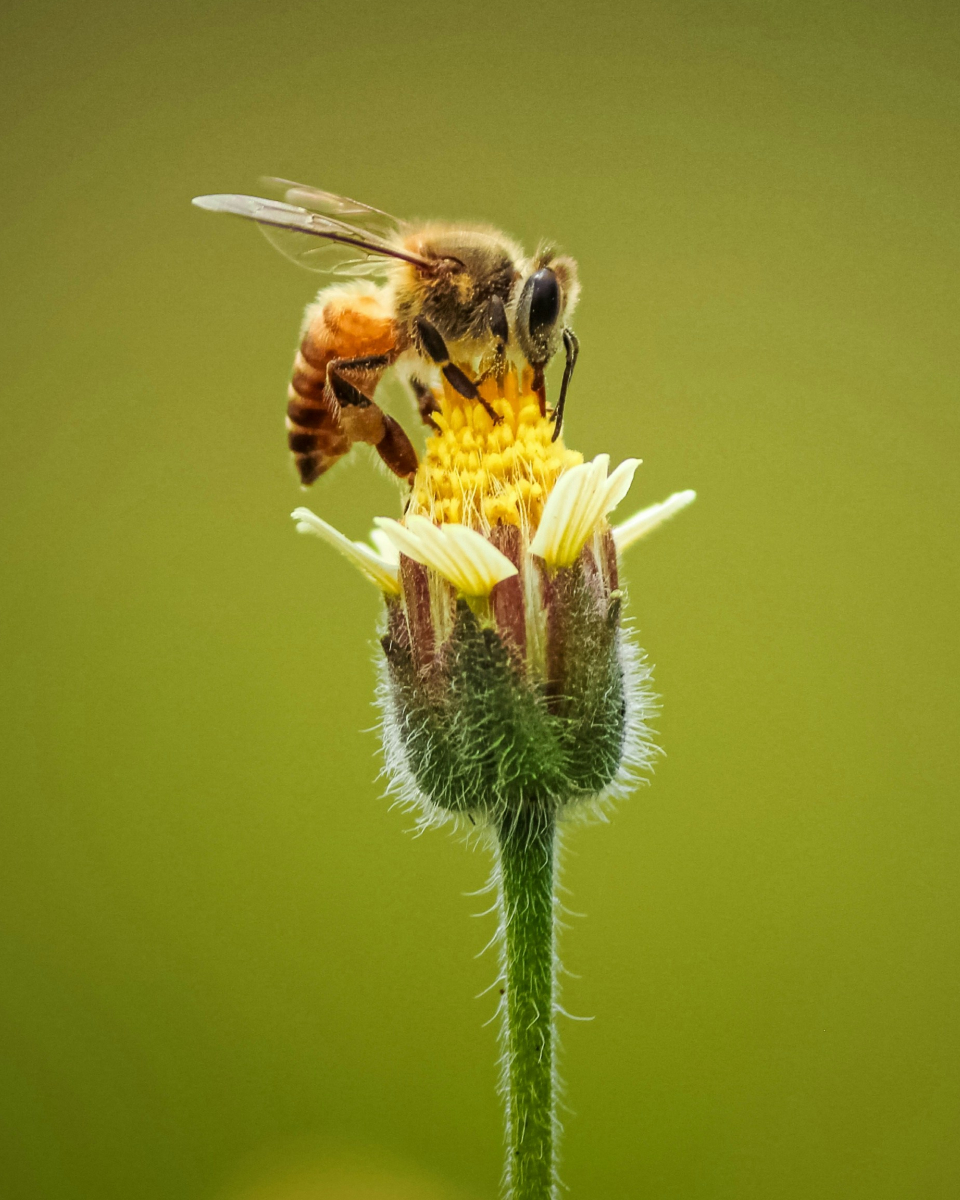
Photo by Ankith Choudhary
Apis mellifera is a eusocial insect with perennial colonies organised around a single reproductive queen, thousands of sterile female workers, and seasonal male drones. Colony-level organisation includes strict division of labour, age-based polyethism (workers transition through nursing, building, guarding, and foraging roles as they age), and sophisticated communication systems: the waggle dance encodes the distance, direction, and quality of food sources with precision comparable to symbolic language; pheromone signalling governs alarm response, colony identity, and reproductive state. Colonies inhabit enclosed cavities, maintaining brood area temperature at approximately 34–36°C and humidity at approximately 50–65% through collective thermoregulation via fanning, clustering, and water evaporation. Foraging range is typically 1–3 km radius under normal forage conditions, with documented maxima of approximately 10 km.
Stressors affecting individual and colony-level welfare include nutritional limitation (forage quality and availability), temperature extremes, parasitism (Varroa destructor, Nosema spp.), pathogen load (RNA viruses vectored by Varroa, bacterial pathogens including Paenibacillus larvae causing American Foulbrood), pesticide exposure, transport disturbance, and colony manipulations by beekeepers. These stressors interact: combined exposure to acaricides and agricultural fungicides can increase bee toxicity through synergistic detoxification pathway inhibition, documented in peer-reviewed toxicology literature.
Cognitive evidence is the most extensively documented of any invertebrate in the sentience literature. Honey bees demonstrate associative learning, complex odour discrimination, place memory, numerosity-related tasks, and flexible decision-making. They perform avoidance learning with documented sensitivity to aversive stimuli. A 2016 Nature Scientific Reports study showed that after simulated predator attack, bees showed long-lasting, generalised negative affect-like states — reduced response to rewarding stimuli across contexts — consistent with a pessimistic cognitive bias analogous to negative emotional states in mammals. The evidence for functional nociception and emotional state modulation in honey bees is the most substantive available for any insect, though its interpretation as sentience remains scientifically contested.
Lifecycle Summary
Approximately 101–102 million managed A. mellifera colonies exist globally, a 45–47% increase since 1961 (FAO-linked estimates). At an average of approximately 50,000 worker bees per colony across seasonal variation, the managed honey bee population is approximately 5 trillion individual animals — the largest individual count of any managed animal in the world by multiple orders of magnitude. Global honey production reached approximately 1.87 million tonnes in 2018, an increase of approximately 181% from 1961–2017; China accounts for approximately 24% of global production.
Honey bees present the most contested sentience profile of any species in this database. Recent peer-reviewed reviews (Frontiers in Animal Science, 2024; PMC, 2025) and the 2024 New York Declaration on Animal Consciousness conclude there is a realistic possibility of sentience in honey bees, based on nociceptor evidence, functional opioid systems, associative learning, judgment-bias experimental results showing negative affect-like states, and convergent neural evidence. Other researchers maintain that insect neural architecture cannot support phenomenal consciousness. Legal and regulatory frameworks have not uniformly integrated this evidence; honey bees are classified under plant health, biosecurity, and agricultural production law in most jurisdictions rather than general animal welfare statutes.
Varroa destructor — an obligate ectoparasite mite now globally distributed — is the most significant single driver of managed bee colony health outcomes. Varroa’s vectoring of RNA viruses including Deformed Wing Virus is the primary cause of the high annual colony loss rates (30–40%+ in some US survey data) that structure the economics and management of commercial beekeeping globally.
Lifespan (Natural vs Exploited)
Queens: natural biological potential approximately 2–5 years, with some reports to approximately 7 years. In commercial beekeeping, queens are proactively replaced (requeened) every 1–2 years to maintain productivity and reduce swarming tendency; realised queen lifespan in production systems is therefore approximately 12–24 months. Early culling of queens for perceived reduced egg-laying rate, poor temperament, or disease signs is common. The biological potential lifespan is approximately halved or more under commercial management.
Workers: approximately 5–7 weeks in summer under normal foraging conditions; overwintering cohorts may live 4–6 months due to reduced metabolic demands and foraging activity. Worker lifespans may be shortened in high-intensity systems by increased foraging demands imposed by large-scale pollination contracts, pesticide exposure, and frequent transport stressors, though quantitative comparisons between intensive and low-intensity management conditions are limited.
Drones: approximately 4–8 weeks, typically dying during or shortly after mating flights; surviving drones are evicted from the colony before winter and die.
Colony loss rates in intensive migratory pollination systems: US survey data (Apiary Inspectors of America) document annual colony losses exceeding 30–40% in some years, with primary causes attributed to Varroa and associated viruses, queen failure, and management and environmental stressors.
Exploitation Systems
Honey and beeswax production. Stationary and migratory apiaries managed primarily for honey extraction. Workers collect nectar, process it into honey through evaporative concentration and enzymatic conversion, and store it in wax comb. Beekeepers add “supers” (additional boxes) during nectar flow periods and remove capped honey frames for centrifugal extraction. Beeswax is harvested from comb cappings and rendered from used frames. Global honey production approximately 1.87 million tonnes in 2018; China (~24%), Ethiopia, Turkey, Argentina, and the United States are major producers. Honey enters food markets directly and as an ingredient in processed food, beverage, and traditional medicine products. Beeswax enters pharmaceutical, cosmetic, food coating, and industrial applications. Additional hive products — propolis, royal jelly, bee pollen, and bee venom — are collected using specialised harvest devices and processed for supplement, cosmetic, and alternative medicine markets.
Commercial pollination services. The most commercially significant bee exploitation system in high-income agricultural economies by economic value, though not by honey output. Managed colonies are transported by truck over distances of hundreds to thousands of kilometres to crop fields at critical bloom periods. US almond pollination in California’s Central Valley requires approximately 1.8 million colonies annually — more than half the US total managed colony count — trucked from across the country. Payment structures are per-colony per-pollination-period. Colonies typically undergo multiple pollination contracts per year. Transport involves securing and screening hive entrances, loading pallets onto flatbeds, overnight transit to reduce bee flight and heat stress, and multiple loading and unloading cycles per season. Colony loss rates in heavily contracted migratory systems are documented as elevated.
Queen and package bee production. Specialised operations producing queens and packaged worker populations for sale to replace losses, populate new equipment, or introduce improved genetics. Queen rearing involves grafting day-old larvae into artificial queen cups, rearing in starter and finisher colonies, mating in isolated mating yards or via instrumental insemination, and evaluation of mated queens before sale. Package bees (typically 1–1.5 kg of workers plus a mated queen in a screened cage) are a primary means of colony replenishment in high-loss commercial systems. Trait selection in queen production programmes targets honey yield, docility, low swarming tendency, brood pattern, overwintering success, and Varroa tolerance.
Wild colony populations. Unmanaged A. mellifera colonies in natural and anthropogenic cavities (tree hollows, building walls) persist across most of the species’ range. These populations are not directly managed but interact with managed colonies through pathogen exchange, competition for foraging resources, and genetic exchange via drone mating. Their inclusion is relevant for ecological impact documentation.
Living Conditions Across Systems
Managed colonies are housed in standardised artificial hive systems — predominantly Langstroth hives with movable frames in most commercial contexts — consisting of one or more brood boxes and removable honey-storage supers. The typical colony occupies approximately 40–60 litres of interior volume at peak season. Individual bee stocking density within the hive is extremely high by any comparison to vertebrate livestock — tens of thousands of individuals in a box — but this density is colony-determined through natural population dynamics rather than externally imposed as with salmon in RAS or broiler chickens in sheds.
The bees maintain their own internal environment within defined thermal and humidity ranges through collective thermoregulation. Bees are not confined to the hive; they have continuous free-flight access during daylight hours under normal conditions. The welfare framework thus differs fundamentally from confined livestock: the relevant environmental deprivation concerns are at the landscape level — forage availability, pesticide exposure, foraging competition from managed colony density — rather than at the hive-interior level.
Migratory pollination transport: hive entrances are screened, hives loaded onto flatbed trucks at high stocking rates, transported overnight over hundreds to thousands of kilometres, unloaded at crop sites. Bees experience vibration, temperature fluctuation, exhaust exposure, and restricted air circulation during transit. Studies associate long-distance transport with elevated disease and stress indicators.
Apiary stocking density — number of managed colonies per site — affects inter-colony competition for local forage resources and disease transmission between colonies. Quantitative standards for maximum colony-per-apiary density are largely absent from national regulations; some country-level risk assessments (Norway VKM, 2024) recommend stocking limits in sensitive habitats.
Lifecycle Under Exploitation
Genetic Selection
Selective Breeding of honey bees operates through queen line selection targeting traits including honey yield, gentleness (low defensive behaviour), low swarming tendency, hygienic behaviour (ability to detect and remove diseased brood), Varroa tolerance, brood pattern uniformity, and overwintering success. Methods include performance testing of colonies under standardised protocols, controlled mating in geographically isolated mating yards, and instrumental insemination to maintain genetic control in breeding programmes. Large-scale selection programmes for Varroa-tolerant traits are active in Europe and North America.
Reproduction
Queen production involves grafting 1-day-old larvae into artificial queen cups and rearing through a sequence of starter colonies (accepting the grafts) and finisher colonies (provisioning developing queens). Virgin queens emerge and undergo mating flights to drone congregation areas, mating with approximately 10–20 drones to create the lifetime sperm supply. Controlled mating uses isolated island or mountain apiaries to limit drone population to known genetics; instrumental insemination using anaesthetised or CO₂-immobilised queens enables full genetic control at the cost of significant handling stress to the queen. Natural swarming — the colony’s primary reproductive mechanism — is actively suppressed in commercial systems through swarm management practices including hive inspection, removal of queen cells, and queen wing clipping.
Birth & Early Life
The queen lays fertilised (worker/queen) or unfertilised (drone) eggs in comb cells. Larvae develop through a feeding and metamorphosis sequence within the capped cell — receiving worker jelly and then honey-pollen mixture for workers, royal jelly throughout for queens. Beekeepers routinely manipulate brood comb: removing drone comb to interrupt Varroa reproduction cycle (this kills capped drone brood); removing excess queen cells to prevent swarming; transferring brood frames between colonies to balance colony strength.
Growth & Rearing
Workers transition through in-hive roles — cleaning, nursing larvae, building comb, guarding the entrance, and processing nectar — before beginning foraging at approximately 2–3 weeks of age. The age at first foraging can be accelerated by colony conditions. Beekeepers provide supplemental feed — sugar syrup for carbohydrate and protein substitute patties for pollen — during forage dearths, prior to pollination contracts requiring strong colonies, and to accelerate spring build-up.
Production
Honey harvest: supers are added above the brood nest during nectar flow periods; bees fill and cap the comb; beekeepers remove capped frames, extract honey by centrifuge, and return empty frames. The colony retains a portion of its honey stores; the surplus is taken. In conventional commercial systems, significant honey stores are removed and replaced with sugar syrup, reducing nutritional diversity relative to natural forage-based nutrition. Pollination service: colonies are placed in crop fields at specified rates (typically 2–8 colonies per hectare depending on crop); bees forage on the crop flowers providing pollen transfer; the colony derives some nutritional benefit from crop pollen and nectar in addition to providing the commercial service.
Transport
Live Transport of entire colonies to crop pollination sites is the defining production event of commercial migratory beekeeping. Colonies are moved multiple times per season — from winter forage areas to early-spring crops, then to additional crops through the growing season. Loading, transit stress, unloading, and acclimatisation cycles are repeated. Individual bees experience vibration, temperature variation, and restricted ventilation during transit.
End of Life
Queens are routinely killed during requeening — caged, removed, and manually killed (typically by pinching) — when beekeepers proactively replace queens for productivity or management reasons, at approximately 1–2-year intervals in commercial systems, despite the queen’s biological potential of several more years. Colony euthanasia is conducted for disease control (mandatory destruction of American Foulbrood-infected hives in many jurisdictions), colony weakness or unprofitability, or disease management. Methods include burning entire hive contents, SO₂ gas application, CO₂ suffocation, cooling/freezing, or soapy water immersion (see Slaughter Processes).
Processing
Honey: extracted by uncapping and centrifuging frames; filtered; optionally heated and blended; packaged for retail or bulk sale. Honey may contain residues of veterinary acaricide compounds and agricultural pesticides accumulated during foraging; residue monitoring programs operate in some jurisdictions. Beeswax: rendered from cappings and used frames; may contain accumulated lipophilic pesticide residues including coumaphos and tau-fluvalinate. Propolis, royal jelly, pollen, and bee venom are collected using specialised collection devices and processed for supplement and cosmetic markets.
Chemical Medical Interventions
Varroa destructor management is the primary veterinary intervention in honey bee production globally. Synthetic acaricide compounds approved in various jurisdictions include amitraz (active ingredient in Apivar strips), tau-fluvalinate (Apistan), coumaphos (Checkmite+), and flumethrin (Bayvarol). Application is typically via plastic strips impregnated with the active substance and placed between brood frames; bees contact the strips and distribute the chemical through the colony. Resistance to synthetic acaricides is documented for fluvalinate and coumaphos in some populations and regions; this drives rotation and combination treatment strategies.
Organic acid and botanical treatments approved in various jurisdictions include oxalic acid (applied by dribble, sublimation, or extended-release strips), formic acid (MAQS strips, formic acid pads), and thymol-based products (ApiGuard, Api-Life Var). These are used as alternatives to synthetic acaricides, particularly in the broodless period when they can reach all Varroa mites.
Antibiotics: oxytetracycline is approved in the United States (under veterinary feed directive since 2017) and some other jurisdictions for prevention and treatment of American Foulbrood (Paenibacillus larvae) and European Foulbrood (Melissococcus plutonius). Tylosin and lincomycin are or have been used in some jurisdictions. EU regulations prohibit routine antibiotic use in honey bees and rely on mandatory colony destruction for American Foulbrood.
Interactions between veterinary treatments and agricultural pesticides are documented: tau-fluvalinate combined with certain fungicide residues shows synergistic toxicity to bees in some studies; oxytetracycline combined with tau-fluvalinate showed synergistic effects in some bee colonies. These interactions complicate safety assessment because bees are simultaneously exposed to multiple compounds from both beekeeping and agricultural sources.
Queen management physical interventions: wing clipping (removal of part of one forewing with scissors) to prevent swarming by rendering the queen unable to fly with a swarm; marking queens with paint pens for identification and age-tracking. These are irreversible physical modifications to individual animals performed routinely in commercial management.
Slaughter Processes
There is no standardised global honey bee slaughter system equivalent to vertebrate abattoir infrastructure. Colony euthanasia occurs for disease control (mandatory or voluntary), colony weakness, and commercial exit decisions. Individual bee killing occurs continuously at colony management events.
Colony-level euthanasia methods documented across jurisdictions include: burning of entire hive contents (mandatory under American Foulbrood regulations in many countries — the hive, combs, bees, and equipment are incinerated); sulfur dioxide (SO₂) gas applied to the sealed hive (assessed in a veterinary peer-reviewed study as the most efficient and acceptable current method); hydrogen cyanide gas (assessed as worst due to operator and environmental hazard); sealed plastic bag suffocation with heat exposure; CO₂ displacement of oxygen (dry ice or compressed gas); cooling to below activity threshold then freezing; and soapy water immersion or spraying. A peer-reviewed veterinary ranking study (PMC, 2022) identified SO₂ as the most operationally practical current method while noting that welfare outcomes across methods are inadequately characterised and that no globally harmonised standard exists.
Individual bee killing in routine management: queens are routinely killed by pinching or crushing during requeening — a manual operation performed by the beekeeper with bare hands or forceps, killing tens of millions of queen bees annually in commercial systems. Excess queen cells are destroyed, killing developing queens. Drone comb is removed and destroyed for Varroa control, killing thousands of capped drone pupae per management event per colony. These individual killing events occur across the full scale of managed bee populations and are structurally embedded in standard commercial practice.
No pre-kill stunning framework exists for bees; no religious slaughter exemption architecture applies.
Labour: commercial beekeeping and colony euthanasia are performed by beekeepers and seasonal workers rather than slaughterhouse staff. Occupational risks include bee stings (with potential anaphylactic reactions in sensitised individuals), chemical exposure during acaricide and fumigant application, musculoskeletal strain from heavy hive lifting, heat stress during transport and loading, and smoke inhalation during hive burning. Detailed occupational injury and psychological impact statistics specific to commercial beekeeping and colony destruction are not available in published form.
Slaughterhouse Labour Impact
No dedicated slaughterhouse exists for bees. Commercial beekeeping workers — including seasonal and migrant workers employed for hive transport, supering, and extraction during peak seasons — face the occupational risks documented above. Psychological impact literature specific to bee colony destruction and queen killing has not been published; the generalised animal slaughter psychology literature on stress and desensitisation is not directly applicable given the species and context differences. Large-scale commercial operations in the US, Australia, and China employ seasonal workers whose demographic profiles are not systematically documented in accessible sources.
Scale & Prevalence
Managed colonies: approximately 101–102 million globally, based on FAO-linked estimates from Wiley’s Ecology & Evolution (2023) global managed and wild honey bee colony assessment. Regional managed colony density approximately 2.2 colonies/km² in Asia, 1.2 in Europe, 1.0 in Africa, 0.5 in Latin America, 0.2 in North America and Oceania. An increase of approximately 45–47% in managed colony numbers since 1961.
Estimated individual managed bees: approximately 5 trillion at peak season (101 million colonies × approximately 50,000 workers average); this is the largest managed animal individual count of any species by multiple orders of magnitude. This figure is highly season-dependent and approximate.
Wild A. mellifera colony densities from the same 2023 assessment: average 0.26/km² in Europe, 1.4/km² in North America, 4.4/km² in Oceania, 6.7/km² in Latin America, 6.8/km² in Africa; wild colony totals are estimated at fewer than managed colonies in most regions.
Global honey production: approximately 1.87 million tonnes in 2018 (FAO), up approximately 181% from 1961. China approximately 24% of global production; Ethiopia, Turkey, Argentina, and the United States are significant producers.
US commercial context: approximately 1.8 million colonies deployed annually for California almond pollination. US annual colony loss rates documented at 30–40%+ in survey years with heavy Varroa and migratory stress.
Directional trend: managed colony numbers are expanding globally, driven by pollination demand from intensifying agriculture. Colony losses in commercial systems are simultaneously high, creating a replacement economy of queen and package production that is itself a large production system. Honey production is expanding in Asia and Africa; declining or stable in some high-income countries.
Ecological Impact
Competition with wild pollinators is the primary documented ecological impact of managed honey bee deployment. A 2018 peer-reviewed Nature Scientific Reports study of high-density apiaries in Mediterranean scrubland found that managed bee presence reduced wild bee occurrence by approximately 55% and wild bee nectar foraging success by approximately 50% within 600–1,100 m of hives; the same apiaries reduced honey bee honey and pollen harvest rates by 44% and 36% respectively — indicating that the competition affects managed bee productivity as well as wild bee populations. Meta-analyses confirm that managed honey bee presence reduces wild bee abundance and diversity, with effect magnitudes dependent on habitat type, floral resource availability, and apiary density.
Pathogen spillover from managed to wild bee populations is documented. A PLOS ONE study (2008) modelled Crithidia bombi spread from commercial bumblebee hives to wild bumblebee populations, finding up to 20% wild bee infection within 2 km in simulations; analogous pathogen spillover from managed A. mellifera to wild solitary bees and other pollinators is documented in field studies. Varroa-vectored RNA viruses from managed colonies can reach wild bee populations and spread through shared flowers.
Acaricide and pesticide residue accumulation in hive products and in the wider environment: lipophilic compounds including coumaphos and tau-fluvalinate accumulate in beeswax over successive comb uses and can reach concentrations detectable in honey; residues are detected in bee pollen and in environmental samples near treated apiaries. Interactions between acaricide residues and agricultural pesticides create sublethal and lethal exposures for managed and wild bees through shared foraging on treated crops.
Managed honey bees can facilitate spread of exotic plants by preferentially visiting certain introduced flowering species, potentially altering plant community composition in ways that further affect native pollinator communities.
Managed honey bee presence in natural and protected areas is increasingly recognised as an ecological management concern: Norwegian VKM (2024) and comparable risk assessments identify apiary stocking limits and temporal restrictions as warranted mitigations in sensitive habitats where wild pollinator communities face competition pressure.
Direct land and water use per colony is low relative to vertebrate livestock; however, honey bees’ role in supporting pollinator-dependent intensive agriculture indirectly contributes to the land use patterns associated with that agriculture.
Language & Abstraction
The colony as management unit. Industry and regulatory language operates entirely at the colony level: “colony strength,” “frames of brood,” “pollination unit,” “stocking rate,” and “colony loss” describe the colony as the relevant analytical entity. Individual bees are present in beekeeping discourse only as population metrics (worker numbers, brood frame coverage). This is not euphemism in the same sense as “cull” or “harvest” in vertebrate systems; it reflects the genuine biological reality that a bee colony functions as a superorganism in which individual-level management is not operationally meaningful. The consequence, however, is that the welfare experience of individual bees — including the tens of millions of queens killed annually by requeening, the billions of drones evicted to die before winter, and the trillions of workers subject to pesticide exposure and transport stress — is structurally invisible in the management framework.
“Requeening” describes the proactive killing of a productive queen and her replacement with a younger one; the term frames the operation as a hive management decision (improving the hive’s productivity trajectory) rather than as the killing of a potentially long-lived individual animal. “Queen failure” describes a queen whose egg-laying rate has declined to commercial non-viability; the term positions culling as a response to a production deficiency rather than as a management decision to terminate a living animal.
“Colony loss” is the standard metric for honey bee mortality in commercial and survey contexts; it aggregates deaths across the full complexity of causes — Varroa, pesticide exposure, queen failure, starvation, disease — into a single percentage figure per season. Colony loss at 30–40% represents tens of millions of colony deaths and hundreds of trillions of individual bee deaths in affected regions annually, expressed as a percentage point in an annual report.
“Pollination services” and “ecosystem services” frame managed honey bee deployment as an environmental contribution — bees providing services to agriculture and ecosystems — rather than as a commercial exploitation system in which bees are transported as instruments of crop fertilisation and then transported away when the contract is fulfilled. The “services” framing emphasises what bees do for agriculture rather than what commercial beekeeping does to bees.
Legal classification under plant health and biosecurity law rather than animal welfare law is not merely a regulatory categorisation — it determines what interventions are permitted, what welfare standards apply, what mandatory reporting is required, and what scientific evidence about bee sentience is actionable by regulatory bodies. The classification was established before the current sentience evidence base existed and has not been systematically revisited in most jurisdictions in light of that evidence.
Terminology
Colony, hive, nuc, package bees, brood, brood box, super, frame, queen, worker, drone, requeening, supersedure, queen failure, queen cell, swarm, swarm control, wing clipping, colony strength, frames of brood, pollination unit, stocking rate, apiary, migratory beekeeping, honey flow, nectar flow, dearth, feeding, sugar syrup, pollen patty, mite treatment, acaricide, Varroa control, American foulbrood, European foulbrood, chalkbrood, colony loss, winter loss, split, combine, shake out, burn out, euthanize colony, honey, comb honey, extracted honey, creamed honey, beeswax, cappings, propolis, royal jelly, bee pollen, bee venom.
Within The System
Developments
Report a development: contact@systemicexploitation.org
Notice an inaccuracy or omission?
If you believe information on this page is incorrect, incomplete, or missing important context, you may submit a suggested correction for review.