
Angora Rabbit
Scientific Name:
Oryctolagus cuniculus domesticus (Angora breeds)
Scope
Covers domesticated Angora rabbits — selectively bred lines of Oryctolagus cuniculus domesticus maintained for long-fibre wool production — including the recognised commercial breeds: English, French, Satin, Giant, and German Angora. Includes commercial and small-scale Angora fibre production systems globally, with primary geographic focus on China (~90% of global Angora wool output) and secondary coverage of European, Chilean, and North American producers. Includes meat and skin as co-products of fibre systems. Excludes wild European rabbits, non-Angora domestic meat and fur breeds, and other species sharing the “Angora” name (Angora goat, Angora cat). Non-commercial pet and show Angoras are included only where their biology or husbandry data are relevant to breed-specific traits.
Species Context
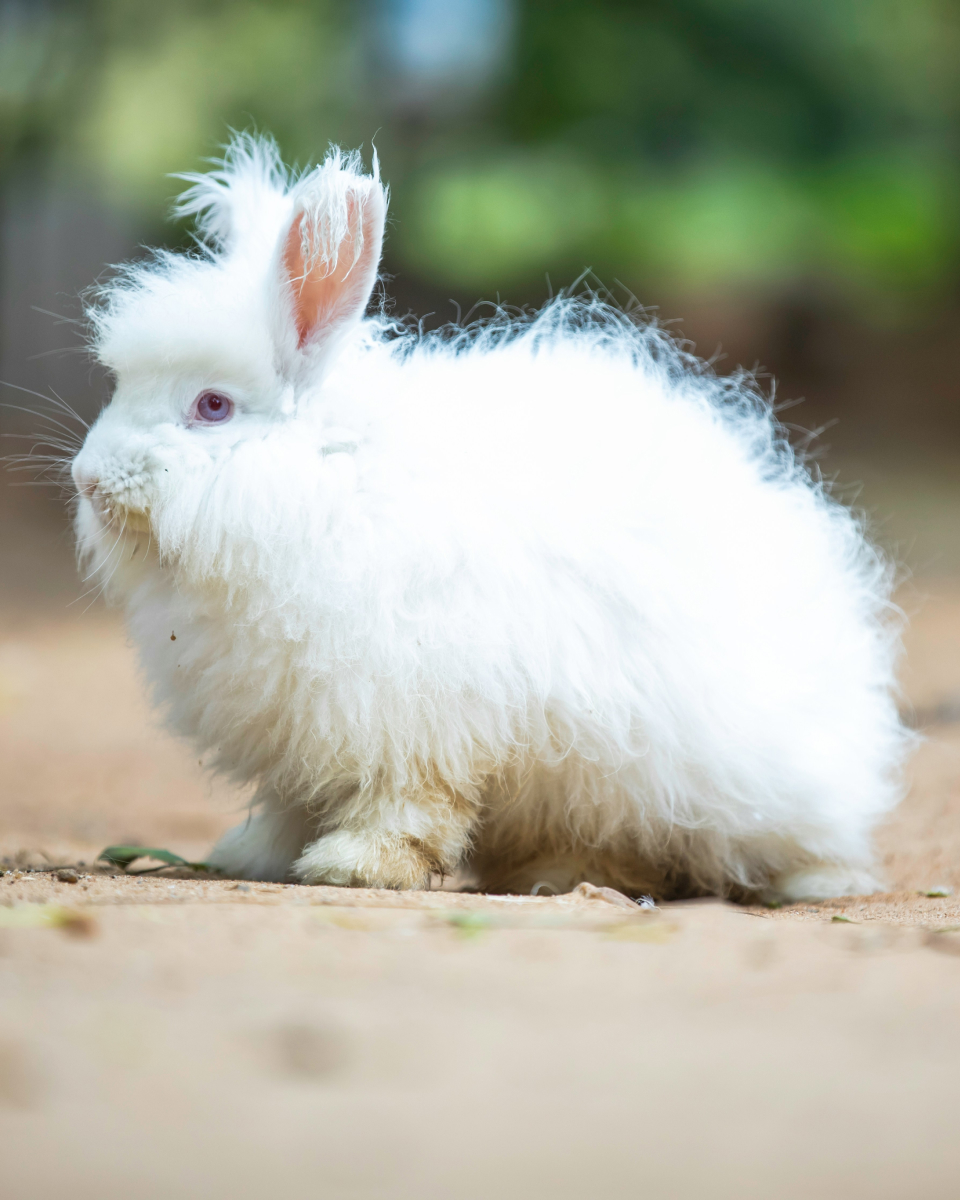
Photo by Anil Sharma
Angora rabbits are a medium-sized domestic rabbit breed with extreme wool growth driven by a recessive genetic mutation, producing fibre at approximately 2.5 cm per month. Some individuals produce up to approximately 1.8 kg of wool per year under intensive management. The long dense coat impairs self-grooming and heat dissipation relative to short-haired rabbits, predisposing Angoras to wool block — gastrointestinal impaction from ingested fibres — and to heat stress in poorly ventilated housing. These are breed-specific welfare risks that compound the general welfare concerns of intensive rabbit confinement.
As domestic rabbits descended from a social, burrow-dwelling species, Angoras share baseline species-typical behavioural needs including locomotion, hopping, exploration, gnawing, and use of hiding places. EFSA and welfare reviews identify confinement, restricted movement, high density, and environmental barrenness as primary stressors in intensive rabbit systems; these apply to Angora production systems directly.
Scientific evidence supports rabbits as sentient mammals with well-characterised nociceptive pathways, behavioural nocifensive responses, and capacity for aversive learning. Rabbits are extensively used in pain and nociception research, with spinal and cortical pain processing documented across multiple experimental models. Domestic rabbits demonstrate learning and memory in maze navigation, conditioning, and social recognition tasks. Angora-specific cognition studies are limited, but the extreme wool phenotype does not alter species-typical cognitive baseline in available literature.
Lifecycle Summary
Angora rabbit exploitation is structured primarily around fibre production — the periodic harvesting of long underwool for textile use. China dominates global production, with more than 50 million Angora rabbits estimated in production and approximately 2,500–3,000 tonnes of hair produced annually. Animals are housed in individual wire-mesh cages for most or all of their productive lives. Wool is harvested every 3–4 months by shearing or plucking, beginning at approximately 8 weeks of age. Commercial animals are typically culled after 2–3 years when fibre yield declines, far below the potential lifespan of 10–12 years. Culled animals enter rabbit meat supply chains as a co-product. The breed’s extreme wool growth creates specific welfare risks absent in other farmed rabbits — particularly wool block (gastrointestinal impaction from ingested fibres) and impaired thermoregulation — that are structurally linked to the selection traits that make the animal commercially viable.
Lifespan (Natural vs Exploited)
Angora rabbits in companion settings commonly live 10–12 years, consistent with general domestic rabbit longevity under low-mortality conditions.
In commercial fibre production, animals are typically culled once wool yield declines, at approximately 2–3 years of age. In systems with 3–4 harvests per year this represents 6–12 harvest cycles before culling. Small-scale and hobby producers may extend productive lives to 4–6 years, but these figures derive from husbandry manuals and breeder reports rather than formal demographic studies.
Primary causes of mortality in production include planned culling for age-related yield decline; wool block, a potentially lethal gastrointestinal impaction from ingested fibres that is specifically elevated in the Angora breed due to its wool length; parasitic disease including wool mites (Cheyletiella parasitovorax); heat stress in inadequately ventilated housing; and infectious disease.
Exploitation Systems
Angora rabbit exploitation operates across one primary system with two co-product streams.
Fibre production. The primary and defining system. Angora rabbits are maintained in individual cages and subjected to repeated fibre harvesting — by shearing, natural-moult plucking, or live plucking — across a productive life of 2–3 years. Harvested fibre is sorted by quality, scoured, dehaired, spun into yarn, and blended with other fibres for knitwear, accessories, and luxury textile products. China dominates global production at approximately 90% of world output. Smaller-scale production for niche and high-value markets operates in Europe, Chile, and the United States.
Meat co-production. Culled Angora rabbits enter rabbit meat supply chains alongside other breeds. FAO describes the Angora system as mixed, with wool as the primary output and meat as a structural by-product. Carcasses are processed into fresh, frozen, and further-processed rabbit meat products. Global rabbit slaughter (all breeds) was approximately 570 million animals in 2021, with China accounting for approximately 53% of production; Angora-specific shares of this total are not disaggregated in available statistics.
Skin and hide co-production. Rabbit skins from culled animals — including Angoras — may be collected for low-grade fur, felt, or leather products. Angora skins are a lower-value output than Rex fur rabbit skins. By-products including offal and blood may enter rendering streams for animal feed or fertiliser.
Living Conditions Across Systems
Intensive fibre farms — China and large-scale operations. Animals housed individually in wire-mesh cages arranged in rows or stacked tiers. Individual housing is standard practice in fibre systems to prevent wool contamination from cage-mate contact and to reduce fighting. Specific minimum cage floor area recommendations from technical production manuals cite approximately 0.56 m² per adult rabbit on wire flooring; in practice, cage dimensions in large-scale operations are not systematically reported and investigative documentation describes substantially smaller enclosures. Sheds are enclosed with controlled ventilation, emphasising low humidity and temperature management given the breed’s reduced heat tolerance. Dung pits below cages in some designs accumulate waste over extended periods, generating localised ammonia concentrations.
Movement constraint is structurally embedded in individual wire-cage housing. Rabbits housed singly cannot perform social behaviours; wire floors prevent the digging, burrowing, and surface exploration that characterise species-typical behaviour. Confinement-associated welfare indicators documented in farmed rabbit welfare literature — stereotypies, reduced growth, altered behaviour — apply to these conditions.
Small-scale and hobby Angora systems. Housing in larger hutches or cages (commonly 0.36–0.64 m² per rabbit) with solid resting areas, bedding, and sometimes outdoor exercise runs. Social contact and environmental complexity are generally greater than in intensive commercial operations. These conditions are documented in husbandry guides rather than welfare research literature.
Lifecycle Under Exploitation
Genetic Selection
Selective Breeding targets high wool yield per harvest, fibre length and fineness, low guard hair content, moulting pattern (with German Angora selected specifically to not moult, enabling shearing on a controlled schedule), growth rate, and reproductive traits. Selection for the non-moulting phenotype in German Angoras prevents the natural shedding that allows plucking in English and French Angoras, making shearing the necessary harvest method and embedding a breed-specific dependency on human intervention to remove accumulated wool.
Reproduction
Breeding stock is maintained as separate nucleus herds. Natural mating is standard in most systems; Artificial Insemination is used in larger intensive units. Does are bred repeatedly through the year with short inter-kindling intervals typical of intensive rabbit production. Gestation is approximately 31 days. Litters are born in nest boxes within cages.
Birth & Early Life
Neonates are altricial and fur-less at birth. Weaning occurs at approximately 4–6 weeks — earlier than the species-typical weaning period — with Premature Weaning and Separation structurally embedded in intensive production. Post-weaning, young stock are housed in grower cages; early grooming management begins to establish coat condition.
Growth & Rearing
Young stock are fed pelleted rations formulated with elevated methionine and cysteine to support wool protein synthesis, supplemented with roughage to reduce wool block incidence. Animals transition from grower to production housing at maturity. The first fibre harvest may occur as early as 8 weeks of age.
Production
Wool Shearing or plucking is performed every 3–4 months across the productive life. Natural-moult plucking — removing loose fibres by hand from moulting individuals — is practised with English and French Angoras during their natural shed cycle, yielding long uniform fibres with minimal guard hair. Shearing using scissors or clippers is practised with non-moulting breeds and as an alternative to plucking, producing a slightly more heterogeneous staple. Investigative sources document live plucking from non-moulting coats in some Chinese facilities — pulling fibres from animals not in moult — but quantitative prevalence data are not available in peer-reviewed literature. Regular grooming between harvests prevents matting and reduces wool block risk.
Transport
Live Transport moves animals from farms to slaughter facilities or collection points when culled for meat or low productivity. Transport conditions mirror general rabbit transport — crates with limited headroom and space. Angora-specific transport data are not available in the literature.
End of Life
Culling triggers include age-related decline in wool yield typically around 2–3 years, reproductive problems, wool quality defects, and disease. On-farm killing methods include mechanical cervical dislocation, non-penetrating captive bolt, and blunt force trauma; experimental comparison of these methods (Walsh et al., 2017) found blunt force trauma had unacceptably high failure rates in mature rabbits, while non-penetrating captive bolt achieved 100% effectiveness for rabbits over 150 g. Animals judged suitable for meat are transported to slaughter facilities.
Processing
Fibre is sorted by quality, scoured, dehaired, and spun into yarn for textile manufacturing. Carcasses from culled animals are processed for rabbit meat — chilled, cut, packaged, or further processed. Skins may be salted and sold for fur or leather processing. By-products including offal and blood enter rendering or fertiliser streams.
Chemical Medical Interventions
Antiparasitic agents are the most commonly documented pharmaceutical intervention in Angora-specific production literature. Wool mites (Cheyletiella parasitovorax) are treated with ivermectin (systemic) or carbaryl powder (topical). Other ecto- and endoparasite treatments — including fenbendazole and additional anthelmintics — follow general rabbit practice; Angora-specific prevalence and treatment frequency data are limited.
Dietary management rather than pharmaceutical intervention is the primary tool for wool block prevention. Rations are formulated with elevated methionine and cysteine for wool protein synthesis; daily provision of roughage including grass hay is standard recommendation to maintain gut motility and reduce ingested fibre accumulation. Laxative or enzymatic supplementation may occur in hobby contexts but is not documented as standard practice on commercial farms.
Vaccines against rabbit haemorrhagic disease virus (RHDV) and myxomatosis are used where these diseases are endemic or legally required. Vaccination coverage data for commercial Angora operations are not systematically reported.
No hormonal growth promoters or performance-enhancing hormones specific to Angora wool production are documented in major production reviews; nutrition is the principal lever for yield optimisation. NSAIDs including meloxicam are available for rabbit analgesia in veterinary contexts but routine use during fibre harvesting on commercial farms is not reported in production or sector literature.
No routine surgical modifications comparable to tail docking or teeth clipping in other species are standard in Angora production. Corrective dental procedures occur in veterinary and pet contexts.
Slaughter Processes
Industrial rabbit slaughter employs three main stunning methods: electrical stunning (head-only or head-to-body), controlled atmosphere stunning (CO₂ or inert gas mixtures), and mechanical stunning (captive bolt). In EU contexts, electrical head-to-body stunning is commonly used for rabbits; controlled atmosphere systems are permitted but less widespread. Post-stun killing uses exsanguination, neck cutting, or decapitation. Throughput data specific to Angora rabbit processing are not available; Angoras enter standard rabbit slaughter lines alongside other breeds when culled for meat.
On-farm killing for animals culled outside slaughter channels employs blunt force trauma, mechanical cervical dislocation (e.g. Rabbit Wringer), or non-penetrating captive bolt. A peer-reviewed comparison (Walsh et al., 2017) established that blunt force trauma has unacceptably high failure rates in mature rabbits, requiring significant physical force and difficult restraint, while non-penetrating captive bolt achieved 100% effectiveness above 150 g bodyweight and mechanical cervical dislocation was also effective when correctly applied.
Religious slaughter provisions — halal and kosher — focus primarily on larger livestock species in most regulatory frameworks. Rabbit-specific religious slaughter data are limited.
Slaughterhouse Labour Impact
Rabbits are processed within poultry and small game segments of animal slaughtering and processing industries. US Bureau of Labor Statistics data for NAICS 311615 (poultry processing, which includes rabbits and small game) recorded a total recordable injury and illness rate of 4.3 per 100 full-time workers. In US animal slaughtering and processing broadly, 49% of days-away-from-work cases involve upper extremity injuries, with sprains, strains, and carpal tunnel syndrome prominent — consistent with high-frequency repetitive cutting and handling tasks at speed.
Musculoskeletal disorders and repetitive strain injuries are documented across meat and poultry processing operations and apply structurally to rabbit processing line work. Psychological impacts of slaughter work — elevated stress, desensitisation, and mental health concerns documented in the broader slaughter workforce literature — apply to workers handling rabbits in multi-species plants, though rabbit-specific psychological impact data are not available.
Workforce demographics in slaughter and processing industries typically involve high proportions of migrant and low-wage workers; rabbit-specific demographic breakdowns are not reported in available statistics.
Scale & Prevalence
Global Angora rabbit population estimates are inconsistent across sources and time periods. FAO data from the early 1990s estimated approximately 20 million farmed Angora rabbits worldwide. Later sources cite more than 50 million Angora rabbits in China alone, producing approximately 2,500–3,000 tonnes of hair annually. A separate Chinese industry figure cites rabbit wool output of approximately 12,000 tonnes. These figures derive from different years and methodologies and cannot be reconciled without current primary data; they establish that China dominates global production at approximately 90% of world output.
China’s Angora population is concentrated in specific provinces, operating within a broader mixed rabbit sector that includes meat breeds (Rex fur, commercial meat breeds) alongside Angora fibre operations.
Smaller-scale production in Europe — primarily France, Germany, and the Czech Republic — and in Chile and the United States supplies niche and high-value textile markets. No harmonised official statistics for non-Chinese Angora production are available.
Directional trend in Western markets is contraction: NGO investigations and high-profile corporate retailer bans on Angora wool following published footage from Chinese facilities have reduced demand in some Western fashion supply chains. Chinese domestic production volumes and trends post-2015 are not reliably tracked in publicly available data.
Ecological Impact
Angora rabbits are monogastric and do not produce enteric methane at ruminant levels. Greenhouse gas emissions from production derive primarily from feed cultivation and production, manure management, and energy use in housing and processing. General rabbit production life-cycle assessments indicate lower emissions per kilogram of edible meat than ruminant livestock; no Angora-specific LCA for fibre output has been identified in the literature, so precise per-kilogram fibre comparisons with sheep wool, cashmere, or synthetic alternatives are not available from primary sources.
Feed production is the primary land-use driver; Angoras are fed forage plus small quantities of grain and by-products, implying lower grain intensity than some intensive meat systems but without precise comparative data.
Concentrated cage systems with dung pits generate localised ammonia emissions and odour. Manure may be used as agricultural fertiliser or stored; potential nutrient runoff from large-scale operations applies where waste management is inadequate. Water use is embedded primarily in feed production and processing operations; no Angora-specific water footprint data have been identified.
Language & Abstraction
Angora rabbits in production systems are designated by function: “woolers” or “woollers” in production manuals distinguish fibre animals from “meat rabbits” within mixed enterprises. Individual animals are further categorised as “does,” “bucks,” “growers,” “breeding stock,” “culls,” and “replacement stock” — production role terms that position individuals as interchangeable functional units within a turnover cycle.
“Harvest,” “clip,” “fleece,” and “yield” frame fibre removal as a neutral extraction of a natural agricultural output, analogous to plant crop harvesting. “Plucking” in the natural-moult context has a more ambiguous function — it describes a method that requires physical removal of loose fibres from the animal but is framed in production literature as working with the animal’s natural shedding cycle. “Live plucking from non-moulting coats” — pulling fibres from animals not in moult — does not have a distinct euphemistic term in industry documentation; it appears in advocacy exposés rather than production literature, reflecting the absence of standardised industry framing for a practice that lacks official regulatory acknowledgement.
The textile product label “Angora” or “Angora wool” identifies a fibre type and quality descriptor for consumer markets without specifying production method, harvest technique, or geographic origin. Consumer perception of “Angora” as a soft luxury fibre is decoupled from the housing and harvest conditions of the producing animals. Labels are not required to distinguish between plucked and shorn fibre, or between different production systems.
Culling at 2–3 years — representing a removal at approximately 20–25% of biological lifespan potential — is framed in production literature as a natural productivity management decision, using the same “cull” terminology applied to end-of-productive-life decisions across all farmed species, normalising early killing through routine livestock management language.
Terminology
Angora, Angora wool, Angora hair, Angora fur, wooler, wooller, meat rabbit, Rex rabbit, breeding stock, breeding doe, buck, grower, fryer, cull, replacement stock, clip, clipping, fleece, harvest, shearing, plucking, combing, moulting, non-moulting, wool block, wool mites, stocking density, cage system, flat deck system, dung pit, pellet ration, forage, by-product, carcass, skin, hide, rabbit wool, rabbit skin, rabbit meat, hair yield, fibre yield.
Within The System
Developments
Report a development: contact@systemicexploitation.org
Notice an inaccuracy or omission?
If you believe information on this page is incorrect, incomplete, or missing important context, you may submit a suggested correction for review.