
Greyhounds
Scientific Name:
Canis lupus familiaris (breed: Greyhound)
Scope
Covers racing greyhounds in commercial greyhound racing systems, including associated breeding operations, training and kennel systems, and retirement and rehoming pipelines. Includes ex-racing greyhounds in adoption programmes and companion settings where their origin is linked to the racing system. Greyhounds are a selectively bred line within the domestic dog species (Canis lupus familiaris), not a separate subspecies.
Excludes wild canids and feral dog populations. Excludes other sighthound breeds except where included in canine research cited for this record. Excludes general companion dog management data not disaggregated by breed or linked to the racing system.
Species Context
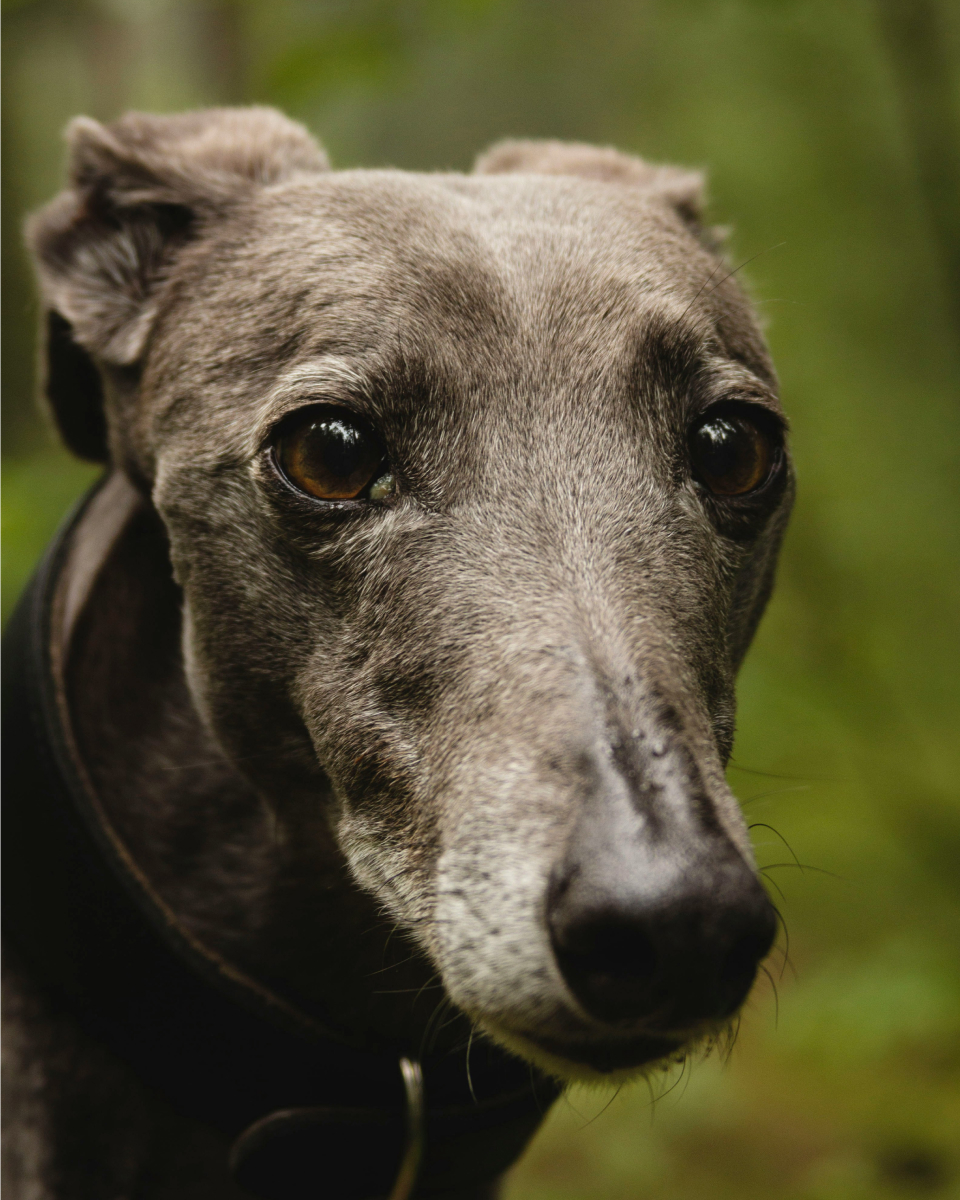
Photo by Jannik Selz
Greyhounds are large dolichocephalic dogs with extremely low body fat, thin coats, and exceptional sprint capacity. Typical adult weight is 25–40 kg depending on sex and line. The combination of low subcutaneous fat and thin coat creates significant sensitivity to thermal extremes — both heat stress during racing and cold stress in unheated kennels — which intersects directly with injury risk and housing requirements.
As domestic dogs, greyhounds form flexible social groups with conspecifics and humans. In racing kennel settings they are typically housed individually but exercised in groups. In pet homes they generally live in pairs or small groups. Behavioural traits include low baseline resting activity, high sprint drive toward small fast-moving stimuli, and strong human-oriented social behaviour. Studies on greyhound anxiety and coping styles document individual variation in anxiety-related behaviour and neuroendocrine stress responses, indicating differentiated coping strategies within the population.
Greyhounds share the domestic dog’s established capacities for social learning, perception of human social cues, and formation of attachment-like relationships. Reviews of dog-human social cognition identify dogs as capable of using human gaze, gestures, and emotional cues in problem-solving contexts. Scientific consensus supports domestic dogs — and greyhounds as a population within this species — as sentient mammals with developed social and cognitive capacities.
Lifecycle Summary
Greyhound exploitation is structured around commercial track racing, in which dogs function as performance assets generating gambling revenue. High breeding volumes create structural surplus — significantly more dogs are bred than racing positions can absorb. Dogs deemed non-competitive are killed at the pre-racing stage; Australian government inquiries estimated 48,891–68,448 greyhounds were killed over a 12-year period for being “too slow” or unsuitable for racing. Racing careers typically run from 18–24 months to 4–6 years of age; end-of-career pathways include rehoming, retention for breeding, and euthanasia. On-track deaths from catastrophic injury are documented by regulators. There is no industrial slaughter or food processing chain — end-of-life killing is primarily veterinary euthanasia. The global industry is contracting due to track closures and legislative bans in multiple jurisdictions.
Lifespan (Natural vs Exploited)
Greyhounds in companion settings commonly live 10–15 years, with several sources citing 10–14 or 12–15 years.
Racing careers typically begin at approximately 18–24 months and commonly end by 4–6 years of age — well below the companion lifespan — after which dogs are retired, rehomed, retained for breeding, or killed. Comprehensive age-at-death distributions for the industry population are not consistently published.
A New South Wales dataset for a single year recorded 3,747 greyhound puppy births, 1,435 retirements, and 832 deaths, with a substantial number of dogs unaccounted for in official outcomes, indicating premature mortality or untracked exits from the system.
Primary causes of mortality within the racing system include acute race- or training-related trauma — including catastrophic limb fractures and spinal injuries — leading to on-track euthanasia; non-catastrophic injuries or performance decline leading to elective euthanasia; and killing of non-competitive dogs at the pre-racing stage. Australian government inquiries estimated 48,891–68,448 greyhounds killed over a 12-year period as “too slow” or unsuitable for racing. NSW regulatory data show on-track death and euthanasia rates declining from 1.4 per 1,000 starts in 2017/18 to 0.15 per 1,000 starts in 2025, following regulatory reforms.
Exploitation Systems
Greyhound exploitation is structured around a single primary system — commercial track racing — with subsidiary breeding, rehoming, and by-product-linked systems.
Commercial track racing. Dogs bred, trained, and raced at licensed tracks for gambling revenue and associated entertainment. Dogs function as performance assets whose value is tied directly to race outcomes. Management in this system prioritises speed, physical conditioning, and injury minimisation to maintain racing days. Racing is the structurally defining function of the entire system: breeding, training, transport, feeding, and end-of-life outcomes are all organised in relation to track performance.
Breeding and genetic selection. Purpose-breeding operations produce racing greyhounds using registered brood bitches and stud dogs with documented racing records. Breeding volumes in most jurisdictions exceed the number of available racing positions, creating structural surplus — dogs that enter the system at birth but never race and are killed before or during the pre-training phase.
Adoption and rehoming programmes. Industry-linked and third-sector programmes transfer ex-racing greyhounds and unsuitable juveniles into companion homes following behaviour assessment, desexing, and veterinary checks. These programmes exist within and are funded partly by the racing industry; their capacity defines the upper limit of dogs that exit the system alive rather than through euthanasia.
Meat and by-product systems. In some jurisdictions greyhounds are slaughtered for meat — cases have been reported in Chinese dog meat facilities — though robust quantitative data for this pathway are limited. Greyhound carcasses from euthanised dogs may enter rendering, local meat channels, or clinical waste disposal depending on jurisdiction and drug residue status.
Knackery meat supply chain. Greyhound racing facilities in multiple countries use knackery or “4-D” meat — from dead, dying, diseased, or disabled livestock, particularly horses — as a primary dietary component. This links the racing system structurally to condemned livestock and equine slaughter streams. Contamination incidents — including a documented Tasmanian case involving dehydronorketamine residues in knackery meat — have caused doping positive tests and illness clusters at racing facilities.
Living Conditions Across Systems
Racing kennel systems. Dogs typically housed individually or in pairs in concrete-floored pens or runs with bedding material. Specific floor area figures are not consistently published; inspections have frequently described single-dog pens with limited length relative to dog body size. Exercise is provided through scheduled access to shared runs or track gallops. Most of the day is spent kennelled. Climate control varies by facility age and jurisdiction. Thermal vulnerability — due to low body fat and thin coat — means unheated kennels in cold climates and inadequately ventilated kennels in hot climates represent direct welfare risks. Documented welfare indicators in racing systems include high incidence of musculoskeletal injuries, lacerations, and heat-stress events associated with racing at speed and track design features including tight turns and catching pens.
Diet and feed conditions. Many racing facilities feed raw knackery or 4-D meat stored refrigerated or frozen. Contamination incidents have led to illness clusters and doping positive tests, indicating food safety risks in storage and handling practices that are systemic rather than incidental.
Companion and adoption settings. Ex-racing greyhounds in pet homes experience substantially different conditions — larger indoor and outdoor spaces, soft bedding, and more continuous human contact. Breed-specific adoption programmes emphasise indoor housing due to temperature sensitivity. This system type represents the intended exit route from the racing system for dogs that survive to rehoming eligibility.
Lifecycle Under Exploitation
Genetic Selection
Selective Breeding targets sprint speed, competitive chase drive, and conformation, based on racing performance records and pedigree lines. Selection pressures may indirectly influence anxiety profiles and coping traits, as documented in studies of greyhound stress behaviour. High breeding volumes are structurally encouraged by the system’s demand for performance selectivity — only a fraction of dogs bred will race competitively.
Reproduction
Breeding uses registered brood bitches and stud dogs with demonstrated racing records. Artificial Insemination is used in some jurisdictions to disseminate genetics internationally. Breeding targets routinely exceed racing vacancies, creating predictable structural surplus at every cohort.
Birth & Early Life
Litters are whelped at breeding farms or kennels. Pups remain with the dam and littermates during early weeks, then progress to early socialisation and handling according to breeder practices. Weaning age and socialisation protocols are not consistently recorded or reported across the industry.
Growth & Rearing
Juveniles enter pre-training where they are introduced to lure chase, starting boxes, and track running. Management focuses on physical conditioning, muscle development, and speed assessment. Dogs assessed as non-competitive are transferred to adoption pipelines, sold as pets, or killed at this stage. Inquiries have documented substantial numbers of non-racing juveniles killed for being “too slow” or physically unsuitable. Conditioning and Training structures the entire pre-racing phase.
Production
Racing careers begin at approximately 18–24 months. Dogs are kennelled at racing facilities, trained, trialled, and entered into regular race meetings. Control mechanisms include registration with racing authorities, microchipping, race nominations, pre- and post-race veterinary checks, and anti-doping testing. Injury surveillance systems in some jurisdictions record on-track injuries and fatalities for regulatory purposes.
Transport
Dogs are transported between breeding farms, training facilities, race tracks, veterinary clinics, and adoption or rehoming centres, primarily via road vehicles using crates or fixed compartments. Detailed transport condition data — temperature, journey duration, stocking density — are not systematically published for this industry.
End of Life
End-of-life pathways include retirement into adoption programmes and companion homes; retention for breeding; euthanasia following race-day injury; elective euthanasia for performance decline, injury, or behavioural assessment outcomes; and killing of non-competitive dogs during or before the racing career. Dogs classified as “retired” in industry records may subsequently be euthanised without being captured in racing statistics; official documents acknowledge that ownership changes limit regulatory oversight of post-retirement outcomes.
Processing
There is no industrial processing chain for greyhound carcasses comparable to livestock slaughter. Carcasses from euthanised dogs may enter rendering operations, local meat channels (in jurisdictions where dog meat is legal), or be disposed of as clinical waste depending on jurisdiction and drug residue considerations. Data on post-euthanasia carcass pathways are sparse and rarely disaggregated from general dog disposal or knackery waste streams.
Chemical Medical Interventions
Routine veterinary interventions follow general companion and working dog practice: vaccinations against standard canine pathogens including parvovirus, distemper, hepatitis, parainfluenza, and leptospirosis; prophylactic anthelmintics; ectoparasiticides; and heartworm preventives. Breed-specific vaccination coverage data are not separately published.
Performance and injury management involves NSAIDs, analgesics, and antibiotics for musculoskeletal injuries and wound care. Orthopaedic surgery may be used to repair fractures in dogs of sufficient racing value; economically unviable injuries result in euthanasia rather than treatment. Detailed drug usage statistics specific to greyhounds are not widely reported.
Anti-doping controls test for prohibited substances including stimulants, narcotics, and therapeutic drugs above threshold levels. Prohibited substance lists and withdrawal period requirements vary by jurisdiction. Positive tests have been associated with contaminated knackery meat — a documented Tasmanian case involved dehydronorketamine residues — indicating that the feed supply chain is a route for inadvertent doping violations.
Desexing (gonadectomy) is widely applied to dogs entering adoption programmes, typically performed by industry or NGO programmes prior to rehoming. Desexing of racing dogs during active careers is less common due to breeding value considerations.
Slaughter Processes
Greyhounds are not slaughtered for food at industrial scale in most jurisdictions. There is no commercial slaughter infrastructure for greyhounds comparable to livestock processing. Killing occurs in three structurally distinct contexts.
Veterinary euthanasia is the dominant pathway in regulated racing jurisdictions, performed using intravenous barbiturate overdose — typically pentobarbital — following sedation, consistent with veterinary guidelines for canine euthanasia. This is applied for race-day catastrophic injuries, elective end-of-career decisions, non-competitive juveniles, and dogs failing behavioural assessment. NSW regulatory data report on-track death and euthanasia rates of 0.15 per 1,000 starts in 2025, down from 1.4 per 1,000 starts in 2017/18.
Unregulated and informal killing occurs for dogs culled as surplus, non-competitive, or uneconomic without veterinary involvement in some jurisdictions and operational contexts. Methods in these cases are not systematically documented.
Dog meat slaughter of greyhounds has been reported in Chinese facilities and potentially elsewhere, using methods consistent with local dog meat practices. Robust, breed-specific data for this pathway are not available.
No industrial stunning methods, slaughter lines, or throughput figures comparable to livestock processing apply to this record.
Slaughterhouse Labour Impact
This field does not apply to greyhounds in the conventional sense. There is no slaughterhouse workforce or processing operation associated with greyhound exploitation systems in regulated jurisdictions.
Veterinary euthanasia is performed by licensed veterinarians, typically as individual clinical procedures. The psychological and occupational burdens associated with repeated euthanasia of healthy animals — documented in veterinary literature as a contributor to compassion fatigue and moral distress among veterinary professionals — are relevant to the racing context but are not captured in industrial occupational health frameworks.
For jurisdictions where informal or unregulated killing occurs, no occupational data are available.
Scale & Prevalence
No global registry provides comprehensive counts of greyhounds in breeding, racing, retirement, and death. Available data are fragmented by jurisdiction and typically limited to racing phases.
Australia is the jurisdiction with the most detailed publicly available data. NSW regulatory reports document annual injury and mortality rates per 1,000 starts, and government inquiries have generated estimated national population and wastage figures. Australian national data collated by welfare organisations reported 373 race fatalities nationally between 2021 and 2024. A single-year NSW dataset recorded 3,747 puppy births, 1,435 retirements, and 832 deaths, with a substantial number of dogs unaccounted for.
Ireland maintains one of the highest breeding volumes in Europe; 2013 data recorded 2,736 litters, implying approximately 16,400 pups at an average of six per litter. These figures may not reflect current volumes following regulatory and industry changes.
In the United States, the commercial greyhound racing sector has contracted substantially due to track closures and legislative bans in multiple states. In the United Kingdom, the industry has faced public scrutiny and some track closures. Market analyses describe global greyhound racing revenue in wagering terms — with North America and Europe as dominant revenue regions and Asia-Pacific projected for high growth — but these figures measure betting turnover, not dog numbers or welfare-relevant population data.
The global trajectory is contraction. Track closures, legislative bans, and declining social licence have reduced the active industry footprint across North America, parts of Europe, and Australia over the past decade.
Ecological Impact
No life-cycle assessments specific to greyhound racing have been identified. Environmental impact is inferred from the system’s resource inputs rather than measured directly.
The most structurally significant environmental linkage is the use of knackery and 4-D meat as primary feed. This channels condemned livestock carcasses — primarily horses and cattle deemed unfit for human consumption — through the greyhound racing system into rendering or consumption, linking the industry’s feed supply to livestock slaughter waste streams. This is a by-product flow rather than a primary driver of environmental demand, but it creates operational dependencies on knackery facilities and their associated waste management systems.
Race track infrastructure — ovals, spectator facilities, kennels, and parking — requires land, water for track irrigation, and energy for lighting and climate control. These inputs are not disaggregated by species or event type in available environmental literature. Relative to major livestock industries, the direct land, water, and emissions footprint of greyhound racing is small at the global scale; concentrated local impacts occur around racing hubs and the knackery operations that supply them.
Language & Abstraction
Greyhounds in racing contexts are referred to as “athletes,” “participants,” and “canines” in industry and regulatory communications, framing the system as a sporting contest and the animals as sporting competitors. This framing positions the dog as a voluntary participant in a performance event rather than as a performance asset managed for commercial return.
“Retirement” and “rehoming” describe the transition from racing to companion settings in employment and placement terms, positioning the end of the racing career as analogous to a professional departure rather than as exit from an exploitation system. For dogs that do not reach rehoming eligibility, the equivalent terms — “euthanasia of unsuitable dogs,” “too slow to pay their way,” “non-performer” — frame killing as a performance management outcome or economic inevitability rather than as a structural mortality category produced by overbreeding.
“Wastage” and “attrition” appear in industry and inquiry documents to describe the gap between dogs registered and dogs with documented outcomes, absorbing untracked deaths and disappearances into neutral operational terminology. “Unaccounted for” as an official category in regulatory data normalises the absence of information about a dog’s fate as a permissible data state rather than a system failure.
“On-track incident,” “catastrophic injury,” and “sudden death” are used in injury reporting for race-day deaths and severe trauma, abstracting from the physical mechanisms involved — compound fractures, spinal injuries, cardiac arrest at race speed — into sanitised event categories.
“Knackery meat” and “4-D meat” name the feed input category by its processing origin rather than its constituent animals — dead, dying, diseased, or disabled livestock — normalising the use of condemned carcasses as a standard feed practice through technical abbreviation.
Terminology
Racing greyhound, brood bitch, stud dog, sire, dam, litter, whelping, pre-trainer, trainer, owner, handler, trial, race start, race meeting, field size, box draw, lure, catching pen, kennelling, trial track, steward, veterinary check, injury report, catastrophic injury, on-track incident, on-track euthanasia, sudden death, retirement, rehoming, adoption programme, wastage, attrition, overbreeding, non-chaser, non-performer, unsuitable for racing, too slow, surrender, euthanasia, knackery meat, 4-D meat, rendering, positive swab, prohibited substance, prohibited drug, doping, welfare standards, integrity commission, race steward, performance assessment, temperament assessment.
Within The System
Developments
Report a development: contact@systemicexploitation.org
Notice an inaccuracy or omission?
If you believe information on this page is incorrect, incomplete, or missing important context, you may submit a suggested correction for review.