
Dolphins
Scientific Name:
Tursiops truncatus and related Delphinidae (see Scope)
Scope
Covers dolphin species subject to exploitation systems at meaningful scale, primarily bottlenose dolphins (Tursiops truncatus and Tursiops aduncus), common dolphins (Delphinus delphis), and river dolphin species exploited for oil and medicinal products. Includes wild populations subject to drive hunting, directed killing, and fisheries bycatch; captive populations in marine parks, aquaria, swim-with-dolphins venues, military facilities, and research institutions; and artisanal use of river and coastal dolphins for oil and bait. Excludes large non-dolphin cetaceans except where they appear in combined statistics that cannot be disaggregated. Excludes unexploited wild populations not interacting with the systems documented here. No fully domesticated or selectively bred production line exists comparable to livestock; selective breeding is facility-specific and limited.
The record title uses “Dolphins” as the common display name; the scientific name field reflects the primary species but body content covers multiple delphinid species where exploitation systems apply across taxa.
Species Context
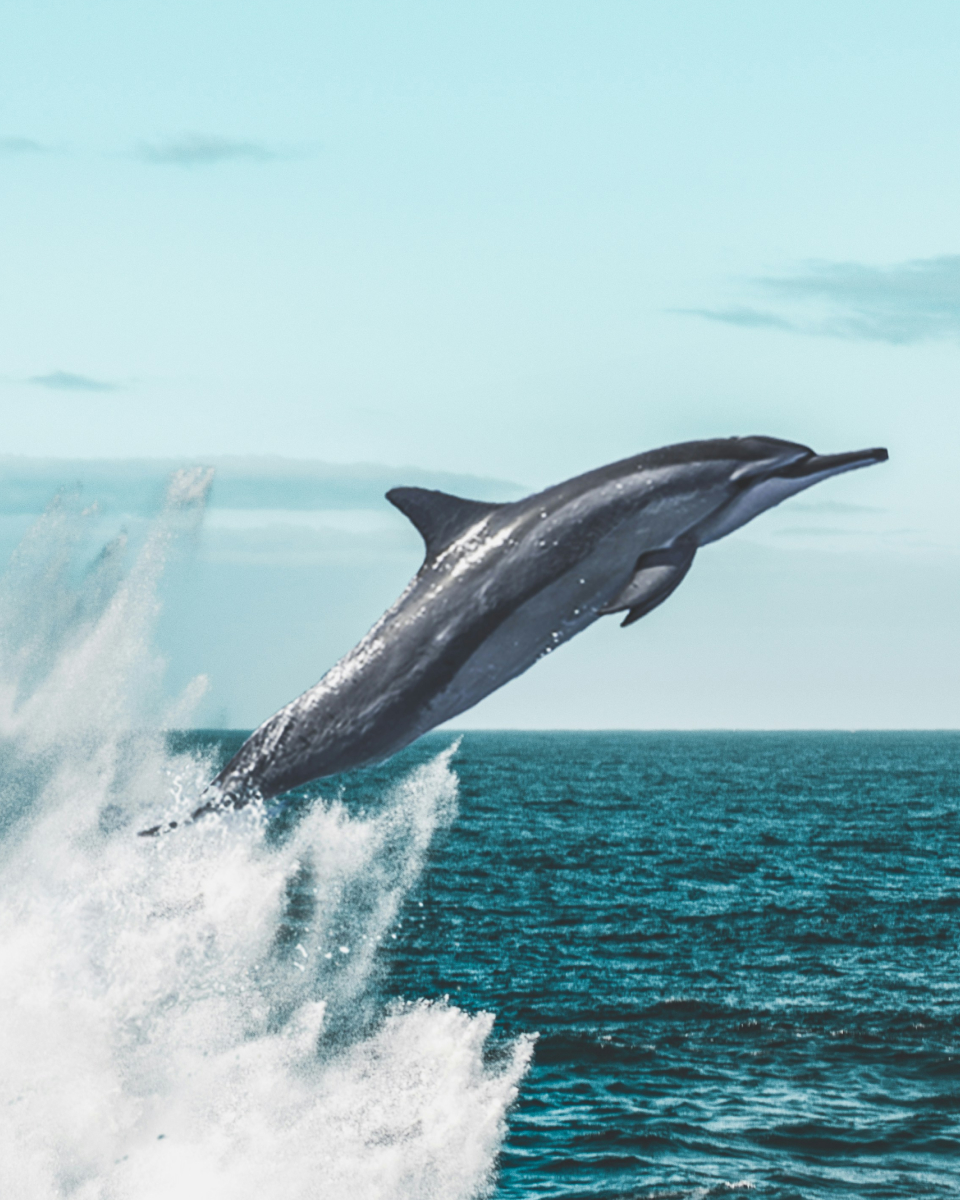
Photo by Pagie Page
Dolphins are medium-sized marine mammals with high encephalisation ratios, complex neocortical organisation, and prolonged juvenile developmental periods. Bottlenose dolphins form fission-fusion societies with stable long-term alliances, cooperative foraging, and maternal lineages. Wild bottlenose dolphins may range over tens to hundreds of kilometres per day and dive to tens to hundreds of metres depending on habitat — spatial requirements that captive environments cannot approach.
Communication relies on broadband whistles and echolocation clicks. Individually distinctive “signature whistles” function as identity signals maintained across an animal’s lifetime. Echolocation is used for navigation, prey detection, and environmental mapping in ways that are fundamentally incompatible with smooth-walled, acoustically reflective concrete tank environments.
Bottlenose dolphins demonstrate mirror self-recognition in standardised marked-body tests, interpreted as evidence of visual self-awareness. Additional documented cognitive capacities include complex acoustic discrimination, rapid operant conditioning learning, long-term memory for individuals and tasks, flexible problem-solving, and social learning. These traits underpin scientific consensus that dolphins are highly sentient mammals with advanced cognitive and social capacities. Stress responses to capture and confinement include elevated mortality following capture, panic behaviour, and ramming of enclosure structures; advocacy and welfare literature reports an approximately six-fold increase in mortality in the period immediately following wild capture, though this figure has not been independently verified through primary peer-reviewed sources and should be treated as indicative pending primary source confirmation.
Lifecycle Summary
Dolphin exploitation operates across five structurally distinct systems: captive display in marine parks and swim-with-dolphins venues; military deployment; directed drive hunting and slaughter; fisheries bycatch; and artisanal extraction for oil and medicinal products. Approximately 3,029 dolphins are held captive globally across 336 facilities in 54 countries, predominantly bottlenose dolphins. The US Navy Marine Mammal Program deploys approximately 120 marine mammals — primarily bottlenose dolphins — in operational mine detection and harbour security roles. Drive hunts at Taiji, Japan and the Faroe Islands kill dolphins annually for meat; Taiji hunts also select live animals for export to captive facilities. Fisheries bycatch removes dolphins incidentally from wild populations across multiple ocean regions. River and coastal dolphins are extracted for oil used as fishing bait and in artisanal medicinal and ritual products, with DNA evidence confirming ongoing use in commercial products. There is no industrial slaughter or food processing chain for dolphins in most jurisdictions.
Lifespan (Natural vs Exploited)
Wild bottlenose dolphins in well-studied coastal populations have median life expectancies of approximately 8–9 years, reflecting high natural mortality from predation, disease, and environmental hazards in these specific monitored populations.
A peer-reviewed comparative analysis of US zoological facility records post-1974 reported a mean life expectancy of 28.2 years and annual survival rates of 0.972 for captive bottlenose dolphins, with the authors concluding that modern US captive survival rates were “at least as high” as those of comparable well-studied wild populations (Reidarson et al., Marine Mammal Science). This finding is contested in independent and advocacy literature, which identifies methodological limitations including the use of facility-affiliated data sources and the selection of wild comparison populations with unusually high natural mortality. Both positions are noted; the discrepancy reflects a genuine scientific dispute about how to construct valid wild-captive comparisons.
Dolphins killed in drive hunts and bycatch operations die at ages reflecting the hunted or incidentally captured population structure; quantitative age distributions are not consistently reported in public sources for these systems.
Captive mortality causes include bacterial, fungal, and viral infections, stress-related pathology, intraspecific aggression, and trauma. Disease accounts for a substantial proportion of documented captive deaths across facility datasets.
Exploitation Systems
Dolphin exploitation operates across five structurally distinct systems.
Captive display — marine parks and aquaria. Dolphins held in tanks and sea pens for choreographed shows, educational presentations, visitor interaction, and commercial revenue. World Animal Protection identified 3,029 dolphins across 336 facilities in 54 countries as of 2019–2025 estimates, with 66% held in concrete tanks and average primary tank area of 444 m². China (23%), Japan (16%), the United States (13%), Mexico (8%), and Russia (5%) account for more than 60% of the global captive dolphin population.
Captive display — swim-with-dolphins venues. A subset of captive facilities — 66% of venues globally — offer direct contact interactions including swimming, riding, and touching programmes. These operations involve higher-frequency human contact and physical handling than standard display. The Mexico, Caribbean, Bahamas, and Bermuda region accounts for approximately 19% of captive dolphins globally, concentrated in swim-with-dolphins operations.
Military deployment. The US Navy Marine Mammal Program trains and deploys bottlenose dolphins in operational roles: detection, location, and marking of underwater mines; and detection of divers in port security operations. The programme operates approximately 120 marine mammals in five operational teams, with additional animals in breeding and support roles. Operational deployment extends to active naval environments including conflict zones. No equivalent programme with this operational profile exists in other documented militaries at this scale, though other nations have maintained marine mammal programmes.
Directed hunting and drive hunts. Taiji, Japan conducts annual drive hunts under prefectural regulation: dolphins are herded into a cove using boat noise, held overnight in netted enclosures, and killed for meat or selected live for export to captive facilities. The Faroe Islands conduct community drive hunts (grindadráp) targeting primarily long-finned pilot whales alongside Atlantic white-sided dolphins, killing approximately 800 animals annually under Faroese regulation. Additional dolphin hunts occur or have occurred in the Solomon Islands and other locations, but detailed data are fragmented.
Fisheries bycatch. Dolphins are incidentally killed or injured in trawl, gillnet, and purse-seine fisheries globally. Documented bycatch figures include approximately 196–262 common dolphins over 15 years in the Azorean pole-and-line tuna fishery, and 52 dolphins across 4,124 observed trawls in a Western Australian trawl fishery — implying higher unobserved totals given the disparity between observer and skipper-reported rates. Historical Eastern Tropical Pacific purse-seine operations deliberately encircling dolphin schools caused large-scale dolphin mortality; subsequent regulatory reform has reduced reported mortality to below 0.1% of estimated population sizes annually in those regulated fisheries.
Artisanal extraction for oil and medicinal products. River and coastal dolphins in South Asia and Brazil are killed or scavenged for fat rendered into oil. The oil is marketed for multiple uses including as bait to attract catfish, and as treatments for rheumatism, asthma, nervous disorders, and in ritual or aphrodisiac products. DNA analysis of commercial oil samples confirmed dolphin DNA in three of four tested products, establishing that this is an ongoing rather than historical practice.
Living Conditions Across Systems
Captive display facilities. Dolphins are held in concrete or fibreglass tanks or small sea pens. Average primary tank area in surveyed facilities was 444 m²; natural bottlenose dolphin home ranges of at least 100 km correspond to tank enclosures 77,000–200,000 times smaller than wild ranging area. Water is typically treated and filtered, with smooth reflective walls acoustically incompatible with dolphin echolocation. Social groupings in captivity often combine animals from different wild populations or social groups, with potential communication incompatibilities from mixed populations. High-frequency human presence, predictable feeding schedules, and limited environmental complexity are standard conditions.
Swim-with-dolphins operations. Close direct human contact through swimming, touching, and riding interactions. Typical enclosures are shallow lagoons or small sea pens in tropical tourist regions. Frequency and intensity of human contact is higher than in standard display settings.
Military facilities. US Navy dolphins are maintained in sea pens and controlled enclosures with structured training, managed breeding, and preventive medicine protocols. Transportation training — conditioning for out-of-water restraint in slings for truck, ship, and aircraft transport — is an explicit programme component. Operational deployment introduces environmental variables absent from standard captive settings.
Drive hunt holding conditions. Dolphins herded into coves during Taiji hunts are confined in netted enclosures overnight before slaughter or selection. Acute confinement stress, mixed unfamiliar social groupings, and proximity to killing operations are characteristics of these temporary holding conditions.
Lifecycle Under Exploitation
Genetic Selection
In captive entertainment and military programmes, selection prioritises trainability, health, reproductive success, and behavioural temperament. Military programmes maintain managed breeding within a closed population. Some facilities exchange individuals to manage genetic diversity. For drive-hunted and bycaught dolphins, no deliberate selection occurs — population structure is determined by wild demographics and capture or gear methods.
Reproduction
Captive dolphins in marine parks and military programmes breed under managed conditions with veterinary oversight. Artificial Insemination is used in some facilities. Reproductive hormone monitoring is standard in managed breeding programmes. Wild-sourced populations continue to reproduce in situ; exploitation through hunting and bycatch removes individuals from breeding populations.
Birth & Early Life
Captive calves are born in tanks or sea pens under veterinary monitoring, with management adjustments to social groupings to reduce aggression. US Navy programme records manage breeding females and dependent calves as distinct categories. Wild-born juveniles captured for live trade or captivity — including animals selected from Taiji drive hunts — experience acute post-capture stress, with a reported elevated mortality risk in the capture period.
Growth & Rearing
Captive dolphins undergo structured training, daily feeding, and health monitoring. Learning objectives include human-directed behaviours for show performance, military task completion, or research participation. There are no intensive feedlot-type rearing systems; growth is managed through diet composition and veterinary care. For hunted and bycaught animals, growth and rearing occur entirely in the wild.
Production
In captive entertainment, production consists of shows, interactive sessions, photo opportunities, and swim experiences, scheduled multiple times daily in high-throughput venues. In military deployment, operational production consists of mine detection, object location and marking, and harbour security tasks. In hunting systems, production is meat, organs, live animals for trade, and oil. In bycatch contexts, dolphins are incidental catches; their removal is a by-product of target species fishing effort rather than an intentional production output.
Transport
Captive dolphins are transported between facilities and to operational deployments via trucks, ships, and aircraft using specialised slings and containers. The US Navy explicitly conditions dolphins for out-of-water transport as part of operational readiness training. Live animals selected from Taiji drive hunts are transported domestically or internationally to purchasing facilities; logistics vary and are not comprehensively documented in available sources.
End of Life
Captive facility deaths occur from age-related disease, infections, trauma, and veterinary euthanasia when health status warrants. Military programme animals may be “retired” from operational status, with end-of-life management including veterinary care and necropsy. Drive-hunted dolphins die at point of slaughter. Bycaught animals die by drowning or injury in gear; some released alive have unknown survival probability. River dolphins are killed for oil extraction.
Processing
Drive hunt carcasses are processed for meat and organs at local facilities — fishermen’s unions in Taiji, community sites in the Faroe Islands. River dolphin fat is rendered into oil distributed through informal and small-scale markets. Captive and military programme carcasses undergo necropsy for diagnostic and research purposes, then disposal by rendering, incineration, or burial under local regulations. There is no industrial commercial meat-processing chain for dolphins in regulated jurisdictions.
Chemical Medical Interventions
Veterinary pharmaceutical use in captive dolphins is individual-level and governed by zoo and marine mammal frameworks. The US Navy Marine Mammal Programme operates a documented comprehensive preventive medicine protocol including vaccinations, antiparasitic treatments, antibiotics, and routine diagnostics. Specific pharmaceutical products used in the Navy programme are not detailed in available open-access sources; standard marine mammal veterinary practice employs broad-spectrum antibiotics, anti-inflammatory drugs, and reproductive endocrinology interventions for managed breeding.
Reproductive hormone monitoring and management is used in all managed breeding programmes, with hormonal assays tracking estrus cycles and pregnancy. Anaesthesia is applied for mark-application procedures in research contexts — including the mirror self-recognition studies — and for selected veterinary interventions.
A 2024 study detected human pharmaceuticals in blubber of live free-swimming wild marine mammals, indicating bioaccumulation of anthropogenic chemical compounds through wastewater and environmental runoff rather than deliberate dosing. This constitutes environmental contamination of wild populations rather than veterinary intervention.
No growth promoters analogous to terrestrial livestock are used in dolphin management. No dolphin-specific surgical modifications comparable to the physical modifications applied to livestock are standard practice.
Slaughter Processes
Taiji drive hunt killing method. The current official killing method in Japanese drive hunt operations involves inserting a metal pin or rod into the neck immediately behind the blowhole to transect the spinal cord, followed by plugging the wound with a wooden peg to reduce blood dispersal into the water. A prior method of throat-slitting was officially banned. Veterinary analysis of filmed footage from 2011 documented time to death exceeding four minutes in at least one recorded case using the spinal cord transection method, indicating the method does not produce instantaneous loss of consciousness in practice.
Faroe Islands grindadráp. Long-finned pilot whales and Atlantic white-sided dolphins are herded into shallow bays by boat and killed using spinal cord lances and knives. Approximately 800 animals are killed annually under Faroese community regulation. The practice is framed under Faroese law as a non-commercial community hunt rather than commercial slaughter.
Bycatch mortality. Dolphins caught in trawl, gillnet, and longline fisheries die by drowning or gear-related injury without deliberate stunning. There is no kill method; mortality is an unintended consequence of capture. Some bycaught animals are released, with survival probability generally unquantified.
Captive euthanasia. Facility dolphins are euthanised by veterinary-administered drugs when health prognosis is poor. Specific pharmaceutical protocols are not detailed in available open-access sources.
Artisanal killing. River and coastal dolphins killed for oil are taken by local fishers; specific kill methods are not systematically documented in available literature.
Slaughterhouse Labour Impact
There is no slaughterhouse workforce associated with dolphin exploitation in the conventional industrial sense. Labour impacts are system-specific.
Drive hunt operations are conducted by local fishers using small boats and hand tools. Quantitative occupational health data — injury rates, psychological impacts — for drive hunt workers are not documented in peer-reviewed literature. Processing and butchering at Taiji occurs at fishermen’s union facilities; workforce demographics and conditions are not reported in available sources.
Captive facility staff — trainers and animal care workers — work in close physical proximity to dolphins. Available welfare-oriented literature focuses on animal rather than worker outcomes; peer-reviewed data on psychological impacts or injury rates for dolphin facility workers are limited. The occupational health and safety risks documented for orca trainers at marine parks are relevant context but are not directly transferable to smaller dolphin facilities.
Military programme personnel work with operationally deployed dolphins in naval environments; occupational health conditions are governed by military service frameworks and are not published in accessible open sources.
Scale & Prevalence
World Animal Protection identified 3,029 captive dolphins across 336 facilities in 54 countries (2019–2025 survey data). China hosts the largest share at approximately 23% of the global captive population, followed by Japan (16%), the United States (13%), Mexico (8%), and Russia (5%). The Mexico, Caribbean, Bahamas, and Bermuda region accounts for approximately 19%, concentrated in swim-with-dolphins operations. 93% of venues with captive dolphins provide shows; 66% provide swim-with-dolphins experiences.
The US Navy Marine Mammal Programme operates approximately 120 marine mammals in five operational teams, predominantly bottlenose dolphins, with additional animals in breeding and support roles.
Taiji conducts annual drive hunts under Japanese prefectural regulation; annual quotas and actual kill numbers vary by year and are affected by under-reporting and aggregation with other small cetaceans in public data. The Faroe Islands grindadráp kills approximately 800 pilot whales and some dolphins annually.
Regional trends in captive display are divergent: some Western European jurisdictions and parts of Australia show declining dolphinarium numbers, while China and parts of Latin America have expanded both venue counts and captive animal numbers.
Global wild dolphin population abundance is large but not comprehensively quantified in available sources across all species. Eastern Tropical Pacific dolphin populations historically depleted by tuna fishery operations now experience less than 0.1% annual reported mortality from regulated purse-seine operations.
Ecological Impact
Wild population depletion from hunting, bycatch, and live capture removes individuals and affects demographic structure and social cohesion in ways that extend beyond numerical reduction, particularly for species with stable social units and long inter-birth intervals.
Fisheries bycatch creates documented mortality across multiple ocean regions. The divergence between observer-reported and skipper-reported bycatch rates in the Western Australian trawl fishery — 12.6 vs 6.5 dolphins per 1,000 trawls — indicates that reported figures systematically understate actual mortality. Eastern Tropical Pacific purse-seine operations historically caused large-scale dolphin mortality; regulatory reform under the Marine Mammal Protection Act and the International Dolphin Conservation Programme has substantially reduced reported mortality in those specific regulated fisheries.
River dolphin oil extraction — confirmed by DNA analysis in commercial products — contributes to population decline and local extirpation of river dolphin species, several of which are already critically endangered.
Petroleum contamination from events such as the Deepwater Horizon spill has been directly linked to adrenal cortical thinning and other pathological findings in affected dolphin populations, establishing industrial pollution as a structural mortality and morbidity driver independent of direct exploitation.
A 2024 study detecting human pharmaceuticals in wild marine mammal blubber indicates bioaccumulation of anthropogenic chemical compounds through wastewater and runoff, representing an emerging environmental contamination pathway with potential but not yet fully quantified effects on dolphin health and reproduction.
Habitat modification from coastal development, vessel traffic, and noise associated with dolphin tourism and shipping alters acoustic environments in ways that directly conflict with echolocation-dependent foraging and communication.
Language & Abstraction
Captive display facilities frame dolphins as “ambassadors for their species,” “educational animals,” and participants in “interactive experiences,” positioning commercial performance operations as conservation and education functions. “Marine park,” “oceanarium,” and “sea life centre” describe confinement infrastructure in recreational and naturalistic terms. “Swim-with-dolphins experience” frames a commercial contact tourism product as an encounter rather than a managed interaction with a captive animal.
Taiji drive hunts are classified under Japanese prefectural and national regulatory frameworks as “drive fisheries,” framing the practice as a fisheries management activity subject to fishing quota structures rather than as a wildlife hunting operation. Killing animals selected for live export to aquaria is described as “collection” or “removal,” positioning live capture as a neutral extraction process. The killing method — spinal cord transection — is described in official documentation as a “humane killing method,” a framing directly contradicted by the documented time-to-death figures from independent veterinary analysis.
The Faroe Islands grindadráp is officially characterised as a “non-commercial community hunt” and a “cultural tradition,” framing mass killing under community-regulation language that distinguishes it from industrial slaughter while not substantively describing the scale or method.
Dolphin meat is marketed in some contexts under local names or generically labelled as “whale meat,” obscuring species origin. Dolphin oil products sold under names referencing medicinal or ritual functions — “love charms,” therapeutic preparations — do not reference the species identity of the source animal, a function confirmed as deliberate by the commercial product testing showing dolphin DNA in unlabelled oils.
Military deployment frames operational use of dolphins as a defence and security function, with programme communications emphasising the “voluntary” nature of trained behaviour and the welfare provisions of the programme. “Fleet support,” “mine detection,” and “harbour security” describe what are operationally the labour functions performed by trained animals in live military environments.
Terminology
Marine park, oceanarium, dolphinarium, interactive dolphin experience, swim-with-dolphins, educational show, small cetaceans, marine mammals, grindadráp, drive hunt, drive fishery, spinal cord transection, humane killing method, processing, collection, removal, military marine mammal, mine-detection dolphin, fleet support, replenishment animal, captive breeding, breeding female, dependent calf, weaned juvenile, ambassador animal, dolphin meat, whale meat, dolphin oil, bait oil, love charm, traditional medicine.
Within The System
Developments
Report a development: contact@systemicexploitation.org
Notice an inaccuracy or omission?
If you believe information on this page is incorrect, incomplete, or missing important context, you may submit a suggested correction for review.