
Camels
Scientific Name:
Camelus dromedarius / Camelus bactrianus
Scope
Covers Old World camels in exploitation systems: the dromedary (Camelus dromedarius, one-humped, fully domesticated) and the domestic Bactrian camel (Camelus bactrianus, two-humped, domesticated). Includes camels in extensive pastoral, semi-intensive, and intensive production systems for meat, milk, draught, and fibre; camels in racing, tourism, and leisure systems; feral camel populations in Australia subject to management culling and commercial utilisation; and camelid-derived biological materials including nanobodies used in biomedical applications.
The wild Bactrian camel (Camelus ferus) is genetically distinct from the domestic Bactrian (~3% divergence) and is managed under conservation rather than production frameworks; it is included only where exploitation overlaps with domestic systems through hybridisation or habitat competition. New World camelids (Lama, Vicugna spp.) and hybrid forms are excluded. The record title uses “Camels” as the common display name; body content uses species-specific terms where the distinction is relevant.
Species Context
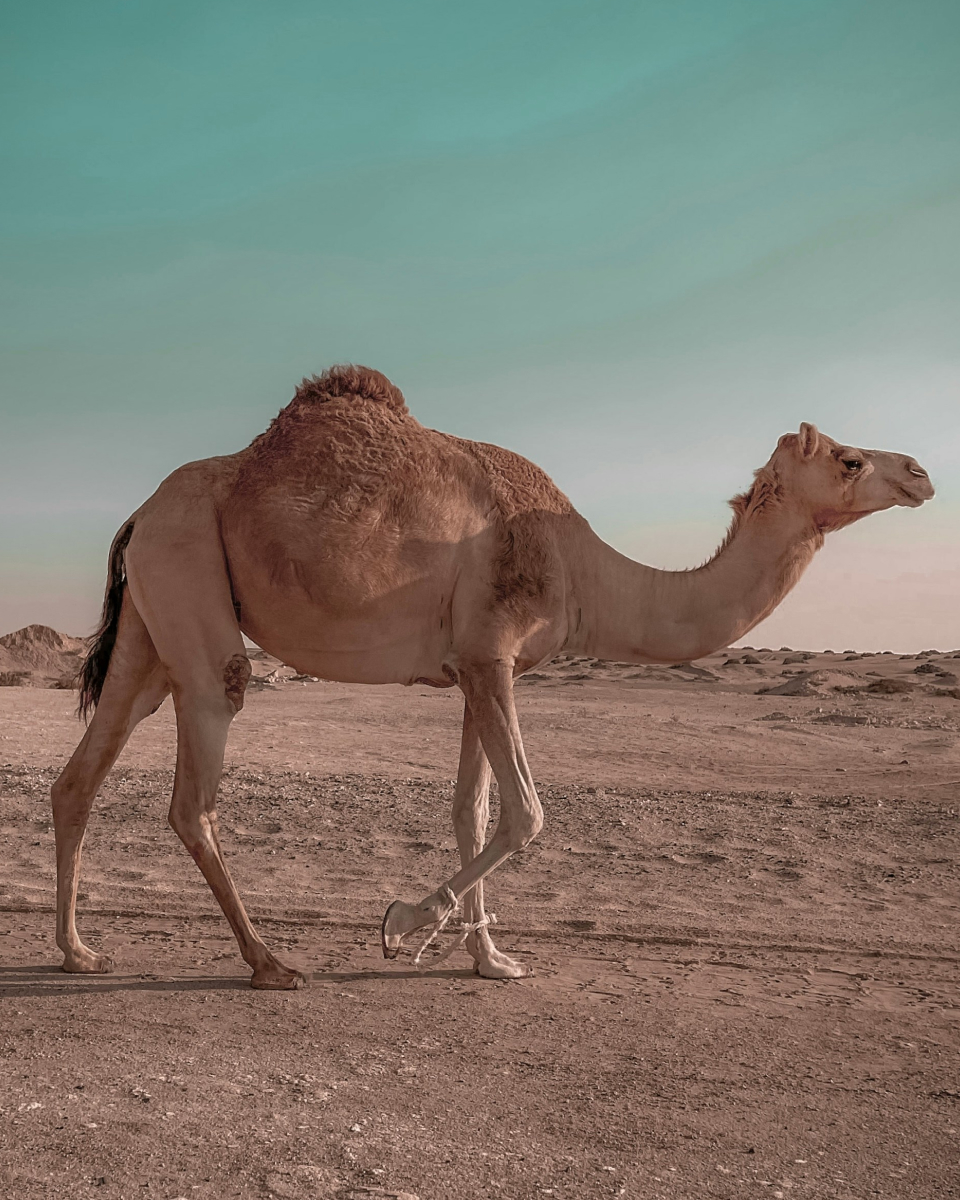
Photo by Jassim Shanavas
Dromedaries and Bactrian camels are large, long-lived, polygynous, social ruminants adapted to arid and semi-arid ecosystems. Key physiological traits include oval erythrocytes, high urine concentration capacity, variable body temperature regulation, and fat storage in the hump — adaptations enabling tolerance of heat, water scarcity, and nutritional stress that are without parallel in other domesticated species.
Social organisation is typically structured around small herds with one adult male, several females, and offspring. Males defend access to females and exhibit strong inter-male competition. Dromedaries show strong herd dependence — a psychometric battery study of 130 dromedaries documented significant variation in problem-solving, memory, and attention, with herd membership substantially modulating individual cognitive performance, interpreted as evidence of social cognition and collective intelligence effects. Experimental work on individually housed males in racing and leisure contexts shows development of stereotypic behaviours including repetitive movements and self-biting; providing one hour daily in a paddock and brief female exposure significantly reduced stereotypy frequency.
Systematic reviews covering camel welfare literature from 1980 to 2023 conclude that camels are sentient mammals capable of experiencing pain, fear, and stress, with welfare affected by handling, restraint, housing, transport, and management factors comparable in sensitivity to other large domestic herbivores.
Lifecycle Summary
Camel exploitation operates across four primary production systems — meat, dairy, draught and transport, and racing and tourism — plus a feral management system in Australia involving aerial and ground culling. The global population exceeds 40 million animals, with more than 80% in Africa and the remainder concentrated in the Arabian Peninsula, Central Asia, and South Asia. Extensive pastoralism is the dominant system globally, with intensive dairy operations expanding in Gulf states and Australia. Camels provide meat as either dedicated production animals or culled from dairy and work herds; milk is processed into pasteurised, fermented, and powdered products for domestic and export markets. Camelid heavy-chain-only antibodies — nanobodies — are derived from camel blood and represent an expanding biomedical and diagnostic application. Feral camels in Australia are managed through aerial and ground culling programmes, with some animals diverted into commercial meat supply chains.
Lifespan (Natural vs Exploited)
Potential dromedary longevity has been cited at up to approximately 50 years, though the maximum verified captive record is 28.4 years, with median life expectancy in managed contexts estimated at approximately 17.8 years. These figures are based on secondary compilations and are not robustly validated across production systems.
In extensive pastoral systems, working camels commonly remain in productive use into their late teens to early twenties, with mortality linked to disease, nutritional stress during droughts, injuries, and limited veterinary access.
In intensive dairy systems, high-producing cows are subject to controlled culling for reduced yield or health problems. Consolidated quantitative culling-age data from intensive dairy operations are not publicly available; internal facility data are not systematically reported.
In meat production, slaughter age ranges from 2–4 years in some commercial systems to more than 10 years for animals culled from dairy and work herds. Feral camel management programmes in Australia cull animals across all age classes.
Exploitation Systems
Camel exploitation operates across four production systems and one management system.
Meat production. Camels are slaughtered for meat as dedicated production animals or as culled animals from milk and work herds. Carcasses supply human meat markets in pastoral and peri-urban regions across Africa, the Middle East, and Central and South Asia, and enter pet meat supply chains in some markets including Australia. Feral camels in Australia have been commercially harvested for pet meat and processing under government-linked utilisation programmes.
Dairy production. Camel milk is an expanding industry in intensive operations — particularly in the United Arab Emirates and Saudi Arabia — and in semi-intensive pastoral systems across the Sahel, Horn of Africa, and parts of Central Asia. Outputs include pasteurised milk, fermented drinks, dried powder, and cheese for domestic consumption and export. Intensive dairy operations — such as the Emirates Industry for Camel Milk and Products (EICMP) — use mechanised milking, structured herd health programmes, and assisted reproduction to maximise yield and genetic progress.
Draught, transport, and work. Camels function as pack and riding animals for agricultural labour, goods transport, and herding, particularly across the Sahel, Horn of Africa, Arabian Peninsula, and parts of South Asia. Draught use is concentrated in extensive and semi-intensive pastoral systems where mechanical alternatives are inaccessible or unaffordable.
Racing, tourism, and leisure. Camels are used in camel racing — a significant cultural and commercial activity in Gulf states and parts of North Africa — and in leisure tourism including rides, trekking, festival performances, and caravans. These systems involve specific selection, conditioning, and training practices. Behavioural welfare concerns are documented for animals in individual housing typical of racing contexts.
Feral management. Approximately one million feral camels — descendants of domesticated animals — exist in Australia’s arid and semi-arid rangelands. They are managed through aerial culling by rifle from helicopters, ground-based shooting, and live mustering to abattoirs under the Australian Feral Camel Management Project and successor programmes. Some culled animals enter commercial processing for meat and by-products. Aerial density surveys have documented significant population reduction following management programme phases.
Biomedical and biotech extraction. Camelid heavy-chain-only antibodies — nanobodies — are derived from camel blood and used in the production of diagnostics and therapeutics. Camel milk components including immunoglobulins and insulin-like proteins are used in nutraceutical and functional food products. These applications are expanding but remain small relative to food production systems.
Living Conditions Across Systems
Extensive pastoral systems. Camels range over large areas with stocking densities dictated by rangeland carrying capacity. They feed on natural vegetation, maintain family group structures, and move daily. Shelter is absent beyond natural features; climatic exposure is high. Welfare concerns are linked to drought, disease, injuries, and limited veterinary access rather than confinement.
Semi-intensive systems. Animals are kept in paddocks or enclosures near settlements with night-time confinement and daytime grazing. Group housing is standard; pen sizes and stocking densities vary widely and are rarely reported systematically in the welfare literature.
Intensive dairy systems. Animals are confined in large paddock pens with dedicated catching areas, narrow races and crushes for individual handling, and structured exercise facilities including walking tracks and horse-walker devices in some operations. Movement is significantly restricted relative to pastoral systems. Mechanised milking and controlled reproduction are standard at scale.
Racing and leisure — individual male housing. Breeding and racing males are housed individually in stalls or boxes for management and safety. Experimental studies demonstrate that individually housed dromedary males develop stereotypic behaviours at elevated frequency; providing one hour of daily paddock access and brief exposure to females significantly reduced stereotypy, establishing a direct relationship between housing conditions and welfare outcomes.
Transport conditions. Camels are transported by road over long distances in trucks, often tethered or closely confined. Welfare reviews identify handling stress, long journey durations, and limited empirical data on stocking densities and injury incidence during road transport as significant concerns.
Feral management operations. Aerial culling involves locating and shooting animals from helicopters in remote terrain. Live mustering for abattoir transport involves aircraft-assisted herding into temporary enclosures, loading, and road transport. Conditions during these operations are not subject to standard agricultural welfare frameworks and are governed by wildlife management codes of practice.
Lifecycle Under Exploitation
Genetic Selection
In pastoral systems, selection is historically based on phenotypic assessment of milk yield, endurance, temperament, and coat quality by pastoralists. Intensive dairy and specialist breeding operations use structured selection programmes incorporating estimated breeding values for milk production, health traits, and docility. Research documenting heritable variation in behavioural type and cognitive performance in dromedaries suggests emerging selection pressure on behavioural traits in tourism and dairy systems. Selective Breeding operates across all intensive and semi-intensive systems.
Reproduction
Pastoral and semi-intensive systems use natural mating with controlled male access to female herds. Gestation is approximately 12–13 months; typical dromedary birth weight is approximately 37 kg. Intensive operations and specialist breeding centres use Artificial Insemination, Embryo Transfer, and semen cryopreservation to accelerate genetic progress and disseminate elite genetics — comparable in function to cattle ART programmes but adapted to camel reproductive physiology. Oestrus synchronisation uses gonadotropins and prostaglandins under veterinary supervision.
Birth & Early Life
In pastoral systems, calves remain with dams and suckle freely; human intervention is limited to assistance during dystocia when available. In intensive dairy systems, calves may be partially or completely separated from dams to allow controlled milking, with feeding via restricted suckling or artificial milk supply. Calf separation practices vary by facility and are not harmonised across the industry. Premature Weaning and Separation is structurally embedded in intensive dairy operations.
Growth & Rearing
In pastoral systems, young camels are reared within family groups and learn grazing routes and social norms; growth depends on forage availability and climatic conditions. In semi-intensive and intensive systems, growth is managed through formulated rations, controlled water access, and structured health programmes. Male calves not retained for breeding or racing are directed to meat production or culled at variable ages depending on local market conditions.
Production
Dairy. Lactating females are milked by hand in pastoral systems or by mechanical milking equipment in intensive operations, typically under structured routines with herd health management and biosecurity protocols. Milk Extraction is continuous throughout the lactation period.
Meat and draught. Camels in meat production are grown on pasture or in feedlots to target slaughter weights. Work animals perform load-carrying and transport functions under tack and harness. Conditioning and Training is central to the working life of draught, racing, and tourism camels.
Racing and tourism. Racing camels undergo intensive conditioning, dietary management, and training for competitive racing. Tourism and leisure camels are trained for controlled human contact and riding.
Transport
Live Transport moves animals between grazing areas, from farms to markets, and from holding facilities to slaughter plants by road. In Australia, feral camel management involves both live mustering and aerial culling; mustered animals are transported to abattoirs by road. Long-distance road transport for export to other producing regions occurs in some supply chains.
End of Life
Slaughter at abattoirs or municipal slaughter facilities terminates productive lives for meat animals and culled dairy and work camels. On-Farm Slaughter occurs for animals unfit for transport. Aerial and ground culling under wildlife management frameworks terminates the lives of feral camels outside standard abattoir infrastructure. Selective Culling removes non-productive or injured animals throughout the production cycle.
Processing
Post-slaughter processing includes dressing, chilling, cutting, packaging, and distribution for human and pet food markets. By-products — offal, hides, fat, and bones — enter leather, rendering, and feed supply chains. Camel hair and wool, primarily from Bactrian camels, is processed for textiles. Milk is processed into pasteurised products, fermented drinks, powder, and cheese, with export-oriented operations complying with importing country food safety standards. Nanobody extraction involves blood collection from live animals for antibody isolation and downstream pharmaceutical or diagnostic manufacturing.
Chemical Medical Interventions
Vaccines are used against regionally prevalent diseases including clostridial infections, rabies, and brucellosis, typically following adapted small-ruminant or cattle protocols. Formalised camel-specific vaccine schedules are less standardised than for cattle, particularly in extensive systems.
Antimicrobials including broad-spectrum antibiotics are used for mastitis, respiratory infections, and systemic disease in intensive dairy and meat systems. Concerns about antimicrobial resistance in camel populations have been raised in sustainability literature; systematic surveillance is limited.
Antiparasitic agents — anthelmintics and ectoparasiticides — are used to control internal and external parasites, with higher use frequency in intensive and semi-intensive systems where stocking density and environmental contamination risk are greater.
Reproductive hormones including gonadotropins and prostaglandins are used for oestrus synchronisation and superovulation in intensive ART programmes. Semen extenders and cryoprotectants are used in semen freezing. These protocols are comparable in function to cattle ART but adapted to camel reproductive physiology.
Sedatives and anaesthetics are employed for surgical procedures, transport conditioning, and some handling operations, following large-animal veterinary practice guidelines.
Castration of males is practised in work, tourism, and some meat production contexts to manage behaviour and reduce aggression. Identification Marking through branding and ear notching is practised regionally. Nose-peg insertion — inserting a wooden or plastic peg through the nasal cartilage for tethering control — is used in pastoral and draught systems in some regions. These physical modifications are not comprehensively quantified at a global level.
Slaughter Processes
Halal slaughter is the predominant method across most camel-producing countries. The standard procedure involves the animal in lateral recumbency or standing, followed by throat cutting severing the major blood vessels and trachea, and exsanguination. Regulatory approaches to pre-slaughter stunning vary significantly by jurisdiction and certifying body. In Australia, halal slaughter of large animals generally requires or permits reversible stunning; other major producing regions permit or require non-stunned slaughter. Camel-specific validation data for effective stunning parameters are limited, and welfare assessments identify the need for species-specific stunning research.
Where pre-slaughter stunning is applied, methods likely include penetrating captive bolt or firearm techniques adapted from cattle, though specific camel-adapted protocols and documented failure rates are not available in the public literature.
Feral camel culling in Australia uses rifle-based shooting from helicopters in aerial operations and ground-based shooting in follow-up operations, conducted under wildlife culling codes of practice rather than abattoir regulatory frameworks. These operations occur in remote rangelands with no access to standard slaughter infrastructure.
Camel slaughter throughput in most facilities is low relative to cattle and sheep, with many operations in pastoral regions occurring at small-volume municipal or local plants.
Slaughterhouse Labour Impact
Camel-specific occupational health and safety data from slaughter and processing operations are not available in the literature. Workers handling camels in slaughter and processing are exposed to risks associated with large-animal handling, restraint, and processing, but injury rates and psychological impact data have not been published for this sector specifically.
Feral camel culling operations present a distinct occupational risk profile: work in remote terrain, firearms use, and aircraft operations. Project reports from Australian feral camel management programmes emphasise the need for specialised training and safety protocols but do not provide quantitative injury statistics.
Workforce demographics across camel processing and pastoral systems — particularly in African and Middle Eastern production contexts — are not documented in available peer-reviewed sources. These represent a significant data gap given that the majority of the global camel population is managed by pastoral communities across sub-Saharan Africa and the Horn of Africa.
Scale & Prevalence
FAO-derived estimates place the global camel population at more than 40 million, with over 80% in Africa. The dromedary dominates the global total, concentrated in sub-Saharan Africa, the Sahel, Horn of Africa, and Arabian Peninsula. Domestic Bactrian camels are concentrated in Central and East Asia, primarily China, Mongolia, and Kazakhstan. Wild Bactrian camels number fewer than 1,000 individuals across remote desert regions of China and Mongolia.
Major national populations (approximate 2023 figures from FAO-derived sources): Chad 10.7 million, Somalia 7.5 million, Sudan 4.8 million, Kenya 4.3 million, Saudi Arabia 2.0 million, Niger 1.9 million, Ethiopia 1.8 million, Mauritania 1.5 million, Mali 1.3 million, Pakistan 1.1 million, China 0.58 million, United Arab Emirates 0.58 million, Mongolia 0.47 million.
Most camels globally are managed in extensive or semi-intensive pastoral systems. Intensive dairy operations represent a small but expanding fraction, concentrated in Gulf states. Camel racing systems are concentrated in Gulf states and North Africa. Feral camel populations in Australia have declined following large-scale management programmes, with aerial survey data confirming significant density reduction across programme phases.
The overall production trend is expansion: camel numbers and milk production volumes are increasing in multiple regions, driven by climate change, desertification increasing the relative advantage of camels over cattle in arid zones, and growing demand for camel dairy products. Intensification of dairy systems is a documented directional trend in Gulf-state production.
Ecological Impact
Extensive camel pastoralism in the Sahel, Horn of Africa, and Arabian regions occupies large rangeland areas. Ecological impacts include competition with other livestock and wildlife for forage and water, vegetation degradation under high stocking densities, and soil compaction. These dynamics are broadly comparable to other ruminant pastoral systems but camel-specific quantitative impact data are limited.
Water use presents a significant system-specific contrast between extensive and intensive production. In traditional Bedouin-style systems, camels have notably lower water requirements than cattle and small ruminants. Intensification with irrigated fodder crops substantially increases water demand: in Saudi Arabia, the shift from Bedouin to intensive management increased water consumption per animal by a factor of 3.2, and national water use associated with intensive camel systems increased from approximately 7,000 m³ to approximately 860,000 m³ over 50 years — a more than 100-fold increase — while Bedouin-style system water use increased from approximately 180,000 m³ to 280,000 m³ over the same period.
Enteric fermentation in camels produces methane; emission factors are less precisely quantified than for cattle. Extensive pastoral systems in Sahelian environments contribute to regional greenhouse gas budgets via enteric fermentation and manure decomposition, with ruminants in these systems emitting tens of kilograms of methane per animal per year depending on diet and species.
Feral camels in Australia are associated with documented damage to native vegetation, competition with native fauna for waterholes, and damage to cultural and infrastructure assets. Population management programmes have reduced these impacts across targeted regions, as confirmed by aerial density surveys.
Wild Bactrian camel habitat is threatened by competition from domestic livestock for pasture and water sources, habitat degradation, and contamination, creating documented interaction between domestic production systems and the conservation status of the wild species.
Language & Abstraction
Production-oriented classification terms — “dairy camel,” “meat camel,” “dry camel,” “cull camel,” “racing camel,” “work camel” — define individual animals by their assigned function within a production system, erasing multi-purpose use common in pastoral contexts and framing culling and replacement as resource allocation decisions.
In Australian legislation and environmental management documents, feral camels are classified as “pest animals” within invasive species frameworks, positioning them as threats to ecological and infrastructure assets to be managed rather than as animals subject to welfare considerations. “Density reduction,” “population control,” “aerial culling,” and “commercial utilisation” are the operative terms in feral management discourse, absorbing mass killing into ecological management and resource recovery categories.
Halal slaughter regulatory language frames camel killing through religious certification procedures and “humane slaughter” standards, with variation in whether pre-stunning is described as compatible with or required for halal certification. The term “reversible stunning” positions pre-slaughter electrical or captive bolt intervention as a procedure that does not compromise the animal’s ritual eligibility for slaughter, framing the regulatory distinction primarily as a certification question rather than a welfare outcome question.
Dairy marketing for intensive camel operations uses terms aligned with the broader dairy industry — “milk production potential,” “herd health management,” “selective breeding programme,” “biosecurity plan” — positioning camel dairy as an emerging modern production sector and abstracting individual animals into units of productive output and health management.
“Nanobody” as a product term describes a biomedical and diagnostic material derived from camelid blood without referencing the extraction process or the animals involved. The term’s function is entirely product-forward: it identifies a molecular structure by diminutive naming (nano- + antibody fragment) without connecting it to camel exploitation.
Terminology
Dairy camel, meat camel, breeding male, breeding female, dry camel, lactating camel, racing camel, leisure camel, work camel, pack camel, draught camel, cull camel, feral camel, pest camel, herd health management, genetic selection, selective breeding, assisted reproduction, embryo transfer, artificial insemination, camel milk, raw camel milk, pasteurised camel milk, fermented camel milk, camel cheese, camel milk powder, camel meat, carcass, offal, pet meat, rendering, hide, leather, camel hair, camel wool, live export, mustering, aerial culling, ground culling, population control, density reduction, commercial utilisation, slaughter line, halal slaughter, non-stun slaughter, reversible stunning, nanobody.
Within The System
Developments
Report a development: contact@systemicexploitation.org
Notice an inaccuracy or omission?
If you believe information on this page is incorrect, incomplete, or missing important context, you may submit a suggested correction for review.