
Raccoon Dogs
Scientific Name:
Nyctereutes procyonoides
Scope
Covers the common raccoon dog Nyctereutes procyonoides (Gray, 1834), including recognised subspecies N. p. procyonoides (continental Asia) and N. p. viverrinus (Japanese raccoon dog/tanuki, sometimes treated as N. viverrinus). Populations included: wild native populations in East Asia; wild invasive and introduced populations across northern and western Europe; farmed and ranched populations for fur, primarily in China and historically in Finland and other countries; and captive populations in zoos and research facilities. Excludes purely cultural or symbolic representations of tanuki without live-animal use and non-raccoon-dog canids mislabelled in trade. Farmed animals are selectively bred for fur traits but are not fully domesticated in the sense of long-term selection for companion or work roles.
Species Context
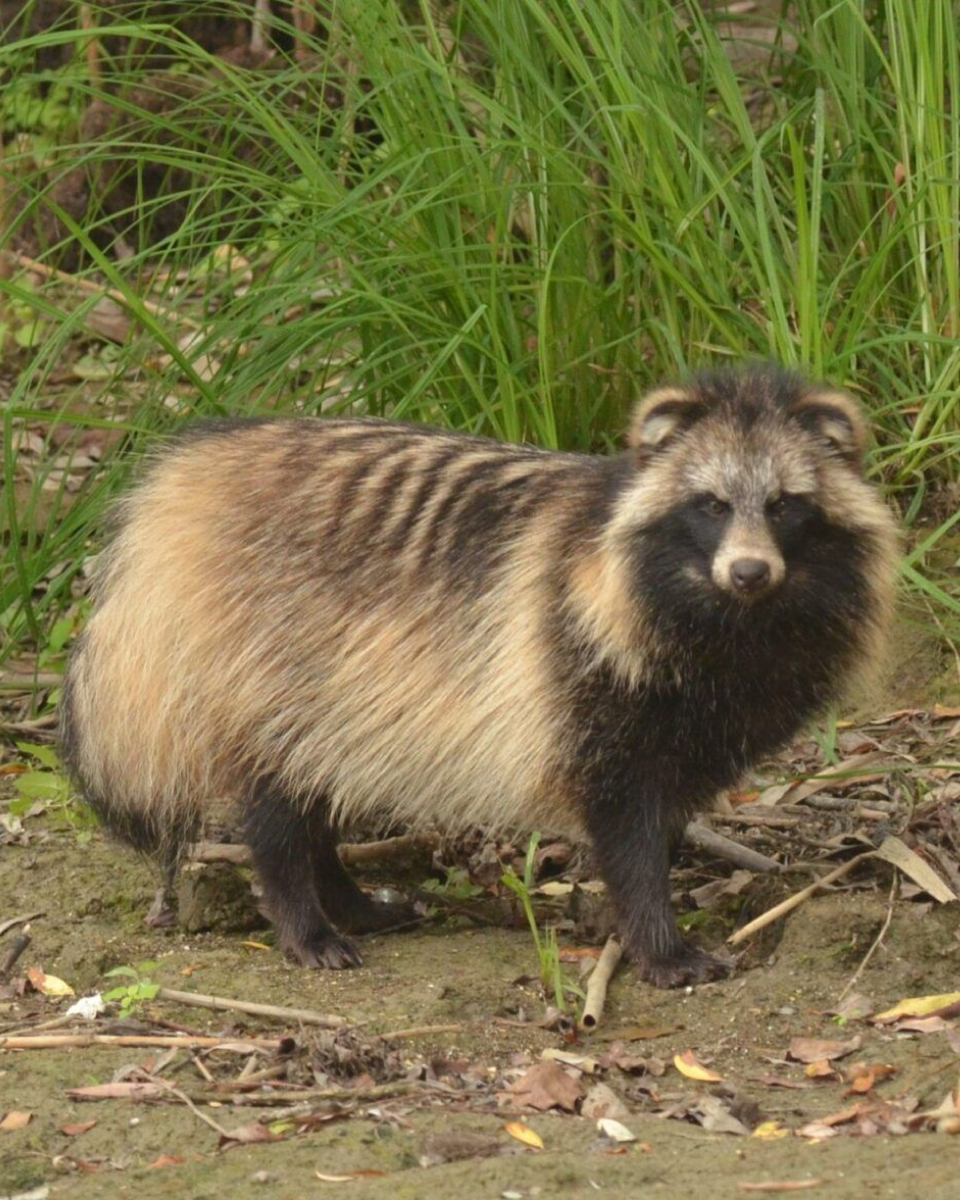
Photo by Wild Travel
Raccoon dogs are medium-sized canids — typically 4–10 kg — with dense fur and a distinctive facial mask resembling raccoons, to which they are not closely related. They are native to northeastern Asia, occupying mixed forests, wetlands, agricultural mosaics, and peri-urban environments. They are crepuscular to nocturnal, omnivorous opportunists consuming small mammals, birds, amphibians, invertebrates, carrion, and plant material. In colder climates they undergo seasonal torpor — a winter sleep — unique among canids. Home ranges are organised around monogamous pairs with associated offspring; olfactory communication via latrines is central to territorial and social signalling.
Raccoon dogs demonstrate flexible foraging and habitat use typical of generalist canids, indicating learning capacity and behavioural adaptability. As canids, they exhibit physiological stress responses — HPA axis activation — and behavioural indicators including freezing, escape attempts, and stereotypies under confinement and handling, as documented for fur-farmed canids. Scientific consensus supports mammalian sentience and canid cognitive capacities in this species, including nociception, social communication, and associative learning, consistent with broader canid cognition research.
Lifecycle Summary
Raccoon dog exploitation operates across two structurally distinct systems: commercial fur farming, and invasive species management in Europe. Fur farming is the primary commercial system, with China as the dominant producer and Finland historically significant. Animals on fur farms are killed at less than one year of age — typically in the first autumn or winter following their birth — when winter pelt quality reaches target values. Raccoon dog fur is routinely mislabelled in trade under names including “raccoon,” “Finnraccoon,” and generic “fur trim,” obscuring the species identity of the source animal. The global fur industry has contracted significantly; raccoon dog farming has declined in Europe, though China remains a major production centre. Invasive raccoon dog populations established in Europe through Soviet-era releases and escapes (1927–1957) are managed through lethal and non-lethal control programmes under EU biodiversity and disease prevention frameworks. There is no food processing chain for raccoon dogs; carcasses are disposal outputs in both systems.
Lifespan (Natural vs Exploited)
Wild raccoon dog lifespan estimates are based on age-structure analyses of harvested and trapped populations, which bias toward younger individuals. Age-structure data indicate most wild individuals die before 5–7 years; oldest males recorded in approximately the 5.5-year class and females in approximately the 7.5-year class.
In captive non-production settings such as zoos, raccoon dogs can live more than 14 years, indicating potential maximum lifespan under protected conditions with veterinary care.
On fur farms, pelt animals are killed at less than one year of age — typically in the first autumn or winter after birth — to coincide with prime winter fur quality. Breeding stock is maintained for multiple years but represents a minority of total farmed animals and is culled when reproductive performance declines.
Wild mortality causes include hunting and culling, road traffic collisions, disease (rabies, canine distemper, sarcoptic mange, parasites), starvation during harsh winters, and predation. Farm mortality causes include planned first-year killing for pelts, culling of surplus or underperforming breeders, disease outbreaks in confined conditions, stress-related conditions, and injuries.
Exploitation Systems
Raccoon dog exploitation operates across two structurally distinct systems.
Fur farming. The primary commercial exploitation system. Raccoon dogs are bred in cage-based systems for their pelts, which enter global fashion supply chains as garments, trim, accessories, and decorative applications. China is the dominant producing country, supplying the large majority of global raccoon dog fur. Finland historically produced a premium product marketed as “Finnraccoon,” but production has declined substantially. Raccoon dog fur is frequently sold under mislabelled or generic product names — “raccoon,” “Finnraccoon,” “fur trim,” “natural fur” — that obscure the species identity. This mislabelling is documented across multiple supply chain investigations and makes consumer identification and species-specific oversight difficult. Carcasses after pelting are rendered or disposed of as animal by-products; they are not a managed production output.
Invasive species management. Raccoon dogs were introduced to European Russia and parts of Eastern Europe from 1927 onward for fur farming and were released deliberately into Soviet territory to supplement wild game; escapees and range expansion established invasive populations now present across Finland, Sweden, Norway, Poland, Germany, and other Northern and Western European countries. These populations are targeted by culling programmes under EU invasive alien species regulation and national biodiversity and disease control frameworks. Management methods include trapping, shooting, use of trained hunting dogs, and coordinated early-warning and rapid-response systems implemented under EU LIFE projects. Invasive raccoon dogs act as reservoirs for rabies, Echinococcus multilocularis, and sarcoptic mange, motivating control on public health as well as ecological grounds.
Zoo and exhibition holdings. Minor in scale. Raccoon dogs are kept in some zoo collections and occasionally as exotic pets. This system is not purposefully managed for a primary output and is excluded from Key Industries.
Living Conditions Across Systems
Intensive fur farms. Standard practice is individual or pair housing in wire-mesh cages, typically elevated with mesh floors. Reported cage surface areas are commonly around 0.6–1.0 m² per cage, with cage heights of approximately 75 cm. Cages are typically unstructured or minimally structured — sometimes a nest box — with no soil substrate for digging, no opportunity for territorial ranging, and no environmental complexity comparable to the species’ natural habitat. Animals are housed singly or in breeding pairs; offspring may share cages briefly during rearing before separation to individual cages.
The sensory environment in fur farm sheds involves chronic exposure to visual, olfactory, and auditory stimuli from closely spaced conspecifics and human activity, with limited opportunity for retreat or withdrawal. Wire floors restrict movement and prevent the digging, foraging, and territorial behaviours central to the species’ ethology. Welfare assessments of fur-farmed canids identify confinement, movement restriction, barren environments, and social isolation as primary welfare risk factors; these apply structurally to raccoon dog farm conditions.
Invasive population management. Animals in European wild or semi-wild habitats subject to management operations are live, free-ranging until capture or shooting. Trapping imposes acute confinement in box traps or leg-hold devices until the trapper returns. Wild animals subject to shooting experience no prior confinement.
Lifecycle Under Exploitation
Genetic Selection
On fur farms, Selective Breeding targets pelt density and colour, body size, growth rate, litter size, maternal performance, and temperament traits that facilitate handling. Breeding records are maintained at farm level. In China, national breeding guidance for fur-bearing animals exists but species-specific raccoon dog line data are not widely documented in accessible international literature.
Reproduction
Breeding animals are maintained for multiple seasons. Controlled mating occurs in late winter or early spring, aligned with the species’ natural seasonal breeding cycle. Specific male and female pairings are managed according to farm breeding plans. Gestation is approximately 60 days; litters commonly number 6–9 pups, though ranges vary by management system. Pups are born in nest boxes or enclosed cage compartments.
Birth & Early Life
Early-life management focuses on survival and growth with limited human handling except for essential husbandry tasks. Neonatal mortality is linked to dystocia, maternal neglect, infectious disease, and intra-litter competition. Pups remain with the dam until weaning.
Growth & Rearing
After weaning, juveniles are housed in small groups, then progressively separated into individual cages. Diet consists of compound feeds or mixed rations containing fish, meat by-products, cereals, and fats, formulated for fur-bearing carnivores. Feeding is scheduled once or multiple times daily. Growth management focuses on achieving target pelt quality before the first winter.
Production
Raccoon dogs used for pelts have no ongoing production phase — their entire body is converted into a single pelt product at slaughter. The productive phase is simply the growth period from birth to first-winter pelting age. Breeding animals are the only subgroup maintained beyond the first season; they undergo repeated annual reproductive cycles with their productive function being genetic contribution to the next cohort.
Transport
Within farms, animals are moved short distances via handling or small transport cages between housing and killing or processing areas. For live transport between farms or to centralised processing facilities, animals are confined in transport crates; raccoon dog-specific transport regulations are generally embedded in broader fur-animal or canid transport frameworks rather than separately specified.
End of Life
On fur farms, killing occurs when pelt quality reaches target in late autumn or early winter of the first year. Documented killing methods include electrical killing — electrodes applied to the mouth and anus to induce cardiac arrest — gassing with carbon monoxide or carbon dioxide in chambers, cervical dislocation, blunt force trauma, and, historically or in some regional contexts, poisoning with strychnine. Welfare organisations have reported instances of animals regaining consciousness during or after skinning when gas or electrical methods are applied ineffectively; systematic peer-reviewed failure-rate data specific to raccoon dogs are not available.
In invasive species management, killing methods include shooting and trapping followed by shooting at close range under national hunting and invasive species management legislation.
Processing
Carcasses are skinned; pelts are fleshed, dried, graded, and sorted before tanning and finishing for garment manufacturing. Tanning involves chemicals including chromium salts and formaldehyde-based agents. Non-pelt tissues are rendered or disposed of as regulated animal by-products. Pelt processing and tanning generate chemical waste streams associated with occupational and environmental risks.
Chemical Medical Interventions
Oral rabies vaccination of wild raccoon dogs is a documented and distinctive intervention in the invasive species management system. Vaccine baits are distributed along border areas and in managed zones to control rabies transmission through invasive European populations. Named vaccines include SAD B19 (older generation) and SPBN GASGAS — marketed as Rabitec — delivered in PVC blisters embedded in fish-based bait matrices and marked with tetracycline as a bait-uptake indicator. This represents a pharmaceutical intervention directed at wild rather than captive animals — a system feature with no equivalent in other records in this database.
On fur farms, vaccinations likely include standard canine vaccines — against distemper, parvovirus, and adenovirus — by analogy with fox and mink farm protocols; raccoon dog-specific vaccination schedules are not documented in accessible international literature. Anthelmintics and ectoparasiticides used in dog and fox management are extrapolated as probable treatments for internal and external parasites in farmed raccoon dogs; species-specific protocols are not systematically reported.
No raccoon dog-specific growth promoter or hormonal growth agent use is documented in accessible literature. In many jurisdictions hormonal growth promoters are restricted for food animals; regulatory frameworks for fur animals can differ, but public data on raccoon dog-specific use are sparse.
For killing in veterinary or management contexts, injectable barbiturates or other euthanasia agents may be used; commercial fur farm killing relies primarily on physical or gas methods due to cost and throughput considerations.
Pelt tanning involves chemical exposure for workers — chromium salts, formaldehyde-based agents, and organic dust — documented as occupational health hazards in fur processing facilities.
Slaughter Processes
Commercial fur farm killing methods documented for raccoon dogs and other fur-bearing carnivores include electrical killing — electrodes applied to the mouth and anus to induce cardiac arrest — which allows killing of multiple animals efficiently; gassing with carbon monoxide from engine exhaust or bottled carbon monoxide or carbon dioxide in chambers; cervical dislocation and blunt force trauma in smaller-scale or emergency contexts; and in some regional or historical contexts, poisoning with strychnine causing respiratory paralysis.
Welfare organisations have reported documented instances of animals regaining consciousness during or after skinning when gassing or electrical methods are not effectively applied — a failure mode producing conscious skinning. Systematic peer-reviewed failure-rate data specific to raccoon dogs are not available; reports derive primarily from NGO investigations and cannot be treated as representative prevalence statistics.
Raccoon dog-specific killing regulations are generally embedded in national fur animal legislation rather than separately specified; documented performance standards or failure-rate monitoring for raccoon dog killing are not publicly available.
In invasive species management in Europe, wild raccoon dogs are killed by shooting during culling or hunting operations, and by shooting at close range following trap capture. These operations are conducted under national hunting and invasive species management frameworks.
Religious slaughter frameworks are not applicable; raccoon dogs do not enter food supply chains governed by halal or kosher requirements.
Slaughterhouse Labour Impact
A peer-reviewed occupational health study of fur-processing workers (Jaakkola et al., Journal of Occupational Health, 2003) documents specific respiratory outcomes. Among 138 exposed workers in fur processing facilities, 37.9% of females reported chronic cough, 28.4% chronic phlegm, 10.5% dyspnoea, and 22.1% chest tightness — significantly elevated compared with control workers. Seven of 138 exposed workers had abnormal chest X-ray findings. Anti-fungal antibodies were significantly elevated, identifying bioaerosols — particularly fungal spores — as the primary allergen pathway. Measured dust concentrations of 1.8–6.7 mg/m³ remained below the general 10 mg/m³ health limit but were associated with respiratory symptoms; fungal colony counts ranged 629–3,681 cfu/m³. These findings are from 2003 and may not reflect current protective equipment use or regulatory conditions.
Workers are additionally exposed to chemical hazards during tanning and finishing — including chromium compounds and formaldehyde-based agents — and to physical injury risks from handling carnivore species with bite and scratch capacity. Psychological impacts associated with routine killing documented in broader fur industry and slaughterhouse worker literature apply structurally to raccoon dog farm operations.
Workforce demographics for raccoon dog-specific processing facilities are not separately reported; the fur processing industry in major producing countries relies substantially on rural and seasonal labour, consistent with other fur species.
Scale & Prevalence
Raccoon dogs are among the principal fur species globally alongside mink and fox, with China the dominant producing country. Species-specific annual pelt volumes are not consistently disaggregated from aggregate fur industry and FAO statistics; global totals for raccoon dog pelts specifically are not available in accessible public databases.
Finland historically produced a premium raccoon dog fur product marketed as “Finnraccoon” — a significant brand in European luxury fur markets — but production has declined substantially from peak levels. Current Finnish production is much lower, though up-to-date raccoon dog-specific figures are not consistently published. The broader global fur industry experienced substantial contraction from a mid-2010s peak due to consumer shifts, animal disease outbreaks (particularly COVID-19-related mink culling and SARS-CoV-2 concerns), and expanding legislative bans; raccoon dog farming has declined in parts of Europe as part of this trend.
Invasive raccoon dog populations in Europe were established through deliberate Soviet-era releases between 1927 and 1957, and subsequent range expansion and further escapes. Populations are now present across Finland, Sweden, Norway, Poland, Germany, and other Northern and Western European countries. Native range populations in northeastern Asia remain widespread and are not considered threatened.
The trend for farmed raccoon dog production is contraction in Europe, with China remaining a major producing country subject to global market pressures. Invasive European populations are stable or expanding absent intensive management, with localised reductions where sustained LIFE project control operations are implemented.
Ecological Impact
Invasive raccoon dogs in Europe pose documented ecological risks through predation on ground-nesting birds, amphibians, and small vertebrates — with particular documented impact on wetland and ground-breeding bird communities — and through disease transmission. Raccoon dogs can act as reservoir hosts for rabies, Echinococcus multilocularis (causing alveolar echinococcosis in humans), and sarcoptic mange, with transmission risks to native wildlife, domestic animals, and human populations. These risks motivate control programmes operating under EU Regulation 1143/2014 on invasive alien species and under national rabies control frameworks.
Fur farming contributes environmental burdens shared with other carnivorous fur species. Life-cycle assessments of fur farming document high climate change impacts and eutrophication potential per unit of product relative to many textile alternatives, driven by feed production (fish, meat by-products, cereals), manure management, and energy use in housing and processing. Nutrient-rich effluents from manure and carcass disposal can contribute to local water and soil contamination. Pelt tanning and finishing involve chromium salts and formaldehyde-based agents that pose environmental risks if released into water systems. These environmental impact figures are from LCAs covering multiple fur species and are not raccoon dog-specific.
Language & Abstraction
The most significant abstraction function in raccoon dog trade is mislabelling. Raccoon dog fur is routinely sold under product names including “raccoon,” “Finnraccoon,” “raccoon fur,” “raccoon trim,” and generic labels such as “natural fur” or “fur trim.” These designations allow the species identity of the source animal to be obscured at the point of consumer contact, making species-specific product avoidance difficult and reducing accountability within supply chains. “Finnraccoon” functions as a geographic and quality brand that positions the product within a premium Scandinavian narrative while removing “dog” from the species designation entirely.
In European regulatory and management documents, invasive raccoon dog populations are classified as “invasive alien species,” “harmful invasive species,” or “pest species” — categorisations that frame the animals primarily through their ecological threat function and authorise lethal control as a management default. “Target species” and “reservoir species” in rabies and Echinococcus management literature further abstract individuals to their roles in epidemiological systems, positioning killing as public health infrastructure rather than individual mortality.
In fur industry contexts, production lifecycle terminology — “breeding stock,” “juveniles,” “weaners,” “pelting season,” “harvest,” “culling,” “processing” — organises animal lives around production stages and material outputs. “Harvesting” and “culling” describe killing in resource extraction and population management language. “Fur-bearing animals” as a regulatory category aggregates raccoon dogs with mink, foxes, and other species, enabling generalised standards that do not capture species-specific conditions or welfare requirements.
Terminology
Raccoon dog, common raccoon dog, tanuki, Finnraccoon, raccoon fur, raccoon trim, fur trim, natural fur, fur-bearing animal, breeding stock, breeder female, breeder male, weaner, juvenile, pelt, skin, hide, pelting season, harvest, cull, culling, processing, by-product, invasive alien species, pest species, target species, reservoir species, vector species.
Within The System
Developments
Report a development: contact@systemicexploitation.org
Notice an inaccuracy or omission?
If you believe information on this page is incorrect, incomplete, or missing important context, you may submit a suggested correction for review.