
Cephalopods (Squid & Octopus)
Scientific Name:
Class Cephalopoda — principal genera: Octopus (esp. O. vulgaris), Illex, Todarodes, Dosidicus, Loligo, Doryteuthis, Nototodarus
Scope
Covers commercially exploited squid and octopus within class Cephalopoda: order Octopoda (octopuses, primarily Octopus vulgaris and related species) and the squid orders Teuthida, Oegopsida, Myopsida, and Loliginida, including principal commercial genera Illex, Todarodes, Dosidicus, Loligo, Doryteuthis, and Nototodarus. Covers wild-caught populations harvested in industrial and small-scale capture fisheries globally, and experimental and emerging aquaculture systems for O. vulgaris and some coastal squid species. Excludes cuttlefish (order Sepiida) and nautiluses (order Nautilida) except where sources aggregate “cephalopods” without species breakdown. No fully domesticated or selectively bred commercial lines exist; selective breeding is at research and pilot stages only.
The record title uses “Cephalopods (Squid & Octopus)” as the display name. Cuttlefish are excluded from scope; nautiluses are excluded. Body content uses species-level names where data are disaggregated and collective terms where they are not.
Species Context
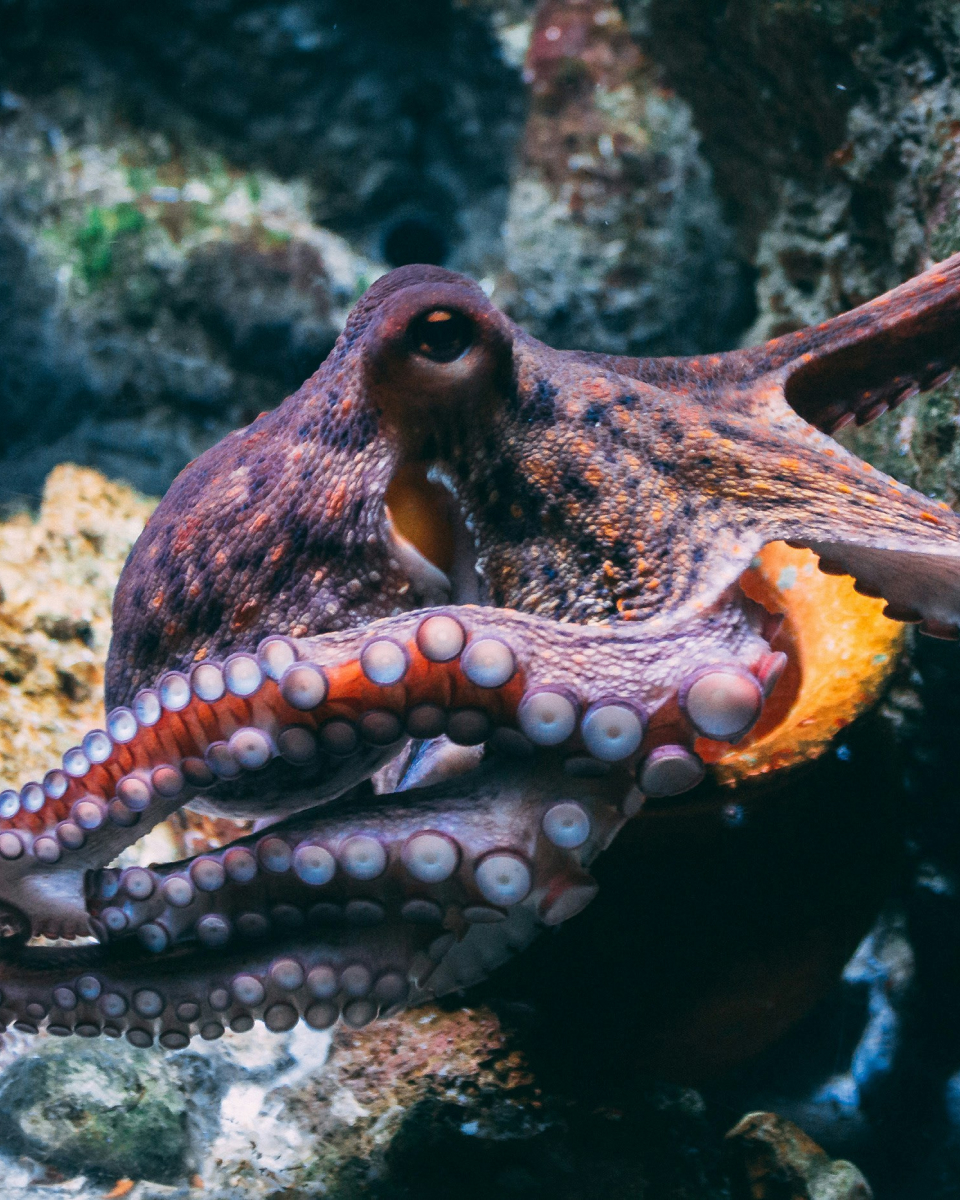
Photo by Diane Picchiottino
Cephalopods are fast-growing, short-lived marine molluscs with high metabolic rates, well-developed camera eyes, large centralised brains, and extensive peripheral nervous systems distributed through their arms. Most commercially exploited squid and octopus species are semelparous — reproducing once and dying — with lifespans of approximately 1–3 years.
Octopuses are primarily solitary, with small defended home ranges and benthic habitat preferences for dens and crevices. Most squid are schooling species forming large aggregations during feeding and spawning migrations. Environmental needs differ substantially: octopuses require shelter, substrate, and stable high-quality benthic conditions; squid require pelagic space, adequate dissolved oxygen, and appropriate light regimes for schooling behaviour.
Captive cephalopods display documented stress responses including colour pattern changes, inking, escape attempts, reduced feeding, stereotypic locomotion, and immunological and metabolic changes in response to poor water quality, high density, and handling. These responses indicate functional pain and stress systems operating at the individual level.
A 2026 review of cephalopod sentience (Schnell et al., Biological Reviews) assessing eight neural and behavioural criteria concluded strong evidence of sentience in octopus, good evidence in cuttlefish and squid, and emerging evidence in nautilus. The authors note that failures to meet criteria in some species reflect data gaps rather than evidence against sentience. This represents a significant update to the scientific consensus, with direct implications for the regulatory status of cephalopods as sentient animals in jurisdictions that do not yet extend protections to invertebrates. Octopuses demonstrate problem-solving, maze learning, long-term memory, individual visual recognition, and complex prey handling; they are covered by research animal protections under EU and UK legislation.
Lifecycle Summary
Cephalopod exploitation is almost entirely based on wild capture fisheries. Global cephalopod capture in 2022 reached approximately 2.76 million tonnes, with squid dominating by volume. Octopus and squid are short-lived semelparous animals with natural lifespans of approximately 1–3 years; in capture fisheries they are taken at juvenile or adult stages without prior human management of their development. Killing occurs without validated stunning — typically by asphyxia, ice chilling, or direct freezing. Commercial-scale cephalopod aquaculture does not yet exist; the most advanced proposal — an intensive octopus facility by Nueva Pescanova on Gran Canaria — failed environmental impact assessment and has been subject to sustained regulatory and scientific challenge. O. vulgaris paralarvae survival rates below 10% by day 60 represent a technical barrier to commercial aquaculture viability. A 2026 peer-reviewed review in Biological Reviews concluded strong evidence of sentience in octopus and good evidence in squid, a scientific development with direct relevance to how exploitation practices are assessed across both the fisheries and proposed aquaculture systems.
Lifespan (Natural vs Exploited)
Most commercially exploited squid and octopus species have natural lifespans of approximately 1–3 years. Octopus vulgaris typically lives 1–2 years; Dosidicus gigas approximately 1–3 years. All commercially exploited species are semelparous — they reproduce once and die, with senescence following reproduction regardless of exploitation.
In well-managed laboratory conditions, some octopuses reach or slightly exceed typical wild lifespan, with senescence occurring post-reproduction as in wild animals.
In proposed aquaculture systems, production cycles of approximately 6–12 months from hatch to slaughter are planned — shorter than potential natural lifespan but consistent with the species’ rapid growth trajectory. Early-life mortality in aquaculture contexts is extremely high: O. vulgaris survival is approximately 30–40% by day 40 and below 10% by day 60 under current captive-rearing protocols, representing a fundamental constraint on commercial viability.
In wild capture fisheries, animals die through capture stress, asphyxia on deck, barotrauma from rapid hauling from depth, physical injury in nets and gear, or direct freezing without prior stunning. Discard of non-target or undersized individuals is documented across major fisheries.
Exploitation Systems
Cephalopod exploitation operates across one dominant system and one emerging proposed system, with a secondary research use.
Wild capture fisheries. The dominant and currently near-total system. Industrial offshore squid fisheries using trawls, purse seines, jig systems, and driftnets operate at large scale in the Western and Central Pacific, Eastern Central Pacific, Southwest Atlantic, and Indian Ocean. Squid jigging uses powerful artificial lights at night to attract aggregations. Coastal octopus fisheries use bottom trawls, pots and traps, and artisanal hand-lines across Northwest Africa, the Mediterranean, the Western Pacific, and Latin America. In some octopus fisheries, females guarding eggs are targeted. Capture volumes are reported at the fishery and aggregate level; species-level disaggregation is incomplete in major FAO reporting.
Proposed intensive aquaculture. No commercial-scale cephalopod aquaculture currently operates. The most advanced proposal — an intensive octopus farm by Nueva Pescanova in Gran Canaria, Spain — targets up to one million octopuses annually at full operation using land-based recirculating tank systems with planned stocking densities of 10–15 octopuses per cubic metre. The project failed environmental impact assessment and has not passed all regulatory approvals as of early 2026. Experimental and pilot aquaculture systems for O. vulgaris and some squid species operate at research scale.
Biomedical and neuroscience research. Cephalopods, particularly octopus and squid, are used in neuroscience, behaviour, physiology, and materials science research. Squid giant axon and cephalopod chromatophores are established models in neurobiology and biophotonics. Cephalopods are covered by research animal protections in the EU and UK. Research use involves captive holding in tanks under controlled conditions; biological samples are collected post-mortem.
Living Conditions Across Systems
Wild capture — pre-capture. Animals live in natural ocean conditions; exploitation affects them from the point of encounter with fishing gear onward.
Onboard holding and storage. Captured animals are held in bins, boxes, or tanks with ice or refrigerated seawater until landing. Space is constrained by vessel size. High piling of animals on deck and in containers is characteristic of industrial operations; exact holding densities onboard are not systematically reported.
Proposed intensive octopus aquaculture. The Nueva Pescanova plan specifies 10–15 octopuses per cubic metre in grow-out tanks — substantially higher than densities used in research systems. Octopuses are naturally solitary and territorial; housing at these densities implies frequent physical contact and competition for shelter. The proposal was criticised by welfare and environmental assessors for inadequate environmental complexity, limited shelter relative to animal numbers, and specification of ice slurry as the killing method. Water quality management in recirculating systems is critical; failures in oxygenation, temperature control, or filtration can cause rapid mass mortalities.
Hatchery and early life (aquaculture). Paralarvae are reared in circular flow tanks with live planktonic prey; survival is highly sensitive to water flow, light regime, and prey availability. Under current protocols, survival below 10% by day 60 represents the primary technical constraint on commercial-scale production.
Research facilities. Laboratory cephalopods are typically housed individually or in small groups under controlled seawater conditions with enrichment including dens, substrates, and hiding objects. Experimental requirements — tagging, cannulation, behavioural testing — involve handling stress.
Lifecycle Under Exploitation
Note: For wild-capture squid and octopus, lifecycle stages from Genetic Selection through Growth & Rearing occur entirely in the wild outside human control. Only from the point of capture onward are animals under direct exploitation management. The stages below reflect this split explicitly.
Genetic Selection
Wild capture: No active genetic selection. Fishing gear selectivity and size-based regulations exert indirect selection pressure via differential removal of size classes. Spawning aggregation targeting may affect age and size structure of reproductively active populations.
Aquaculture/research: Experimental broodstock selection for growth rate, survival, and reproductive performance in O. vulgaris and some squid species is underway at research and pilot facilities but has not produced stable commercial breeding lines.
Reproduction
Wild capture: Natural reproduction in marine habitats. Squid jigging and other fisheries targeting spawning aggregations directly affect reproductively active populations. Broodstock for aquaculture research are typically wild-caught and conditioned in captivity for controlled spawning.
Aquaculture: Controlled mating or induced spawning in tanks, using temperature and photoperiod cues. Broodstock are managed under controlled feeding and health monitoring.
Birth & Early Life
Wild capture: Eggs and early stages develop in natural habitats entirely outside exploitation systems.
Aquaculture: Eggs are laid on tank surfaces or substrate and incubated under controlled flow and oxygen conditions. Paralarvae are fed live prey — enriched Artemia, copepods — under automated feeding and water quality monitoring. Survival below 10% by day 60 is the dominant constraint on commercial viability at this stage.
Growth & Rearing
Wild capture: Growth occurs in natural ecosystems; fishing gear mesh sizes and minimum size regulations determine which size classes are captured.
Aquaculture: Juveniles are moved to larger grow-out tanks, fed formulated or live prey diets, and graded by size. Proposed intensive systems maintain 10–15 animals per m³ through the grow-out phase. Monitoring includes weight sampling, feed conversion tracking, and mortality recording.
Production
Wild capture: Production is the act of capture itself — deployment of jigging gear, trawls, pots, or purse seines to locate and extract animals. High-intensity seasonal fisheries operate at night using powerful lights for squid. Bycatch and discards occur when catch exceeds quota, is undersized, or has insufficient market value.
Aquaculture: Production consists of maintaining live animals to target weight, followed by harvest by netting or tank draining and crowding into smaller units before killing.
Transport
From capture vessels, dead or moribund animals are transported as chilled or frozen product to shore-based processing facilities by truck, ship, or air. Live cephalopod transport is rare; experimental and research movements use aerated seawater tanks for short distances. Aquaculture systems aim to slaughter onsite, minimising live transport.
End of Life
Wild capture: Animals die through asphyxia in air on deck, immersion in ice or ice slurry, or direct freezing — in all cases without prior validated stunning. Some traditional and small-scale processing uses rapid brain destruction (a form of spiking) before processing, but this practice is not standardised or systematically documented across regions.
Proposed aquaculture: The Nueva Pescanova plan specifies ice slurry as the killing method for farmed octopuses. This method — immersion in ice-cold water without prior stunning — is criticised for causing prolonged loss of sensibility relative to electrical or mechanical stunning, and parallels methods being phased out for finfish in jurisdictions with welfare regulations. No validated electrical or mechanical stunning standard specific to cephalopods yet exists; research and policy work on humane cephalopod killing is ongoing.
Processing
Post-capture primary processing involves evisceration, beak and eye removal, skinning, cutting into rings or portions, freezing, and packaging in shore-based facilities or onboard factory vessels. Secondary processing produces value-added products including breaded rings, ready-meals, marinades, and canned products. Offcuts, viscera, and low-grade material are rendered into fishmeal and fish oil or used as bait. Chitinous beaks and pens have limited commercial use compared with crustacean shell chitin.
Chemical Medical Interventions
Minimal pharmaceutical intervention occurs in wild capture fisheries; preservatives and glazing agents are applied to processed product rather than to living animals.
In research and pilot aquaculture systems, anaesthetic and sedative agents are used for immobilisation during handling and procedures. Agents documented in the literature include magnesium chloride and ethanol; protocols remain under development and are not standardised in commercial guidelines. Formalin, hydrogen peroxide, and antibiotics are referenced in aquaculture disease control literature for cephalopods, but specific substance-species protocols and regulatory frameworks are not comprehensively documented.
No widely adopted vaccines or hormonal growth promoters for cephalopods are reported in available literature. Reproduction in aquaculture is controlled via environmental cues — temperature and photoperiod — rather than exogenous hormones. Water treatment in recirculating systems uses disinfectants including chlorine and UV sterilisation, and biological filtration; these are directed at water management rather than the animals directly.
No routine surgical modifications are standard in commercial or research cephalopod contexts. Invasive procedures in research — tagging, cannulation — occur under ethical review frameworks.
Slaughter Processes
No validated stunning standard specific to cephalopods exists across any jurisdiction. Current killing methods in both wild capture and proposed aquaculture operate without prior stunning.
In wild capture fisheries, cephalopods die by asphyxia in air on deck, immersion in ice or ice slurry causing chilling, or direct freezing. Some traditional and small-scale systems apply rapid brain destruction — a form of manual spiking — before processing; this is not documented as a standardised practice across major producing regions. Quantitative data on method prevalence and time-to-death for cephalopods under these methods are sparse; available discussion draws on extrapolation from finfish and decapod crustacean literature rather than systematic cephalopod-specific studies.
The Nueva Pescanova intensive octopus farm plan specifies ice slurry as the intended killing method. This has been formally criticised by welfare researchers and NGOs on the basis that ice slurry causes prolonged loss of sensibility in other aquatic animals, and that applying it to octopuses — which the 2026 Schnell review classifies as having strong evidence of sentience — represents a welfare failure. No validated alternative for commercial-scale cephalopod killing has been established; the research and policy debate is active.
Religious slaughter frameworks are not applicable to cephalopods; the species does not enter food supply chains governed by halal or kosher requirements.
Morocco’s total allowable octopus catch was set at 28,800 tonnes for 2025 — a 23.6% increase from 2024 — indicating the management and throughput scale of a single major octopus fishery.
Slaughterhouse Labour Impact
Cephalopods are processed within general seafood processing facilities. Occupational health data from NIOSH for Alaskan onshore seafood processors (2014–2015) show musculoskeletal injuries accounting for approximately 40% of workers’ compensation claims; sprains, strains, and tears are the most common traumatic injury category offshore. Risk factors include repetitive cutting and cleaning motions, cold and wet working environments, long shifts, and manual handling of heavy loads — all of which are present in squid and octopus processing lines.
Cephalopod-specific processing occupational health studies are not available; labour conditions in squid and octopus processing lines are subsumed into general seafood processing sector data. Psychological impact data specific to cephalopod processing are absent from the literature; the psychological burden associated with large-scale killing of animals with documented sentience has not been systematically studied in this sector.
Workforce demographics in seafood processing globally involve substantial migrant and seasonal labour, particularly in major processing countries. Species-specific demographic breakdowns for cephalopod processing facilities are not available.
Scale & Prevalence
Global cephalopod capture in 2022 was approximately 2.76 million tonnes across all species, maintained at highest recorded levels according to FAO’s 2024 State of World Fisheries report. Squid dominates total cephalopod volume; octopus contributes a significant but smaller share. Species-level disaggregation by squid and octopus is incomplete in FAO’s main global aggregate, and disaggregation to individual species level is further limited.
Major producing regions include the Western and Central Pacific, Eastern Central Pacific, Southwest Atlantic, Indian Ocean, and Eastern Central Atlantic. Northwest African octopus fisheries are among the most significant octopus-specific operations globally; Morocco set a total allowable catch of 28,800 tonnes of octopus for 2025.
No commercial-scale cephalopod aquaculture production volumes are reported in FAO aquaculture statistics. The Nueva Pescanova Gran Canaria facility is the furthest-advanced proposal, targeting up to one million octopuses annually at full capacity, but has not yet reached commercial operation.
FAO Globefish market analyses describe tight cephalopod supply and high prices in 2024–2025, driven by reduced landings in some areas and sustained demand, particularly from Asian markets. Cephalopod catches exhibit inter-annual variability linked to climate conditions including El Niño cycles.
Ecological Impact
Wild capture fisheries remove cephalopods from mid-trophic positions in marine ecosystems. Cephalopods are significant predators of fish, crustaceans, and other invertebrates and are prey for large fish, marine mammals, and seabirds; their removal at scale affects trophic dynamics in ways that are not fully quantified at the global level. A 2024 global assessment of cephalopod fisheries using a pressure-state-response framework identified fishing pressure concerns in several major producing countries, though specific impact metrics vary by fishery and management regime.
Bottom trawling in octopus fisheries causes benthic habitat disturbance; the extent and ecological consequences vary by fishing ground and gear type. Bycatch of non-target species is documented across major squid and octopus trawl and jigging fisheries.
Proposed intensive octopus aquaculture at the Nueva Pescanova Gran Canaria facility has been assessed for environmental impact. One analysis estimates greenhouse gas emissions of approximately 4.6 kilotons CO₂-equivalent per year for the proposed facility. Environmental impact assessment documentation identified potential nutrient and organic matter pollution into surrounding coastal waters, risks to nearby marine protected areas, and elevated energy demand. The facility failed its environmental impact assessment.
Proposed cephalopod aquaculture relying on fishmeal and fish oil feeds would increase fishing pressure on lower-trophic forage fish stocks, with implications for marine food webs and food security in fishing-dependent communities. Potential escape of cultured animals and transfer of pathogens or chemicals to wild populations is identified as a risk if aquaculture expands, though no quantitative data exist for cephalopods specifically.
Language & Abstraction
Cephalopods are classified in fisheries statistics primarily at the class or order level — “cephalopods,” “squid,” “octopus” — with species-level identity often replaced by trade categories such as “loligo squid,” “flying squid,” or “octopus spp.” These aggregate labels obscure the diversity of exploited species, their different ecological roles, and the different welfare implications of their distinct biologies. The aggregate framing facilitates management and trade documentation that does not distinguish between species with substantially different sentience evidence profiles or population dynamics.
Aquaculture proposals use production language — “farming units,” “stocking density,” “biomass,” “output,” “sustainable protein source,” “high value product” — that frames individual animals as components of an industrial throughput system. The 10–15 octopuses per m³ stocking density in the Nueva Pescanova proposal is expressed as a production parameter; the welfare implications of housing a naturally solitary, territorial animal at that density are not foregrounded in production documentation.
The framing of cephalopod killing as “chilling” or “ice slurry immersion” in aquaculture and processing contexts positions killing as a temperature management step — a cold chain operation — rather than as the death of a sentient animal. The contrast between this framing and the 2026 Schnell review’s classification of octopuses as having strong evidence of sentience is not reflected in current regulatory or industry language, which in most jurisdictions does not extend welfare protections to cephalopods.
Processing terminology — “cleaned tubes,” “squid rings,” “tentacles,” “cephalopod meal” — dissociates product from animal origin through anatomical fragmentation and renaming. “Cephalopod meal” in feed ingredient lists positions the rendered material purely as a nutritional substrate.
Terminology
Cephalopods, squid, octopus, loligo squid, flying squid, jumbo squid, common octopus, Octopus vulgaris, Illex spp., Dosidicus gigas, capture fisheries, jigging, trawling, purse seining, traps, pots, artisanal fishery, industrial fishery, landings, biomass, quota, total allowable catch, effort control, bycatch, discards, stock assessment, recruitment, spawning aggregation, hatchery, broodstock, paralarvae, nursery, grow-out, stocking density, farming unit, tank culture, recirculating aquaculture system, RAS, flow-through system, closed-loop system, feed conversion ratio, FCR, formulated feed, fishmeal, fish oil, live feed, harvest, processing plant, primary processing, secondary processing, cleaned tubes, squid rings, tentacles, whole frozen, value-added products, ready-meals, freezing, glazing, cold storage, export market, premium market, cephalopod meal, cephalopod oil.
Within The System
Developments
Report a development: contact@systemicexploitation.org
Notice an inaccuracy or omission?
If you believe information on this page is incorrect, incomplete, or missing important context, you may submit a suggested correction for review.