
Sea Bass
Scientific Name:
Dicentrarchus labrax
Scope
Covers European sea bass, Dicentrarchus labrax (family Moronidae), the primary “sea bass” species in Mediterranean aquaculture and EU trade statistics. Includes wild Mediterranean and Eastern Atlantic D. labrax populations; hatchery-based farmed stocks from first-generation domesticated lines onward; and selectively bred strains targeting growth rate, deformity reduction, and robustness to handling and crowding. Excludes other species marketed as “sea bass” — including Asian sea bass / barramundi (Lates calcarifer), black sea bass (Centropristis striata), Chilean sea bass (Dissostichus spp.), and Lateolabrax spp. — and freshwater bass (Micropterus spp.). Exploitation systems covered include marine cage aquaculture (intensive), semi-intensive and extensive lagoon and pond systems, brackish and freshwater earthen ponds, and wild capture fisheries where D. labrax is a target or significant by-catch species.
Species Context
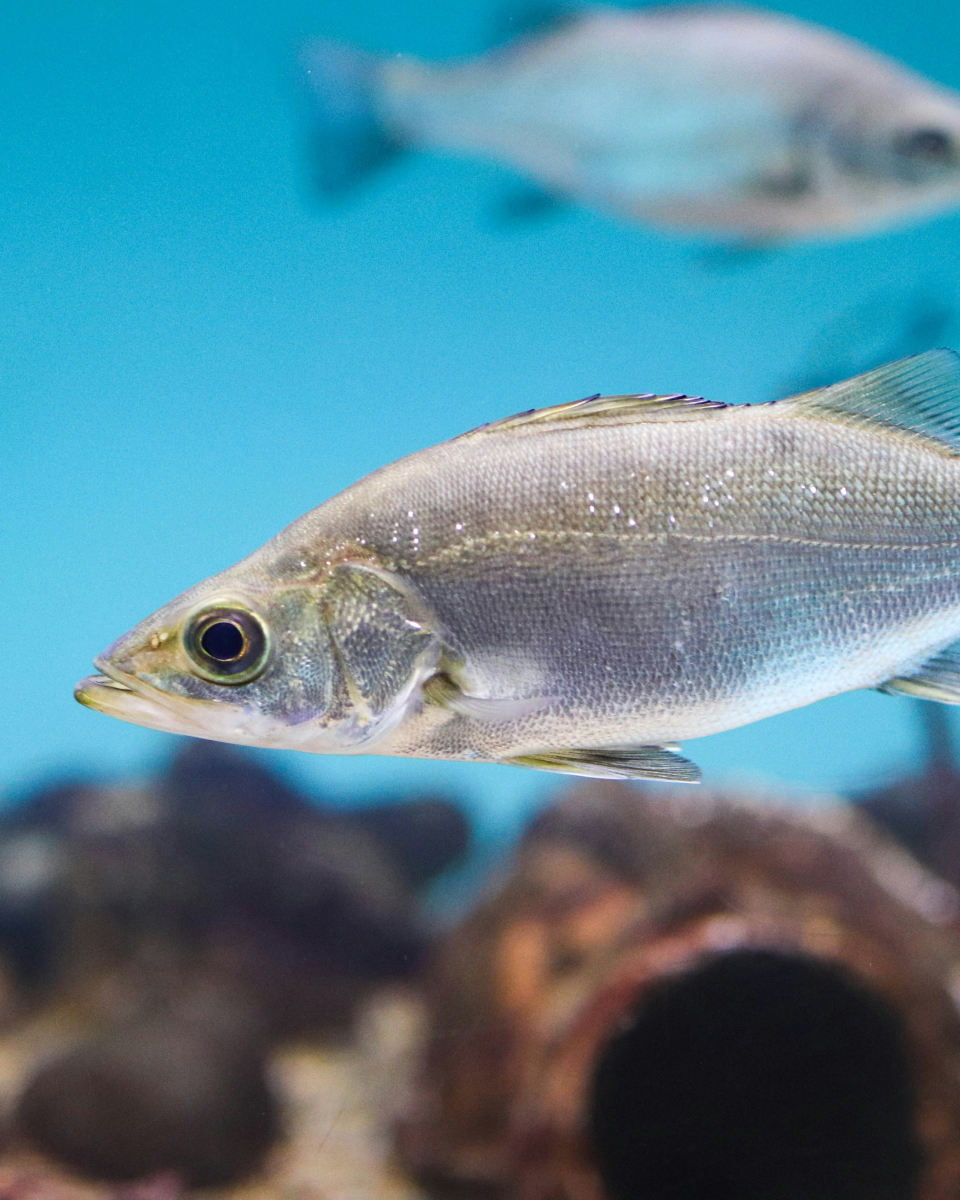
Photo by SLNC
Dicentrarchus labrax is a euryhaline, carnivorous coastal teleost inhabiting estuaries, lagoons, and coastal waters. It tolerates salinities from near-freshwater to full marine conditions; optimal growth typically occurs at 18–24°C with reduced performance outside this range. Unlike gilthead sea bream, D. labrax is gonochoristic — sex is fixed at maturation, with no natural sex change. Juveniles form shoals; adults can be more solitary or loosely aggregated. Farmed fish held at high densities exhibit schooling, aggression modulation, and social hierarchies influenced by size and prior social experience.
Experimental work specifically documents operant learning in sea bass: individuals have been shown to learn lever-pressing for food reward, perform 2D object discrimination in mazes, exhibit individual variability in exploration and learning performance, and retain task solutions over repeated trials. Comparisons of wild-caught and domesticated juveniles show differences in activity levels but similar maze learning performance, indicating that the capacity for associative learning is retained under domestication. Sea bass shows standard teleost stress responses — cortisol elevation, changes in ventilation and activity — to crowding, handling, confinement, and acute environmental change. Welfare assessment frameworks for on-growing sea bass treat the species as a sentient vertebrate with measurable behavioural and physiological welfare indicators.
Lifecycle Summary
European sea bass aquaculture produced approximately 236,215 tonnes globally in 2019 — a more than threefold increase from approximately 71,000 tonnes in 2000 — making it one of the two dominant finfish species in Mediterranean aquaculture alongside gilthead sea bream. Turkey accounts for approximately 52% of global production; Turkey and Greece together contribute approximately 69%. Marine sea-cage systems account for approximately 87% of global production. Farmed fish are harvested at 18–30 months at 300–600 g, representing a reduction from a wild potential lifespan of 10–15 years. The EU-27 produced approximately 84,350 tonnes in 2019 — equivalent to an estimated 34–338 million individual fish depending on harvest size. Aquaculture accounts for approximately 82% of EU sea bass supply; wild capture is a minor and declining share. Slaughter methods include live chilling in ice slurry, electrical and percussive stunning, and asphyxiation — with live chilling remaining widely practiced despite welfare guidance recommending pre-stun protocols.
Lifespan (Natural vs Exploited)
Wild D. labrax typically reach 10–15 years based on fisheries age-reading studies and growth models; estimates vary by region and study. Sexual maturity occurs within the first few years of life, with timing dependent on sex, growth conditions, and region.
In intensive marine cage systems, on-growing cycles run approximately 18–30 months from hatchery juvenile to slaughter weight. Production statistics indicate most farmed individuals are killed before 3 years of age — well below maximum wild lifespan. In semi-intensive and extensive lagoon systems, slower growth means fish may be held for more than 2 years before reaching market size, but still far below typical maximum wild age. In brackish and freshwater pond systems in Egypt and Tunisia, production cycles are broadly comparable to intensive marine systems.
Mortality causes under exploitation include infectious disease outbreaks (bacterial, viral, and parasitic), handling and transport stress, environmental events such as oxygen depletion, harmful algal blooms, and temperature extremes, predation in open sea cages, and culling of deformed or underperforming individuals.
Exploitation Systems
European sea bass exploitation operates across four production system types, with wild capture as a minor supplementary source.
Marine sea-cage aquaculture. The dominant system globally, accounting for approximately 87% of production at the world level and approximately 98% in the EU. Floating cages — located in coastal waters or offshore positions — hold large shoals of hatchery-produced fish fed formulated extruded diets until harvest. One documented Atlantic farm at Sines, Portugal operates 16 cages holding approximately 150,000 fish each, producing up to 500 tonnes annually at a site with mean depth approximately 24 m, where tidal currents drive water renewal through cage netting.
Semi-intensive and extensive lagoon systems. Traditional Mediterranean systems in which sea bass are held in managed coastal lagoons or ponds with barriers controlling movement; fish may be sourced from hatcheries or historically from wild fry entering lagoon systems. Sea bass is polycultured alongside gilthead sea bream, mullets, and eels in some systems. Lower stocking densities and reliance on natural productivity supplement or replace formulated feeds. The historical practice of collecting wild juveniles from coastal waters for lagoon stocking has been largely replaced by hatchery supply, driven in part by biosecurity and genetic management considerations.
Brackish and freshwater earthen ponds. Used in Egypt, Tunisia, and some EU regions; ponds are supplied with brackish or diluted seawater. All sea bass production in Egypt and Tunisia is from this system type. Stocking densities are intermediate between extensive and intensive; environmental parameters are managed through water inputs but constrained by infrastructure.
Wild capture fisheries. D. labrax is targeted or taken as high-value by-catch in coastal fisheries across the Mediterranean and Eastern Atlantic. Approximately 82% of EU supply is from aquaculture; wild capture represents the remaining approximately 18% of EU supply and a smaller fraction of total global supply. Wild capture is documented here for completeness and scope integrity but is not the primary exploitation system for this species.
Downstream product flows are dominated by fresh and chilled whole fish — gutted or ungutted — for direct market and food service supply. Filleting occurs where specific markets require it. Processing by-products — heads, frames, viscera — are rendered into fishmeal and fish oil for aquafeed manufacturing and other secondary uses.
Living Conditions Across Systems
Marine sea-cage grow-out. Commercial operations at tens of kg/m³, with stocking densities adjusted to avoid oxygen depletion and maintain growth performance. Large mixed-sex groups are size-graded periodically to reduce competition and cannibalism. Cages provide continuous exposure to ambient temperature, salinity, and current conditions through net enclosure, limiting horizontal and vertical movement relative to the animal’s natural range. Lighting is predominantly natural; artificial lighting may be used in some systems to control photoperiod. Crowding and handling during grading and harvest are identified as high-risk welfare events in welfare assessment frameworks.
Semi-intensive lagoon and pond systems. Fish are held in larger water bodies at lower stocking densities than cages. Barriers — reeds, nets, cement structures — control movement. Feeding relies partly on natural productivity, producing more variable growth. Environmental variability is higher than in cage systems, with less mechanical management of water quality parameters.
Extensive lagoon systems. Fish have access to relatively large areas with minimal artificial input; stocking densities are low; growth depends on natural food webs. Environmental variability is high and largely uncontrolled.
Brackish and freshwater ponds. Earthen ponds or raceways with managed water inputs; intermediate stocking densities; environmental parameters manipulated via water management within infrastructure limits.
Welfare assessment frameworks for on-growing sea bass identify monitoring of behavioural indicators — abnormal swimming, surface crowding, feed competition — physical lesions, fin damage, and mortality as core welfare status measures. Handling, grading, and transport are consistently flagged as high-risk events.
Lifecycle Under Exploitation
Genetic Selection
Selective Breeding programmes target growth rate, feed conversion efficiency, body conformation — with specific focus on reducing skeletal deformities, a documented production welfare problem in farmed sea bass — and robustness to handling, crowding, and disease. Domestication of D. labrax is recent relative to terrestrial livestock, and commercial strains are still under active development. Broodstock may be sourced from wild origins or domesticated lines, with controlled mating schemes to manage inbreeding and maintain performance traits.
Reproduction
Broodstock are maintained in tanks with controlled photoperiod and temperature manipulation to regulate spawning timing. Hormonal induction using GnRH analogues or other agents may be used in some operations to synchronise or enhance spawning — Reproductive Cycle Manipulation. Fertilised eggs are collected and incubated in flow-through or upwelling systems at defined temperature, salinity, and oxygen levels.
Birth & Early Life
Eggs hatch into larvae reared in hatcheries using live prey — rotifers, Artemia enriched with essential fatty acids — followed by gradual weaning onto formulated microdiets and then dry pellets. Water quality and stocking density are tightly controlled. Early-life stages are sensitive to environmental fluctuations and handling; mortality management relies on protocol optimisation and disease control.
Growth & Rearing
Juveniles are transferred through nurseries and then to sea cages, ponds, or lagoons. Feeding uses formulated pellets delivered via automated feeding systems or hand feeding; continuous feeding regimes are used in some intensive cage operations. Selective Culling through grading reduces size heterogeneity. Health monitoring and welfare assessments focus on lesions, fin damage, growth performance, and mortality records.
Production
Fish are grown to market size — commonly 300–600 g, with some markets requiring larger fish — over 18–30 months. Performance metrics including FCR, survival rate, and harvest yield are recorded at farm and sector level. Outputs are graded at harvest by size and quality for fresh and processed product channels.
Transport
Live transport occurs between hatchery, nursery, and grow-out sites in oxygenated well-boats or tanks. Harvest-stage fish may be transported live to shore-based facilities or slaughtered on-site and shipped on ice or under refrigeration. Welfare risk assessments identify transport as a key high-risk stage requiring monitoring; well-boat systems aim to maintain water quality and minimise handling stress.
End of Life
Fish are crowded in cages or ponds and captured by nets or pumping systems before killing. Slaughter methods include live chilling in ice slurry — the most widely practiced method commercially — electrical stunning followed by ice slurry or bleeding, percussive stunning, and asphyxiation. Some operations perform slaughter at the cage site; others move fish to shore-based processing facilities. Method selection varies by country, company, and facility type. Welfare guidance recommends pre-stun protocols, but live chilling remains in widespread use.
Processing
Post-mortem processing includes bleeding where applied, gutting, heading, filleting, packaging, and chilling or freezing. Processing by-products are directed to rendering, fishmeal and fish oil production, and other secondary uses.
Chemical Medical Interventions
Vaccines against major bacterial pathogens — including Vibrio spp. and other Gram-negative bacteria — are used in Mediterranean sea bass aquaculture, delivered via injection or immersion depending on fish size. Vaccine development for viral diseases is ongoing; the species serves as a platform for vaccine evaluation and disease management research.
Antibiotics and other antimicrobials are used in disease management under national and regional regulatory frameworks. Mediterranean fish health literature identifies antimicrobial resistance management as a current challenge in high-density culture; specific named compounds and usage rates are not consistently reported at species level in available public sources.
Antiparasitic chemotherapeutic agents are applied for ecto- and endoparasite control, subject to national regulatory approval. The parasitic copepod Lernanthropus kroyeri is one of the major parasites for Mediterranean sea bass aquaculture — infesting the gills and causing disruptions of growth performance and occasional mortalities, with prevalence rates approaching 100% documented at some cage sites across the Eastern Mediterranean and Adriatic. The monogenean gill parasite Diplectanum aequans is increasingly recognised as a significant production loss driver alongside L. kroyeri. The dinoflagellate Amyloodinium ocellatum causes amyloodiniosis in lagoon-type rearing sites during warm seasons, producing high mortalities in affected systems.
MS-222 (tricaine methanesulfonate) and other fish anaesthetics are used for handling, procedures, and in some slaughter contexts; use is governed by veterinary guidelines and national licensing.
GnRH analogues and other hormonal agents may be used for broodstock spawning synchronisation under veterinary supervision, with specific substances and protocols varying by jurisdiction.
Tagging, fin clipping, and batch marking are used in research and selective breeding programmes. Large-scale surgical modification — de-spining or equivalent — is not documented as a standard commercial practice in Mediterranean sea bass aquaculture.
Slaughter Processes
Slaughter methods for European sea bass parallel those documented for gilthead sea bream in Mediterranean aquaculture. Live chilling in ice slurry — transfer of crowded fish into ice-water mixtures until death — is widely practiced commercially. Electrical stunning and percussive stunning are used in a proportion of operations and are recommended in welfare guidance as methods providing more rapid and reliable loss of consciousness before death. Asphyxiation in air or elevated CO₂ without prior effective stunning is also practiced in some operations. Specific method prevalence across the industry is not systematically reported; welfare and fish health documents address sea bass slaughter within broader Mediterranean finfish categories rather than species-specifically.
EU guidance frameworks for finfish slaughter recognise both electrical and percussive stunning as preferred approaches; implementation and enforcement vary between regions and operators. Failure rate data specific to sea bass are not available in accessible literature.
Operations at the scale of the Sines example — 16 cages, ~150,000 fish per cage — imply slaughter operations handling large daily volumes during peak harvest periods. Sea bass and bream are often processed in the same facilities using the same methods and infrastructure.
Religious slaughter provisions applying specifically to sea bass are not documented in publicly accessible sources.
Slaughterhouse Labour Impact
European sea bass processing shares the occupational hazard profile of Mediterranean marine finfish aquaculture broadly: repetitive-motion injuries, cuts and lacerations, slips and falls, cold exposure, and musculoskeletal strain are the primary documented injury categories. Sea-cage harvesting adds physically demanding open-water work, exposure to weather, and manual handling of heavy harvest equipment and biomass.
Turkish and Greek operations dominate production and employ substantial workforces in processing and on-farm operations. Species-specific occupational health data for sea bass processing workers are not disaggregated from general Mediterranean aquaculture labour statistics in available published sources. Migrant and seasonal labour are present in Mediterranean aquaculture labour markets, consistent with broader patterns in regional food processing industries.
Scale & Prevalence
Global European sea bass aquaculture production was approximately 236,215 tonnes in 2019, increasing from approximately 71,000 tonnes in 2000. Turkey accounts for approximately 52% of global production; Turkey and Greece together approximately 69%. The EU-27 produced approximately 84,350 tonnes in 2019, representing an estimated 34–338 million individual fish — the wide range reflecting uncertainty in average harvest size across operations. Marine systems account for approximately 87% of global production and approximately 98% of EU production; brackish and freshwater systems account for the remainder, dominated by Egypt and Tunisia.
Sea bass and gilthead sea bream together produced approximately 526,000 tonnes in Mediterranean marine aquaculture in 2022, with Mediterranean countries (EU plus Turkey) contributing approximately 422,837 tonnes and North African and Levant regions approximately 100,000 tonnes. The two species are produced, sold, and regulated in closely linked market and supply chain contexts.
Wild capture of D. labrax accounts for approximately 18% of EU supply; EUMOFA data confirm aquaculture’s 82% share of EU production. Wild catch volumes are substantially lower than aquaculture output across all markets.
The trend is sustained expansion, with growth concentrated in Turkey and non-EU Mediterranean producers. Production figures beyond 2022 are not consolidated from current publicly available sources.
Ecological Impact
Sea-cage waste — uneaten feed and faeces — settles in the water column and beneath cages, contributing to organic enrichment and elevated nutrient loads in the depositional footprint. A Frontiers in Marine Science study of the Sines, Portugal farm site — 16 cages producing up to 500 tonnes annually in coastal waters with mean depth approximately 24 m — assessed local water circulation shaped by a nearby breakwater, with tidal currents driving water renewal; the study focused on nutrient and organic enrichment potential as the primary environmental concern. Benthic community impacts, sediment chemistry changes, and eutrophication are documented concerns for Mediterranean cage sites generally.
The historical practice of collecting wild D. labrax juveniles from coastal waters for lagoon stocking created direct pressure on wild recruitment. This practice has been largely replaced by hatchery supply across most production regions, partly in response to biosecurity concerns and the goal of reducing genetic interactions between farmed and wild stocks. Farmed fish escapes from sea cages remain a recognised risk for genetic introgression with wild D. labrax populations.
Sea bass aquaculture relies on formulated feeds containing marine and terrestrial ingredients; species-specific lifecycle assessment metrics — GHG emissions per kg, land and water use across feed chains — have not been published for D. labrax specifically. Broader Mediterranean marine finfish aquaculture analyses are the available reference point, with feed production as the dominant LCA impact category consistent with other carnivorous marine species.
Lagoon and pond systems alter coastal habitats through barrier construction and water management; risk of eutrophication increases with supplemental feeding intensity in semi-intensive pond configurations.
Language & Abstraction
European sea bass is marketed under “European sea bass,” “Mediterranean sea bass,” “seabass,” and “farmed seabass” — with the farmed designation appearing in some markets as a product origin signal rather than a welfare or system descriptor. The “sea bass” category creates taxonomic ambiguity in trade: Lates calcarifer (barramundi/Asian sea bass) and Dissostichus eleginoides (Chilean sea bass/Patagonian toothfish) occupy the same consumer category in different markets despite being biologically and ecologically unrelated species with different production contexts.
Production documentation classifies the animal through system type — “intensive,” “semi-intensive,” “extensive,” “marine,” “brackish,” “lagoon system” — framing the relevant distinctions as technical configurations rather than conditions experienced by the fish. Lifecycle terms — “broodstock,” “hatchery,” “fry,” “fingerling,” “juvenile,” “on-growing,” “grow-out,” “market-size fish” — position individuals as cohort units moving through production phases. “Biomass” and “stocking density” describe fish populations as volumetric production inputs.
Welfare assessment frameworks for sea bass introduce measurable indicators — lesions, fin condition, mortality, stress physiology, abnormal behaviour — that operationalise welfare within a compliance and performance measurement structure. This framework acknowledges fish welfare as a system variable while embedding it in production performance language: “welfare status,” “welfare indicator,” “risk assessment,” “improvement of welfare” describe welfare as a manageable production parameter. The language of welfare improvement positions current practice as a starting point on a continuum rather than naming specific current methods as welfare failures.
“Harvest” encompasses the crowding, capture, and killing sequence; “processing” absorbs slaughter and dressing into a neutral operational category.
Terminology
European sea bass, seabass, Mediterranean sea bass, farmed seabass, prime species, broodstock, hatchery, larval rearing, weaning, fry, fingerling, juvenile, on-growing, grow-out, market-size fish, semi-intensive, intensive, extensive, lagoon system, marine cage, sea cage, brackishwater pond, freshwater pond, polyculture, biomass, stocking density, harvest, processing, fillet, whole fish, chilled fish, fresh fish, aquaculture production, marine production, brackish production, welfare indicator, welfare assessment, health management, vaccination, fishmeal, fish oil.
Within The System
Developments
Report a development: contact@systemicexploitation.org
Notice an inaccuracy or omission?
If you believe information on this page is incorrect, incomplete, or missing important context, you may submit a suggested correction for review.