
Monkeys
Scientific Name:
Macaca fascicularis / Macaca mulatta / Callithrix jacchus
Scope
Covers nonhuman primates commonly termed monkeys: primarily Old World monkeys (family Cercopithecidae) and New World monkeys (families Cebidae, Atelidae, Callitrichidae) exploited across six systems — biomedical and regulatory research, commercial breeding and export, the exotic pet trade, entertainment and tourism, labour (coconut harvesting), and bushmeat. Core species in documented exploitation systems include long-tailed/cynomolgus macaque (Macaca fascicularis), rhesus macaque (M. mulatta), pig-tailed macaque (M. nemestrina), common marmoset (Callithrix jacchus), baboons (Papio spp.), squirrel monkeys (Saimiri spp.), and capuchins (Cebus/Sapajus spp.). Excludes great apes (Hominidae) and prosimians (e.g. lemurs) except where included in aggregate nonhuman primate statistics. Wild monkey populations are included only where directly subject to exploitation through hunting, capture, or trade.
Species Context
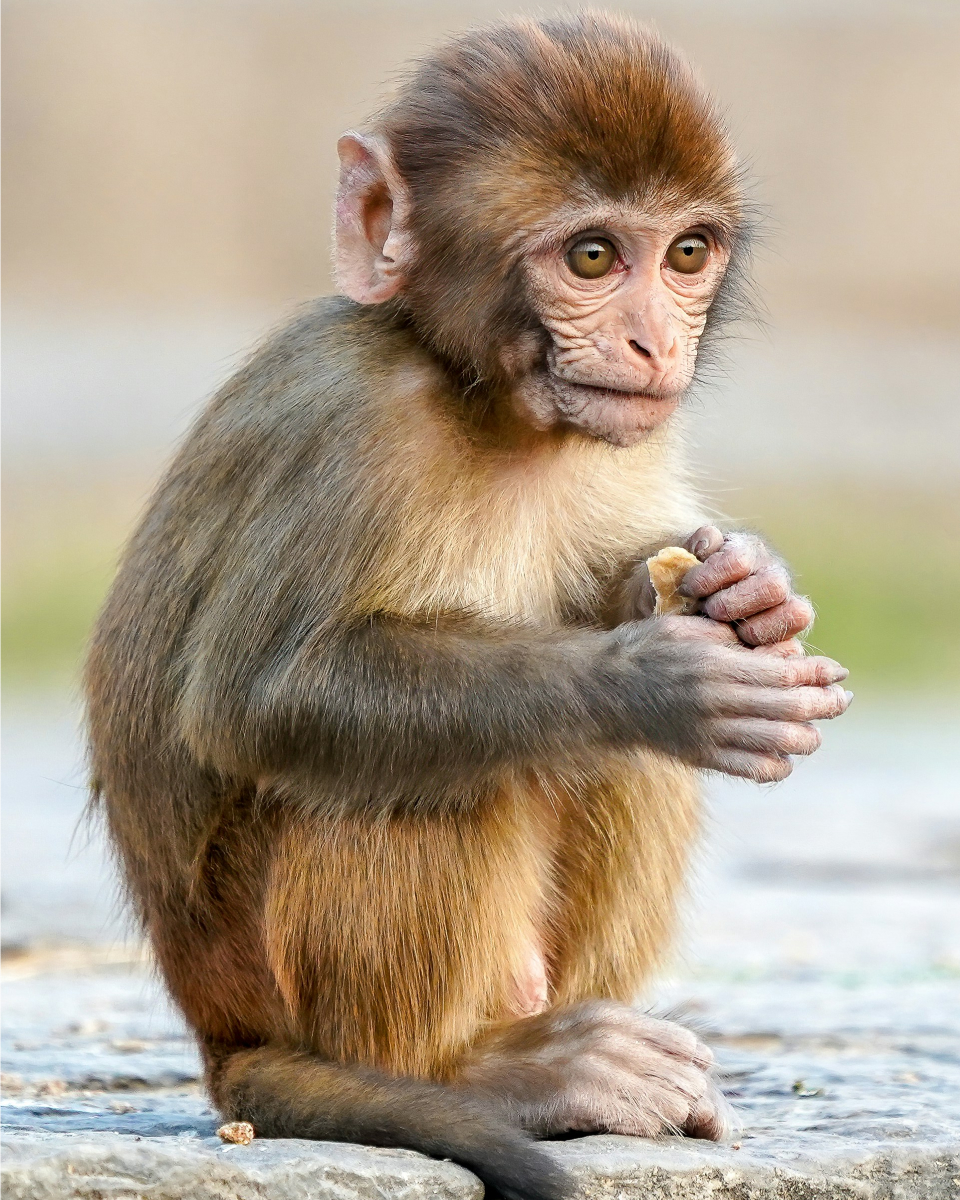
Photo by Bob Brewer
Exploited monkey species span a wide range of sizes, ecologies, and social structures. Most are group-living with multi-male/multi-female troops, linear or despotic dominance hierarchies — particularly in macaques and baboons — and stable matrilineal social units. Captive housing standards recognise requirements for social contact and vertical and horizontal space for climbing, leaping, running, and foraging. Physiological stress markers — elevated glucocorticoids, stereotypies, and self-injury — are documented under restrictive housing and social isolation, and inform EU, UK, and US housing requirements for research animals.
Cognitive evidence in exploited species is extensive but requires precision. Mirror self-recognition — the capacity to use a mirror to identify marks on one’s own body — is robustly demonstrated in great apes but not in monkeys without prior training. Trained rhesus macaques can learn to use mirror information to guide behaviour in mark-type tests, which represents either training-enabled self-referential processing or acquisition of a mirror-use skill; spontaneous untrained mirror self-recognition is not consistently demonstrated in monkeys. This distinction is relevant for cross-record comparison. Beyond mirror self-recognition, monkeys demonstrate complex social cognition, associative and observational learning, tool use (capuchins), and numerical and causal reasoning (macaques), documented across extensive comparative literature.
The research utility of monkeys is directly grounded in their physiological and pharmacological similarity to humans — particularly relevant for biologics and vaccines that act on primate-specific molecular targets. This similarity is simultaneously the basis for their use and the basis for the welfare concerns attending that use.
Lifecycle Summary
Monkey exploitation is structurally divided between high-regulation captive research systems and lower-regulation or unregulated systems encompassing wild capture, trade, entertainment, labour, and bushmeat. The research and regulatory testing system dominates documented global numbers: in 2023, 65,823 nonhuman primates were used in research, testing, and teaching in the US alone, with an additional 41,989 held but not used. Use increased 22% between 2015 and 2017 and continues to expand, driven primarily by demand for long-tailed macaques in pharmaceutical safety testing of biologics and monoclonal antibodies. The long-tailed macaque — the predominant species in international trade — was classified as IUCN Endangered in 2022 and that status was upheld following formal challenge in 2025, reflecting documented pressure from trade on wild populations. Between 2018 and 2022, at least 2,600 wild macaques entered the US laboratory system with falsified documentation, evidencing illegal wild capture within a legally regulated supply chain. CITES-recorded shipments of live long-tailed macaques from 2010 to 2019 are estimated at approximately USD 1.26 billion in total trade value.
Lifespan (Natural vs Exploited)
Rhesus macaques have a wild lifespan of approximately 20–25 years; in captivity with veterinary care they can reach 30–40 years. Long-tailed macaques have a similar potential longevity. Captive research colony animals at US primate centres have been documented reaching 30–38 years; geriatric animals are maintained in social outdoor corrals at some facilities.
In regulatory toxicity and biomedical research, many monkeys are euthanised at study endpoints, with study durations ranging from days in acute toxicity assessments to months or years in chronic toxicity and reproductive studies. Many animals are killed well before mid-adulthood — at young adult age — following a single study assignment.
In the exotic pet trade, longevity depends on husbandry quality in private households; it is rarely systematically reported, and early mortality from inappropriate care is documented qualitatively.
In bushmeat systems, monkeys are killed at variable ages when target size is reached. No age-at-death data by species are available.
In coconut harvesting, working animals may remain in service for years; end-of-life outcomes are not systematically documented.
Exploitation Systems
Monkey exploitation operates across six systems with distinct operational logics, primary species, and regulatory frameworks.
Biomedical and regulatory research. The dominant system by animal numbers and documentation. Monkeys — overwhelmingly macaques and marmosets — function as experimental subjects for safety assessment of human medicinal products (particularly monoclonal antibodies and biologics acting on primate-specific targets), neuroscience, infectious disease and vaccine research, and surgical training. Regulatory safety testing requires nonhuman primates when rodent data are considered insufficient due to species-specific pharmacology; this requirement is mandated for most biologic drug applications and cannot currently be waived without alternative method validation. Research outputs include toxicological datasets, tissue and organ collections for histopathology, biobanked materials, and cell lines derived from primate tissues.
Commercial breeding and export. Dedicated breeding centres in China, Mauritius, Cambodia, and Vietnam maintain colonies of long-tailed and rhesus macaques to supply research institutions, pharmaceutical companies, and contract research organisations globally. Colonies are managed for specific-pathogen-free (SPF) health status, reproductive output, and documented genetic histories. Juveniles are exported via IATA-compliant air freight. This system is formally regulated under CITES; documentation of illegal activity — at least 2,600 wild macaques entering the US with falsified permits between 2018 and 2022 — indicates that illegal wild capture is embedded within the legal export supply chain.
Exotic pet trade. Small New World monkeys — marmosets, capuchins, squirrel monkeys — and some macaques are sold to private owners as exotic companions, with individual animals priced in the thousands of USD. Trade includes captive-bred individuals and, historically, wild-caught animals. Keeping monkeys as pets is illegal or severely restricted in many jurisdictions, including most EU member states, but legal in others including many US states.
Entertainment and tourism. Monkeys are used in circuses, street performances, tourist photo props, and theme parks across multiple regions. Pig-tailed macaques feature in performance and tourist contexts in Southeast Asia. Animals are typically sourced from local capture or small-scale breeders. Global quantification is not available; population estimates rely on NGO investigations and regional case studies.
Labour — coconut harvesting. In parts of Thailand and neighbouring countries, pig-tailed macaques (M. nemestrina) are trained to climb trees and harvest coconuts on command. Some animals are reported to have been wild-caught before training. Working animals are tethered by metal collars when not in active use, with limited movement space and minimal environmental complexity documented in investigation reports.
Bushmeat. Monkeys are hunted across tropical forest regions of West and Central Africa and parts of Asia for subsistence and commercial meat markets. Hunting methods include firearms, snares, and traps. Carcasses are transported from hunting sites to urban and peri-urban markets — sometimes smoked or partially processed in the field for preservation. Commercial bushmeat trade is identified as a major driver of primate population declines across the Congo Basin and West African forest zones.
Living Conditions Across Systems
Laboratory and breeding facilities. European and UK guidelines — including NC3Rs NHP accommodation guidelines (2017) — specify that housing must allow species-typical locomotion including climbing, leaping, and running, and advocate exceeding minimum space allocations from earlier Council of Europe standards (ETS 123). Social housing is the specified default; single housing requires exceptional scientific or veterinary justification and must be time-limited with enhanced environmental provision. In the US, 9 CFR §3.80 defines minimum enclosure floor space per primate by body weight, with total space for group housing calculated as the sum of individual minima. Institutional SOPs require enrichment plans — manipulable objects, foraging devices, and structural complexity — with withholding of enrichment requiring scientific justification.
Coconut harvesting. Investigation reports document animals tethered by metal collars individually, near simple shelters, when not actively working. Movement is restricted to the tether radius; no environmental complexity is described.
Exotic pet trade. Private housing varies widely and is not standardised. Available documentation is anecdotal; small indoor cages and indoor or outdoor tethering are described. Conditions in retail holding before sale are not systematically reported.
Bushmeat supply chain. Live captured animals held before slaughter at market sites are typically confined in small cages with multiple individuals. Quantitative enclosure dimensions are rarely reported.
Lifecycle Under Exploitation
The lifecycle structure varies substantially across systems. The research/breeding system lifecycle is described first as the dominant documented system; other systems are addressed where they diverge.
Genetic Selection
Research and breeding colonies apply selection for specific-pathogen-free (SPF) status — defined pathogen profiles meeting importing-country requirements — reproductive performance, docility, and where relevant, specific genotypes or immune profiles for research purposes. Export-oriented colonies manage genetic records to avoid inbreeding and to maintain health certification status. No equivalent selection structure exists in bushmeat, entertainment, or coconut harvesting systems, where animals are sourced from wild capture or small unstructured breeding operations.
Reproduction
Controlled breeding in colony enclosures uses managed harem groups or multi-male/multi-female social groups; breeding may be seasonal or year-round depending on species and facility. Reproductive histories and pedigrees are recorded to manage genetic diversity and meet study design requirements. In bushmeat and wild-capture-dependent systems, reproduction occurs in natural habitats outside human management.
Birth & Early Life
In research colonies, infants are born in social group housing. Early separation or nursery rearing may occur to standardise developmental histories for specific study types or for biosecurity management, though social housing of dam and infant is recommended under NC3Rs and EU guidelines. In coconut harvesting, young animals captured from the wild are removed from social groups for training.
Growth & Rearing
Research colony juveniles remain in social groups with peers and adults, receiving routine veterinary monitoring, vaccination, and environmental enrichment. In bushmeat systems, growth occurs in natural habitats until animals reach huntable size. Coconut harvesting subjects undergo Conditioning and Training: habituation to human handlers, learning to climb trees on command, and responding to directional cues for harvest.
Production
Research and regulatory use constitutes the production phase for colony animals: animals assigned to studies undergo acclimation, conditioning for cooperation in procedures, and experimental protocols — dosing, blood sampling, surgical procedures, behavioural testing — under project licences authorised by ethics review bodies. Animal Experimentation is the defining practice of this stage. In coconut harvesting, production consists of active agricultural labour on plantations. In the entertainment system, production is performance conditioning and public display.
Transport
International trade moves monkeys from breeding centres in exporting countries to laboratories and CROs in importing countries in IATA-compliant individual or small-group transport crates via air freight; movements are recorded in CITES and national trade databases. Live Transport for research supply is a structurally central practice. In bushmeat systems, carcasses are transported from hunt sites to markets by foot, motorbike, or boat.
End of Life
In regulatory and biomedical research, monkeys are typically euthanised at study endpoints — for necropsy and tissue collection — by methods classified as euthanasia: overdose of anaesthetic agents followed by exsanguination or cardiac perfusion. Some regulatory frameworks permit reuse of animals across studies under ethical and legal constraints. In bushmeat, killing occurs in the field or at markets by shooting, clubbing, or throat cutting — without prior stunning or regulated method requirements. In the exotic pet trade, animals die from disease, inappropriate husbandry, or veterinary euthanasia in private settings.
Processing
Research post-mortem processing includes full necropsy, organ and tissue collection for histopathology, biobanking, and generation of cell lines and derived biological materials. Laboratory carcasses are disposed of as biohazardous waste via incineration. Bushmeat processing involves fur removal by singeing over open fire, evisceration, and smoking or drying for preservation and market sale.
Chemical Medical Interventions
Research colony animals receive routine vaccination against zoonotic and colony diseases including measles, tetanus, poliovirus, and rabies, alongside antiparasitic treatments and standard veterinary care. Reproductive management includes recording and, in some facilities, hormonal timing of breeding to coordinate study supply.
In regulatory and biomedical studies, animals receive the investigational product under test — monoclonal antibodies, biologics, vaccines, small molecules — at defined doses, routes, and durations following study protocol. The species is selected for these studies precisely because primate-specific molecular targets require a primate model; the substances administered are intended for human therapeutic use and are tested in monkeys as the required non-rodent safety species.
Anaesthetic and analgesic agents are required under EU Directive 2010/63/EU and equivalent regulations for all invasive procedures. Sedatives and tranquillisers are used for routine handling and transport; specific agents are defined in facility SOPs. Surgical procedures — device implantation, neurosurgical procedures, catheterisation — are performed under full anaesthesia with peri-operative analgesia as mandated.
EU and EMA regulatory guidance emphasises reduction and replacement of nonhuman primates in safety testing where scientifically justified, and permits waiving of long-term primate studies under specific conditions. This framework requires justification for species selection and encourages adoption of alternatives as validation proceeds.
No pharmaceutical interventions are documented for coconut harvesting, bushmeat, or most entertainment contexts.
Slaughter Processes
In research and regulatory settings, killing is classified and executed as euthanasia: overdose of anaesthetic agents — typically injectable barbiturates or inhalational agents — followed by cardiac perfusion or exsanguination, with necropsy as the immediate subsequent step. Methods are governed by institutional guidelines and national regulations. Detailed method distribution statistics and failure rates by species are not centrally compiled in publicly accessible global datasets.
In bushmeat systems, killing occurs without regulated method requirements. Field accounts document shooting with firearms, clubbing, and throat cutting as primary methods. These are applied to wild animals in forest environments without holding facilities, stunning, or post-kill welfare assessment.
In the exotic pet trade and entertainment contexts, killing methods are not systematically documented; death occurs from natural causes, disease, or veterinary euthanasia in private or informal settings.
Religious slaughter frameworks are not documented as a significant structural factor for monkey exploitation in any system.
Slaughterhouse Labour Impact
In research facilities, euthanasia and necropsy are performed by trained animal technicians, veterinarians, and research staff under institutional health and safety protocols. Documented occupational risks for nonhuman primate facility workers include zoonotic disease exposure — B virus (Macacine alphaherpesvirus 1) in macaque-handling staff is a documented fatal risk requiring specific PPE protocols — and physical injury risk from animal handling. Psychological impact data specific to staff performing monkey euthanasia are not systematically available; broader laboratory animal staff welfare literature documents moral distress associated with animal killing as a structural feature of the work.
In bushmeat processing, the workforce is informal — hunters, market traders, and household processors. Documentation of injury rates and psychosocial impacts specific to monkey bushmeat processing is absent from available literature; data are aggregated across the broader bushmeat trade.
In coconut harvesting, the relevant labour dimension is the handlers and trainers of working animals; occupational health data are not available.
Scale & Prevalence
Research and testing: in 2023, 65,823 nonhuman primates were used in research, testing, and teaching in the United States, with an additional 41,989 held but not used (USDA Animal Welfare Act reporting). In 2021, US laboratories reported over 113,000 nonhuman primates held or used, with macaques accounting for the majority. US NHP research use increased 22% between 2015 and 2017, reaching 75,825 in 2017, and has remained at high levels since. A National Academies report estimated approximately 70,000–75,000 nonhuman primates used annually worldwide around 2011; given subsequent growth in biologics and vaccine testing, current global figures are likely higher.
International trade: CITES-recorded shipments of live long-tailed macaques from 2010 to 2019 are estimated at approximately USD 1.26 billion total value (Frontiers in Conservation Science, 2022). More than 30,000 monkeys are reported sold annually to the US for animal testing (World Animal Protection). Between 2018 and 2022, at least 2,600 wild macaques entered the US laboratory system with falsified documentation, documented through enforcement and prosecution records.
Long-tailed macaque conservation status: IUCN Endangered classification assigned in 2022; upheld after formal challenge in October 2025.
Other systems: global counts of monkeys in pet trade, entertainment, and bushmeat are not systematically quantified. Available data consist of seizure statistics, NGO investigation reports, and regional case studies without global totals.
The overall trend for research use is expansion, driven by biologics demand. Trade pressure on long-tailed macaque wild populations is documented and contested.
Ecological Impact
Bushmeat hunting is documented as a major driver of primate population declines across West and Central African forest zones. A systematic assessment identified 301 terrestrial mammal species — including many nonhuman primates — as threatened with extinction partly due to bushmeat hunting. Removal of monkeys from forest ecosystems affects seed dispersal and plant community dynamics; quantitative ecosystem-level impact metrics for specific exploited species are limited in available literature.
International trade for research supply is documented as a pressure on long-tailed macaque wild populations. The species’ IUCN Endangered listing is attributed in part to overexploitation through trade, alongside habitat loss. The scale of illegal wild capture — evidenced by the 2018–2022 falsified permit cases — complicates assessment of actual extraction rates relative to documented trade volumes.
Captive breeding and research facilities require land, water, and energy for housing, enrichment, veterinary infrastructure, and animal care; quantitative lifecycle assessment data specific to primate facilities are not available in published literature.
Language & Abstraction
Research and regulatory documentation consistently uses “nonhuman primate,” “NHP,” or “primate” as the categorical term for all exploited monkey species, aggregating macaques, marmosets, baboons, and capuchins into a single regulatory and statistical unit. This aggregation reduces species-level visibility — the long-tailed macaque, which represents the large majority of traded research animals and the species under documented conservation pressure, appears in most statistics indistinguishably from other NHPs. Role-based terms — “test system,” “animal model,” “toxicology model,” “safety pharmacology model” — frame individual animals as experimental instruments positioned within study design logic.
Colony management language produces “breeding stock,” “breeders,” “production colony,” “naïve animals,” “retired animals,” and “culls” — terms that position reproduction, experimental allocation, and killing as sequential operational stages in a managed production system. “Naïve animals” specifically frames the absence of prior experimental exposure as a production quality attribute.
The regulatory framing of the 3Rs — replacement, reduction, refinement — positions NHP use within a harm-benefit calculus that simultaneously acknowledges the welfare burden of primate research and provides the legitimising framework for its continuation. “Refinement” as a term describes welfare improvements to existing practices; its adoption as regulatory language absorbs the welfare critique into the management system rather than constraining the system’s existence.
The trade in long-tailed macaques operates under CITES Appendix II regulation, which permits legal commercial trade under permit systems. The documentation of falsified permits — wild animals traded as captive-bred — illustrates how legal trade documentation frameworks can be used to launder illegally captured animals into regulated supply chains. “Purpose-bred” and “captive-bred” function as legal status designations that carry welfare and conservation implications but which the permit falsification cases demonstrate are not self-verifying.
In bushmeat contexts, “wildlife product,” “bush meat,” and species-specific hunting designations frame monkey meat within the wildlife exploitation language of subsistence and commercial hunting rather than livestock production, positioning the activity as outside the livestock welfare governance systems that apply to farmed animals.
Terminology
Nonhuman primate, NHP, primate, test system, animal model, toxicology model, safety pharmacology model, breeding stock, breeder, juvenile, naïve animal, subject, study animal, experimental animal, production colony, SPF colony, purpose-bred, captive-bred, long-tailed macaque, cynomolgus macaque, rhesus macaque, marmoset, squirrel monkey, baboon, primary enclosure, housing unit, single housing, group housing, pair housing, environmental enrichment, acclimation, quarantine, dosing phase, recovery phase, endpoint, necropsy, tissue harvest, colony management, cull, transport crate, shipment, export consignment, laboratory use, regulatory study, repeat-dose toxicity study, reproductive toxicity study, developmental toxicity study, safety study, control group, treatment group, breeding facility, quarantine facility.
Within The System
Developments
Report a development: contact@systemicexploitation.org
Notice an inaccuracy or omission?
If you believe information on this page is incorrect, incomplete, or missing important context, you may submit a suggested correction for review.