
Chickens
Scientific Name:
Gallus gallus domesticus
Scope
Covers domestic chickens (Gallus gallus domesticus), the selectively bred subspecies of red junglefowl (Gallus gallus) used at industrial scale in meat, egg, and breeding systems. Includes commercial broiler lines, commercial layer lines, and grandparent and parent breeding flocks supplying hatcheries. Includes smallholder and village chickens where integrated into market-oriented production or commercial input chains. Includes use in biomedical research and vaccine production where chickens or embryonated eggs function as production substrates.
Excludes wild red junglefowl (G. gallus) except as evolutionary reference. Excludes other Gallus species (e.g. G. sonneratii) and other poultry taxa (turkeys, ducks, geese, quail). Excludes ornamental and companion-only chickens except where their breeding intersects with commercial hatchery supply.
Species Context
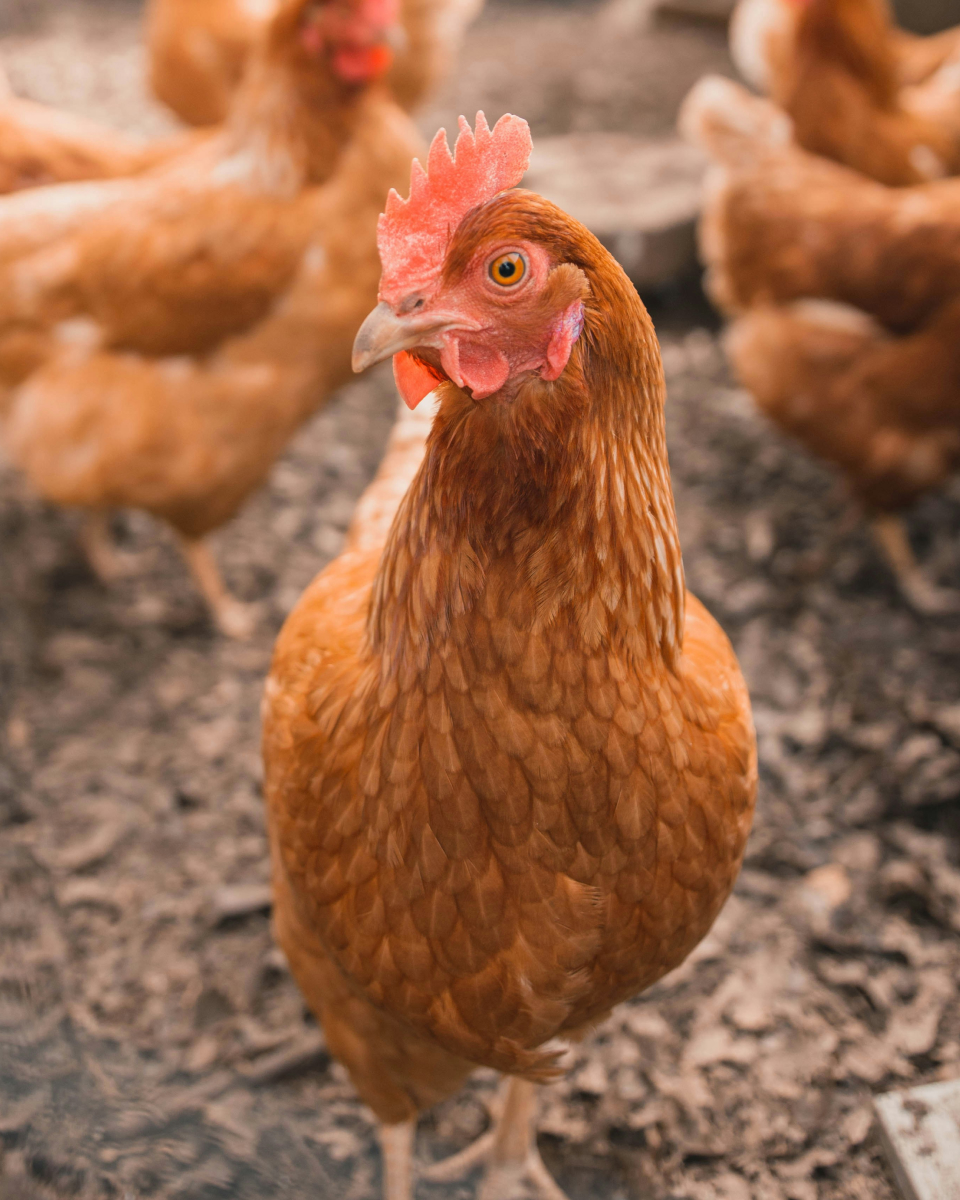
Photo by Ben Moreland
Chickens are medium-sized ground-dwelling birds within the order Galliformes, sexually dimorphic, and adapted to social group living in semi-forested environments. Commercial lines have been subjected to intensive artificial selection — broiler lines for rapid growth, breast muscle yield, and feed conversion efficiency; layer lines for sustained high egg output, shell quality, and laying persistency.
In naturalistic conditions, chickens form stable social groups typically of 4–30 individuals, maintain dominance hierarchies, recognise conspecifics individually, and perform species-typical behaviours including foraging by scratching and pecking, dustbathing, perching, exploration, and nesting. These behavioural motivations persist under intensive confinement and are systematically frustrated by high stocking densities, substrate deprivation, and restricted movement.
Scientific evidence supports complex cognition and sentience. Chickens demonstrate transitive inference in social ranking tasks, indicating higher-order social cognition. Evidence also exists for social learning, self-control in operant tasks, and cognitive bias as an affect-linked measure of emotional state (Marino, 2017; Nicol, 2015). Stress responses include elevated corticosterone, behavioural changes including immobility and escape attempts, and physiological indicators of chronic stress under crowding, thermal extremes, and social disruption.
Lifecycle Summary
Chicken exploitation systems are structured around two parallel production streams — broilers and layers — both originating in hatchery systems supplied by controlled breeding flocks. Male chicks from layer lines are killed at hatch through Male Offspring Killing, as they carry no egg-production value. Broilers are grown to slaughter weight in 5–8 weeks under intensive confinement via Growth Acceleration and Intensive Confinement. Layers produce eggs across a laying cycle of approximately 52–60 weeks before being depopulated as spent hens. Beak Trimming is applied to layer pullets and breeder flocks to reduce injurious pecking under high-density conditions. All commercial chickens — broilers, spent hens, and depopulated breeders — are processed through industrial slaughter lines. By-products including feathers, offal, and blood are rendered into feed and industrial materials.
Lifespan (Natural vs Exploited)
In low-mortality conditions, domestic chickens commonly live 5–12 years, with documented individuals reaching up to 16 years.
Commercial broilers are slaughtered at 5–8 weeks of age (approximately 35–56 days) in industrial fast-growing systems. EU standard slaughter age is approximately 42 days; US average is approximately 47 days. Slower-growing breeds used in certified or alternative systems are typically slaughtered at 56–81 days depending on target weight and scheme. Pre-slaughter mortality in intensive broiler systems is driven by metabolic disorders associated with rapid growth — including ascites, sudden death syndrome, and tibial dyschondroplasia — alongside respiratory disease and culling of birds unable to access feed and water.
Commercial layers are depopulated at approximately 72–80 weeks of age when egg production declines below commercial viability, despite biological capacity for several additional years of laying. Mortality in layer systems is driven by disease, osteoporosis-related fractures linked to calcium depletion from sustained egg production, and culling of non-productive or injured hens.
Male chicks from layer lines are killed at hatch — within hours of hatching — as they carry no production value within layer systems and do not grow at broiler rates.
Exploitation Systems
Chicken exploitation operates across two primary production streams, a controlled breeding sector supplying both, and several secondary uses.
Broiler production. Chickens reared for meat in large-scale indoor grow-out houses, or in systems with outdoor access (certified free-range or organic). Slaughtered at target live weight for whole carcass and cut-up products. By-products include feathers, offal, blood, and fat, processed into feather meal, meat-and-bone meal, tallow, and related rendered materials for feed and industrial use.
Egg production. Layers maintained through a laying cycle of approximately 52–60 weeks to produce shell eggs for direct consumption and processed egg products including liquid, dried, and pasteurised egg ingredients. Spent hens — layers at the end of productive cycles — are slaughtered for low-value meat, mechanically separated chicken, or rendering.
Breeding sector. Grandparent and parent breeding flocks maintained under controlled lighting and feed restriction regimes to produce fertile hatching eggs for commercial hatcheries. Grandparent flocks supply parent stock; parent flocks supply day-old broiler and layer chicks. Birds are depopulated at the end of each breeding cycle.
Down and feather production. Chickens are a secondary source of down and feathers for bedding and apparel, primarily as a by-product of slaughter. Live-plucking of chickens is less common than in geese and ducks but occurs in some production contexts.
Research and pharmaceutical production. Chickens and embryonated eggs are used as substrates in vaccine manufacturing — including influenza, Newcastle disease, and other human and veterinary vaccines — produced by viral inoculation of embryonated eggs. Chickens are also used as biomedical models in immunology, developmental biology, and genetics research, involving laboratory housing and experimental procedures.
Cockfighting. Chickens — predominantly selectively bred gamecocks — are used in organised fighting in jurisdictions where the practice is legal or where enforcement is limited. This use operates outside mainstream commercial systems.
Living Conditions Across Systems
Broiler intensive indoor systems. Large single-species flocks of 10,000–40,000 birds per house on litter floors under artificial lighting. EU legislation sets a baseline maximum stocking density of 33 kg/m², with permitted increases to 39 kg/m² and conditionally to 42 kg/m² subject to environmental management criteria and mortality thresholds. At a 2 kg slaughter weight, 39–42 kg/m² corresponds to approximately 19.5–21 birds per m². Systems use mechanical ventilation; perches and environmental enrichment are absent in standard configurations. Birds have minimal space for locomotion at later growth stages as flock biomass increases. Some EU member states legislate lower maximums: Austria 30 kg/m², Sweden 36 kg/m².
Broiler alternative and higher-welfare systems. Schemes such as the Better Chicken Commitment and certified organic standards require lower stocking densities, the provision of natural light, perches, and pecking materials, and the use of slower-growing breeds. Outdoor access is required in free-range and organic systems, with specified maximum outdoor stocking densities.
Layer — conventional cages. Small groups of hens in wire cage units providing approximately 430–550 cm² per bird in pre-enriched cage systems, with no litter, no dustbathing substrate, and no ability to nest or perch. Conventional battery cages are banned in the EU (from 2012) and several other jurisdictions, but remain in use in many major producing countries.
Layer — enriched cages. Cage units with perches, nest boxes, and a scratching area; space allowance per bird is larger than conventional cages but confinement to cage units is maintained. Social grouping is small to medium.
Layer — barn and aviary systems. Birds housed on litter floors and multi-tier structures with perches and nest boxes; higher flock densities than cage systems per unit floor area, with greater behavioural opportunity than caged systems. No outdoor access.
Layer — free-range and organic. Indoor housing with mandatory outdoor access via popholes. Outdoor stocking densities and indoor specifications are defined by national regulations and certification standards. Practical outdoor access is variable depending on flock size, pophole provision, and seasonal conditions.
All intensive layer and broiler systems are characterised by high ambient noise levels from ventilation systems and flock activity, artificial light cycles, and social group sizes exceeding natural grouping ranges, with limited or no opportunity for individual recognition across entire flocks.
Lifecycle Under Exploitation
Genetic Selection
Selective Breeding within closed pedigree lines concentrates traits for rapid growth, breast muscle yield, and feed conversion efficiency in broiler lines, and for sustained high egg output, shell quality, and laying persistency in layer lines. Selection is controlled by a small number of global breeding companies supplying the majority of commercial stock.
Reproduction
Grandparent and parent breeding flocks are maintained under controlled lighting regimes to manage maturation and reproductive output. Feed restriction is applied to broiler breeder flocks to control bodyweight and prevent metabolic disorders associated with fast-growing lines. Artificial Insemination is used in some heavy broiler breeder lines where natural mating is impaired by body conformation. Hatchery Incubation of fertile eggs occurs under standardised temperature, humidity, and turning conditions.
Birth & Early Life
Chicks hatch in commercial hatcheries and are processed within 24 hours: sexed, vaccinated, and sorted. Male chicks from layer lines are killed through Male Offspring Killing at hatch by maceration or gassing, as they carry no production value in layer systems. Female layer chicks and broiler chicks of both sexes are placed into rearing or grow-out facilities as day-olds.
Growth & Rearing
Broiler chicks are moved directly into grow-out houses and reared on high-protein formulated feed to target slaughter weight. Replacement layer pullets are reared in separate facilities — rearing barns or caged systems — until transfer to laying units at approximately 16–18 weeks. Beak Trimming is applied to layer pullets in most commercial systems to reduce injurious pecking under high-density conditions.
Production
Broilers reach slaughter weight at 5–8 weeks in intensive systems; the grow-out phase constitutes the entire productive life. Layers enter production at approximately 18–20 weeks and produce through peak and declining phases. Egg Collection is continuous throughout the laying cycle. Breeding flocks produce fertile hatching eggs across defined cycles before depopulation.
Transport
Live Transport moves birds between production stages — from hatchery to grow-out or rearing facilities, and from farms to slaughter plants. Broilers and spent layers are caught, crated, and loaded onto transport modules. Catching causes acute stress; spent hens are particularly susceptible to fractures during catching. Transport distances and conditions vary by region and regulatory framework.
End of Life
Slaughter at processing plants terminates the productive cycle for broilers, spent layers, and depopulated breeders. Selective Culling removes non-productive, injured, or diseased birds at farm level throughout the production cycle. Depopulation of entire flocks — whether at the end of production cycles or in response to disease — uses gas, cervical dislocation, or other approved methods depending on flock size and jurisdiction.
Processing
Carcasses move through scalding, defeathering, evisceration, chilling, and portioning on high-throughput lines. By-products including feathers, offal, and blood are channelled into rendering streams.
Chemical Medical Interventions
Antimicrobials are used across commercial chicken production globally for disease treatment, prophylaxis, and — in jurisdictions where permitted — growth promotion. Documented classes include fluoroquinolones (enrofloxacin, levofloxacin, ciprofloxacin) and macrolides (tylosin, tilmicosin), several of which are designated critically important for human medicine by the WHO. Antibiotic growth promoter use is banned in the EU and restricted in a number of other jurisdictions but persists in many major producing countries. In India, for example, an estimated 70% of antibiotics used in broiler production are administered prophylactically or for growth promotion (Chantziaras et al., Indian broiler sector case study).
Vaccines are standard across commercial systems for Newcastle disease, infectious bronchitis, Gumboro disease (infectious bursal disease), and Marek’s disease, among others. Vaccination schedules, routes of administration, and vaccine types vary by region and company protocol.
Non-antibiotic feed additives including coccidiostats, enzymes, and probiotics are used across broiler and layer systems. Coccidiostats control coccidiosis — a protozoan intestinal disease prevalent under intensive conditions.
Beak Trimming is performed using hot-blade cauterisation or infrared treatment at hatchery or in early rearing. Hot-blade trimming causes acute pain and chronic pain associated with neuroma formation; infrared treatment causes less acute pain but outcomes depend on precision of application.
Other physical modifications applied in some production contexts include dubbing (comb and wattle removal) in breeder and layer flocks, and toe clipping in broiler breeders to prevent injury during mating. Prevalence varies by region and is not systematically reported.
Slaughter Processes
Electrical water-bath stunning is the dominant method in industrial broiler slaughter. Live birds are shackled upside down by the legs and moved along overhead conveyors into an electrified water bath before automated neck cutting. Efficacy is variable. At current levels of 44 mA — documented in some US processing plants — only 36% of birds showed EEG patterns consistent with effective stunning after more than 4 seconds of exposure. A separate study found that below 120 mA, only 40% of birds were effectively stunned. A documented tension exists between low-frequency, high-current settings (more effective stunning, greater carcass damage) and higher-frequency settings (better meat quality, reduced stunning efficacy). Pre-slaughter shackling while conscious causes distress and is a recognised welfare concern independent of stunning outcome.
Controlled atmosphere stunning and killing (CAS) — using CO₂ alone or CO₂ in combination with inert gas mixtures — is used in some processing facilities, particularly in Europe. CAS eliminates live shackling but CO₂ at high concentrations is aversive; inert gas mixtures (e.g., argon or nitrogen-based) are associated with less aversion.
Religious slaughter under halal and kosher certification may omit pre-slaughter stunning depending on jurisdictional rules and certifying body requirements. Quantitative data on the proportion of chickens slaughtered without prior stunning is not systematically collected at a global level.
Industrial slaughter lines operate at very high throughput rates. Line speed pressures affect the reliability of shackling, stun exposure duration, neck cut accuracy, and bleed-out verification.
Spent hens have lower carcass value than broilers and are processed on fewer dedicated slaughter lines; some are processed into mechanically separated chicken rather than whole-carcass products.
Slaughterhouse Labour Impact
Poultry processing is among the most injury-intensive sectors in manufacturing. In the United States in 2016, approximately 230,000 workers were employed in poultry slaughter and processing. The nonfatal workplace injury and illness rate for poultry processing workers was 4.2 cases per 100 full-time equivalent workers — significantly above the 2.9 per 100 rate for all private industry workers (Bureau of Labor Statistics, 2018). The elevated rate was driven primarily by job transfer or restriction cases at 2.1 per 100 workers, compared to 0.7 per 100 across private industry, reflecting musculoskeletal injuries from repetitive, high-speed cutting tasks.
Injury causes include cutting tools, packaging machinery, and exposure to high-speed processing equipment during repetitive tasks. High line speeds — the subject of ongoing regulatory debate in multiple jurisdictions — are directly linked to the pace and volume of cutting and handling tasks.
Workforce demographics in poultry processing typically involve high proportions of migrant or low-income workers. Labour sourcing patterns including temporary agency work and contract arrangements are documented across major producing countries including the United States, the United Kingdom, Germany, and Brazil. Psychological impacts of slaughter and kill-line tasks are documented in occupational health literature but systematic quantitative data is limited.
Scale & Prevalence
Chickens are the most numerous terrestrial livestock species globally. FAO figures indicate a global flock of approximately 33–34 billion chickens at any given point, though precise annual figures vary by source and methodology.
Global edible poultry meat production (chicken and other poultry combined) was projected at approximately 142.6 million tonnes in 2023, representing a 1.35% increase over 2022.
The largest broiler producing countries are China, the United States, and Brazil. Brazil has the highest expansion rate among major producers. China is the largest single producer of poultry meat by volume. The United States, Brazil, and the EU are the dominant exporters.
Layer systems produce approximately 1.4 trillion eggs annually globally (FAO, recent estimates). China accounts for the largest share of global egg production.
Overall production direction is expansion, with growth concentrated in middle-income economies and export-oriented producers. Intensification — higher output per bird per cycle — is the dominant trend in established commercial systems.
Ecological Impact
Poultry production has lower per-calorie resource use and greenhouse gas emissions than ruminant livestock systems. A US-based life-cycle analysis (Eshel et al., PNAS, 2014) found that beef required 28 times more land, 11 times more irrigation water, 5 times more greenhouse gas emissions, and 6 times more reactive nitrogen than the average of dairy, poultry, pork, and eggs combined. Poultry and eggs were comparable to pork and dairy in per-calorie environmental burden within that framework.
The majority of environmental burdens from poultry production derive from feed production — land use for grain and soy cultivation, fertiliser-driven nitrogen and phosphorus emissions, and associated greenhouse gas emissions. Poultry’s higher feed conversion efficiency relative to ruminants produces lower per-unit emissions but the aggregate scale of production creates substantial total land, water, and nutrient demand.
Concentrated poultry operations generate localised environmental impacts including ammonia and particulate emissions affecting nearby air quality, and nutrient runoff from litter and manure contaminating surface and groundwater. Reactive nitrogen burden is identified as a key ecosystem impact parameter. Specific quantified biodiversity impacts per system type are not systematically documented in available literature.
Language & Abstraction
Chickens within commercial systems are classified by production role and lifecycle stage rather than as individual animals. Terms such as “broiler,” “layer,” “pullet,” “spent hen,” “parent stock,” and “grandparent stock” position the animal as a functional unit within a production hierarchy. Classification erases individual variation and frames management decisions — including killing — as system-level resource allocation.
“Spent hen” frames the end-of-lay culled bird as a depleted input rather than an animal at the close of a productive period, normalising disposal through the language of resource exhaustion. “Thinning” — the partial depopulation of broiler houses mid-cycle to reduce stocking density — frames live removal and slaughter of a proportion of the flock as a spatial management tool. “Depopulation” covers both end-of-cycle slaughter of entire flocks and mass killing in disease-control contexts, abstracting both into an operational category.
“Mechanically separated chicken” and “further processing” describe post-slaughter disassembly processes that reduce the animal to a category of industrial material. “Carcass yield,” “carcass defects,” and “condemned carcasses” in slaughter and processing literature treat the bird’s body as a commercial output subject to quality control, with defects framed as production failures rather than indicators of system conditions.
The term “line speed” in slaughter regulation debates abstracts the volume of individual animals killed per hour into a throughput variable, framing welfare and injury risk primarily as operational parameters.
Male chick culling — the systematic killing of billions of male layer-line chicks annually at hatch — is referred to in industry and regulatory documents as “culling of male chicks,” “male chick disposal,” or managed under the broader term “hatchery management,” positioning a structural mortality category as a routine husbandry event.
Terminology
Broiler, broiler chicken, fryer, roaster, layer, laying hen, pullet, cockerel, spent hen, parent stock, grandparent stock, breeder flock, hatchery, hatching egg, table egg, shell egg, egg product, egg powder, egg liquid, broiler meat, poultry meat, chicken meat, carcass, eviscerated carcass, offal, by-product, mechanically separated chicken, rendered product, feather meal, meat and bone meal, grow-out, grower, finisher, stocking density, live weight, kill line, line speed, flock, batch, mortality, culling, depopulation, thinning, catching, processing plant, slaughterhouse, further processing, integrator, contract grower.
Within The System
Developments
Operation Carne Fraca meatpacking corruption
Health of Animals Regulations transport amendments
Criminal Code amendments prohibiting animal fighting
SAG Decrees implementing welfare regulations
Ban on bullfighting & cockfighting extension
FDA/USDA cultivated meat regulatory framework
Regulation for scaled livestock & poultry farms
Mandatory pre-stunning ends religious slaughter exemption
Farm Animal Confinement Initiative
Mandatory CCTV in slaughterhouses
Multi-year epizootic & poultry & dairy depopulations
Western Australia battery cage ban
Report a development: contact@systemicexploitation.org
Notice an inaccuracy or omission?
If you believe information on this page is incorrect, incomplete, or missing important context, you may submit a suggested correction for review.