
Horses
Scientific Name:
Equus caballus
Scope
Covers domestic horse (Equus caballus, domesticated form of Equus ferus) across seven exploitation systems: working, traction, and transport; sport and competition; leisure, tourism, and therapy; meat and by-product production; breeding; biopharmaceutical and serum production; and military and police deployment. Includes feral horse populations (Australian Brumbies, US mustangs, European feral ponies) as O. caballus populations with documented ecological and management significance. Excludes zebras and asses (other Equus spp.), wild equids except Przewalski’s horse (E. ferus przewalskii) where referenced as biological baseline, and purely symbolic or representational uses without direct animal deployment. Individual horses commonly move through multiple systems over their lifetime; the record treats this mobility as a structural feature rather than an exceptional transition.
Species Context
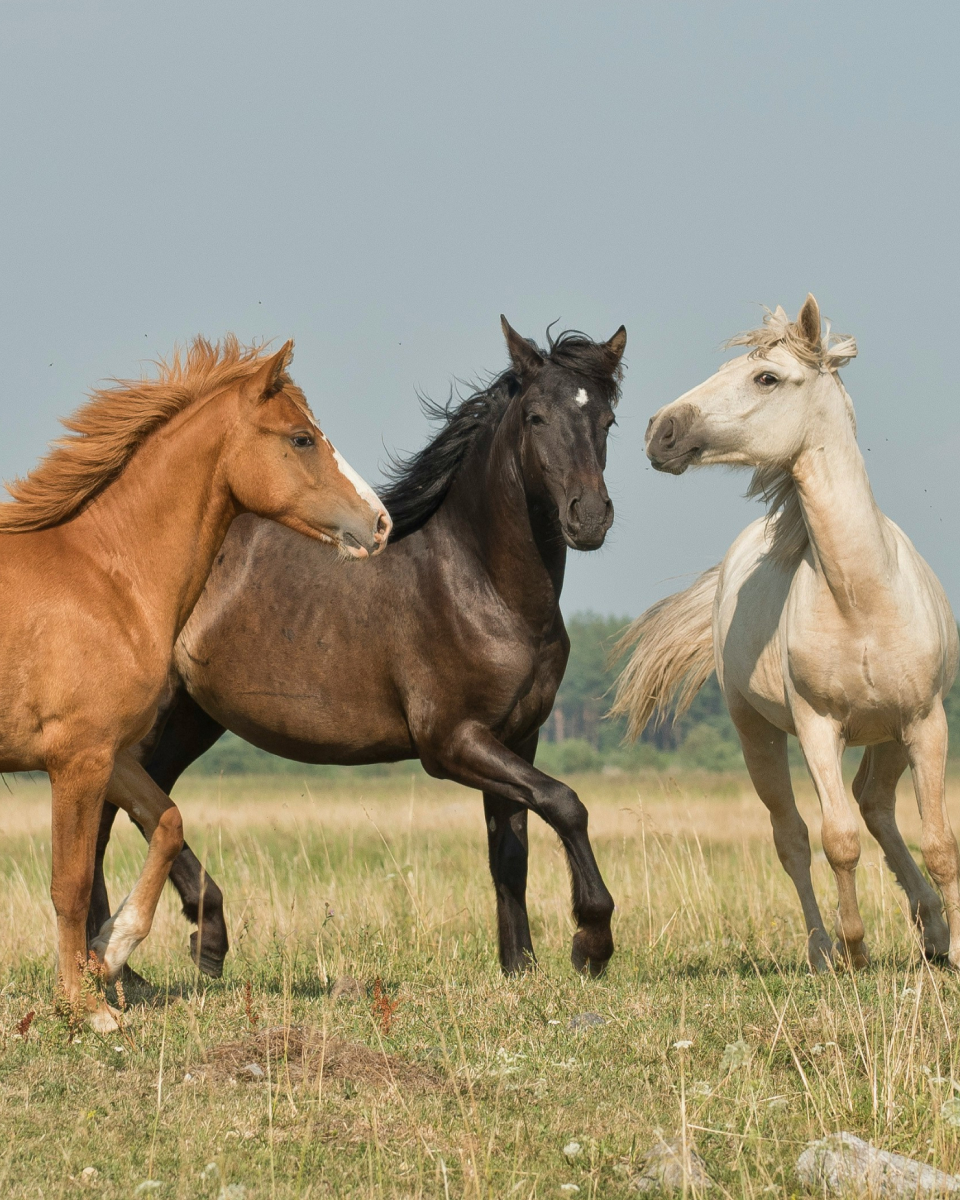
Photo by Annika Treial
Equus caballus is a large hindgut-fermenting herbivore with cursorial morphology adapted to continuous locomotion across open grassland and steppe. Natural social organisation is in harem bands — one or more stallions, several mares, and offspring — with stable social bonds and linear dominance hierarchies; bachelor groups of young males are also documented. Strong motivation for grazing, locomotion, and social interaction characterises the species; horses require continuous or frequent access to forage and space for movement, with deprivation of either producing documented stress responses and stereotypic behaviour.
Stress indicators include elevated heart rate and cortisol, increased frequency of stereotypies (crib-biting, wind-sucking, weaving, box-walking), aggression, and social withdrawal. Stereotypies are associated with restricted movement, limited forage access, and social isolation in stabled management — the dominant housing mode in sport and leisure systems. Their prevalence in managed horse populations is a systemic welfare marker.
Cognitive and emotional capacities are well-evidenced. Horses recognise individual humans and conspecifics, retain memory of human emotional expressions across encounters, and demonstrate cross-modal recognition of vocalisations and facial expressions. Research at the University of Sussex documents associations between emotional processing, social behaviour, and stress physiology consistent with complex socio-cognitive capacities. Scientific consensus treats horses as sentient mammals with significant emotional awareness and social intelligence — capacities directly relevant to the welfare implications of isolation, confinement, and training methods used across sport and working systems.
Lifecycle Summary
Horses are exploited across more concurrent systems than any other species in this database, and no single system dominates globally in the way that meat production dominates for chickens, pigs, and cattle. Global horse population is approximately 60 million (current FAOSTAT estimates; the detailed regional figures in available secondary literature are from 2008 and require updating). The majority of the world’s horses function as working animals in low- and middle-income countries — for agricultural traction, goods and passenger transport, and urban commerce — a system governed by WOAH Animal Health Code Chapter 7.12 on working equids. Sport and leisure use dominates in high-income countries. A biopharmaceutical system using horses as antivenom, antitoxin, and anti-rabies serum producers — through hyperimmunisation and repeated plasmapheresis — constitutes a pharmaceutical manufacturing application unique to this species in the database. Meat production draws primarily from culled horses exiting other systems, though some dedicated horse meat production exists in parts of South America, Central Asia, and Europe.
Lifespan (Natural vs Exploited)
Feral and wild horses typically reach 15–20 years, with higher juvenile mortality from predation, injury, and disease. Domestic horses in leisure, companion, and many sport contexts reach 25–30 years with veterinary care; documented maximum lifespans exceed 40 years.
Working equids in low-income contexts have functional working lives of approximately 8–15 years, with earlier culling or death from lameness, malnutrition, and unmanaged disease; total lifespan may still reach the late teens if animals survive to retirement.
Racing Thoroughbreds enter training at approximately 2 years and typically retire from racing by 4–8 years; a subset transition to breeding or secondary equestrian careers, but premature mortality from musculoskeletal injury and catastrophic breakdowns is documented.
Horses slaughtered for meat are killed between approximately 2–10 years depending on system — dedicated meat production versus culled sport or work horses — both substantially below species maximum.
Primary causes of mortality across systems: musculoskeletal disease and lameness, colic, metabolic and infectious disease, trauma, reproductive complications, and slaughter at loss of economic function.
Exploitation Systems
Horses are exploited across seven systems, frequently sequentially within a single individual’s life.
Working, traction, and transport. The global majority of horses by number function as working animals in low- and middle-income countries across Asia, Africa, and Latin America, performing agricultural traction, logging, brick kiln operation, and urban goods and passenger transport. WOAH’s working equids chapter (2024) governs international welfare standards; actual conditions vary substantially, with documented welfare problems including lameness, malnutrition, inadequate harness fit, and overwork without rest in the absence of effective regulation or veterinary access. The Draught & Transport taxonomy term in the Industries taxonomy was created to capture this system.
Sport and competition. Multiple disciplines are documented: flat racing (Thoroughbred, Quarter Horse, Arabian), harness racing, endurance, eventing, show jumping, dressage, polo, and rodeo. Racing produces the most economic activity and is the most numerically significant sport discipline; wagering revenue, media rights, and breeding value are primary outputs. Thoroughbred racing requires live cover (natural mating) for breed registration under Jockey Club rules in most major jurisdictions — a regulatory constraint that shapes the entire Thoroughbred breeding system and prohibits artificial insemination. Performance horses are subject to intensive early training, competition transport, and pharmaceutical management of pain and injury.
Leisure, tourism, and therapy. Riding schools, trekking operations, carriage ride services, and equine-assisted activities and therapy (EAAT) constitute a large sector in high-income countries. Horses in therapy programmes work with individuals with physical and psychological disabilities; the Conditioning and Training required is specific to this application.
Meat and by-products. Horse meat is consumed in parts of South America (Argentina, Brazil), Central Asia (Kazakhstan), Europe (France, Italy, Belgium), and some Asian markets. Production draws from two sources: dedicated horse meat production (some farms in South America and Central Asia) and the secondary slaughter of culled horses from sport, working, and leisure systems that have lost economic function. By-products include hides and leather, horsehair for bow string and brush manufacturing, and rendered fat for industrial and cosmetic applications. Blood and organs may be directed to pharmaceutical processing.
Breeding and genetics. Stud farms maintain pedigree racing and sport lines, draught breed lines, and local breeds for meat or cultural use. Outputs include breeding stock, semen for AI, and embryos for transfer. The Thoroughbred studbook prohibition on AI means this dominant racing breed requires live cover globally, creating a structural difference from virtually all other commercially bred animal species.
Biopharmaceutical and serum production. Horses are hyperimmunised with antigens — tetanus toxoid, snake venoms, scorpion venoms, rabies virus, diphtheria toxoid — to generate high-titre antibodies in their blood. Plasma is collected by repeated plasmapheresis: blood is withdrawn, red cells separated and returned to the horse, and plasma containing the antibody-rich fraction is retained for immunoglobulin purification. The resulting products — antitoxins, antivenoms, anti-rabies hyperimmune globulin — are global pharmaceutical commodities used in emergency and preventive medicine. Horses used in this system are maintained for multiple years as donors; large body size, placid temperament, and immunological responsiveness are selection targets. This is a pharmaceutical manufacturing system without equivalent in any other record in this database.
Military and police deployment. Mounted police units in many countries and ceremonial military units maintain horses for crowd management, patrol, ceremonial functions, and in some conflict contexts for operational transport.
Living Conditions Across Systems
Pasture-based systems. Continuous or rotational pasture access with variable stocking density; temperate systems commonly apply approximately 0.5–2 hectares per horse depending on climate and pasture productivity. Group turnout allows social interaction. Pasture-based management is most closely aligned with species-adapted behaviour.
Stall and box stabling. Individual loose boxes are the dominant housing mode for sport and leisure horses in high-income countries. British Horse Society minimum recommended dimensions: ponies approximately 3.05 × 3.05 m; horses approximately 3.65 × 3.65 m; foaling boxes approximately 4.25 × 4.25 m. Horses in box stabling typically receive scheduled exercise and limited turnout; visual and limited tactile contact with adjacent horses through bars or partitions. Restricted locomotion, limited forage access, and reduced social contact in stabling systems are the primary welfare risk factors and the documented drivers of stereotypy development.
Tie-stalls and tethering. Horses tied at the head in individual standing stalls or tethered in yards; movement restricted to standing and minimal lateral motion. Common in lower-resource working contexts across Asia, Africa, and parts of Latin America.
Working equid conditions. Street or roadside housing, basic shelters, or open fields; variable access to shade, water, and rest; tethering and hobbling documented across regions. WOAH working equids chapter identifies inadequate nutrition, over-work, poor harness fit, insufficient veterinary care, and lack of rest as systemic welfare problems in this population globally.
Lairage and slaughter holding. Short-term holding pens at abattoirs with concrete floors; unfamiliar horses are commonly mixed; noise, unfamiliar odours, and handling increases arousal. Pre-slaughter welfare is governed by EU Regulation 1099/2009 in the EU and equivalent frameworks in other jurisdictions.
Lifecycle Under Exploitation
Genetic Selection
Selective Breeding objectives differ substantially by system. Racing and sport lines — Thoroughbred, Warmblood, Quarter Horse, Arabian — are selected using performance records, pedigree analysis, conformational assessment, and increasingly genomic tools. Meat and working lines are selected for body size, growth efficiency, draught capacity, or local environmental adaptation; in some low-income work contexts, selection is opportunistic with minimal formal breeding control. Biopharmaceutical donor lines are selected for large body size, placid temperament, ease of venous access, and strong immunological response.
Reproduction
Methods include natural service (live cover), artificial insemination (AI), and embryo transfer. Live cover is mandatory for Thoroughbred registration in most major racing jurisdictions under Jockey Club rules — a regulatory constraint with no equivalent in any other farmed species. AI with chilled or frozen semen is used across most other breeds and disciplines. Embryo transfer allows multiple offspring per season from high-value mares. Reproductive interventions include prostaglandins for luteolysis, progestogens and other hormones for oestrus synchronisation, and teaser stallion use to assess oestrus status. Reproductive Cycle Manipulation via hormonal protocols applies in stud farm operations.
Birth & Early Life
Foaling occurs in monitored foaling boxes or paddocks. Neonatal care includes colostrum monitoring, umbilical cord disinfection, and immune status checks. Early management includes imprint training (desensitisation to handling during the immediate post-birth period in some systems), early halter introduction, and Identification Marking via microchipping, freeze or hot branding, and equine passport registration in EU jurisdictions.
Growth & Rearing
Weaning at approximately 4–6 months, managed as abrupt or gradual individual or group separation. Post-weaning, youngstock are managed in group paddocks or youngstock barns; routine deworming, vaccination, and hoof care schedules begin. Growth-oriented diets in high-performance and meat systems; forage-based management in working and leisure systems.
Production
Racing and sport horses enter intensive training from approximately 2 years (Thoroughbreds) — earlier than is biomechanically optimal for skeletal development, a welfare concern documented in the racing literature. Training involves stabling with regulated exercise, competition schedules with regular transport. Working horses undertake progressive loading tasks with urban or rural work schedules; harness fitting and equipment quality are primary welfare determinants. Meat horses are managed to slaughter specification body condition. Biopharmaceutical donor horses undergo repeated antigen challenge and plasmapheresis cycles on defined schedules. Conditioning and Training is the defining practice for sport, working, and therapy systems. Blood Harvesting is the defining practice for the biopharmaceutical system.
Transport
Live Transport is structurally central to the sport and competition system — horses travel to races, shows, auctions, and export regularly, including long-distance international movements by road, sea, and air. Transport to abattoir is a distinct welfare event involving capture, loading, and road transport of varying duration. EU transport regulation (Council Regulation (EC) No 1/2005) governs journey times, stocking densities, rest periods, and handling standards within the EU; enforcement and equivalent standards outside the EU vary substantially. Long-haul live export by sea for slaughter — documented for horses exported from South America to Asia — is a welfare concern identified in regulatory reviews.
End of Life
Routes out of the production system include on-farm euthanasia by barbiturate overdose (typically pentobarbital), slaughter for human consumption, slaughter for pet food, rendering for industrial use, or abandonment and feralisation in some contexts. The route is primarily determined by economic function, residual value, injury status, and — for EU food-chain horses — passport medication history. Horses treated with phenylbutazone are excluded from the EU food chain; their fate depends on whether medication history is accurately recorded and enforced.
Processing
Meat processing: dressing, carcass chilling, cutting, deboning, and further processing into retail cuts, sausages, cured meats, or pet food. Hide processing produces equine leather; horsehair is collected for bow hair, brush manufacturing, and upholstery; blood, bone, and fat are processed by rendering. Biopharmaceutical processing of plasma involves fractionation, purification, and formulation of immunoglobulin products.
Chemical Medical Interventions
NSAIDs are the primary pain management class in equine veterinary practice. Phenylbutazone (“bute”) is the most widely used equine NSAID, also applied as topical diclofenac cream; flunixin meglumine and firocoxib are additional agents. Phenylbutazone is banned from the EU human food chain; horses treated with it must be marked as permanently excluded from the food chain in their passport. Failure to record or enforce this prohibition was the mechanism underlying the 2013 European horsemeat adulteration scandal. Sport drug regulations — USEF, FEI — set plasma thresholds or withdrawal periods for NSAIDs and other therapeutic agents.
Sedatives and tranquillisers used for handling, dentistry, minor procedures, and transport include xylazine, detomidine, romifidine, and acepromazine. General anaesthesia for surgical procedures uses ketamine combinations and inhalant agents in clinical settings.
Vaccines routinely administered include tetanus, equine influenza, equine herpesvirus 1 and 4, West Nile virus in endemic regions, and rabies where indicated. Anthelmintics targeting internal parasites include ivermectin, moxidectin, benzimidazoles, and pyrantel; parasite resistance monitoring is a growing clinical concern.
Reproductive interventions: prostaglandins for luteolysis, progestogens for oestrus suppression in performance mares, AI with chilled or frozen semen in non-Thoroughbred breeds, and embryo transfer in high-value mares.
Castration (orchiectomy) of male horses is routine management for behaviour and handling safety; most male horses not retained as breeding stallions are castrated, typically in the first two years.
Biopharmaceutical production requires repeated antigen administration — snake venoms, tetanus toxoid, rabies antigen — followed by plasmapheresis under anticoagulation. Post-collection fluid therapy replaces withdrawn volume. Horses in these systems may serve as donors for multiple years under scheduled immunisation and collection protocols.
Performance-enhancing drugs banned in sport include anabolic steroids, blood doping agents, and prohibited stimulants; the regulatory structure is discipline- and federation-specific. Some therapeutic substances are permissible at defined thresholds; detection technology and regulatory harmonisation remain areas of ongoing development.
Slaughter Processes
Penetrating captive bolt stunning is the standard commercial method for horse slaughter in most regulated facilities. A 2025 peer-reviewed study from a Mexican abattoir (100 horses) assessed shot positioning and effectiveness, identifying accurate placement and adequate head restraint as the primary determinants of reliable unconsciousness. Horses present specific anatomical challenges for captive bolt placement — skull thickness and anatomy require positioning at the intersection of lines from ear base to opposite eye — that differ from cattle. Post-stun killing uses exsanguination via neck incision, with shackling and hoisting; EU Regulation 1099/2009 governs stun-to-bleed interval.
Free-bullet firearms are used particularly in smaller facilities and field contexts, including emergency and on-farm euthanasia. Neck cutting without prior stunning may occur where regulation is weak or unenforced; systematic data on the prevalence of unstunned slaughter are not available for horses globally.
On-farm euthanasia by intravenous pentobarbital overdose is the standard method for companion, leisure, and sport horses that are not channelled through the slaughter system; this is performed by veterinarians and is the most welfare-governed killing route available to horses.
Long-haul live export by sea to slaughter — documented for horses transported from South America to Japan and other Asian markets — exposes animals to extended voyage durations with documented mortality and welfare compromise; this trade has been subject to regulatory review in multiple jurisdictions.
Religious slaughter frameworks do not constitute a significant structural factor in horse processing in any major producing market.
Labour conditions at horse abattoirs and in the equine sector more broadly are documented at a general level. CDC analysis of Thoroughbred farm injuries identifies upper limb trauma from direct horse contact (struck, trampled, kicked) as the dominant injury mechanism. General slaughter and meat processing sector data on musculoskeletal strain, lacerations, and psychological burden are applicable structurally; horse-specific abattoir occupational health data are not separately reported in available peer-reviewed literature.
Slaughterhouse Labour Impact
On Thoroughbred farms, CDC-analysed data identify direct contact with horses — being struck, trampled, or kicked — as accounting for a large share of recorded upper limb injuries. The biomechanical force generated by horses at the scale involved makes this injury profile different from other livestock species.
At commercial horse abattoirs, no species-specific occupational health dataset has been identified in peer-reviewed literature; labour conditions are inferred from general meat processing sector data documenting elevated musculoskeletal strain, lacerations, repetitive motion injury, and documented psychological stress from high-volume killing work. Psychological impact studies from mixed-species slaughter facilities are structurally applicable.
The equine veterinary and care sector — stable staff, trainers, farriers — has documented injury patterns including falls from horses, kick injuries, and crush injuries during handling; quantitative global data are not consolidated.
Scale & Prevalence
Global horse population is in the range of 60 million based on current FAOSTAT reporting; detailed regional distributions in the literature (approximately 15 million in South America, 13.9 million in Asia, 9.9 million in North America, 8.7 million in Latin America/Caribbean, 6.4 million in Europe) derive from 2008 FAOSTAT data and require updating from current FAO STAT tables. All figures are subject to under-reporting of working equids in low-income contexts.
Global horse meat production was approximately 913,000 tonnes in 2008 per FAO-based analysis; current figures require direct FAO STAT query. Major producing regions in 2008: South America, Asia, and parts of Europe.
Thoroughbred racing: approximately 490,000 registered Thoroughbreds are foaled globally annually (estimate from industry sources; not consolidated in a peer-reviewed global count). Sport horse breeding: tens of thousands of Warmblood registrations annually across European and international studbooks.
Working equids: WOAH and Brooke estimate 100 million or more horses, donkeys, and mules combined in working roles globally, predominantly in low- and middle-income countries; this figure encompasses all equid species and is only partially horse-specific.
The directional trend in high-income countries is declining agricultural and transport working use and stable or increasing sport and leisure use. In lower-income regions, working equid populations are maintained or expanding due to limited mechanisation.
Ecological Impact
Horses require substantial land for grazing relative to smaller livestock; pasture-based management in extensive systems contributes to grassland maintenance where stocking is appropriate but to overgrazing and vegetation degradation where density exceeds carrying capacity.
Feral horse populations impose documented ecological impacts on sensitive ecosystems. A 2023 study of Australian alpine peatlands found that areas disturbed by feral horses (Brumbies) exhibited higher carbon emissions, degraded water quality, and reduced soil infiltration compared with undisturbed areas; hard hooves compact peat, reduce infiltration, and trigger erosion in wetland and riparian zones. Carbon-rich topsoil loss and altered plant communities have downstream consequences for water quality and catchment function.
As hindgut fermenters, horses emit enteric methane; per-unit emissions and total contribution are lower than for cattle at global scale, but detailed comparative inventories grouping horses separately from other equids are limited in published life-cycle assessments.
In rangeland systems, feral horses compete with native herbivores for forage and water; competition with native ungulates and management of horses as overabundant species in conservation areas (Australian alpine national parks, US Bureau of Land Management herd areas) generates ongoing regulatory and ecological management activity.
Language & Abstraction
The legal and regulatory classification of horses shifts across systems, determining the welfare and food safety framework applicable to any individual animal. A horse classified as a “sport horse” or “companion animal” is governed by different welfare frameworks than the same horse reclassified as an “animal destined for slaughter” when its sporting career ends. The EU passport system was designed to bridge this classification gap by creating a permanent food chain status attached to the individual animal; the 2013 horsemeat scandal demonstrated that the bridge depends on complete and accurate documentation, which proved insufficient at scale.
“Retirement” describes the transition from active sport, work, or breeding use to a non-productive status; it is a positive framing that does not specify whether the animal’s subsequent fate is leisure, secondary use, long-term care, or slaughter. “Culling” and “disposal” apply to horses exiting all systems for economic reasons without implying the quality of care during the transition. The same animal may be described as “retired” in one sector document and “destined for slaughter” in another, with both descriptions accurately representing the same trajectory.
“Culled sport horses” and “ex-racehorses” are categories in the horse meat supply chain that describe animals whose primary system career has ended; this framing positions their slaughter as a secondary outcome rather than a planned production endpoint. In dedicated horse meat systems — particularly in South America and Central Asia — animals may be purpose-bred for meat, but this is a smaller proportion of global horse meat production than the cull route.
Racing terminology positions horses through economic and performance categories — “prospect,” “maiden,” “stakes winner,” “broodmare,” “stud stallion” — that describe value within the racing and breeding system without reference to individual biological lifespan. “Breakdown” describes catastrophic musculoskeletal failure during racing; the term positions a structural welfare outcome of early training and high-intensity racing as an incident rather than as a systemic risk produced by the training and racing model.
“Hyperimmune plasma” and “equine-origin immunoglobulin” in biopharmaceutical contexts name the products by their biochemical composition and species origin without describing the production process — repeated antigen challenge and plasmapheresis — that generates them.
Terminology
Working equid, livestock, companion animal, meat horse, slaughter horse, riding horse, sport horse, racehorse, broodmare, stallion, stud, gelding, foal, yearling, weanling, filly, colt, draught horse, pony, cull, culling, disposal, depopulation, retirement, rendering, by-product, chevaline, equine serum, hyperimmune plasma, equine immunoglobulin, horsehair, equine leather, mounted police horse, trekking horse, carriage horse, therapy horse, breeding stock, donor horse, donor mare.
Within The System
Developments
Bill C-355 banning live horse air export for slaughter
Health of Animals Regulations transport amendments
Investigation into livestock auction market conditions
Report a development: contact@systemicexploitation.org
Notice an inaccuracy or omission?
If you believe information on this page is incorrect, incomplete, or missing important context, you may submit a suggested correction for review.