
Trout
Scientific Name:
Oncorhynchus mykiss / Salmo trutta
Scope
Covers salmonids commercially farmed and marketed as “trout”: primarily rainbow trout (Oncorhynchus mykiss), the dominant farmed species globally at approximately 99% of trout aquaculture production, and brown/sea trout (Salmo trutta) as a secondary farmed and stocked species. Includes selectively bred strains of both species, triploid/sterile lines, and domesticated hatchery stocks used for aquaculture and recreational fishery stocking. Covers freshwater raceways, flow-through systems, ponds, recirculating aquaculture systems (RAS), and freshwater and marine cage systems. Wild-captured trout entering commercial value chains are included; recreational fisheries are out of scope except where fish are hatchery-stocked. Excludes Atlantic salmon (Salmo salar, covered in the Salmon record), purely ornamental strains, and non-commercial wild populations not subject to stocking or harvest pressure. Oncorhynchus mykiss is the primary analytical focus of this record; species-specific divergences for S. trutta are noted where relevant.
Species Context
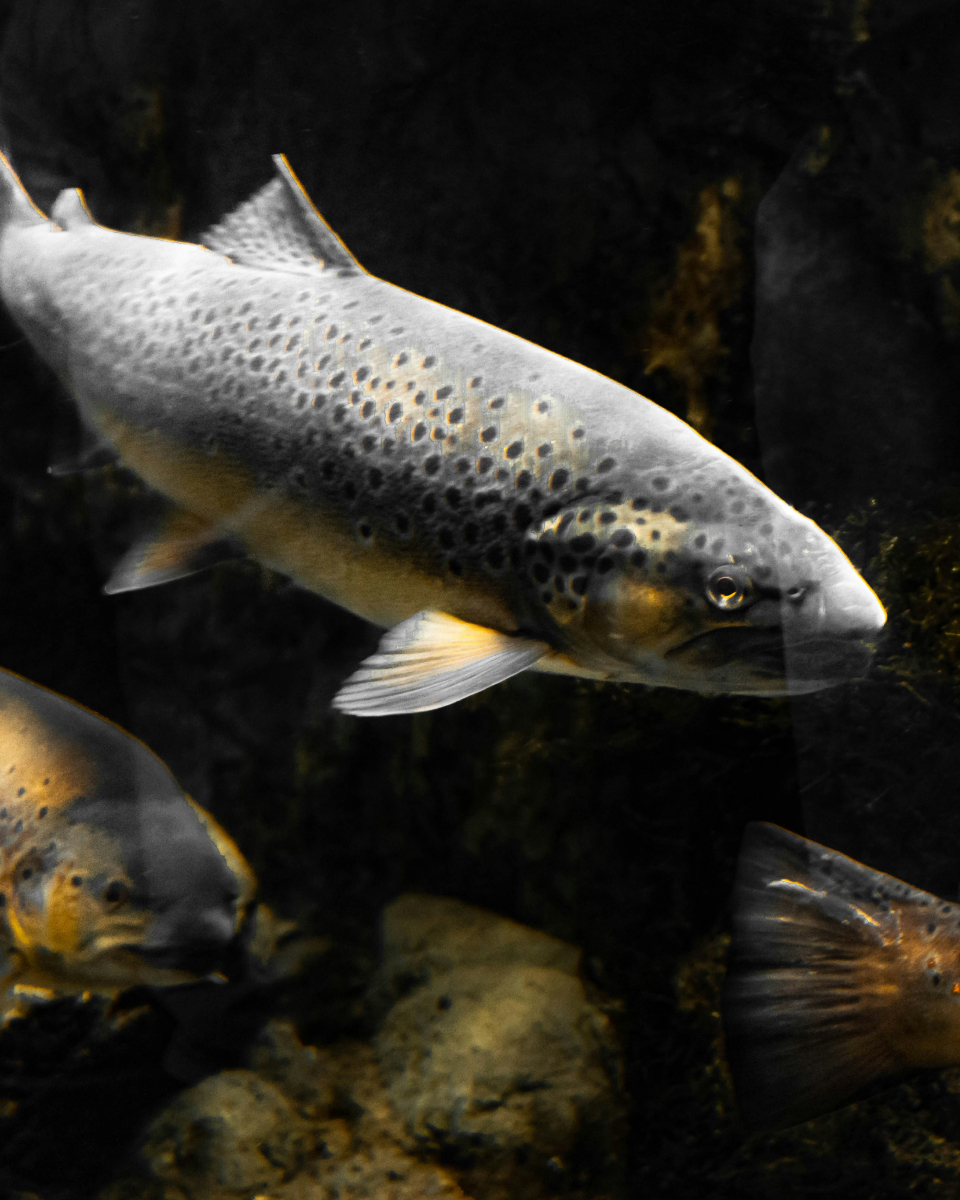
Photo by Sara Kurfeß
Oncorhynchus mykiss and Salmo trutta are cold-water salmonids requiring high dissolved oxygen, temperatures typically below approximately 20°C, and clean water with appropriate flow. Many populations are anadromous — spawning in freshwater, migrating to sea or large lakes for feeding, and homing to natal streams to spawn using olfactory imprinting. Farmed rainbow trout are domesticated strains that have largely lost anadromous behaviour but retain the physiological requirements of the species.
Social behaviour in farmed conditions involves dominance hierarchies, territoriality around feeding stations, and aggression that intensifies with crowding and limited refuges; fin damage is a standard consequence of inter-fish aggression at commercial densities. Key welfare parameters are water temperature, dissolved oxygen, ammonia and nitrite levels, flow rate, and density.
The nociceptive capacity of rainbow trout is among the best-documented of any fish species. Electrophysiological characterisation of the trigeminal system identified at least 22 nociceptors responsive to mechanical, thermal, and chemical stimuli, including polymodal nociceptors structurally comparable to those in mammals (Sneddon, Disease of Aquatic Organisms, 2003). Behavioural studies documented lip-rubbing, rocking, reduced feeding, and altered antipredator behaviour following noxious stimulation — responses attenuated by morphine, demonstrating functional opioid pathways (Sneddon et al., Proceedings of the Royal Society B, 2003). Rainbow trout exposed to chronic stressors show reduced coping capacity, altered cognition, and behavioural changes consistent with affective states in welfare science review literature. Scientific consensus supports fish sentience and pain capacity and is reflected in legislative frameworks in Norway and the UK that apply welfare requirements to farmed fish.
Lifecycle Summary
Global rainbow trout aquaculture production was approximately 848,100 tonnes with a value of approximately USD 3.6 billion in 2020 (FAO/IAFFD); approximately 99% of all trout production comes from aquaculture. Iran and Turkey each accounted for approximately one-fifth of world rainbow trout production in 2020; the EU-27 collectively contributed approximately 19% (~187,936 tonnes), with France, Italy, Denmark, and Spain among the largest EU producers. Chile is a significant producing country outside Europe and the Middle East. Production is expanding globally through intensification in RAS and geographic expansion into Asia and the Middle East.
Trout slaughter welfare is the most quantitatively documented welfare problem in freshwater aquaculture and one of the most precisely measured in any record in this database. The methods still in widespread commercial use — air asphyxia, ice slurry immersion, and CO₂ narcosis — are classified by EFSA as poor welfare methods that produce prolonged periods of consciousness during the dying process. A 2025 peer-reviewed study (Nature Scientific Reports) quantified air asphyxia welfare impact at approximately 10 minutes of moderate to intense pain per individual fish (range 1.9–21.7 minutes), or approximately 24 minutes per kilogram of production (range 3.5–74 min/kg), and modelled that electrical stunning investment could avert 60–1,200 minutes of moderate to extreme pain per US dollar of capital deployed. This remains an active area of regulatory and industry discussion.
Rainbow trout is also the species on which foundational fish pain science was conducted: nociceptor characterisation and morphine-modulated behavioural pain responses were first rigorously documented in O. mykiss, establishing the empirical basis for the contemporary fish welfare consensus.
Lifespan (Natural vs Exploited)
Wild rainbow and brown trout typically reach 4–11 years depending on population; anadromous forms may spend up to approximately 4 years in freshwater and up to approximately 5 years at sea before returning to spawn, with potential maximum ages approaching a decade.
Farmed rainbow trout have substantially compressed lifespans. Freshwater smolt production occurs within approximately 1 year; sea cage or large freshwater cage grow-out to market weight of 2–6 kg takes a further 10–20 months, giving a total farmed lifespan of approximately 1.5–2.5 years. Smaller portion-size trout produced in freshwater raceway systems may be harvested at 9–12 months total. These figures are approximately one-quarter to one-third of the species’ potential wild lifespan.
Broodstock retained for multiple spawning cycles in hatcheries approach several years of age but remain below wild maxima. Primary causes of production mortality: disease outbreaks (bacterial, viral, parasitic), density-related stress and injury, water quality failures including oxygen depletion and temperature spikes, handling during grading and vaccination, and predation at cage systems.
Exploitation Systems
Trout exploitation operates primarily through a single system — freshwater and coastal aquaculture — across four production infrastructure types.
Freshwater flow-through raceways. The dominant production system in Europe and North America. Concrete or earthen channels supplied by streams, springs, or diverted river water; fish stocked as fry or smolts and grown to market size with continuous water exchange and high feed inputs. Effluent is discharged continuously to receiving watercourses, carrying dissolved nutrients and suspended solids from uneaten feed and faeces. The majority of global trout production by volume uses this system type. Outputs are primarily portion trout (~300–500 g) and large trout (2–6 kg) for human food markets; heads, frames, and viscera are rendered into fishmeal and oil or directed to pet food.
Recirculating aquaculture systems (RAS). Land-based tanks with mechanical and biological filtration, oxygenation, and in some systems temperature control. Enables high stocking densities and year-round production without dependence on natural water sources; substantially lower direct nutrient discharge than flow-through systems, with waste concentrated in sludge. Energy-intensive relative to flow-through; lifecycle assessments show RAS has the highest global warming potential and acidification footprint of trout production systems, with the lowest eutrophication and water-use impacts.
Pond systems. Earth ponds at lower stocking densities; used for small-scale and organic trout farming. More variable water quality management than raceways; lower environmental control. Some naturalistic features — substrate, vegetation — not present in raceway or tank systems.
Cage culture in lakes, reservoirs, and marine sites. Net pens in freshwater bodies or coastal sea water; exposure to ambient conditions including currents, temperature fluctuations, and contact with wild fauna through net walls. Used predominantly for grow-out of large trout and “sea trout” forms of O. mykiss (steelhead) to several kilograms. Subject to sea lice pressure in marine sites, though at substantially lower intensity than open-ocean Atlantic salmon cages.
Hatchery production for stocking. Trout produced in hatcheries as fry or fingerlings and released into rivers and lakes to support recreational and subsistence fisheries. This represents an exploitation system where fish are produced but not reared to harvest in captivity; the welfare endpoint is determined by wild conditions and recreational killing rather than the production system.
Living Conditions Across Systems
Stocking densities across system types (indicative commercial ranges): extensive ponds approximately 5–10 kg/m³; semi-intensive ponds approximately 10–15 kg/m³; flow-through raceways at commercial grow-out approximately 20–50 kg/m³ reaching 30–50 kg/m³ at harvest density; RAS typically 40–50 kg/m³ with some systems sustaining 70–100+ kg/m³ under tight water-quality control; lake and freshwater cages approximately 10–25 kg/m³. Welfare literature describes approximately 60 kg/m³ as an upper practical maximum beyond which growth and welfare consistently decline. At 50 kg/m³ and an average portion-trout harvest weight of approximately 400 g, approximately 125 fish occupy each cubic metre of water.
Flow-through raceways: linear channels with forced directional flow; fish continuously swim or station-hold against the current; minimal structural complexity; substrate typically bare concrete; exposure to natural light cycles.
RAS: circular or rectangular indoor tanks; artificial lighting with controlled photoperiod; controlled temperature and oxygen; high hydrodynamic energy from tank circulation; environmental enrichment minimal in standard commercial configurations.
Cage systems: net enclosures in open water with ambient conditions; exposure to currents, waves, and temperature variation; contact with wild species and predators through net walls.
All system types involve large, undifferentiated groups with no ability to establish stable territories; aggressive interactions at feeders and during crowding events are characteristic of farm conditions at commercial densities. Periodic handling — grading, vaccination, harvesting — constitutes high-stress events in all systems.
Lifecycle Under Exploitation
Genetic Selection
Commercial trout farming uses Selective Breeding programmes targeting growth rate, feed conversion ratio, delayed sexual maturation, fillet yield, and resistance to key pathogens. Broodstock maintained in specialised breeding centres under controlled feeding and photoperiod. Triploidisation — pressure or temperature shock of fertilised eggs to prevent second polar body extrusion — produces sterile fish that do not undergo early sexual maturation; triploids are used for grow-out and for stocking programmes where reproductive containment is required.
Reproduction
Artificial strip-spawning is standard: mature males and females are anaesthetised or physically restrained; milt and eggs are manually expressed; fertilisation occurs in containers; eggs are water-hardened before transfer to incubation trays or vertical incubators. Reproductive Cycle Manipulation via photoperiod and temperature manipulation shifts natural spawning seasons to allow year-round smolt production and synchronise production cycles across farms.
Birth & Early Life
Fertilised eggs are incubated in darkened, flowing freshwater hatcheries under controlled temperature; eyed eggs may be refrigerated and shipped internationally for supply chain flexibility. Hatching produces alevins that absorb the yolk sac in incubation systems before transfer to first-feeding tanks; early grading by size reduces cannibalism and standardises cohort growth rates.
Growth & Rearing
Fry and fingerlings are reared in tanks, raceways, or ponds on formulated high-protein feeds with increasing pellet size as fish grow. Stocking density management, health monitoring, and vaccination are the primary management interventions during the freshwater phase. In systems with a sea or large-cage phase, smolts are transferred at 40–120 g to grow-out facilities. Growth Acceleration through selective breeding and nutritional optimisation drives compressed production timelines relative to natural growth rates.
Production
On-farm fattening to target market size: ~300–500 g for portion trout in freshwater systems; 2–6 kg for large trout in sea cage or lake cage systems. Health management includes routine veterinary treatment for bacterial and viral diseases; feed optimisation includes increasing use of plant-protein-based diets with reduced fishmeal components. Some farms specialise entirely in broodstock and egg production, with “production” corresponding to gamete yield rather than grow-out biomass.
Transport
Eggs transported in cooled, oxygenated containers; fry and smolts transported in aerated tank trucks to grow-out sites or stocking locations; harvest-size trout transported live to processing facilities or on ice following on-farm killing. Crowding into smaller volumes for pumping and loading is standard pre-transport practice. Live transport events constitute defined stress events with elevated cortisol, injury risk, and mortality potential.
End of Life
Pre-slaughter fasting — typically 24–72 hours — empties gut contents to reduce effluent and metabolic demand during processing. Fish are crowded in ponds, raceways, or cages using nets, pumped or netted into smaller holding volumes, and moved to slaughter systems. Crowding above threshold densities significantly increases injury and stress during this phase.
Processing
Post-slaughter: bleeding by gill cutting or decapitation, evisceration, heading and gutting, filleting, trimming, and packaging. Products include whole gutted fish, fillets, smoked trout, portions, and value-added products. Heads, frames, viscera, and downgraded fish are rendered into fishmeal and oil, directed to pet food, or used in nutraceutical and cosmetic applications for skin collagen.
Chemical Medical Interventions
Vaccines administered to trout target bacterial diseases including furunculosis (Aeromonas salmonicida), vibriosis (Vibrio anguillarum), and enteric redmouth (Yersinia ruckeri); delivery methods include immersion and injection. Specific products and disease targets vary by region and pathogen pressure.
Antibiotics used therapeutically include amoxicillin and oxytetracycline for bacterial infections. A lifecycle assessment of Spanish (Galician) trout farms (PubMed, 2022) identified amoxicillin discharge as the dominant driver of antimicrobial resistance enrichment in recipient watercourses, representing the clearest documented pathway from a specific farmed fish species to freshwater AMR in available literature. Antibiotic use is regulated with mandatory withdrawal periods and maximum residue limits; actual usage levels vary substantially by country and disease pressure.
Antiparasitic bath treatments are used against ectoparasites; specific substances and approval status vary by jurisdiction and are subject to regulatory revision.
Anaesthetics for handling, vaccination, and artificial spawning include MS-222 (tricaine methanesulfonate) and other agents regulated under national veterinary medicine frameworks; choice and legal status vary by country. Morphine has been used experimentally to demonstrate functional opioid pathways in rainbow trout nociception research; routine clinical analgesia is not applied in production systems.
Triploidisation via pressure or temperature shock at fertilisation is a physical-chemical intervention producing sterile fish; welfare consequences relative to diploids (skeletal deformities, other anomalies) are documented in the literature though appear to be less pronounced in trout than the higher rates reported for triploid Atlantic salmon.
Adipose fin clipping marks hatchery-origin fish for identification in fisheries; photoperiod manipulation using artificial lighting manages spawning timing and smoltification.
Slaughter Processes
Trout slaughter welfare represents the most poorly resolved welfare challenge in freshwater aquaculture by available evidence, and the most precisely quantified in any record in this database.
Methods still in widespread commercial use — classified by EFSA as poor welfare — include: air asphyxia (removal from water and exposure to air until death); ice slurry immersion (sudden temperature drop slowing physiology while fish remain conscious for a prolonged period); and CO₂ narcosis in water (CO₂ dissolved in water causes aversive distress before unconsciousness, during which fish show escape responses and physiological indicators of pain). A 2025 peer-reviewed study (Nature Scientific Reports) quantified the welfare impact of air asphyxia specifically: approximately 10 minutes of moderate to intense pain per individual fish (range 1.9–21.7 minutes), or approximately 24 minutes per kilogram of trout slaughtered (range 3.5–74 min/kg). The same study modelled that investment in electrical stunning equipment could avert 60–1,200 minutes of moderate to extreme pain per US dollar of capital invested — one of the first systematic cost-effectiveness analyses of an animal welfare intervention for a farmed fish species.
Welfare-acceptable methods identified by EFSA include: percussive stunning (mechanical blow to the head sufficient to induce immediate unconsciousness), electrical stunning using wet or dry systems with sufficient current parameters, and electrocution. In the UK, approximately 80% of trout production (British Trout Association membership) reports use of electrical stunning systems; RSPCA-certified farms are required to use percussive, electronarcosis, or electrocution methods and to avoid dry electrical stunning. Adoption of acceptable methods is substantially lower outside the UK and northern Europe.
Post-stun killing uses gill cutting or decapitation; correct and prompt bleeding is required to prevent recovery of consciousness. Pre-slaughter crowding — concentrating fish for pumping or netting — constitutes a high-stress welfare event even before the killing method is applied.
No validated religious slaughter framework applies to trout.
Slaughterhouse Labour Impact
Trout processing occurs predominantly in small to medium enterprises in Europe — particularly in Germany, France, Italy, and the UK — and in larger industrial facilities in Iran, Turkey, and Chile. Tasks include crowding and pumping operations, stunning system operation, bleeding, evisceration, filleting, trimming, and packing. Cold, wet working environments, repetitive cutting tasks, and machinery operation create standard fish processing occupational risks.
Trout-specific occupational health data are not reported separately from broader seafood or aquaculture sector statistics. Studies of stunning protocol implementation in trout facilities indicate variable operator training and monitoring as a primary determinant of welfare outcome — a finding that implies inconsistent task execution rather than systematic workforce safety data. The general seafood processing occupational injury profile — musculoskeletal strain, lacerations, cold environment exposure, repetitive motion injuries — applies structurally.
Scale & Prevalence
Global rainbow trout aquaculture: approximately 848,100 tonnes in 2020 (FAO/IAFFD), approximately USD 3.6 billion value. Approximately 99% of all trout production is from aquaculture; wild commercial trout harvest is negligible in global tonnage terms. Iran: approximately 20% of world production; Turkey: approximately 20%; EU-27 collectively approximately 19% (~187,936 tonnes), with France, Italy, Denmark, and Spain as the largest individual EU member state producers; Chile is significant in South America.
Individual count conversion: at ~848,100 tonnes and an average harvest weight of approximately 400 g for portion trout, global annual harvest is approximately 2.1 billion individual fish; this figure is sensitive to average weight assumptions and the mix of portion versus large trout in the production total.
Directional trend: stable to expanding production driven by intensification in RAS, geographic expansion in the Middle East and Asia, and increasing per-capita seafood consumption. FAO’s 2024 SOFIA report confirmed that total global aquaculture production surpassed capture fisheries in 2022, and trout aquaculture participates in this expanding sector.
Ecological Impact
Freshwater eutrophication from effluent discharge is the primary ecological impact of flow-through and pond systems. Dissolved nitrogen, phosphorus, and suspended solids from uneaten feed and faeces are discharged continuously to receiving watercourses, contributing to algal growth, reduced dissolved oxygen, and altered aquatic community composition in downstream environments. A lifecycle assessment of Iranian trout farms identified total suspended solids as the leading driver of water-quality impacts including eutrophication and ecosystem toxicity.
Antimicrobial resistance enrichment in freshwater systems is a documented ecological and public health consequence of antibiotic use. A lifecycle assessment of Galician (Spanish) trout farms identified amoxicillin discharge as a primary driver of AMR enrichment in recipient waters — the clearest documented link between a specific farmed fish species and freshwater AMR in available peer-reviewed literature.
Aquafeed production is the dominant contributor to trout farming’s greenhouse gas emissions, acidification, and land competition across lifecycle assessments conducted in Spain, Denmark, and Iran. RAS systems have higher energy-related emissions than flow-through systems but substantially lower direct freshwater nutrient discharge; the environmental trade-off between system types is a function of the relative weighting of energy versus nutrient impact categories.
Escaped farmed trout — particularly rainbow trout released or escaped into river systems outside their native North American range — can interact with and compete against native brown trout and other salmonids; the ecological significance of this interaction varies by receiving ecosystem and release volume.
Hatchery stocking programmes introduce large numbers of hatchery-origin fish into wild river and lake systems, affecting the genetic integrity and ecological dynamics of wild populations; the direction and magnitude of effects depend on stocking intensity and the genetic divergence of hatchery stocks from wild populations.
Language & Abstraction
“Intensive,” “semi-intensive,” and “extensive” describe trout production systems in terms of inputs and output per unit area or volume — feed input, biomass per cubic metre, labour intensity — rather than conditions experienced by individual fish. High-density raceway systems at 40–50 kg/m³ are routinely described as “intensive” without explicit reference to the individual-level crowding they represent. The terminology is borrowed from terrestrial livestock systems where its welfare implications are better established; its application to fish systems normalises density metrics as production parameters rather than welfare parameters.
“Harvest,” “biomass,” and “mortality rate” replicate the same framing documented in the Salmon record: fish deaths are production variance metrics. The trout record adds a specific case of this: deaths by air asphyxia are recorded as a mortality management operation completing a production cycle, not as a welfare event — despite being the most precisely quantified welfare harm in freshwater aquaculture.
“Humane slaughter” in UK and EU regulatory and certification contexts distinguishes between acceptable stunning methods and poor ones; the term functions as a welfare compliance category. Its application in practice shows that approximately 20% of UK trout production continues under unstunned methods even within the industry that most widely adopts the “humane” standard, and globally the proportion using poor methods is substantially higher. “Humane” operates as a ceiling-quality descriptor for a minority of production rather than a baseline standard.
“Sea trout” describes the anadromous form of Salmo trutta in wild and recreational fishery contexts, and also describes large farmed rainbow trout grown in sea cages in some markets. The same term thus applies to a wild native species and to a non-native farmed fish using marine grow-out systems; the ambiguity is unresolved in standard trade labelling.
The foundational fish pain evidence base was generated specifically in rainbow trout — the same species that is the primary commercial trout. The species whose nociceptive system is most rigorously characterised, and whose pain responses most clearly meet the behavioural criteria for affective pain states, is produced by methods that the welfare literature identifies as producing prolonged conscious suffering during slaughter in the majority of global commercial production.
Terminology
Trout, rainbow trout, sea trout, large trout, portion trout, trout portions, trout fillet, trout fillets, smoked trout, trout caviar, roe, trout roe, eyed eggs, fry, alevin, fingerling, parr, smolt, grower, broodstock, stock trout, triploid trout, production cycle, grow-out, finishing, harvest, harvest-size fish, biomass, stocking density, intensive system, semi-intensive system, extensive system, flow-through system, raceway, pond, cage, net pen, recirculating aquaculture system, RAS, hatchery, grading, stripping, spawning, smolt production, fingerling production, value-added products, by-products, trimmings, offal, rendering.
Within The System
Developments
Report a development: contact@systemicexploitation.org
Notice an inaccuracy or omission?
If you believe information on this page is incorrect, incomplete, or missing important context, you may submit a suggested correction for review.