
Catfish
Scientific Name:
Pangasianodon hypophthalmus / Ictalurus punctatus / Clarias gariepinus
Scope
Covers commercially farmed catfish across three dominant exploited groups within order Siluriformes (~3,400 valid species): Pangasiidae — primarily striped catfish (Pangasianodon hypophthalmus, marketed as “tra,” “Pangasius,” or “Basa”), the largest catfish aquaculture species globally by export volume; Ictaluridae — primarily channel catfish (Ictalurus punctatus) and its hybrids, dominant in US aquaculture and expanding in China; and Clariidae — primarily African catfish (Clarias gariepinus) and related species, dominant in Sub-Saharan Africa and parts of Southeast Asia. Wild-caught Siluriformes in the Mekong, Nile, and Ganges-Brahmaputra river systems contribute to regional food fisheries but are not the primary focus. Ornamental and aquarium catfishes are excluded. The three farmed systems have substantially different geographies, stocking intensities, and market destinations and are treated as distinct production modes within a single record.
Species Context
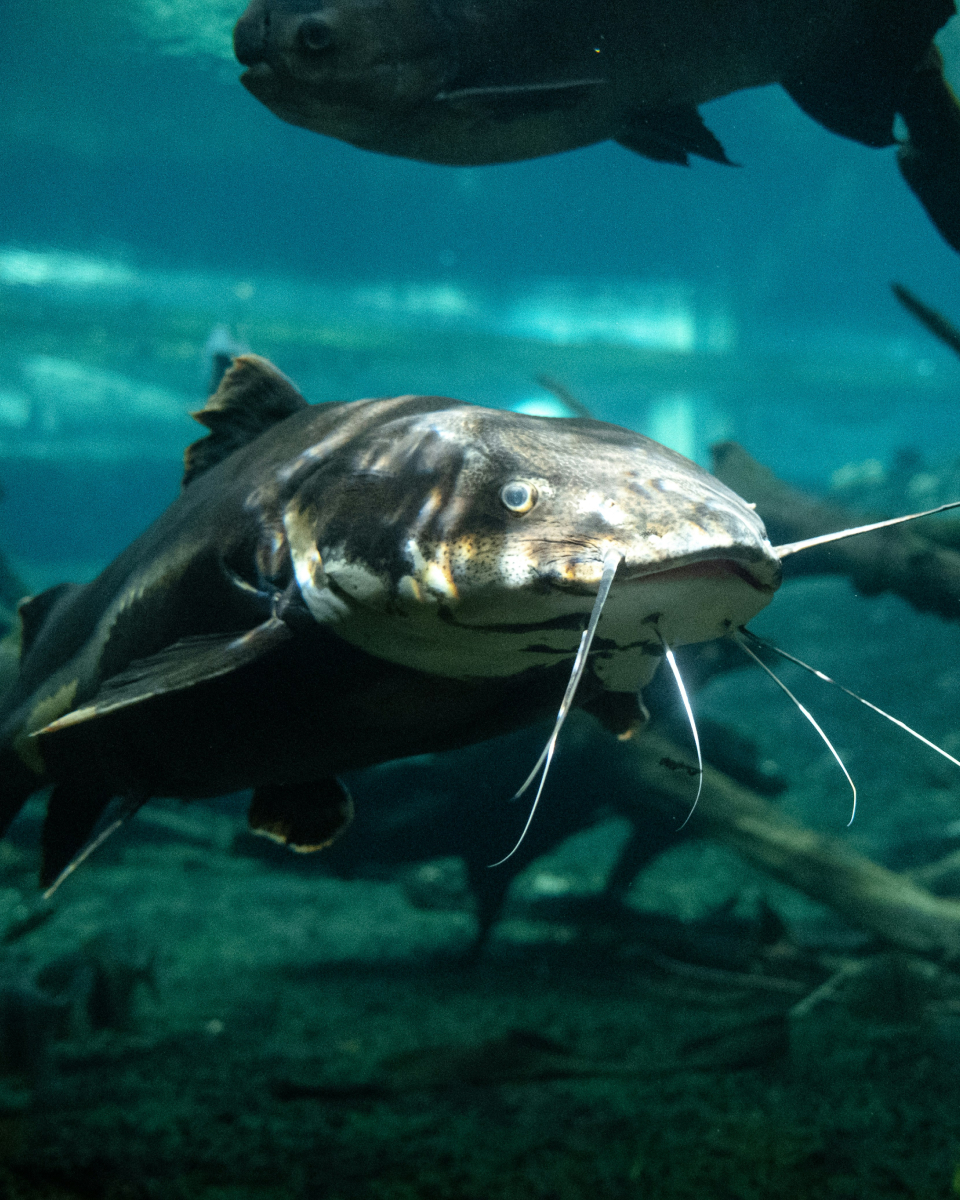
Photo by Laura España
Siluriformes are ray-finned fishes characterised by barbels, scale-less skin, and diverse body shapes. The three primary farmed groups differ substantially in biology and welfare-relevant characteristics.
Pangasianodon hypophthalmus is a large, fast-growing obligate freshwater species native to the Mekong River; it can reach several kilograms and tolerates warm, turbid water with elevated ammonia and reduced oxygen. It has a functional swim bladder and suprabranchial organs providing some air-breathing capacity.
Ictalurus punctatus is a North American freshwater species tolerant of variable water quality; it is an omnivore and bottom feeder with well-developed chemoreceptive barbels; natural lifespan 15–20+ years.
Clarias gariepinus has a highly developed suprabranchial arborescent organ that allows it to breathe atmospheric oxygen directly, enabling survival in severely hypoxic or desiccating conditions and permitting short-distance terrestrial movement using pectoral fins — the biological basis for its common designation as “walking catfish” and the reason it establishes invasive populations readily when escaping aquaculture systems. This characteristic is the primary reason *C. gariepinus* tolerates the extremely high RAS densities (100–400 kg/m³) used commercially.
Aggression and cannibalism in juvenile *C. gariepinus* are documented production management problems at both low and high stocking densities; agonistic behaviour drives selective sorting and density management in early life stages. Stress physiology is documented in all three groups: cortisol, glucose, and lactate elevations under chronic crowding are recorded for *C. gariepinus* in Wageningen University welfare research, consistent with fish sentience and pain capacity evidence reviewed in the Salmon and Trout records.
Lifecycle Summary
Global catfish aquaculture production reached approximately 5.5 million tonnes in 2017 valued at over US$10.5 billion at farm gate, with Pangasiidae accounting for approximately 51% and Clariidae approximately 24% of that catfish tonnage. Catfish collectively constitute one of the top finfish groups in global aquaculture by volume.
Three production systems define the catfish record. The pangasius system in Vietnam’s Mekong Delta is an intensive export-oriented industry operating at stocking densities of 18–125 fish/m² in deep earthen ponds (2–6 m), producing 70–850 tonnes per hectare per crop cycle; it supplies primarily the EU, United States, and Russian markets under a contested set of product names that has been the subject of formal trade legislation. The US channel catfish system is an extensive earthen pond industry in the Mississippi Delta operating at approximately 34,000–35,000 fish/ha in multi-batch stocking systems. The African catfish system uses recirculating aquaculture systems (RAS) at densities of 100–400 kg/m³ — among the highest documented stocking densities for any farmed vertebrate in this database — enabled by *C. gariepinus*’s suprabranchial air-breathing organ, which allows survival in hypoxic conditions that would be lethal to most other farmed fish.
The “catfish” naming dispute — a trade and regulatory conflict over whether Vietnamese pangasius could be labelled “catfish” in the US market, where the term was legally reserved for domestic Ictaluridae by the 2002 US Farm Bill — is the most clearly documented instance in this database of a product naming regulation functioning as an economic trade barrier rather than an animal welfare or food safety standard.
Lifespan (Natural vs Exploited)
Natural lifespans: channel catfish (*I. punctatus*) 15–20+ years under favourable conditions; *P. hypophthalmus* several years in natural Mekong populations; *C. gariepinus* up to approximately 8–10 years in wild conditions.
Exploited lifespans: pangasius harvested at 12–18 months at 1.0–1.5 kg; channel catfish harvested at 18–24 months at 0.5–1.5 kg; African catfish harvested at 12–18 months at 1.0–2.0 kg. All three species are slaughtered at a fraction of their potential natural lifespan. Broodstock retained for hatchery reproduction may be maintained for several years beyond grow-out slaughter age.
Primary causes of production mortality: bacterial infections, poor water quality (particularly in intensive systems), cannibalism in early life stages for *C. gariepinus*, and handling and transport stress events.
Exploitation Systems
Catfish exploitation operates through three substantially different aquaculture production systems, plus minor wild capture components.
Pangasius pond aquaculture (Vietnam and expanding regions). Intensive earthen pond culture of *P. hypophthalmus* in the Mekong Delta of Vietnam, primarily in An Giang and Dong Thap provinces. Ponds typically 2–6 m deep with stocking densities of 18–125 fish/m², producing 70–850 tonnes per hectare per crop cycle on supplementary feeds. Vietnam is the dominant global pangasius producer; the system employs hundreds of thousands of workers predominantly women from rural areas in harvesting and processing. Pangasius fillets are quick-frozen to approximately −40°C and exported primarily to the EU (labelled “Pangasius” or “striped catfish”), the United States (where labelling is governed by specific regulatory history), and Russia. The pangasius industry supplies one of the least expensive white fish fillets on global markets and has displaced some European and North American domestic white fish markets.
US channel catfish pond aquaculture. Extensive earthen pond culture of *I. punctatus* and channel × blue catfish (*I. furcatus*) hybrids in the Mississippi Delta (Mississippi, Alabama, Arkansas). Typical stocking at approximately 34,000–35,000 fish/ha (~0.34–0.35 fish/m²) in multi-batch systems where fish of different sizes coexist in the same pond and are periodically harvested by seine netting as they reach market size. Production serves the domestic US market primarily; the industry contracted significantly from the 1980s–1990s peak as imported pangasius displaced market share. China has developed channel catfish production using the selectively bred “Jiang Feng No. 1” strain, which shows approximately 22–25% growth advantage over baseline stocks.
African catfish RAS aquaculture. Intensive to super-intensive recirculating aquaculture systems for *C. gariepinus* and *Heterobranchus* spp. in the Netherlands (dominant European producer), Nigeria, Ghana, and parts of Southeast Asia. Commercial RAS densities of 100–400 kg/m³ (semi-intensive to super-intensive) are enabled by *C. gariepinus*’s air-breathing capacity. Nigeria is the largest African catfish producer. Some RAS operations in Europe and West Africa supply live fish markets; others produce gutted and smoked product.
Wild capture fisheries. Siluriformes are taken in wild fisheries in the Mekong (where native giant Pangasiidae contribute to subsistence and local markets), the Congo, the Nile, and other major river systems. These wild fisheries are not systematically quantified in FAO species-specific data and are minor relative to farmed production volumes for the three primary species covered here.
By-products and downstream flows. Processing generates heads, frames, viscera, and skin directed to fishmeal, fish oil, fertiliser, and animal feed. Some processing by-products enter pet food streams. Research use of catfish species — particularly as toxicology models and in basic aquaculture physiology — is documented but not a significant production system.
Living Conditions Across Systems
Pangasius ponds. Deep earthen ponds (2–6 m) with high stocking densities (18–125 fish/m²); high biomass supported by continuous feeding and aeration management. Water is typically turbid; water quality managed through water exchange and aeration rather than filtration. Fish have no access to substrate complexity or natural pond structure given the continuous high-density management.
US channel catfish ponds. Shallow earthen ponds (~1–1.5 m) at low stocking density (~0.34–0.35 fish/m²) relative to pangasius or African catfish systems; multi-batch, meaning fish of multiple age classes and sizes coexist. Aeration via paddlewheel aerators is standard in intensive US ponds; dissolved oxygen management is the primary daily welfare-relevant parameter.
African catfish RAS. Tank-based closed or semi-closed systems with mechanical and biological filtration; commercial densities of 100–400 kg/m³ and documented experimental densities of 500–3,000 fish/m³ — the highest stocking densities documented for any farmed vertebrate in this database. Wageningen University welfare research documents elevated cortisol, glucose, and behavioural stress indicators in *C. gariepinus* under chronic high-density conditions, though growth performance remains relatively stable across a wide density range. Environmental enrichment is absent in commercial RAS configurations; artificial lighting and continuous water circulation are characteristic.
Across all systems, catfish are held in large undifferentiated groups without access to natural substrate, refuge structures, or the spatial ranges characteristic of their wild ecology. Olfactory and tactile sensory modalities dominate in turbid or dark tank conditions; visual stimuli are limited.
Lifecycle Under Exploitation
Genetic Selection
Selective Breeding programmes target growth rate, feed conversion ratio, disease resistance, and fecundity. Channel catfish breeding in the US has produced commercial lines through USDA and university programmes; the Chinese “Jiang Feng No. 1” strain of *I. punctatus* achieves approximately 22–25% growth advantage over baseline stocks. Pangasius breeding in Vietnam uses hatchery broodstock derived from Mekong wild fish; selective propagation focuses on growth and fecundity without the multi-generation closed-population breeding characteristic of salmonid programmes. *C. gariepinus* selection programmes focus on growth, survival, and tolerance of high-density conditions.
Reproduction
Hatchery-based artificial reproduction is standard across all three systems. Hormonal induction using pituitary extracts from sacrificed donor fish or synthetic GnRH analogues with dopamine antagonists triggers spawning in broodstock held in tanks or ponds. Broodstock channel catfish produce approximately 3,000–4,000 eggs per pound of body weight annually in managed systems. Reproductive Cycle Manipulation via temperature management coordinates spawning timing. Strip-spawning and dry fertilisation are used in some hatchery operations; in others, natural spawning in controlled tank environments with spawning substrate is permitted.
Birth & Early Life
Eggs are incubated in hatchery tanks or trays; larvae are reared in nursery systems on live feeds — including *Moina* (water flea) and *Artemia* — before transition to commercial starter diets. Cannibalism and mortality in early life stages of *C. gariepinus* are documented production challenges requiring selective sorting by size to reduce aggression between differently-sized individuals. High nursery mortality rates drive density management as a primary early-life intervention.
Growth & Rearing
Juveniles are transferred to grow-out ponds, tanks, or RAS systems and fed formulated diets. Pangasius grow-out uses plant-protein-rich compounded feeds with reduced fishmeal components relative to salmonid systems; soy-based diets are dominant. Channel catfish grow-out in the US uses floating pelleted feeds that allow observation of feeding activity at the pond surface. African catfish RAS grow-out uses high-protein formulated feeds with continuous automated feeding. Growth Acceleration through selective breeding and nutritional optimisation is the primary lever across all systems.
Production
Pangasius ponds operate on single-batch or continuous stocking cycles producing 70–850 tonnes/ha depending on intensity. Channel catfish ponds operate on multi-batch systems where seining removes market-sized fish while smaller cohorts continue growing. African catfish RAS operate at semi-intensive (approximately 100 kg/m³), intensive (approximately 200 kg/m³), or super-intensive (approximately 400 kg/m³) density regimes.
Transport
Live transport in aerated trucks or tanks between hatcheries, grow-out facilities, and processing plants. Pre-slaughter transport stress — elevated cortisol and glucose — is documented in catfish consistent with all teleost stress response data. Pangasius export product is processed on-site in Vietnam’s Mekong Delta processing plants and transported as frozen fillets, minimising live transport beyond domestic supply chains.
End of Life
Harvest involves crowding through seine netting (channel catfish, pangasius) or crowding and pumping (RAS systems), followed by transfer to processing. Pre-harvest crowding and pumping is a defined stress event with documented welfare implications.
Processing
Industrial processing lines handle stunning, bleeding, gutting, filleting, and freezing. Pangasius tra fillets are quick-frozen to approximately −40°C for export. African catfish processing in some European operations uses a documented protocol: pre-starvation for at least 72 hours, gradual cooling from 27°C to 15°C, then ice-water immersion until death followed by decapitation — a multi-hour process whose welfare implications are discussed in the Slaughter Processes field. Automated lines in large processing facilities process tens of thousands of fish per day.
Chemical Medical Interventions
Antibiotics are used in catfish aquaculture particularly in high-density Vietnamese pangasius systems; oxytetracycline and other broad-spectrum antimicrobials have been documented in Vietnamese and Chinese catfish production. International and national regulations increasingly restrict antibiotic use for growth promotion and mandate residue limits; the EU has imposed import controls on some Vietnamese catfish products due to antibiotic residue violations. Regulatory oversight and compliance vary substantially between producing countries.
Hormonal induction for spawning uses pituitary extracts from sacrificed donor fish and synthetic GnRH analogues combined with dopamine antagonists, consistent with practices documented for carp. This is not routine growth promotion; it is applied at reproduction only.
Vaccines against bacterial pathogens are less commonly deployed in catfish than in salmonid systems; health management relies more on biosecurity, water quality control, and selective breeding. Some vaccination programmes for columnaris disease and bacterial diseases are documented in US channel catfish.
No routine growth-promoting hormone use in grow-out is reported in the literature for catfish; growth improvements are attributed to selective breeding and nutrition. No routine surgical modifications are standard.
Regulatory variation is pronounced: Vietnamese pangasius production has been the subject of EU rapid alert system notifications for prohibited substances and antibiotic residues; US channel catfish operations are subject to USDA Food Safety and Inspection Service (FSIS) oversight; African catfish production in Nigeria and other Sub-Saharan African countries operates under national veterinary medicine frameworks with variable enforcement.
Slaughter Processes
Slaughter methods for catfish are variable across systems and poorly standardised globally relative to salmon or trout.
CO₂ narcosis — immersion in CO₂-enriched water — is documented for some catfish processing contexts; fish may be immobilised within approximately 2–4 minutes but show behavioural stress responses indicating aversive experience during the period before immobilisation. CO₂ narcosis is classified as a poor welfare method in current aquaculture welfare guidance, consistent with its classification for trout and salmon.
Electrical stunning is used in some facilities; parameters for reliable unconsciousness induction in catfish are not universally standardised across the taxonomically diverse Siluriformes. Recovery without secondary killing occurs if stun is not followed promptly by gill cutting or decapitation.
For African catfish (*C. gariepinus*), a cooling protocol documented in a German processing patent involves: pre-starvation for at least 72 hours, gradual temperature reduction from 27°C to 15°C, followed by immersion in ice-water until death, and then decapitation. This protocol extends the dying process over several hours; the welfare status of fish during gradual chilling below activity threshold but before neurological death is not established in the catfish-specific welfare literature.
Percussive stunning, spinal spike, and gill-cut exsanguination are also documented. Quantitative failure-rate data specific to catfish slaughter are sparse; the majority of fish welfare slaughter studies concentrate on salmonids or cyprinids rather than Siluriformes.
Processing throughput at major pangasius facilities and US channel catfish plants reaches tens of thousands of fish per day, placing pressure on consistent application of welfare-governed stunning protocols.
Religious slaughter frameworks may apply in some catfish-consuming Muslim-majority markets; species-specific catfish halal slaughter protocols are not reported in the literature.
Slaughterhouse Labour Impact
Vietnam’s pangasius processing industry employs hundreds of thousands of workers, with women from rural Mekong Delta communities comprising a large proportion of the processing workforce. Processing tasks — filleting, trimming, and packing — are highly repetitive manual operations in cold, wet environments. The industry is a significant employer in the Mekong Delta region; occupational health data specific to pangasius processing are not available in peer-reviewed form, but the occupational risk profile — musculoskeletal strain from repetitive cutting, lacerations, cold environment exposure, and shift work — is consistent with seafood processing sector documentation globally.
US channel catfish processing employs workers in Mississippi Delta communities; the industry has historically been an employer in one of the US’s most economically disadvantaged regions. Workforce conditions align with general meat and seafood processing sector occupational health profiles.
Psychological impact data for catfish processing workers are not available. General fish and meat processing literature on stress, desensitisation, and burnout is applicable structurally; species-specific or system-specific data have not been published.
Scale & Prevalence
Global catfish aquaculture production approximately 5.5 million tonnes in 2017, valued at over US$10.5 billion at farm gate. Pangasiidae approximately 51% of that catfish tonnage; Clariidae approximately 24%. These figures are from a 2022 IntechOpen chapter compiling FAO and sectoral data; current FAO STAT species-level data should be consulted for the most recent figures.
Vietnam pangasius: production of approximately 1.5–1.7 million tonnes annually in peak years (late 2010s); export value exceeding USD 2 billion annually; primary markets EU, US, Russia. Production fluctuates with market conditions and import restrictions.
US channel catfish: industry contracted significantly from a peak of approximately 180,000 acres in production in the 1990s–2000s; approximately 40,000–60,000 acres in production in recent years as imported pangasius displaced market share. China’s channel catfish production has grown through selectively bred strains.
African catfish (*C. gariepinus*): Nigeria is the largest Sub-Saharan African producer; the Netherlands is the largest European producer. Global *C. gariepinus* production figures are not consolidated separately from Clariidae totals in FAO data; production is expanding across West Africa as RAS technology spreads.
Individual count estimate: at 5.5 million tonnes total catfish aquaculture and a broad average harvest weight of approximately 1 kg for the three primary species, approximately 5.5 billion individual catfish are slaughtered annually. This figure is approximate and sensitive to species mix and average weight assumptions.
Directional trend: pangasius production is stable to modestly expanding after a period of contraction following EU and US import restrictions; US channel catfish is contracting; African catfish production is expanding across Sub-Saharan Africa. Overall catfish aquaculture is a growing sector globally.
Ecological Impact
Pangasius pond discharge generates substantial nutrient loading from the high-density Mekong Delta system; nitrogen and phosphorus from uneaten feed and faecal material discharge to canals and waterways connected to the Mekong system. Studies have documented elevated ammonia, nitrite, and total suspended solids in water bodies adjacent to pangasius production zones. The Mekong River Commission has noted cumulative pressures on Mekong basin fisheries and water quality from multiple sources including aquaculture.
Antibiotic residue discharge from pangasius and other catfish systems contributes to antimicrobial resistance enrichment in freshwater environments, consistent with the pathway documented for trout in Spain and tilapia generally.
Clarias gariepinus has established invasive populations in Florida (US), parts of Europe, and other regions following escape from aquaculture systems; its air-breathing and terrestrial mobility enable survival and dispersal that most farmed fish cannot achieve. Invasive *C. gariepinus* and related species prey on native fish and aquatic invertebrates and compete with native predatory fish for prey; the ecological consequences of establishment in novel freshwater systems are documented in Florida and European river systems.
Channel catfish pond culture generates nutrient loading from feed and waste similar to other pond systems; Mississippi Delta catfish ponds have been associated with nitrogen and phosphorus discharge into local waterways.
Carbon footprint of pangasius production has been assessed in lifecycle assessments as relatively low per kilogram of protein relative to terrestrial meats, partly because *P. hypophthalmus* efficiently converts plant-based feeds and requires minimal fishmeal in its diet. The climate advantage of pangasius relative to beef or pork is documented in peer-reviewed LCA literature; comparisons with other farmed fish vary depending on system boundaries and transport modes.
Language & Abstraction
The “catfish” naming dispute between the United States and Vietnam is the clearest documented example in this database of a product naming regulation functioning primarily as a domestic industry protection mechanism. The US Consolidated Appropriations Act of 2005 and subsequent Farm Bills restricted the use of the term “catfish” in US interstate commerce to members of the family Ictaluridae — the domestic channel catfish family — effectively requiring that Vietnamese Pangasianodon hypophthalmus be marketed under alternative names (“Basa,” “Swai,” “tra”) that carry no established consumer recognition or premium. The regulation was framed publicly as a consumer information measure; its documented effect was to erect a nomenclatural trade barrier protecting the contracting US channel catfish industry from price competition with cheaper Vietnamese imports. This is a regulatory naming decision with direct material consequences for producers, workers, and market prices — not a food safety or species identification standard.
“Pangasius,” “Basa,” and “Swai” function as distinct commercial identities for the same species in different markets. In the EU, “Pangasius” appears on retail labels as a species name; in some Asian markets, “tra” is the vernacular. In the US, “Swai” has become the dominant retail term following the labelling restriction. None of these names communicates the production system, density, country of origin, or antibiotic use history of any specific product.
“Multi-batch” in US channel catfish pond management describes a production protocol where fish of multiple year classes and sizes coexist in the same pond and are removed as they reach market size over multiple years. The term is a production efficiency descriptor; it describes a crowding and co-housing system from a management optimisation perspective without addressing the welfare implications of fish of different sizes competing in the same environment.
RAS density metrics — 100 kg/m³, 200 kg/m³, 400 kg/m³ — describe African catfish stocking at biomass per volume. At 400 kg/m³ and an average weight of 500 g, approximately 800 individual fish occupy each cubic metre of water. The biomass metric, consistent with its use across all aquaculture records, positions fish as weight units within a density management system rather than as individuals in a spatial environment.
Terminology
Catfish, siluriform, Pangasius, pangasius, tra, Basa, Swai, striped catfish, channel catfish, African catfish, walking catfish, Clarias, Ictalurus, Pangasianodon, pangasiid, ictalurid, clariid, broodstock, fry, fingerling, grow-out, multi-batch stocking, seine, seining, RAS, raceway, pond culture, cage culture, biomass, stocking density, feed conversion ratio, production cycle, harvest, market size, whole fish, fillet, frozen fillet, quick-frozen, by-product, offal, fishmeal, fish oil, smoked catfish, processing plant.
Within The System
Developments
Report a development: contact@systemicexploitation.org
Notice an inaccuracy or omission?
If you believe information on this page is incorrect, incomplete, or missing important context, you may submit a suggested correction for review.