
Goats
Scientific Name:
Capra hircus
Scope
Covers domestic goats (Capra hircus, syn. Capra aegagrus hircus) across all major exploitation systems: dairy production, meat production (chevon, cabrito), fibre production (cashmere from the fine undercoat of cashmere-producing breeds; mohair from Angora goats), and skin/leather. Includes dairy, meat, fibre, and mixed-purpose breeds from highly specialised indoor European dairy herds to extensive pastoralist systems in Sub-Saharan Africa and Central Asia. Feral goats derived from domestic stock are included where managed or culled as part of commercial systems. Wild caprines (bezoar ibex Capra aegagrus, mountain goats Oreamnos americanus) are excluded except as genetic reservoirs. Companion and pet goats are excluded from primary analysis. The same individual goat commonly contributes to multiple product streams simultaneously: a dairy doe also produces kids for meat and a hide at culling; a cashmere goat also produces meat at end of fibre-productive life.
Species Context
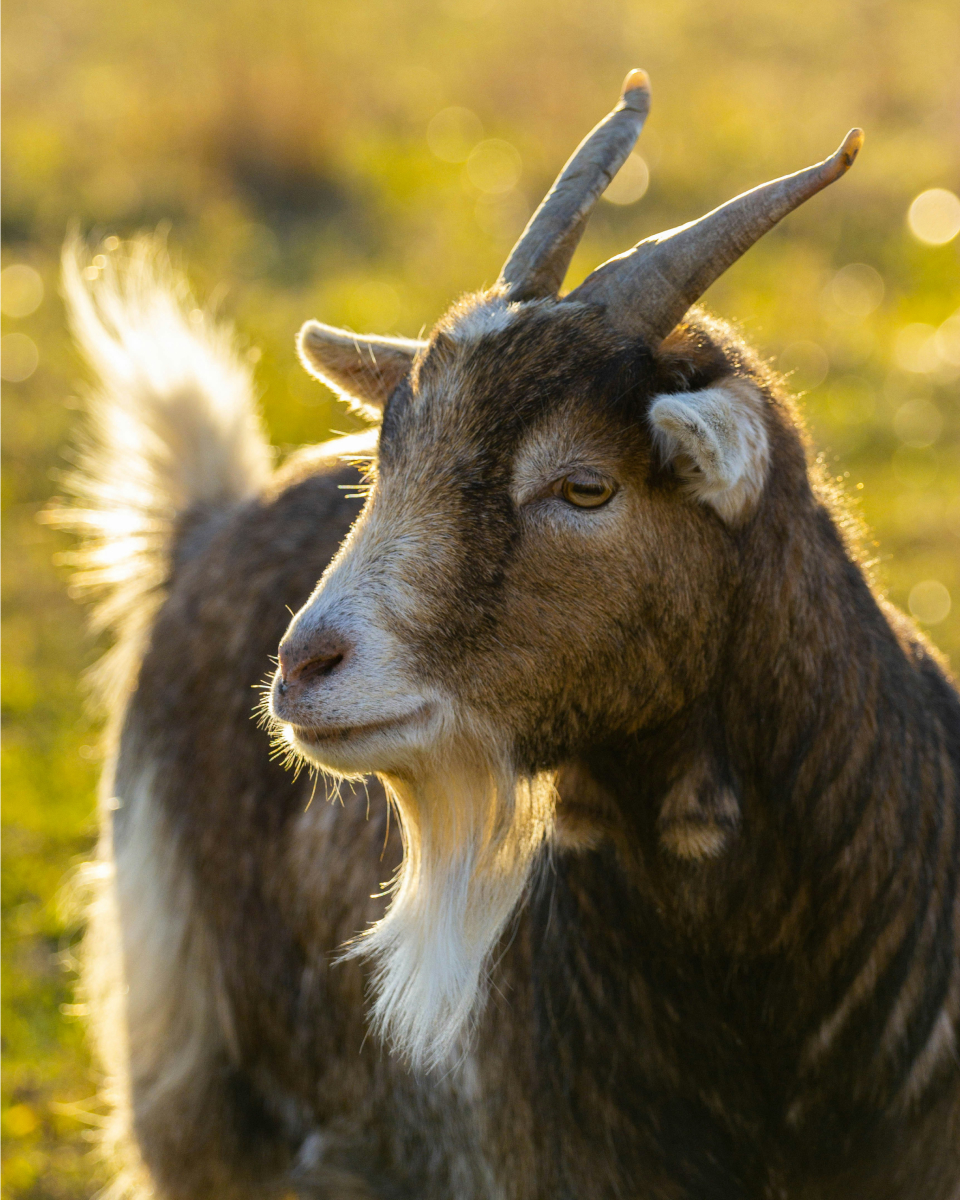
Photo by Maxime Agnelli
Capra hircus is a small ruminant with a four-chambered stomach, highly selective browsing behaviour, and exceptional adaptability to arid and marginal environments where cattle and sheep cannot sustain production. Wild ancestors were cliff-dwelling animals with the agility, inquisitiveness, and environmental scanning capabilities appropriate to predator-rich rocky terrain; these characteristics persist in domestic goats as exploratory behaviour, problem-solving motivation, and strong responses to novelty.
Social structure is organised around dominance hierarchies within female-centred groups; males compete through head-butting and scent-marking during breeding season. Maternal bonding is strong and individual — does recognise their own kids through vocal and olfactory cues within hours of birth, and separation is a documented welfare stressor.
Cognitive evidence is substantive. Goats follow human gaze and use pointing gestures in object-choice tasks — social cognition documented in a peer-reviewed study (Kaminski et al., Animal Behaviour, 2005) comparable to findings in domestic dogs and great apes. Judgement-bias paradigms demonstrate that affective states modulate decision-making in goats, supporting the interpretation that they experience valenced emotional states analogous to positive and negative affect in mammals more broadly. Selection-line comparisons show that dairy goat lines differ from dwarf lines in reversal learning performance, indicating that production selection correlates with cognitive and behavioural characteristics (Frontiers in Psychology, 2021). Goats respond to stress with elevated cortisol and altered behaviour; they are recognised as sentient mammals in legislative frameworks including EU Council Regulation 1099/2009 and national animal welfare acts.
Lifecycle Summary
Goats are the fourth most numerous domestic animal globally after cattle, sheep, and pigs, with a total population of approximately 1.1 billion. The global dairy goat population alone was estimated at approximately 218 million head in 2017 (FAO-based estimates), with 52% in Asia and 39% in Africa. Total goat milk production reached approximately 18.7 million tonnes in 2017, representing a 62% increase from 1993 to 2013. China holds the largest total goat population globally, predominantly oriented toward meat; France and Spain lead European dairy goat specialisation with high per-doe yields from intensively managed indoor herds.
Goats occupy a distinctive position in global food and fibre systems as the primary livestock of smallholder and pastoralist households in low-income tropical and dryland regions. In much of Sub-Saharan Africa and South Asia, goats function simultaneously as dairy animals, meat animals, mobile capital assets, and draught manure contributors within integrated crop-livestock systems. The cognitive and emotional evidence base for goats is among the strongest of any livestock species documented in this database.
Lifespan (Natural vs Exploited)
Under low-predation, low-disease managed conditions, goats can reach 10–15 years, with some individuals reported beyond 15 years in non-production settings.
In intensive dairy systems, productive lifespan for does is commonly 3–5 lactations (approximately 5–7 years), after which culling for reduced milk yield, reproductive failure, or lameness is typical. In extensive pastoralist and smallholder systems, adult goats may remain in the herd for several years but actual lifespan is reduced by predation, drought, disease, and undernutrition.
In meat systems, kids in intensive or semi-intensive feedlot operations are typically slaughtered between 3–12 months depending on target liveweight and market; cabrito (suckling kid) may be slaughtered at 4–8 weeks. Neonatal mortality is significant in extensive systems from hypothermia, infection, mismothering, and predation.
Male dairy kids in intensive systems that have no value for meat production may be killed on-farm at or near birth — the same structural surplus-male mortality category documented in dairy cattle and dairy sheep systems.
Fibre goats (cashmere, mohair) have productive fibre-bearing lives of approximately 5–7 years before being culled for meat; Angora goats typically produce high-quality mohair for approximately 4–6 years, with fibre coarsening with age.
Exploitation Systems
Goat exploitation operates across four primary systems that frequently overlap in the same animal.
Dairy production. Dairy goats are milked for fluid milk, cheese (including prominent regional products such as chèvre in France, manchego in Spain, and feta from sheep-goat blends), yoghurt, and powdered milk. Specialised dairy goats in Europe (Saanen, Alpine, Toggenburg, LaMancha) are managed in indoor barns with mechanised milking systems; per-doe milk yields of 700–1,200 litres per lactation are typical in high-production European herds. In Asia, Africa, and Latin America, goat dairy systems range from semi-intensive smallholder herds to extensive pastoral systems where goats supply primarily household milk consumption. In intensive dairy systems, kids are separated from dams shortly after birth and reared on milk replacer — the same structural early-life separation documented for dairy cattle. Male dairy kids in specialised dairy breeds have limited commercial value for meat and may be killed on-farm or sold early.
Meat production. Goat meat (chevon) is the most widely consumed meat globally after poultry and pork in terms of producing-country markets, with highest per-capita consumption in Africa, the Middle East, South and Southeast Asia, and parts of Latin America. Suckling kid meat (cabrito) is a distinct market product requiring slaughter at 4–8 weeks. Meat goats in rangeland and pastoral systems are managed extensively; feedlot finishing is used in some commercial operations in Australia, the US, and parts of Asia. Many goats slaughtered for meat are cull animals from dairy, fibre, or mixed-purpose herds rather than purpose-bred meat animals.
Cashmere fibre production. Cashmere is the fine undercoat fibre (typically 14–19 micron diameter) combed or dehaired from cashmere-producing breeds in spring as they naturally shed their winter coat. Primary producing regions are Inner Mongolia and other northern Chinese provinces (~75% of world raw cashmere), Mongolia, Afghanistan, Iran, and Kyrgyzstan. Cashmere goats are held extensively in semi-arid and arid rangeland systems. The cashmere industry is linked to documented pasture degradation in Mongolia and northern China from expanding goat numbers under market incentive; increasing cashmere demand has driven herd expansion onto marginal land, contributing to desertification documented in peer-reviewed rangeland ecology literature.
Mohair fibre production. Mohair is the long-staple, lustrous fibre shorn from Angora goats twice yearly. Primary producers are South Africa (~50% of world supply), the United States (Texas), and Turkey. Angora goats are managed in semi-extensive systems; shearing is performed under conditions that expose freshly shorn animals to cold stress — documented mortality from hypothermia in newly shorn Angora goats during cold weather is a recurring welfare concern in South African and US mohair operations.
Skin and leather by-products. Goat skins processed into leather for footwear, gloves, and garments constitute a significant by-product of meat slaughter globally; kid skins (moroccan, glacé) are used in premium leather goods. Animals are not routinely managed specifically for skin quality — skins are a slaughter by-product rather than a primary production objective in most systems.
Pharmaceutical and biotech downstream flows. Blood, offal, bones, and intestinal mucosa from slaughter enter rendering, pet food, and pharmaceutical manufacturing streams; heparin from intestinal mucosa, collagen, and goat serum for research antibodies are documented pharmaceutical uses. Biotin-labelled goat antibodies and goat-anti-mouse secondary antibodies are standard laboratory reagents in immunological research.
Living Conditions Across Systems
Intensive dairy systems. Indoor group pens with slatted or bedded floors; stocking densities commonly 1.5–2.5 m² per adult doe; milking parlour handling twice daily. Animals may have limited or no pasture access in highly intensive European systems. Housing design, ventilation, and feeding management are the primary welfare determinants.
Extensive dairy and mixed systems. Variable housing from basic shelters to none; animals range on pasture, scrubland, or rangeland during the day; access to foraging is a welfare asset relative to intensive housing, but exposure to climatic extremes, variable nutrition, parasitism, and predation risk are welfare concerns in extensive systems.
Pastoral and rangeland systems. Goats range over large areas across arid, semi-arid, and tropical pasturelands; human supervision frequency is low; management interventions are limited to seasonal handling for health treatments and kidding. Welfare challenges include undernutrition in drought years, high parasite burden, and inadequate veterinary access.
Feedlot finishing. Confined pen systems for meat goats at higher stocking densities than extensive systems; similar welfare risk profile to feedlot cattle with the additional complication that goats are highly inquisitive and motivated for environmental exploration — confinement to bare pens restricts species-adapted behaviour more severely than for less exploratory species.
Depot facilities (Australia). Goats assembled from extensive rangeland systems at depot holding facilities before transport or live export; MLA documentation notes high stocking densities and mixed-origin groups at depots, with increased disease transmission and stress-related morbidity risks during this aggregation phase.
Lifecycle Under Exploitation
Genetic Selection
Selective Breeding programmes differ substantially by production system. Specialised European dairy breeds are selected through structured performance recording, AI from elite sires, and genomic tools for milk yield, composition, fertility, and udder conformation. Meat breed selection (Boer, Kalahari Red, Spanish) targets growth rate, carcass composition, and adaptability to rangeland conditions. Cashmere selection programmes focus on fibre fineness and yield; Angora selection targets staple length, lustre, and annual fibre weight. Research documents that selection for milk production correlates with altered cognitive and behavioural characteristics in dairy versus non-dairy lines.
Reproduction
In intensive dairy systems, Reproductive Cycle Manipulation via progestagen sponge intravaginal devices and equine chorionic gonadotrophin (eCG) injection is used to synchronise oestrus and enable out-of-season breeding — extending the milking season beyond the natural autumn breeding period. Artificial insemination using chilled or frozen semen from elite sires is used in improved dairy breeds. Extensive and smallholder systems rely primarily on natural mating with buck introduction to doe groups at defined times. Kidding season is managed to align with forage availability and market timing.
Birth & Early Life
In intensive dairy systems, kids are separated from dams at birth or within hours and reared on colostrum then milk replacer, terminating the maternal bond that does establish through vocal and olfactory recognition within hours of birth. This is Premature Weaning and Separation applied at its earliest point — at or near birth rather than at weeks or months. In extensive and smallholder systems, kids remain with dams for variable periods. Male dairy kids in specialised dairy breeds may be killed on-farm at birth or sold at very young ages. Disbudding — thermal destruction of the horn bud using a hot iron at approximately 1–2 weeks of age — is near-universal in dairy and many meat systems to prevent horn development; pain management at disbudding is inconsistent and varies by jurisdiction.
Growth & Rearing
Replacement does are grown to breeding weight under forage and concentrate regimes; intensive systems set precise growth targets for first mating age. Male kids retained for meat are grown in extensive, semi-intensive, or feedlot conditions to target liveweight. Castration of male kids not retained for breeding is standard in many systems; timing and pain mitigation vary. Growth Acceleration through concentrate feeding and selective breeding is most marked in feedlot finishing contexts.
Production
Dairy does undergo repeated lactation cycles, with milking frequency typically twice daily and dry periods of 60–90 days between lactations before the next kidding. Wool Shearing — in the form of cashmere combing and Angora goat shearing — defines the production stage for fibre systems. Cashmere is combed once annually in spring; Angora goats are shorn twice yearly. Fibre-producing goats in Mongolian and Chinese systems are managed primarily on native rangeland through winter and spring.
Transport
Live Transport between farms, markets, depots, and slaughter facilities is regulated to varying degrees by national transport codes. Australian rangeland goats move through depot systems before domestic slaughter or live export; journey durations and welfare conditions at depots have been the subject of MLA welfare management documentation. Religious festival markets in the Middle East, South Asia, and North Africa generate large seasonal live goat transport volumes for Eid al-Adha.
End of Life
Commercial slaughter for meat; on-farm killing of unproductive, injured, or sick animals; emergency depopulation (disease outbreaks); and feral population control culling. Methods include mechanical captive bolt (penetrating or non-penetrating), electrical head-only or head-to-body stunning, and lethal injection (primarily individual veterinary contexts). Dairy does are culled typically after 3–5 lactations and enter the meat supply as cull goat meat. Fibre goats are culled when fibre production declines; Angora goats at end of fibre-productive life provide carcasses for meat markets.
Processing
Meat: dressing, hide removal, evisceration, chilling, cutting, and boning; offal separated for food or rendering; blood, bones, and offal directed to rendering or pharmaceutical extraction. Dairy: pasteurisation, fermentation, coagulation, and cheese-making for processed products. Fibre: washing (scouring), dehairing, carding, combing, spinning, and dyeing before textile manufacturing.
Chemical Medical Interventions
Vaccines routinely administered include those targeting clostridial diseases (Clostridium perfringens types B, C, D; C. tetani), pasteurellosis (Mannheimia haemolytica, Pasteurella multocida), and regionally significant diseases: Peste des Petits Ruminants (PPR) vaccine is a priority intervention in endemic areas across Africa, the Middle East, and Asia; contagious caprine pleuropneumonia (CCPP) vaccination is deployed in affected regions. PPR vaccination campaigns are central to the global PPR eradication programme initiated by FAO and OIE.
Anthelmintics — benzimidazoles (albendazole, fenbendazole), macrocyclic lactones (ivermectin, doramectin), and levamisole — are used extensively for gastrointestinal nematode control; anthelmintic resistance is a documented and serious production and welfare problem in goat systems globally, particularly in areas with frequent drench administration without refugia management.
External parasite control uses acaricides and insecticides for tick and lice control in regions with high ectoparasite burden; product choice and regulatory status vary by country.
Progestagen sponges (medroxyprogesterone acetate, fluorogestone acetate) and eCG (equine chorionic gonadotrophin/PMSG) are used for oestrus synchronisation and out-of-season breeding in intensive dairy systems; the eCG supply chain involves PMSG collection from blood-farm mares, creating a welfare linkage to the horses record.
Disbudding using hot iron at approximately 1–2 weeks of age is near-universal in dairy and many meat systems for hornless management; EFSA and veterinary guidelines recommend local anaesthetic (lidocaine) and systemic analgesia (non-steroidal anti-inflammatory drugs) as mandatory welfare requirements; compliance is variable globally. Castration using rubber ring (elastration), Burdizzo crush, or surgical method is performed in many systems on male kids not retained for breeding; analgesia requirements and compliance vary by jurisdiction.
Antibiotics are used therapeutically for respiratory, enteric, and mastitis-related bacterial infections; prophylactic and growth-promoting antibiotic use is restricted in the EU and some other markets and declining globally under AMR pressure.
Slaughter Processes
Commercial goat slaughter uses pre-slaughter stunning — penetrating captive bolt (pneumatic or cartridge), electrical head-only or head-to-body systems — followed by neck cutting for exsanguination, in line with standard small ruminant slaughter protocols. Goats are typically processed on shared sheep and goat lines in mixed small-ruminant abattoirs; throughput ranges from small local abattoirs handling tens of animals daily to industrial plants processing hundreds per hour.
Religious slaughter exemptions are quantitatively significant for goats given the species’ centrality to halal and Islamic ritual slaughter markets. In many Muslim-majority countries and in halal supply chains globally, slaughter without prior stunning is practised; some jurisdictions require post-cut stunning; others permit full stunning exemption. The annual volume of goat slaughter for Eid al-Adha represents one of the largest single-event animal kill events in the global food system — estimated at tens of millions of goats killed across multiple countries within days. Conditions at informal festival slaughter — outside regulated abattoir infrastructure — are substantially less welfare-governed than commercial slaughter.
EFSA’s review of killing methods for goats documents welfare consequences associated with handling and restraint, mis-stun risk in captive-bolt application to the small cranium of goats (smaller target area than cattle), and recovery from inadequate stunning. On-farm emergency killing uses firearms or penetrating captive bolt; humane killing training for farm workers is inconsistent globally.
Slaughterhouse Labour Impact
Worker conditions in small-ruminant slaughter and processing align with those documented across red-meat processing sectors: musculoskeletal injuries from repetitive cutting, lacerations, cold environment exposure, and strain from handling animal weight and equipment. Goat-specific occupational injury datasets are not published separately; data are subsumed within sheep-and-goat or small-ruminant processing statistics.
Workforce demographics in major producing and processing countries include significant proportions of migrant and low-wage workers; this pattern is documented across red-meat sectors globally. Psychosocial stressors from slaughter work are documented in broader meat processing literature but goat-specific psychological impact studies have not been published.
Handling and loading at depot facilities and during live transport involves manual labour with physical risks from kicks, falls, and zoonotic exposure (Q fever — Coxiella burnetii — is a documented occupational hazard specific to goat and sheep handling); depot conditions with high stocking densities and time pressure amplify these risks.
Scale & Prevalence
Global goat population: approximately 1.1 billion total. Global dairy goat population approximately 218 million head in 2017 (FAO-based), with 52% in Asia and 39% in Africa; Africa showed 32% growth from 2007 to 2017, Asia 19%. Total goat milk production approximately 18.7 million tonnes in 2017, a 62% increase from 1993 to 2013.
China holds the largest total goat population globally, predominantly meat-oriented; India, Pakistan, Bangladesh, and Ethiopia have very large goat populations serving primarily domestic meat and milk markets. France, Spain, and the Netherlands lead European specialised dairy production. South Africa, the United States (Texas), and Turkey are the primary Angora mohair producers. China, Mongolia, Afghanistan, Iran, and Kyrgyzstan are the primary cashmere producers.
Global goat numbers are on a long-term growth trajectory, particularly in developing regions; FAO data indicate continued expansion driven by population growth, urbanisation-linked demand for goat products in peri-urban areas, and goats’ adaptability to marginal land unsuitable for cattle.
Individual slaughter numbers: FAO estimates annual goat slaughter at approximately 440–470 million animals globally. This positions goats as the fourth most numerous terrestrial food animal slaughtered after chickens, pigs, and cattle.
Ecological Impact
Grazing and browsing impact. Goats are the most ecologically flexible browsing ruminant in domesticated livestock; their ability to consume shrubs, thorny vegetation, and low-quality forages makes them suited to dryland systems but also makes them capable of removing vegetation cover that other livestock cannot access. Under high stocking rates and poor management, goat overgrazing contributes to vegetation loss, soil erosion, and desertification — documented particularly in Sub-Saharan Africa and parts of Central Asia. Conversely, controlled goat grazing is deployed as a deliberate tool for shrub management and invasive plant control in some rangeland and land management contexts.
Cashmere-driven pasture degradation. The expansion of cashmere goat numbers in Mongolia and Inner China in response to rising global demand for cashmere fibre is documented in peer-reviewed rangeland ecology literature as a driver of pasture degradation and desertification. Mongolian pastureland under goat pressure has shown vegetation loss and soil destabilisation at documented scales; the cashmere supply chain thus connects luxury textile markets in high-income countries to land degradation in Central Asian rangeland ecosystems.
Greenhouse gas emissions. Goats are ruminants and produce enteric methane; per-unit-of-product emissions are variable across systems. Extensive systems on native rangeland have lower direct input requirements than intensive systems; life cycle assessments for goat milk and meat suggest emissions comparable to or somewhat lower per kilogram of protein than cattle systems, but with wide variation by region, system intensity, and feed source.
Feral goat impacts. Feral goat populations derived from domestic escapes have established on islands and in mainland regions worldwide; the IUCN documents feral goats as a significant invasive herbivore impacting native vegetation on islands in the Galápagos, Hawaii, New Zealand, and Australia. Feral goat browsing pressure on native vegetation is well-documented; eradication programmes have been conducted on some islands with documented vegetation recovery.
Language & Abstraction
Goats are classified as “small ruminants” or “livestock” in most regulatory and scientific frameworks, grouping them with sheep in a single management category that shapes data collection, regulatory standards, and welfare assessments. This grouping is convenient for regulatory economy but obscures species-specific characteristics: goats are more inquisitive, more capable of escape, more selective in feeding behaviour, and more reactive to novelty than sheep, and welfare assessments calibrated for sheep do not automatically transfer.
“Surplus kids” in dairy goat industry documents describes male dairy kids and seasonally excess female kids for whom no productive role exists in the dairy system. The term positions the structural production of animals with no pathway to productive use as a management surplus category rather than as a predictable mortality consequence of dairy system design — the same framing documented for “bobby calves” in dairy cattle and “surplus male chicks” in layer hen systems.
“Cabrito” and “kid meat” foreground the age and consumer appeal of young goat meat without identifying the production context; in diary systems, cabrito commonly refers to male dairy kids slaughtered at 4–8 weeks as a by-product of the dairy cycle. “Chevon” is the less common English-language term for goat meat that positions the product as equivalent to beef (boeuf/veau) or mutton in European cultural framing.
“Cashmere” as a luxury fibre product category is entirely delinked from its production context — semi-extensive rangeland systems across Central Asia and China, with documented environmental consequences from demand-driven herd expansion. The product name signals softness, rarity, and quality; its derivation from a specific undercoat harvest from a specific animal in a specific landscape system is invisible in retail contexts.
Disbudding is described in veterinary and industry documentation as a “routine husbandry procedure” and a “welfare measure” — the latter framing positions the prevention of horn-related injuries as the primary welfare consideration, while the procedure itself (thermal destruction of the horn bud in a conscious kid at 1–2 weeks of age, under variable pain management) is a welfare cost that the framing absorbs into standard management language.
Terminology
Goat, small ruminant, doe, buck, billy, nanny, wether, kid, replacement doe, breeding buck, cull goat, surplus kid, dairy goat, meat goat, fibre goat, cashmere goat, Angora goat, mohair goat, lactating doe, dry doe, kidding, kidding rate, kidding season, kidding pen, feedlot goat, depot goat, rangeland goat, pastoral goat, goat milk, goat cheese, goat yoghurt, goat meat, chevon, cabrito, goat carcass, goat hide, goat leather, offal, tripe, mohair, cashmere, goat hair, live export goat.
Within The System
Developments
Health of Animals Regulations transport amendments
SAG Decrees implementing welfare regulations
Mandatory pre-stunning ends religious slaughter exemption
Live export ban will not be repealed this term
Restriction on live animal exports to non-EU countries
Report a development: contact@systemicexploitation.org
Notice an inaccuracy or omission?
If you believe information on this page is incorrect, incomplete, or missing important context, you may submit a suggested correction for review.