
Llamas
Scientific Name:
Lama glama
Scope
Covers domestic llama (Lama glama) across all exploitation systems: meat and fibre production in Andean pastoral systems, pack transport and trekking, guard animal deployment, hobby and companion keeping, zoo and exhibition use, and biopharmaceutical production (VHH nanobody generation). Geographic focus is the Andean highlands of Bolivia, Peru, Argentina, and Chile — where approximately 96% of the global llama population is concentrated in extensive pastoral systems managed by approximately 200,000 smallholder families — with secondary coverage of North American, European, and Australasian hobby, trekking, and guard populations. Related taxa excluded: wild guanaco (Lama guanicoe), vicuña (Vicugna vicugna), domesticated alpaca (Vicugna pacos), and Old World camelids (Camelus spp.), though biological and welfare findings about camelids generally are referenced where llama-specific data are absent.
Species Context
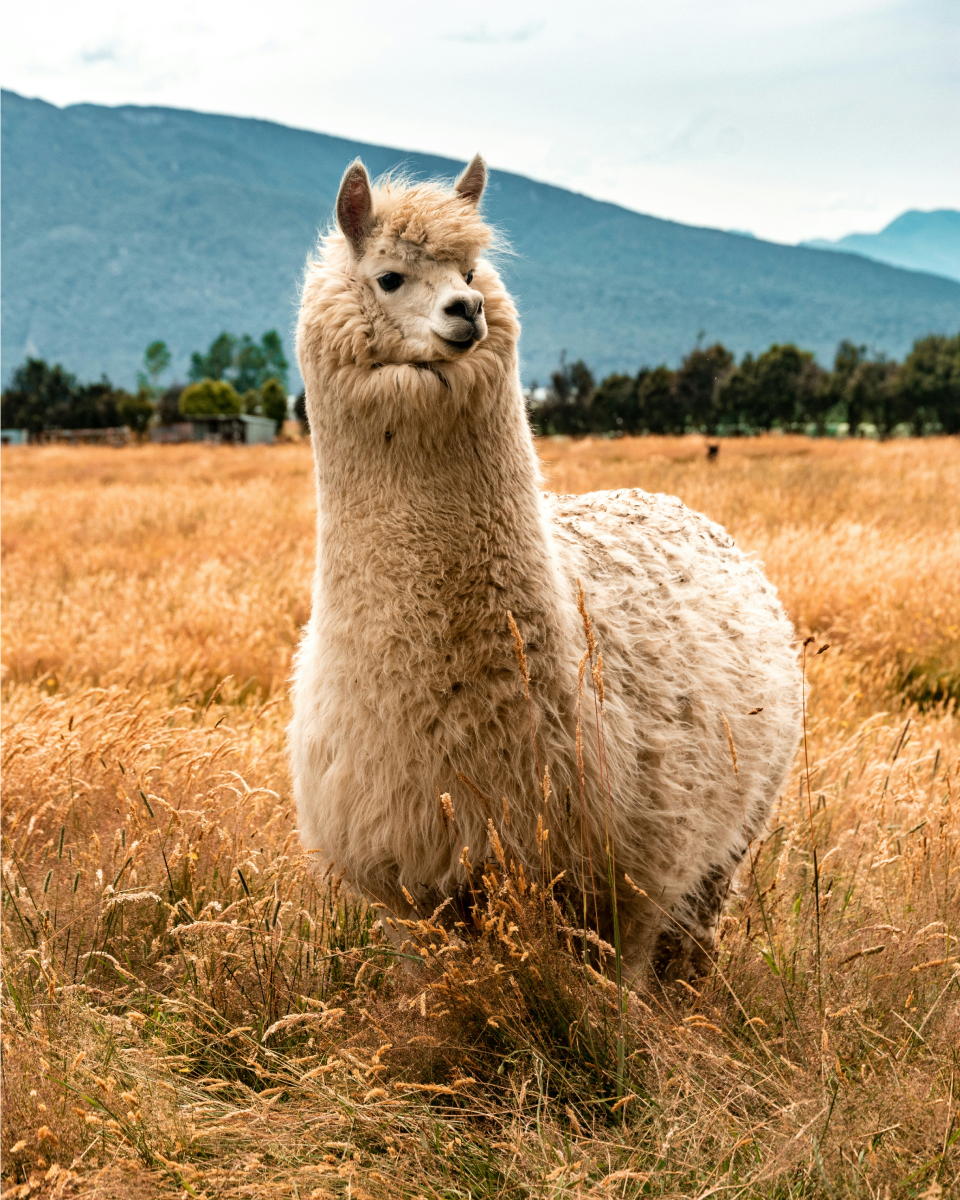
Photo by Sébastien Goldberg
Lama glama is a medium-to-large South American camelid — adult body mass approximately 110–250 kg, shoulder height approximately 102–110 cm — adapted specifically to high Andean puna and altiplano environments at approximately 3,700–5,000 m elevation. Gestation is approximately 350 days; females produce a single offspring (cria); sexual maturity in females approximately 18–24 months. Llamas are efficient users of low-quality forage at low stocking densities; documented densities of 0.41 llamas/ha/year in dry Bolivian rangeland to 3.8 llamas/ha/year in humid zones reflect the extensive land requirement of their natural management system.
Social structure is gregarious; traditional pastoral systems maintain mixed-sex, multi-age herds across extensive ranges under herder supervision. Handling studies document avoidance, flight, and aggression (biting, bumping, kicking) in response to aversive restraint; handling response correlates with caretaker attitudes and frequency of positive human contact. Llama latrine behaviour — concentrated communal dung piles used consistently across individuals — creates distinct nutrient deposition patterns with documented ecological consequences.
Cognitive evidence includes a peer-reviewed demonstration that llamas use social information from both conspecifics and humans in a spatial detour task, consistent with social learning capacity facilitated by domestication for cooperative work with humans. Llamas are treated as sentient livestock in welfare literature; camelids are included among mammals with complex behaviour, nociception, and stress physiology in the broader vertebrate sentience consensus.
Lifecycle Summary
The global llama population is approximately 3.2–4 million animals, of whom approximately 62.5% are in Bolivia and the remainder primarily in Peru, Argentina, and Chile. This makes llamas the smallest-population domestic animal species with a dedicated record in this database. Exploitation is structurally dominated by multi-purpose smallholder pastoralism in Andean highland systems where the same animal provides meat, fibre, hides, manure, and pack transport within a single household economy.
Two features distinguish the llama record from all other records in this database. First, the traditional slaughter method used at many Bolivian facilities — the puntilla — is the most specifically documented inadequate slaughter method by published failure rate: a peer-reviewed Meat Science study of 20 llamas found that 95% showed signs of brain and spinal cord function after stabbing, indicating they remained sensible before bleeding, and that repeat stabbing was required in 45% of animals. This is a documented welfare failure rate with no equivalent in published abattoir research for any other species in the database. Second, llamas are a primary source animal for VHH single-domain antibody (“nanobody”) production — a biopharmaceutical role unique to camelids in which hyperimmunisation and blood collection generate research and therapeutic reagents entering global scientific supply chains.
Lifespan (Natural vs Exploited)
Well-managed domestic llamas typically live approximately 15–20 years, with some individuals reported beyond 20 years under low-mortality conditions. In extensive Andean pastoral systems, working pack and fibre animals may remain in use into their mid- to late teens; culling typically occurs when productivity (meat yield at condition threshold, fibre quality, load-carrying capacity, or reproductive output) declines.
In meat-oriented herds, young animals may be slaughtered at approximately 12–24 months to optimise carcass traits before productivity decline in harsh seasons. Hobby, trekking, and guard animals in the Global North frequently live into late teens or early twenties when veterinary access and nutrition are maintained.
Primary causes of mortality across systems: enterotoxemia (Clostridium perfringens), gastrointestinal parasitism, neonatal morbidity (hypothermia, infectious disease, malnutrition), predation in extensive Andean systems (pumas, Andean foxes), obstetric complications, drought-related undernutrition, and slaughter for meat or by-product utilisation.
Exploitation Systems
Llamas are exploited across six systems that frequently overlap within the same animal and household economy.
Extensive Andean pastoral meat and fibre production. The dominant global system by animal number. Multi-purpose household herds managed by smallholder and pastoralist families in the Bolivian, Peruvian, Argentine, and Chilean altiplano and puna. Animals provide meat (fresh and dried charque), fibre, hides, manure as fuel and fertiliser, and in some areas pack transport within a single integrated livelihood system. Communal or family herds graze natural pastures over seasonal ranges; on-farm slaughter or small municipal abattoirs handle meat production; fibre is shorn annually or biennially; cull animals — old, unproductive, or surplus males — are directed to meat. FAO initiatives identify this system as a livelihood foundation for approximately 200,000 Andean families.
Specialised meat production. Semi-specialised herds selecting for tall, long-bodied Q’ara-type llamas with emphasis on growth rate and carcass conformation. Surplus males and culled females are slaughtered at approximately 12–24 months for meat optimisation. By-products include offal, hides, and bones entering local processing chains.
Fibre production. Llama fibre is coarser than alpaca fibre and enters value chains for blended textiles, rope, woven goods, and handicrafts. Selective breeding programmes for finer-fibre llamas exist but are limited relative to the alpaca industry, which dominates fine camelid fibre markets globally. Fibre is harvested by shearing; downstream processing involves washing, carding, spinning, and weaving.
Pack transport and trekking. Traditional Andean caravan systems use llamas to carry loads over mountain trails where wheeled vehicles cannot operate; this system has contracted with road infrastructure expansion but persists in remote areas. In the Global North, trekking enterprises deploy trained llamas to carry gear for tourist hiking groups. Conditioning and Training for load-bearing and trail behaviour is the defining production practice for this system.
Guard animal deployment. Llamas kept singly or in small groups with sheep or goat flocks in North America, Europe, and Australia to deter canid predators (foxes, coyotes, domestic dogs); selected for alertness, low fear of conspecifics, and predator-appropriate response. This system typically involves long-term deployment without commercial outputs beyond the deterrence service.
VHH nanobody and biopharmaceutical production. Camelids, including llamas, produce heavy-chain-only immunoglobulins whose variable domains (VHH fragments, commercially designated “nanobodies”) have distinctive properties: small size (~15 kDa), high thermal and chemical stability, ability to bind epitopes inaccessible to conventional antibodies, and ease of genetic engineering. Llamas are hyperimmunised with target antigens; blood is drawn for peripheral blood lymphocyte isolation and VHH library construction; phage display selection identifies antigen-specific nanobodies. These enter research supply chains as antibody reagents and, in increasing numbers of cases, as therapeutic candidates or approved therapeutics (caplacizumab, the first approved nanobody therapeutic, is derived from camelid VHH). This is a pharmaceutical manufacturing system with no equivalent in any other farmed species record except horses (biopharmaceutical plasma) and cattle (FBS).
Living Conditions Across Systems
Extensive Andean pastoral systems. Free-range grazing over communal or private rangelands with effective stocking densities of 0.41–3.8 llamas/ha; animals are outdoors year-round, using natural vegetation for shelter with occasional corrals or stone enclosures for night confinement, handling, shearing, or predator protection. Social grouping is natural multi-age herd composition. This system most closely matches species-adapted behaviour patterns.
Semi-intensive and hobby/trekking/guard systems (Global North). Paddock-based fenced pastures; simple shelters for weather protection; handling facilities (corrals, races) for management. Space requirements for llamas in these contexts are not standardised in species-specific regulations; advisory sources recommend several hundred square metres per animal. Handling frequency is higher than in extensive Andean systems; studies indicate handling response quality correlates with consistency and type of human contact.
Biotech/research settings. Llamas used for nanobody production may be kept in research facility paddocks or contracted farms under institutional animal care oversight; immunisation schedules, blood collection frequency, and animal maintenance are governed by institutional ethical review and national animal research regulations.
Quantitative indoor stocking-density or pen-dimension standards comparable to intensive pig or poultry systems are absent in the llama literature; production remains predominantly extensive or semi-intensive.
Lifecycle Under Exploitation
Genetic Selection
Selective Breeding in Andean pastoral systems operates primarily through phenotypic selection by household producers, selecting for body size and conformation (Q’ara meat type), fibre type and colour, temperament, and load-carrying capacity. Nucleus or breeding herds retain elite males; breeding decisions are largely household- or community-level. Artificial insemination is used in some research and breeding programmes but is not widespread in production systems. Biotech applications select for immunological responsiveness to specific antigens.
Reproduction
Natural mating dominates across all production systems. Females can breed annually given adequate body condition; no widely documented routine use of hormonal synchronisation comparable to dairy cattle or dairy goats exists for llamas. Controlled joining periods — introducing breeding males to female groups at defined seasons — are used in some managed herds to coordinate kidding timing with forage availability and weather.
Birth & Early Life
Crias are born in open pastures in Andean systems; births in paddock systems may occur in shelters. Crias stand and suckle within hours of birth. Colostrum management and early vaccination against Clostridium perfringens types C and D and C. tetani (CDT toxoid) are recommended within 48–72 hours of birth with a booster 2 weeks later; these recommendations rely on off-label use of ruminant vaccines. Mortality risks in early life include hypothermia, malnutrition, and infectious disease — significant in extensive Andean systems during harsh seasons.
Growth & Rearing
Weaning timing varies; many producers wean at several months depending on dam body condition and production goals. Diet in Andean systems is natural grazing with seasonal hay or concentrate supplementation during dry season; experimental work documents meat quality effects of hay versus concentrate supplementation in young llamas. Management interventions include periodic deworming, vaccination, castration of males not retained for breeding, and hoof and dental care where veterinary access permits.
Production
In meat systems, animals are slaughtered when body condition and market demand align — commonly 1–3 years in meat-focused herds. Wool Shearing of fibre occurs annually or biennially; fleece is sorted by quality and body region for processing. Pack and trekking animals undergo Conditioning and Training in youth and carry loads for multiple years. Guard animals integrate with target flocks for long-term deployment. Nanobody production animals undergo hyperimmunisation schedules followed by scheduled blood collection for VHH library construction.
Transport
Live Transport to markets, intermediate traders, or slaughter facilities by truck. Loading and unloading involves restraint and group management; stress biomarker data for llamas during transport are sparse. Market distances in Andean systems range from short local journeys to multi-day movements between highland and lowland markets.
End of Life
Commercial slaughter for meat at formal abattoirs or informal on-farm killing; culling for poor productivity, illness, or age; non-commercial deaths via veterinary euthanasia in hobby systems. Puntilla as the traditional Andean killing method precedes neck cutting at some Bolivian facilities and has been the subject of specific welfare assessment (see Slaughter Processes). Nanobody production animals are eventually culled or euthanised at end of useful immunological life.
Processing
Meat: carcass dressing, hide removal, evisceration, chilling, and fabrication into cuts; charque (dried llama meat) is a traditional Andean preserved product. Hides are tanned for leather; offal directed to human food or pet food; bones and by-products to rendering. Fibre: washing, carding, spinning, dyeing, and weaving into textiles for domestic and export markets.
Chemical Medical Interventions
Vaccination in llamas is conducted off-label in most jurisdictions using products licensed for cattle, sheep, or horses; no vaccines are specifically licensed for camelids in many countries. CDT toxoid (against Clostridium perfringens types C and D and C. tetani) is the most widely recommended vaccine for crias and adults. Equine-labelled viral vaccines have been tested in llamas, with a three-dose series at 3-week intervals producing virus-neutralising titres similar to horses, persisting for over 40 weeks.
Anthelmintics — benzimidazoles (albendazole, fenbendazole) and macrocyclic lactones (ivermectin, doramectin) — are used to control gastrointestinal parasites; dosing is extrapolated from small ruminant guidelines given limited camelid-specific pharmacokinetic data. Antimicrobials are administered for bacterial infections under veterinary supervision using similar extrapolation from ruminant protocols.
Routine use of exogenous reproductive hormones (oestrus synchronisation, superovulation) is less documented than in cattle or sheep; assisted reproductive technologies exist but are not standard in production systems.
Castration of males not required for breeding is standard in many non-Andean and hobby systems, performed surgically under anaesthesia and analgesia following large animal protocols. Routine dehorning or beak/claw modifications are not applicable (llamas have no horns); claw trimming and dental work are performed as needed.
Nanobody production involves repeated antigen administration (hyperimmunisation) using defined immunisation schedules; blood collection for peripheral blood lymphocyte isolation is performed under veterinary oversight at research or contracted facilities. The frequency and volume of blood collection protocols vary by research institution and national animal ethics frameworks.
Regulatory position: most veterinary interventions in llamas rely on extra-label drug use under veterinary authorisation; formal llama-specific dosing studies remain limited, and treatment protocols are transferred from ruminant literature with acknowledged uncertainty.
Slaughter Processes
The puntilla is the traditional Andean slaughter method used at some Bolivian and other regional facilities: a knife is stabbed into the upper neck targeting the foramen ovale region, intended to sever the spinal cord and induce immediate loss of sensibility, followed by neck cutting for exsanguination. A peer-reviewed Meat Science study specifically assessing puntilla application to 20 llamas in a Bolivian municipal abattoir found that 95% of animals showed signs of brain and spinal cord function after stabbing — indicating they were sensible (conscious) before bleeding began — and that repeat stabbing was required in 45% of animals. This is the most specifically documented inadequate slaughter method by failure rate in any peer-reviewed abattoir study in this database.
The OIE Animal Welfare Standards (now WOAH) do not permit puntilla-type immobilisation methods — including cervical stab or tendon severing — and apply these standards to camelids as well as conventional livestock. Transition to mechanical stunning (captive bolt or firearm) followed by exsanguination is recommended in OIE guidance. The extent to which Andean slaughter facilities have transitioned to compliant methods is not systematically documented.
Where modern abattoir equipment exists, captive bolt or firearm stunning adapted from ruminant protocols is used. Llama-specific failure-rate data for mechanical stunning methods are not published; head geometry and size differences from cattle and sheep may affect optimal application parameters.
Religious slaughter considerations are not specifically documented for llamas in the literature; where applicable, general ruminant religious slaughter rules are likely followed.
Throughput at llama slaughter facilities is modest — small municipal abattoirs and rural facilities in Andean regions, frequently processing mixed species on the same lines — and per-hour throughput figures are not reported in available literature.
Slaughterhouse Labour Impact
No llama-specific occupational health datasets exist. Workers in llama-processing facilities in Andean countries are part of broader meat-processing sectors; occupational risks — musculoskeletal strain, lacerations, cold environment exposure — are consistent with other red-meat processing contexts. Llama-specific slaughterhouse psychology studies have not been published.
The puntilla method, where still in use, involves manual knife application by individual workers to a restrained animal that is frequently not immediately incapacitated; the welfare demands on workers performing this method under conditions of documented high failure rates and repeat applications involve a labour dimension not captured in standard occupational health framing.
Workforce in Andean slaughter and processing operations is drawn from local rural communities; demographic patterns are not systematically documented.
Scale & Prevalence
Global llama population: approximately 3.23 million in a specific survey assessment; FAO regional estimates indicate approximately 4 million llamas in South America combined with approximately 7.5 million alpacas and wild vicuñas and guanacos as part of a camelid total exceeding 12 million. Bolivia accounts for approximately 62.5% of llamas; Peru is the second largest population. Approximately 200,000 smallholder families across Argentina, Bolivia, Chile, Ecuador, and Peru manage the Andean pastoral llama population.
United States: approximately 29,700 llamas in the 2022 USDA Census of Agriculture — a 76% decline from 2007 levels, reflecting the collapse of a late-1990s/early-2000s hobby and investment market boom followed by sustained contraction. Smaller hobby and trekking populations exist in Europe (Ireland, UK, mainland Europe) and Australia.
System-type distribution: the majority of llamas globally are in extensive Andean pastoral systems serving smallholder livelihoods; hobby, trekking, and guard populations in North America and Europe are a small minority by number. Nanobody production animals constitute a very small and non-publicly quantified population at research institutions and contracted farms.
Directional trend: Andean llama populations are stable with some sub-regional variation; FAO documentation emphasises the need to support camelid-based livelihoods amid climate and market pressures. North American and European populations are contracting from their speculative peak.
Ecological Impact
Llamas are adapted Andean herbivores whose grazing at ecologically appropriate densities is part of the puna and altiplano ecosystem function. At low to moderate stocking densities, mixed grazing with wild vicuñas may allow habitat sharing without marked behavioural displacement of wild camelids. In some protected areas in Bolivia, however, increasing llama grazing and abandonment of traditional rotational management practices have been linked to habitat degradation relevant to threatened species including the Andean cat (Leopardus jacobita), documented in a Rufford Foundation-supported conservation study at Sajama National Park.
Experimental rewilding work in proglacial Andean landscapes — published in a peer-reviewed study (PMC, 2023) and covered by the University of Texas at Austin research communications — found that llama grazing and latrine behaviour in previously glaciated terrain increased vascular plant cover by 57% between the second and third years of the experiment, introduced new plant species via seed dispersal, and increased soil organic carbon and nitrogen in areas around communal dung piles. Llamas preferentially graze near their dung piles where vegetation is nutrient-enriched, creating spatial heterogeneity in plant community structure. This positions llamas as documented ecological engineers in deglaciating high-altitude landscapes — the only species in this database for which a positive vegetation-engineering role is quantitatively documented.
Greenhouse gas emission data specific to llamas are limited; camelids are recognised in FAO camelid initiatives as adapted, efficient users of marginal land with lower input requirements than conventional ruminant livestock, but life-cycle assessment values specific to llama meat or fibre are not widely published.
Language & Abstraction
Llamas are classified as “livestock,” “camelids,” or “South American camelids” in agricultural and legal frameworks, grouping them with alpacas, vicuñas, guanacos, and in some legal contexts Old World camels. Policy documents refer to llamas as “animal genetic resources,” “productive resources,” and “livelihood assets” — framings that position them as components of development and biodiversity conservation programmes rather than as individual animals in exploitation systems. FAO documentation using language like “sustainable camelid livestock” and “camelids for sustainable development” embeds llama production within environmental responsibility discourse, drawing on the species’ ecological efficiency and climate adaptation to frame exploitation as conservation-aligned.
“Q’ara llama” describes a specific biotype selected for meat production (tall, lean conformation with minimal fibre); the term is a production-typology label that positions the animal in relation to carcass characteristics. “Charque” names the dried llama meat product without identifying it as derived from an animal — the standard commodity nomenclature pattern documented across all meat products in the database.
The puntilla receives no equivalent in the language analysis of any other record. It is described in Andean slaughter contexts as a “traditional method” and in OIE documents as an impermissible “immobilisation” technique. The word “traditional” in this context functions to normalise a method with a documented 95% conscious-before-bleeding failure rate as a culturally embedded practice rather than as a specific welfare failure; “immobilisation” in OIE language positions the welfare concern as a definitional category issue (it is not a stunning method) while the underlying issue is that animals are not rendered insensible before being bled.
“Nanobody” and “VHH” in biopharmaceutical contexts describe the molecular product derived from camelid immune systems without identifying the production animal, the immunisation process, or the blood collection regime. Research and clinical literature refers to “camelid-derived single-domain antibodies” as properties of the molecular tool rather than as outputs of an animal exploitation system.
Terminology
Llama, South American camelid, SAC, meat llama, fibre llama, Q’ara llama, breeding male, breeding female, stud male, dam, sire, cria, weanling, yearling, pack llama, trekking llama, guard llama, working llama, breeding herd, production herd, nucleus herd, meat production, fibre production, camelid fibre, llama wool, llama meat, charque, carcass, offal, hide, pelt, by-products, value chain, livestock unit, animal genetic resource.
Within The System
Developments
Report a development: contact@systemicexploitation.org
Notice an inaccuracy or omission?
If you believe information on this page is incorrect, incomplete, or missing important context, you may submit a suggested correction for review.