
Silkworms
Scientific Name:
Bombyx mori
Scope
Covers the domesticated silkworm Bombyx mori (L.) and its commercial strains and hybrids used in sericulture, biotechnology, and research. The wild ancestor Bombyx mandarina is referenced for biological baseline comparison and domestication context. Non-Bombyx silk-producing insects (Antheraea spp. producing tasar silk, Samia spp. producing eri silk, Antheraea assamensis producing muga silk) are excluded; these involve different species, rearing ecologies, and often semi-wild or wild-harvested systems outside this record’s scope. Non-mulberry silkworm systems are therefore excluded; this record covers mulberry silkworm sericulture (B. mori reared on Morus spp.) only. Wild bombycid moths are excluded except as comparators.
A defining biological characteristic applies to no other species in this database: Bombyx mori is completely domesticated. Adults are flightless, have reduced vision, do not feed, and cannot survive or disperse without human management. The species has been under artificial selection for approximately 5,000 years; genomic analysis identifying 354 candidate genes under strong artificial selection, concentrated in silk gland, midgut, and testis, confirms that domestication has produced a biologically dependent organism whose entire existence is structured around human production requirements.
Species Context
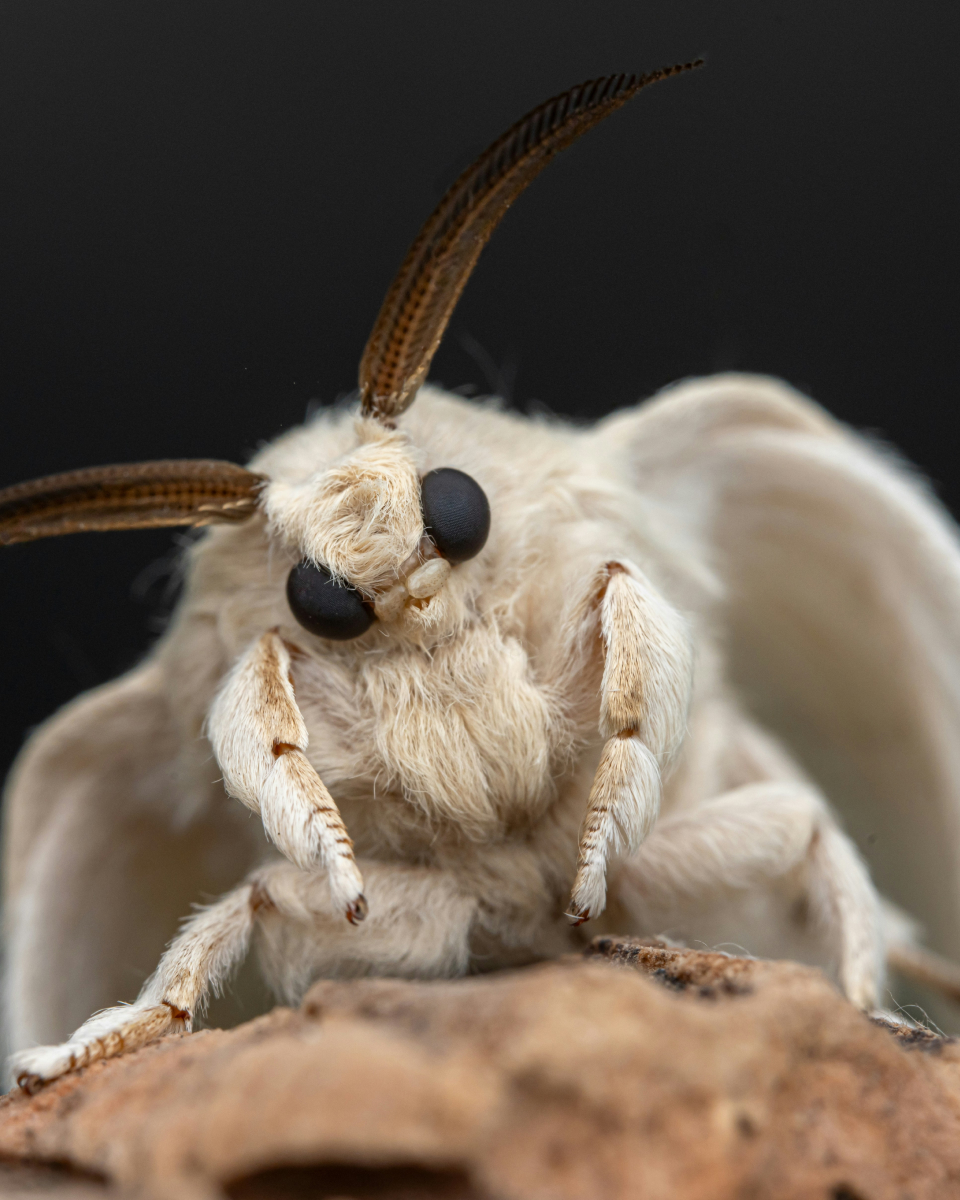
Photo by Jackie Best
Bombyx mori is a fully domesticated lepidopteran insect (order Lepidoptera, family Bombycidae). The life cycle is holometabolous: egg (approximately 0.9–1.5 mm), five larval instars over approximately 20–30 days under standard rearing at approximately 25°C, a spinning prepupal period of 2–3 days within a forming cocoon, pupal development of approximately 10–14 days, and a short adult life of approximately 5–10 days during which mating and egg-laying occur. Adults are flightless, lack functional eyes for complex vision, and do not feed — adaptations produced by domestication selection that maximise cocoon output and adult docility at the cost of the behaviours required for independent survival.
Larvae are solitary feeders but are reared at high densities on trays or racks; no complex social structures are documented. B. mori larvae demonstrate conditioned feeding responses and their central nervous system shares conserved molecular signalling pathways with vertebrates, making the species a standard research model in immunology, pharmacology, and toxicology. Stress responses include induction of heat shock proteins (HSP70 family) under thermal stress and activation of innate immune responses (humoral and cellular) to pathogens. Environmental requirements are narrow: optimal rearing at approximately 24–28°C with approximately 70–85% relative humidity for young instars, transitioning to approximately 23–24°C and 60–70% RH for fifth-instar larvae and the spinning phase.
The sentience status of B. mori is not established by species-specific research. The 2024 New York Declaration on Animal Consciousness acknowledges a realistic possibility of consciousness in invertebrates generally. For B. mori specifically, the evidence base for subjective experience is substantially thinner than for honey bees: no judgment-bias or affect-state experiments equivalent to those conducted in A. mellifera have been published for B. mori. The record documents available evidence without asserting sentience.
Lifecycle Summary
A 2017 welfare analysis by Rethink Priorities, combining FAO raw silk production data with cocoon-per-kilogram conversion factors, estimated that 420 billion to 1 trillion individual silkworms were killed or died on farms in that single year — the largest documented annual kill count associated with any single species in this database by many orders of magnitude. China and India together account for more than 80% of global mulberry silk output; approximately 5,500 cocoons are required to produce 1 kilogram of raw silk. For the majority of these animals, life terminates in the pupal stage inside the cocoon during stifling — a heat-exposure process using sun drying, steam, or hot air that kills the pupa without prior stunning to preserve the continuous silk filament.
Disease mortality is structurally more significant than stifling in welfare terms. The same Rethink Priorities analysis modelled that disease “contributed up to 99% of cumulative negative-experience days on farms” — substantially exceeding the welfare impact of the stifling kill event by the study’s own framework. Pébrine (Nosema bombycis microsporidiosis), nuclear polyhedrosis virus, and bacterial and fungal pathogens cause mass mortality events across rearing cycles, with between 61 and 170 billion silkworms estimated to die annually from disease and pests alone.
Bombyx mori occupies the second most contested sentience position in this database after honey bees, with even less species-specific research. B. mori possesses nociceptors, heat shock protein stress responses, innate immunity, and a central nervous system used as a research model for human disease and pharmacology; whether these support subjective experience is not addressed in published B. mori-specific sentience research.
Lifespan (Natural vs Exploited)
In a naturalised context approximated by wild B. mandarina, the egg-to-adult life cycle takes approximately 6–8 weeks under favourable conditions; adults live approximately 10 days; multiple generations occur per year in suitable climates.
In commercial silk sericulture, the vast majority of animals are killed in the pupal stage inside the cocoon, approximately 25–35 days after hatching depending on strain and temperature — less than half the natural total lifespan. Silk filament continuity depends on killing the pupa before the adult moth emerges and cuts through the cocoon, making pupal-stage termination structurally necessary for the textile product.
In grainage (breeding) operations, selected batches are allowed to complete pupation, emerge as adults, mate, and lay eggs; these animals reach approximately 40–50 days total lifespan including all stages, near the species maximum.
Primary causes of mortality in production: intentional stifling during cocoon processing; infectious disease (pébrine, nuclear polyhedrosis virus, bacterial and fungal pathogens); and rearing failures related to temperature excursion, humidity deviation, and leaf quality.
Exploitation Systems
Silkworm exploitation operates across three systems.
Textile sericulture. The dominant system globally by individual animal number. Larvae are reared on mulberry leaves through five instars, transferred to mounting frames (mountages) during the pre-spinning fifth instar, and allowed to spin cocoons over 2–3 days. Cocoons are harvested and transported to processing facilities where pupae are stifled, cocoons dried, and filaments reeled into raw silk. China operates the largest and most industrialised textile sericulture system, with organised rearing centres, controlled-environment rearing houses, and industrial-scale reeling facilities. India operates the second largest system, predominantly smallholder-based mulberry cultivation and cottage rearing combined with larger reeling units. Uzbekistan, Vietnam, Thailand, and Brazil produce at substantially smaller scales.
Downstream material flows from textile sericulture: raw silk reeled into yarn and fabric entering apparel, home textiles, and technical applications; pupae separated during or after reeling directed to animal feed, edible protein, oil extraction, fertiliser, and human consumption in some producing regions; sericin protein removed during degumming directed to cosmetic and pharmaceutical applications.
Grainage and seed production. Specialised operations maintaining parental and commercial hybrid lines to supply disease-free layings (DFLs) — certified silkworm eggs — to cocoon-producing farms. These operations allow selected adult moths to mate and lay eggs rather than stifling all pupae. Parental lines are often inbred; commercial hybrids are typically bivoltine × multivoltine crosses balancing silk quality with productivity.
Biomedical and biotechnological research. B. mori is used as an infection model for antimicrobial drug screening — bacteria, fungi, and candidate therapeutics are injected into larvae, which respond with measurable immune and survival outcomes. The silkworm infection model has been developed for a range of clinically relevant pathogens including Staphylococcus aureus, Candida albicans, and Pseudomonas aeruginosa. B. mori larvae and pupae are also used as bioreactors for recombinant protein expression following baculovirus infection; this approach produces research reagents and candidate therapeutic proteins at scale. Genomic and genetic research uses B. mori as a lepidopteran model organism; CRISPR and transposon-mediated genome editing are applied in laboratory contexts to modify silk properties and express heterologous proteins.
Silk biomaterials. Fibroin and sericin extracted from cocoons produced in textile sericulture are processed into medical textiles, absorbable sutures, tissue engineering scaffolds, drug delivery nanoparticles, and hydrogels. This system draws on the output of textile sericulture as its raw material input rather than operating an independent rearing system.
Living Conditions Across Systems
Textile sericulture rearing houses. Larvae are reared on trays or racks in rearing rooms; stocking densities in later instars can reach several hundred larvae per square metre of tray surface, though numeric standards vary between programmes and are not consistently reported. Rearing rooms are maintained at specified temperature-humidity ranges: approximately 25 ± 1°C and 75–85% relative humidity for early instars, transitioning to approximately 23–24°C and 65–70% RH for late instars and spinning. Larvae receive mulberry leaves 4–6 times per day; frass and residual leaf material are cleaned between feedings.
Larvae are not individually confined but share tray surfaces; during spinning, they are transferred to mountages — bamboo, plastic, or cardboard frames providing semi-individual compartments — where cocoon spacing is optimised for yield and cocoon quality rather than behavioural requirements. Lighting is typically diffuse or subdued as strong direct light is reported to affect feeding behaviour and cocoon quality; ventilation is necessary to manage heat and moisture from large numbers of metabolically active feeding larvae.
Industrial and controlled-environment sericulture. Purpose-built rearing houses with automated temperature and humidity regulation, tiered shelving systems, and sometimes mechanised feeding and cleaning; these operations achieve more consistent environmental control than cottage systems and are expanding in China’s organised sericulture zones.
Grainage operations. Pupae and adults are maintained in separate controlled rooms with specific temperature-humidity and photoperiod regimes. Adults are confined in mating cages or on paper oviposition substrates. The adult’s biological incapacity — flightlessness, non-functional feeding — means confinement is not behaviorally restrictive in the same terms as vertebrate or social insect confinement.
Research facilities. Conditions standardised for experimental reproducibility: typically 25°C, 50–70% relative humidity, 12:12 light:dark photoperiod, defined artificial diets or fresh mulberry leaves; densities per container are set to minimise inter-larval competition and disease transmission.
Lifecycle Under Exploitation
Genetic Selection
Selective Breeding is conducted at centralised institutes and seed production centres, targeting cocoon yield, filament length and quality, shell ratio (silk content relative to cocoon mass), disease resistance, voltinism characteristics (bivoltine, multivoltine), and adaptation to local climates. Genomic tools are increasingly applied; resequencing of 40 B. mori genomes identified 354 candidate genes under strong artificial selection, clustered in silk gland, midgut, and testis function. Commercial hybrids — typically bivoltine × multivoltine crosses — are generated to combine high silk quality with productivity under varied conditions.
Reproduction
Parental inbred lines are reared under controlled conditions; adult moths are manually paired in mating cages to ensure targeted crosses for commercial hybrid production. After mating, females lay approximately 300–500 eggs on paper or plastic substrates. Eggs are collected, surface-disinfected (formalin or alternative agents), and stored under controlled temperature and photoperiod conditions to induce or break diapause as required for crop scheduling. Reproductive Cycle Manipulation via temperature shifts and photoperiod control synchronises egg hatching and production cycles across large cohorts.
Birth & Early Life
Eggs (disease-free layings) are distributed from grainage operations to rearing farms and incubated at approximately 25°C with photoperiod control until synchronised mass hatching. Hatchery Incubation of silkworm eggs is the equivalent operation to fish egg incubation in salmonid records. Neonate first-instar larvae are fed tender young mulberry leaves or artificial diet at high humidity (approximately 85–90%) and frequent feeding intervals to minimise early mortality.
Growth & Rearing
Through instars 2–5, larvae are managed under declining temperature and humidity schedules, fed 4–6 times daily, and periodically thinned or redistributed on trays. Cleaning operations remove frass and leftover leaf material between feedings. Growth Acceleration through strain selection for high growth rate and efficient leaf-to-silk conversion, combined with intensive feeding management, drives rapid accumulation of silk gland volume. Disease control is the primary management challenge: hygiene protocols, disinfection of equipment and rearing surfaces, and use of disease-resistant strains are the primary interventions; prophylactic pharmaceutical use is minimal relative to vertebrate livestock.
Production
When larvae reach the spinning-ready stage of the fifth instar (ripening), they are transferred to mountages. Silk secretion from modified salivary glands begins; larvae spin in a figure-eight motion, coating themselves in sericin-bound fibroin filaments over 2–3 days to form the cocoon. The spinning phase represents the primary production event — the transformation of the larva into the saleable commodity. Environmental conditions during spinning are managed to optimise filament continuity and cocoon quality.
Transport
Eggs (DFLs) move from grainage operations to rearing farms under cooled or insulated conditions; the transport event is short-duration and the animals are in a diapausing, metabolically dormant state. Fresh cocoons move from rearing farms to reeling facilities; conditions during cocoon transport — open sacks, ventilated crates — are not standardised and are not governed by animal welfare regulations in any jurisdiction.
End of Life
For textile production, life terminates at the pupal stage via stifling (see Slaughter Processes). In grainage operations, moths die after mating and oviposition; surplus or rejected pupae and adults are redirected to feed or processing. In research applications, larvae and pupae are euthanised by injection, cold exposure, or terminal experimental procedures.
Processing
Post-stifling: cocoons are dried to target moisture content, then boiled or steamed to soften sericin; filaments from multiple cocoons are combined and reeled into raw silk thread. The continuous filament from a single cocoon can extend 300–1,500 metres. Pupae are separated during or after reeling. In biomaterials applications, cocoons are degummed to remove sericin and fibroin is dissolved and recast into specific forms.
Chemical Medical Interventions
Egg disinfection uses formalin historically and alternative disinfectants (sodium hypochlorite, ethanol, commercial disinfectants) where formalin use has been restricted; surface sterilisation prevents transmission of pébrine and other pathogens through the egg stage.
Disease management across rearing cycles relies primarily on hygiene protocols, environmental control, and use of disease-resistant or disease-tolerant strains rather than systemic pharmaceutical treatment. This is structurally different from vertebrate livestock: B. mori has no approved vaccines and no routine antibiotic treatment regime equivalent to poultry or aquaculture systems. Microscopical examination of parent moths for Nosema bombycis spores (Pasteur’s method) before egg production is the standard pébrine control measure; infected batches are destroyed.
In research and biomedical contexts, larvae receive injections of pathogens, drugs, and candidate therapeutics for infection model and toxicology studies. B. mori is used to screen antimicrobial agents for activity and safety: candidate compounds are administered to larvae infected with target pathogens, and survival outcomes are measured as a proxy for efficacy and host toxicity. This use replaces or supplements rodent models for early-stage antimicrobial development. Recombinant baculovirus infection of larvae or pupae enables heterologous protein expression for research and potential therapeutic applications.
Genetic interventions in research contexts include transposon-mediated insertion and CRISPR-Cas9 genome editing to modify silk protein sequences, alter pigmentation, introduce new fibre properties, and express foreign proteins; these laboratory lines are not in commercial production.
Regulatory position: B. mori rearing is regulated under agricultural frameworks in producing countries; no veterinary medicine approval infrastructure equivalent to that governing vertebrate livestock pharmaceuticals applies to commercial sericulture.
Slaughter Processes
Cocoon stifling is the standard kill method for textile silk production globally. The pupa must be killed before the adult moth emerges, because eclosion behaviour — the moth secreting alkaline fluid and pushing through the cocoon — breaks the continuous silk filament into short lengths unsuitable for reeling. Stifling preserves filament continuity and is structurally inseparable from the textile production mechanism.
Three methods are used commercially. Sun drying: cocoons spread in thin layers under direct sunlight for 1–3 days depending on climate; temperature within the cocoon mass rises as solar heat accumulates; this is the lowest-cost and most variable method. Steam stifling: cocoons exposed to steam at approximately 90–100°C in chambers for tens of minutes to a few hours, followed by drying; more controllable than sun drying with faster kill. Hot-air stifling: cocoons dried in hot-air chambers at approximately 70–90°C with controlled airflow until pupae are killed and cocoons reach target moisture content; the most industrially controlled method.
None of these methods involves pre-kill stunning. Temperature rises around the pupa inside the cocoon; the kill occurs as thermal exposure reaches lethal levels. Published assessments of stifling focus on cocoon quality outcomes — principally prevention of moth emergence — rather than welfare metrics; quantitative assessment of duration of conscious experience during stifling is absent from published literature.
The welfare significance of stifling, while structurally unavoidable for continuous-filament silk production, is quantitatively secondary to disease mortality in welfare-day analysis. The Rethink Priorities modelling attributed up to 99% of cumulative negative-experience days to disease rather than stifling, driven by the extended duration and mass scale of disease-related mortality across rearing cycles.
No stunning framework, religious slaughter exemption, or species-specific welfare regulation applies to silkworm stifling in any producing jurisdiction.
Slaughterhouse Labour Impact
Sericulture and silk reeling are labour-intensive across the production chain. The ILO notes high manual labour inputs in mulberry cultivation, silkworm rearing, and silk reeling. The workforce in major producing countries — China and India — includes large numbers of smallholder farmers, women, and rural labourers; sericulture is actively promoted in development policy as a source of rural employment and income.
Documented occupational hazards include repetitive-strain injuries from manual leaf picking, feeding, and cleaning operations; heat and humidity exposure during rearing and reeling; handling of disinfectants (historically formalin, now alternative agents) with associated chemical exposure risk; and standard agricultural risks during mulberry cultivation. Reeling operations involve sustained work at hot-water basins, with documented heat stress risk.
Systematic injury rate and occupational health statistics specific to silkworm rearing and silk reeling are not consistently reported in international datasets; silk is typically aggregated into broader textile or agricultural sector reporting. Psychological impact literature specific to silkworm killing is absent from published research.
Scale & Prevalence
Global raw silk production approximately 145,000–160,000 tonnes per year (recent period, FAO statistics); China and India together account for over 80% of mulberry silk output. At approximately 5,500 cocoons per kilogram of raw silk, global annual cocoon production implies approximately 800 billion–1 trillion individual cocoons produced per year as the production base for this raw silk volume. The Rethink Priorities 2017 analysis estimated 420 billion to 1 trillion silkworms killed or died on farms in that year alone; this remains the best available estimate and is the largest documented annual individual-animal kill count in this database.
Disease mortality: the same analysis estimated 61–170 billion silkworms dying annually from disease and pests — a figure representing mass mortality events during rearing cycles distinct from the stifling kill event.
China dominates global production with highly organised sericulture including large-scale rearing centres and industrial reeling; a mix of bivoltine and multivoltine strains is used. India’s system is predominantly smallholder-based mulberry cultivation and cottage rearing with large reeling units; both mulberry and non-mulberry silks are produced but only mulberry B. mori is within this record’s scope. Uzbekistan, Thailand, Vietnam, and Brazil produce at substantially smaller scales.
Global silk production is relatively stable with modest fluctuations; some regions are modernising and consolidating sericulture, but precise counts by system type (industrial versus smallholder) are not systematically compiled.
Ecological Impact
A life cycle assessment of Indian mulberry silk found that on a mass basis, silk production has higher environmental impacts than many other natural fibres across multiple categories including energy use and global warming potential. The majority of environmental impact arises from cocoon production — specifically fertiliser use in mulberry cultivation and energy consumption (including fuelwood and fossil fuels) in cocoon stifling, drying, and reeling.
Land use is primarily associated with mulberry plantation establishment and maintenance; mulberry is a perennial cultivated on irrigated or rain-fed cropland, with land requirements per kilogram of raw silk substantially exceeding those of synthetic fibres but variable relative to other natural fibres depending on yield assumptions.
Water use includes irrigation of mulberry (dominant in water footprint) and process water for reeling and subsequent dyeing; quantitative water footprints vary substantially between regions and production systems.
Emission sources include fertiliser-related nitrous oxide from mulberry fields, combustion emissions from fuelwood and fossil fuels used in stifling and reeling, and electricity consumption in controlled rearing houses and processing units. Biodiversity impacts relate to land conversion for mulberry, pesticide use in mulberry cultivation where applied, and fuelwood extraction for processing heat; these impacts are documented qualitatively but consistent biodiversity metrics across the silk LCA literature are absent.
Direct ecological impact from the silkworms themselves is negligible: B. mori cannot survive outside managed conditions, does not establish feral populations, and has no interaction with wild ecosystems.
Language & Abstraction
The most structurally complete product-level abstraction in this database. “Silk” as a textile material name carries associations of luxury, natural provenance, and craft heritage with no embedded reference to the animal that produces it, the number of animals killed per unit of product (approximately 5,500 per kilogram), or the production mechanism (pupae killed by heat to preserve filament continuity). “Raw silk,” “reeled silk,” “spun silk,” “silk fibroin,” and “sericin” are biochemical and material descriptors; the transformation from living pupa to textile fibre is complete at the naming level.
“Stifling” is the standard industry term for the cocoon kill operation. The term describes the mechanism — preventing emergence (stifling the moth before it can exit) — as a quality preservation measure rather than as a killing event. Its framing is functional and product-oriented: “stifling cocoons” positions the operation as protecting the commodity from internal disruption, not as a mass kill of pupae.
“Cocoon” itself performs the most complete abstraction in the record: it is simultaneously the product, the container, and the alive animal inside. The pupa inside a harvested cocoon is biologically living; the cocoon is processed and traded as a commodity. The same word covers the raw agricultural product and the animal within it.
“Disease-free layings (DFLs)” in grainage terminology describes certified eggs by their sanitary status without reference to the parent moths; the term positions seed production as a quality certification operation with the parental generation embedded in the certificate rather than named as animals.
In biomedical literature, B. mori appears as “invertebrate model,” “insect model,” or “silkworm infection model” — framings that position the animal as a methodological tool comparable to a culture medium or cell line rather than as a whole organism. “Silkworm bioreactor” extends this framing: the organism is named by its production function within a manufacturing context.
The policy framing of sericulture as a “rural livelihood” and “women’s empowerment” industry in South Asian and Southeast Asian development documents positions the exploitation system primarily as a socioeconomic development mechanism, with the animals’ role in that system entirely backgrounded. This framing is structurally documented here without evaluative commentary.
Terminology
Silkworm, Bombyx mori, mulberry silkworm, grainage, seed production, seed cocoons, commercial hybrid, disease-free layings, DFLs, bivoltine, multivoltine, univoltine, voltinism, larva, instar, fifth instar, ripening worms, spinner, spinning, mountage, cocoon, green cocoon, pierced cocoon, defective cocoon, cocoon crop, cocoon yield, cocoon weight, shell weight, shell ratio, rearing bed, rearing house, chawki rearing, early instar rearing, late instar rearing, brushing, disinfection, egg incubation, hatching, silk gland, silk filament, raw silk, reeled silk, spun silk, silk waste, floss, degumming, reeling, throwing, winding, twisting, stifling, sun drying, steam stifling, hot air stifling, cocoon drying, silk fibroin, sericin, silk yarn, silk thread, silk fabric, pupae, silkworm pupae meal, silkworm oil, sericulture, reeling unit, filature, bivoltine seed, commercial seed, laying, oviposition, model organism, bioreactor, infection model.
Within The System
Developments
Report a development: contact@systemicexploitation.org
Notice an inaccuracy or omission?
If you believe information on this page is incorrect, incomplete, or missing important context, you may submit a suggested correction for review.