
Civets
Scientific Name:
Paradoxurus hermaphroditus / Civettictis civetta / Nandinia binotata
Scope
Covers three civet species in their primary commercial exploitation contexts. Asian palm civet (Paradoxurus hermaphroditus) is the primary species in kopi luwak (“civet coffee”) production, live wildlife trade, and tourism display across South and Southeast Asia. African civet (Civettictis civetta) is the primary species in civet musk production for the perfumery industry, concentrated in Ethiopia. African palm civet (Nandinia binotata) is documented in bushmeat trade across Central and West African rainforest regions. Additional viverrid species — Viverricula indica (small Indian civet), Paradoxurus jerdoni (Jerdon’s palm civet) — enter trade at smaller, less documented scales and are referenced where evidence exists.
All three primary systems rely overwhelmingly on wild-caught individuals. There are no standardised domesticated or selectively bred civet lines in commercial production comparable to farmed mink or domestic livestock. Some multi-generation holdings exist on coffee and musk farms, but captive breeding is opportunistic rather than systematic, and wild capture remains the dominant supply mechanism for all three systems.
Excluded: non-captive observational research, camera-trap studies, and incidental roadkill. Civet species in purely conservation or sanctuary contexts are excluded.
Species Context
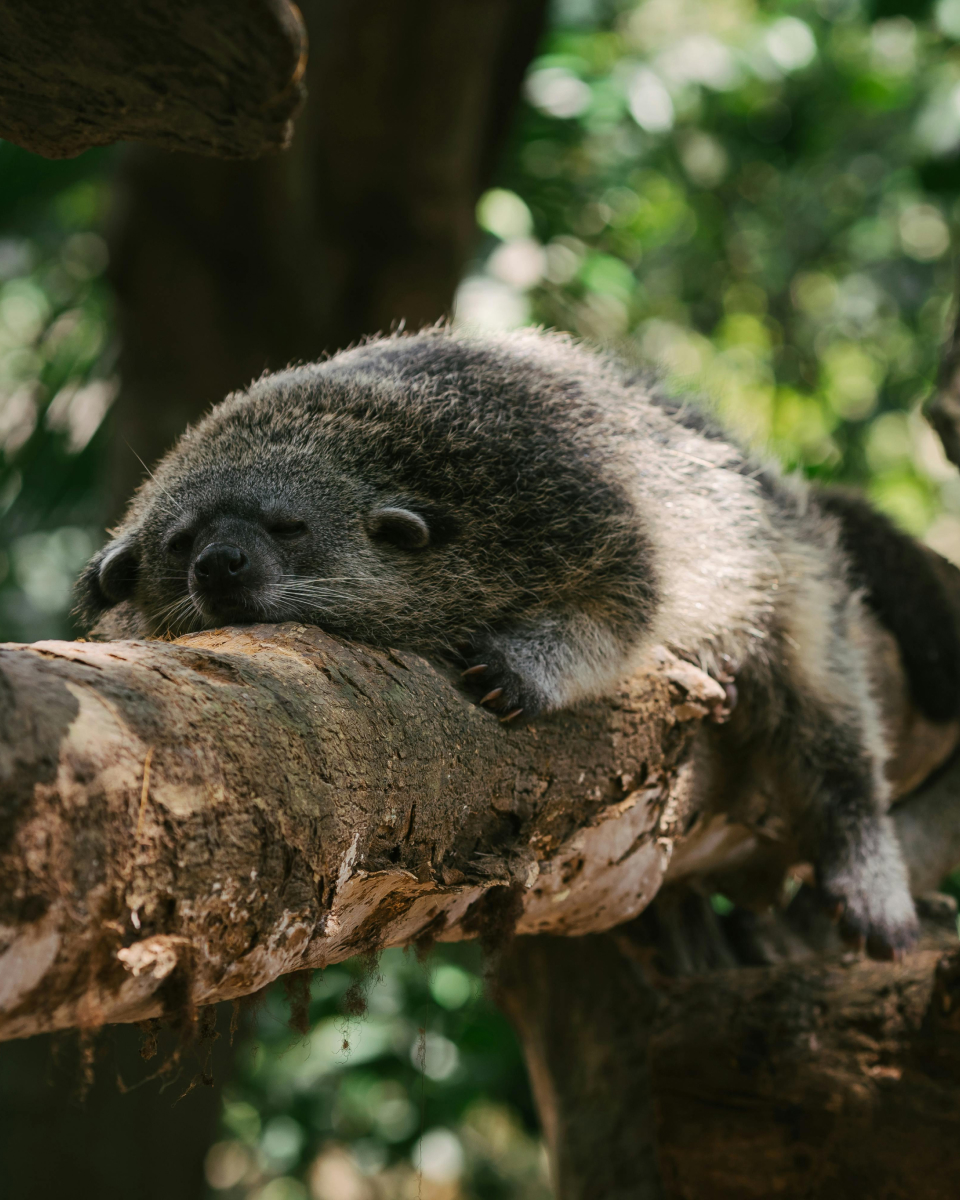
Photo by Mikhail Nilov
Asian palm civet (Paradoxurus hermaphroditus) is a small to medium nocturnal carnivore/omnivore (body mass approximately 2–5 kg) occupying forest, agro-forest, and peri-urban habitats across South and Southeast Asia. It is a solitary, arboreal-terrestrial generalist consuming fruit, invertebrates, small vertebrates, and nectar; it functions as a seed disperser in forest ecosystems. Home ranges vary by habitat quality; individuals maintain overlapping but loosely exclusive ranges with primary nocturnal activity patterns. Continuous proximity in small cages represents a substantive deviation from natural ranging, spatial, and temporal behaviour.
African civet (Civettictis civetta) is a larger terrestrial viverrid (body mass approximately 7–20 kg) distributed across sub-Saharan Africa, occupying woodland and forest edge habitats. It is solitary and nocturnal, with a varied omnivorous diet; its perineal glands produce the musk secretion commercially harvested in Ethiopia.
African palm civet (Nandinia binotata) is an arboreal specialist distributed across Central and West African rainforests, frugivorous and nocturnal, acting as a significant seed disperser and component of forest carnivore guilds.
Stress responses in Asian palm civets documented in captive coffee systems include prolonged stereotypies (pacing, circling), self-wounding, inappetence, and aggression following capture or transport, consistent with chronic stress and behavioural frustration in a mammal denied species-typical ranging, foraging, and temporal activity patterns. These behavioural indicators are interpreted within the standard mammalian welfare evidence framework. Civet-specific cognitive testing is limited, but the species exhibits learning, avoidance conditioning, spatial memory, and site fidelity consistent with current scientific consensus that mammals of this neuroanatomical complexity are sentient and capable of experiencing pain and distress.
Lifecycle Summary
Civets are the most poorly quantified species in this database. No FAO or equivalent global dataset tracks civet populations in captivity; no census of animals in coffee, musk, or bushmeat systems exists. Scale estimates derive from NGO investigations, market research, and local survey data with significant methodological limitations.
The kopi luwak (“civet coffee”) market represents the most globally visible civet exploitation system. Its commercial premise — that wild Asian palm civets naturally ingest and ferment coffee beans, producing a superior product through digestive processing — is systematically contradicted by documented production reality. A Wild Welfare investigation of Dalat, Vietnam documented farm networks hidden from tourists producing “upwards of 100 tonnes” of civet coffee annually from caged civets — an order of magnitude above earlier marketing claims of 100–200 kg total global wild production. A peer-reviewed Animal Welfare journal study of 16 Bali plantations (48 civets) found that 77% of confined civets experienced only 2 of 4 assessed welfare freedoms, with stereotypic pacing, circling, and self-trauma common, and welfare scores averaging 2.2 out of 4. The “wild-collected” and “free-range” claims used in kopi luwak marketing function to represent the product as non-captive in origin while production is predominantly from caged animals.
The African civet musk system involves wild-trapped animals repeatedly restrained for perineal gland scraping without anaesthesia to collect musk as a perfumery fixative, primarily in Ethiopia. A significant proportion of newly captured civets die from stress and captive conditions before musk yields can be established.
Asian palm civets were identified as intermediate hosts in the 2002–2004 SARS (SARS-CoV-1) outbreak; live civet markets in Guangdong province were implicated in cross-species transmission to humans. Intensive civet farming and live markets are structurally documented as potential zoonotic amplification environments.
Lifespan (Natural vs Exploited)
Asian palm civets: natural lifespan approximately 15–20 years in wild conditions; maximum recorded lifespan in well-managed long-term captivity approximately 24 years. In civet coffee systems, welfare assessments and investigation reports describe deaths from capture stress, diarrhoea, poor diet, and injuries, with many animals replaced within a few years rather than maintained to natural age. Robust survival curves for animals in coffee or musk systems do not exist in published literature.
African civets in musk farms: a significant proportion of wild-caught individuals die after trapping and transfer to cages from stress-induced aggression and disease. Surviving animals may be held and repeatedly harvested over months or years; quantitative median lifespans in farm conditions are not documented.
Civets in bushmeat trade: killed at the age of capture. Lifespan is determined by hunting pressure on the wild population rather than any managed production cycle.
Exploitation Systems
Civet coffee (kopi luwak) production. Asian palm civets are held in captivity and fed large quantities of ripe coffee cherries. Beans pass through the digestive tract, are recovered from faeces, washed, dried, and roasted. The product is marketed as a premium specialty coffee product, priced at USD 100–1,300 per kilogram in retail markets, based on claims that digestive fermentation by civets modifies bean chemistry and improves flavour. The production system spans: small-scale tourist display operations at coffee plantations (Bali, Sumatra, Philippines) where caged civets are part of the tourism experience; commercial production farms ranging from small backyard operations to networks of intensive caged facilities producing at scale, often concealed from tourist-facing marketing; and a category of “wild-collected” product whose supply chain is documented by investigation to depend substantially on caged animals despite marketing claims of forest-floor bean collection. Indonesia and Vietnam are the largest production centres; the market extends across India, Cambodia, Laos, the Philippines, and China. Market estimates place annual production at approximately 250,000–400,000 kg globally with a market value of approximately USD 50 million in 2024 (commercial market research, flag as methodology-uncertain).
Civet musk production. African civets are trapped from wild populations in Ethiopia and transferred to caging facilities where they are held and periodically subjected to perineal gland scraping — a manual extraction procedure performed without anaesthesia — to collect musk secretion. Musk is dried and exported as a perfumery fixative. Ethiopia has historically been the dominant supplier of natural civet musk to the global perfume industry. Synthetic civetone (the primary odorant constituent of natural civet musk) is available and increasingly substituted in commercial perfumery; demand for natural musk has declined in some markets as a result, though Ethiopia continues to produce for markets where natural origins are specifically sought.
Bushmeat and meat trade. African palm civet is hunted in Central and West African rainforest regions — Nigeria, Cameroon, Gabon, Liberia, and adjacent countries — for bushmeat and sold in local and regional markets. One published survey documented approximately 8,000 palm civets hunted annually in part of the Cross-Sanaga-Bioko forest complex; continental scale is not quantified in available literature. In parts of Asia, Asian palm civets are also taken for meat and entered into live wildlife trade alongside other small carnivores.
Exotic pet and tourism display trade. Civets — predominantly Asian palm civets — are sold as exotic pets from wild capture, particularly juveniles. Small-scale relative to coffee and musk systems. Tourism display of civets on coffee plantations constitutes a partially distinct use category where the animal’s live presence is part of the commercial visitor experience as well as the production mechanism.
Living Conditions Across Systems
Civet coffee tourism and production facilities. The peer-reviewed Animal Welfare journal study of 16 Bali plantations (48 civets, 2016) documents the most systematically characterised conditions available. Housing consisted of small individual or paired wire cages with raised wire mesh floors, no solid resting platforms, no vegetation, and no hiding spaces; cages were described as barren and frequently contaminated with faeces and urine. Floor areas were on the order of approximately 0.5–2 m² — compared to natural home ranges of several hectares — with minimal vertical complexity. Civets in tourism facilities were exposed to daytime visitor traffic, camera flash, and continuous noise; naturally nocturnal animals confined under diurnal disturbance conditions with no dark refuge. The study’s structured welfare assessment found 77% of civets experienced only 2 of 4 assessed freedoms; stereotypic pacing, circling, and self-trauma were common; welfare scores averaged 2.2/4.
Intensive production farms (non-tourist). Wild Welfare investigation of Vietnamese Dalat operations describes smaller cages and higher stocking numbers in facilities not exposed to public view, with a focus on maximising coffee output. Detailed cage dimension data are not systematically reported; qualitative accounts indicate higher intensity and lower environmental complexity than visitor-facing facilities.
Musk farms (Ethiopia). Wild-caught African civets transferred to cages with documented stress, aggression, disease, hygiene deficiencies, and diet limitation; conditions described in academic commentary but not quantified in peer-reviewed form with cage dimension or population datasets.
Bushmeat and live trade holding. Captured civets are held temporarily in small crates or cages pending slaughter or sale; short-duration but high-density, minimal shelter, without welfare management.
Lifecycle Under Exploitation
Genetic Selection
No intentional genetic selection programmes operate for any of the three primary civet exploitation systems. Coffee and musk systems rely on wild-captured animals; selection is effectively by trap susceptibility and survival of initial captivity stress rather than planned breeding for production traits. Bushmeat systems involve no selection — individuals taken from wild populations at the point of hunting.
Reproduction
Some coffee farms maintain breeding pairs and produce captive-born animals, but wild capture remains the dominant supply mechanism. Mating, gestation, and rearing may occur in small cages without genetic management or veterinary oversight. Musk farms are documented to rely primarily on continued wild capture rather than systematic captive breeding; reproduction in farm conditions is not well documented. In bushmeat systems, reproduction occurs in the wild; exploitation begins at capture.
Birth & Early Life
In coffee systems where breeding occurs, juveniles may be kept in cage systems from early life; formal data on captive weaning age and early mortality are absent from published literature. Farm-born juveniles on musk farms, if present, are likely to be held in comparable caging from birth. Bushmeat and pet trade juveniles may be captured alongside adults.
Growth & Rearing
Coffee system civets are maintained in individual or small-group cages with diets primarily of coffee cherries supplemented by fruit, rice, or commercial feeds. Welfare assessments report both underweight and obese individuals in the same facilities, indicating inconsistent nutritional management relative to species requirements. Musk farm animals receive farm-supplied diets that may differ substantially from natural prey and fruit composition; disease and hygiene problems are documented but standardised growth management is absent.
Production
Coffee system: adult civets are fed high quantities of ripe coffee cherries during production periods; Forced Feeding of a monoculture diet at volumes exceeding natural foraging choice is the operative production mechanism. Faeces are collected from cage floors, beans separated by washing, dried, and prepared for roasting. Some farms cycle animals between display and production cage configurations. Musk system: African civets are subjected to repeated Physical Restraint for perineal gland scraping at intervals of weeks to months over the duration of their captivity; musk is dried after collection. The scraping procedure is performed without anaesthesia.
Transport
Civets are transported from trapping sites or live markets to coffee or musk farms; stress and aggression following transfer are documented, with high mortality in the initial post-capture period in musk systems particularly. Transport of dead or live animals from bushmeat hunting sites to markets occurs in mixed wildlife loads. No welfare standards specific to civet transport are documented in any jurisdiction.
End of Life
Coffee system: end-of-life outcomes include on-site killing for disposal, sale into other wildlife trade channels, or death from disease, injury, or stress. Systematic culling ages or protocols are not documented. Musk system: animals may die from disease, aggression, or stress during captivity; end-of-life slaughter practices are not characterised in peer-reviewed literature. Bushmeat system: death occurs at the point of slaughter for meat or in traps and nets.
Processing
Coffee: beans dried, hulled, roasted, packaged, and sold under kopi luwak or equivalent branding, often at multiple price points with varied production provenance claims. Downstream value chain includes domestic tourism sales, export to high-income markets, and online retail. Musk: dried secretion traded to perfumery manufacturers and fragrance houses as a fixative; further chemical processing or blending occurs downstream. Bushmeat: carcasses butchered for meat, sometimes smoked or dried for preservation and transport; skins may be used or discarded.
Chemical Medical Interventions
Veterinary protocols for civet farms are not systematically documented in peer-reviewed literature. Higher-end tourism facilities may apply routine vaccinations against canine distemper, rabies, and parvovirus, but coverage across the industry is unknown. Antiparasitic treatment (ivermectin, fenbendazole) and antibiotic use would be expected in some captive small-carnivore management contexts, but specific compounds, frequencies, and industry prevalence are not reported in available sources.
No evidence of systematic growth promoter or hormonal treatment use exists in coffee or musk systems; production logic centres on product extraction rather than animal growth.
In musk extraction, no anaesthesia or analgesia is documented for the perineal scraping procedure in Ethiopian farm literature; the procedure involves direct manual contact with the perineal gland region of a physically restrained, wild-caught carnivore.
Zoonotic disease significance: Asian palm civets were identified as intermediate hosts in the 2002–2004 SARS (SARS-CoV-1) outbreak; live civet markets and intensive farming environments are structurally characterised as potential amplification sites for zoonotic coronaviruses and other pathogens due to high-density captivity of wild-sourced animals with compromised immunity from chronic stress. Specific surveillance and prophylaxis protocols for civet farms are not reported in available literature.
Slaughter Processes
No dedicated civet slaughterhouse infrastructure or standardised kill protocols exist. Methods used for civets killed in meat and bushmeat systems, and for disposal from coffee and musk farms, include blunt force trauma, throat cutting without prior stunning, and drowning, depending on local practice and context — consistent with small-carnivore killing methods documented in the same regions for other species. No species-specific welfare data on stunning method effectiveness or failure rates for civets are available in peer-reviewed form.
Musk farm deaths occur from disease, aggression, and stress, and from deliberate killing when musk yields decline; specific killing protocols are not described in available literature.
Bushmeat civets are killed in traps, nets, or by shooting; live animals are killed at point of sale or slaughter at market. Throughput at bushmeat market level is documented at thousands of animals annually in specific surveyed regions (approximately 8,000 palm civets in one West/Central African forest complex), but global throughput is not quantified.
No pre-kill stunning standard, no religious slaughter exemption framework, and no regulatory welfare requirement specific to civets is documented in any producing jurisdiction.
Slaughterhouse Labour Impact
No civet-specific occupational health literature exists. Workers in civet coffee farms and tourism operations face occupational risks from bites and scratches from stressed, wild-caught carnivores; zoonotic exposure risk (civet species are documented reservoirs for coronaviruses, rabies, and other pathogens); and general small-scale animal husbandry ergonomic risks. Musk extraction workers face direct physical contact with the perineal glands of restrained wild carnivores, with bite and scratch risk during restraint. Injury rates, psychological impacts, and workforce demographics for civet farm and musk facility workers in Ethiopia, Indonesia, and Vietnam are not reported in published form.
Bushmeat hunters and market workers face generic wildlife-handling risks including zoonotic exposure; no disaggregated occupational data for civet-specific handling are available.
Scale & Prevalence
All scale figures for civets in exploitation systems carry substantial uncertainty and should be treated as indicative rather than definitive.
Kopi luwak: estimated annual production approximately 250,000–400,000 kg globally; estimated market value approximately USD 50 million in 2024 (commercial market research source, methodology not independently verified). Indonesia and Vietnam are the primary production centres. Earlier marketing claims of 100–200 kg total global annual wild production are contradicted by investigation evidence of single Vietnamese district farm networks producing “upwards of 100 tonnes” annually from caged animals. The magnitude discrepancy between claimed wild production and documented caged production is the defining evidentiary finding about kopi luwak supply chain transparency. Market analyses project continued expansion at approximately 4.8% compound annual growth rate to 2033.
Civet musk (Ethiopia): total numbers of African civets held in musk farms are not reported; localised wild population decline near trapping zones is documented. Global demand for natural civet musk is declining as synthetic civetone substitution expands in commercial perfumery.
Bushmeat: approximately 8,000 African palm civets documented hunted annually in the Cross-Sanaga-Bioko forest complex (Nigeria/Cameroon); continental scale is not quantified. Bushmeat hunting pressure is described as increasing in some regions with habitat loss and human population expansion.
No global census of civets in any captive system exists. No FAO or equivalent international dataset tracks civet populations in exploitation.
Ecological Impact
Wild population depletion. Kopi luwak demand has driven increased trapping of Asian palm civets across the species’ range. Local population declines and uncertainty about sustainability are reported; systematic population data comparing trapped versus non-trapped areas are limited. The Asian palm civet is currently classified as Least Concern by IUCN, but localised depletion near high-demand production zones is documented and may not be captured in global conservation assessments.
Ethiopian African civets face localised population pressure from musk trapping combined with habitat loss. Musk farm reliance on continued wild capture rather than closed breeding sustains an ongoing extraction pressure on wild populations.
Ecosystem function loss. Asian palm civets and African palm civets are documented seed dispersers in their respective ecosystems; removal through trapping and hunting reduces their contribution to seedling recruitment and forest regeneration. Civets also function as mesopredators in forest carnivore guilds; sustained removal can alter prey species dynamics. Civet-specific ecosystem modelling is sparse.
Zoonotic disease transmission pathways. Intensive captive civet systems — coffee farms, live markets — create high-density co-housing of wild-caught animals with compromised immune function, documented as conditions that facilitate cross-species viral transmission. The SARS-CoV-1 outbreak origin in Guangdong live markets and civet farms is the most consequential documented outcome of this structural risk.
Land use and direct environmental footprint of civet coffee and musk production is negligible relative to the ecological impact of wild population depletion; no life-cycle assessment of either system has been published.
Language & Abstraction
The kopi luwak supply chain operates under the most systematically documented misrepresentation of production origin in any record in this database. “Wild-collected,” “wild-sourced,” “free-range,” and “natural” are standard product claims in kopi luwak marketing; investigation evidence documents that these claims are applied to products derived predominantly or entirely from caged animals. The language functions not merely to obscure production conditions but to actively invert them: “free-range” civet coffee describes the production output of caged animals fed a forced diet of coffee cherries in barren wire enclosures. The market value premium attached to these claims — kopi luwak retails at up to USD 1,300/kg — creates a direct financial incentive to falsify provenance claims, making the language abstraction economically load-bearing for the production system.
“Kopi luwak,” “civet coffee,” and “weasel coffee” foreground the animal’s digestive involvement as the defining product characteristic while omitting reference to captivity, trapping, forced diet, and housing conditions. Tourism materials describe civets as “nature’s coffee processor,” “helpers,” or “coffee makers” — functional roles that position the animal as a willing participant in a natural process rather than as a wild carnivore confined in a barren cage and fed a nutritionally inappropriate monoculture diet. “World’s most expensive coffee” and “rarest coffee” in luxury marketing abstract away the intensive cage network that makes the stated production volumes possible.
“Civet musk” and “civetone” in perfumery and fragrance industry documentation describe the product by its chemical composition and olfactory function; the trapping, caging, and unanaesthetised perineal scraping of wild African carnivores that produces the material is structurally absent from product labelling and fragrance ingredient documentation.
“Small game mammals” and “other species” in bushmeat market survey classifications aggregate civets with multiple wildlife species into non-species-specific categories, making civet-specific offtake statistically invisible in most regional market documentation.
The civet’s role as an SARS-CoV-1 intermediate host produced a brief, geographically specific regulatory response in 2003–2004 (live market closures in Guangdong) and then receded from active regulatory concern; the structural conditions — high-density captivity of wild-caught carnivores — that facilitated transmission remained unchanged in the broader kopi luwak and musk farming systems outside the specific outbreak geography.
Terminology
Kopi luwak, civet coffee, weasel coffee, elephant civet coffee, wild-collected, wild-sourced, free-range civet coffee, premium coffee, specialty coffee, civet farm, civet coffee plantation, civet coffee tourism, civet cage, coffee-processed beans, civet-processed coffee, civet musk, civetone, natural civet musk, musk farm, musk harvest, musk extraction, musk scraping, perfume fixative, bushmeat, wild meat, small game mammals, wildlife trade, live wildlife, exotic pet, display animal, breeder civet, production civet, wild-caught stock, replacement stock, coffee yield, musk yield.
Within The System
Developments
Report a development: contact@systemicexploitation.org
Notice an inaccuracy or omission?
If you believe information on this page is incorrect, incomplete, or missing important context, you may submit a suggested correction for review.