
Musk Deer
Scientific Name:
Moschus spp. (M. moschiferus / M. chrysogaster / M. berezovskii / M. fuscus / M. anhuiensis / M. leucogaster / M. cupreus)
Scope
Covers all currently recognised species in family Moschidae, genus Moschus: Siberian musk deer (M. moschiferus), alpine musk deer (M. chrysogaster), dwarf musk deer (M. berezovskii), black musk deer (M. fuscus), Anhui musk deer (M. anhuiensis), white-bellied musk deer (M. leucogaster), and Kashmir musk deer (M. cupreus). Taxonomic treatment varies regionally; all are exploited for musk and are treated collectively in this record. Includes both wild free-ranging populations subject to poaching and captive-bred or farmed populations in China, India, Nepal, and other range states. Excluded: non-Moschus species producing musk-like secretions (musk rats, musk ducks), synthetic and botanical musk analogues, and purely in situ conservation populations where no body parts are harvested.
No fully domesticated breed lines have been established. Long-term captive breeding across multiple generations has not produced behavioural domestication or reduced stress responses to handling and confinement characteristic of domestic livestock. Musk deer in captivity are treated as captive wild animals rather than domestic animals throughout this record.
Species Context
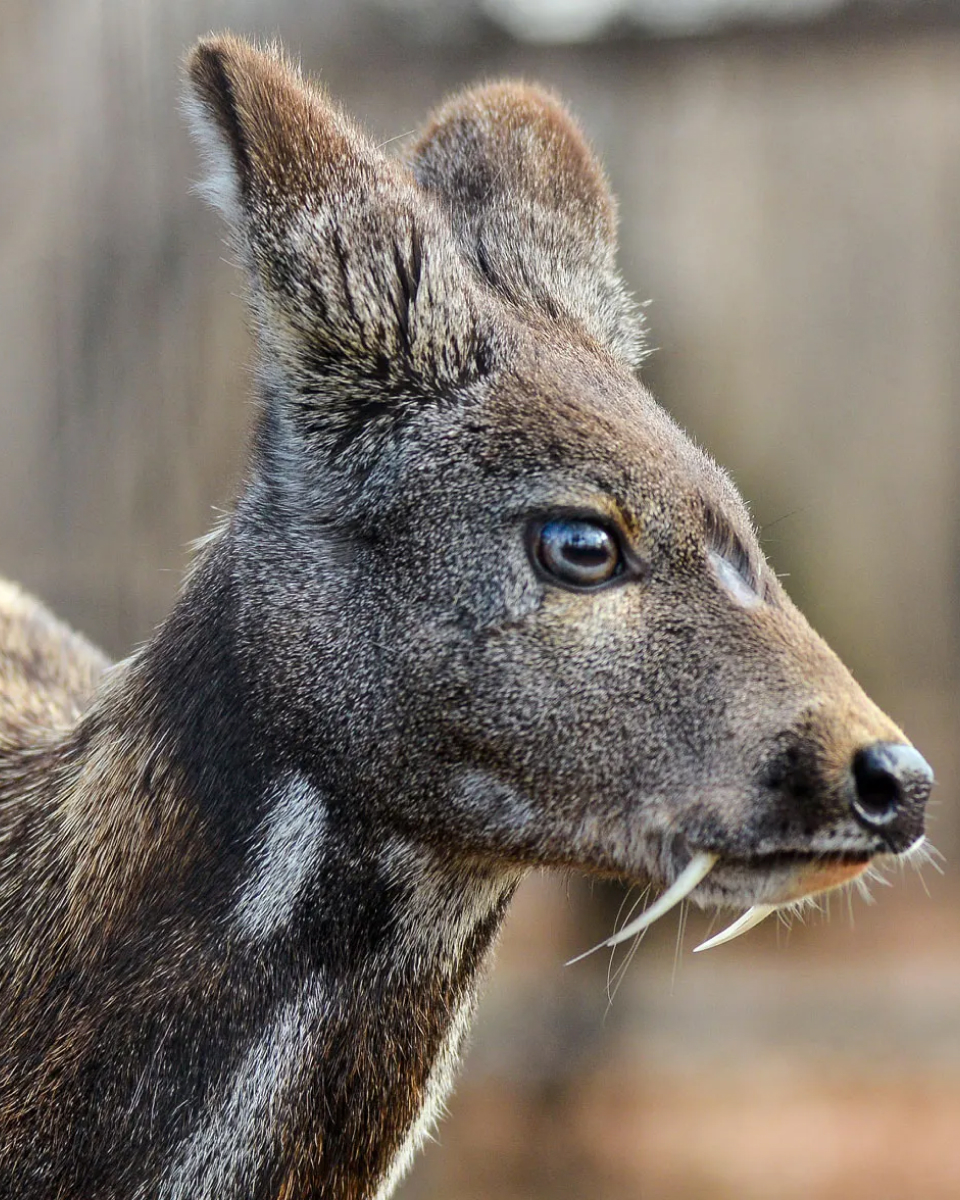
Photo by Encyclopædia Britannica
Musk deer are small, hornless ruminants (adult body mass approximately 10–18 kg) with elongated upper canines in males and a preputial musk gland present only in sexually mature males. They occupy steep montane forest, alpine shrub, and subalpine scrub habitats at approximately 2,400–4,300 m elevation across the Himalaya, Tibetan Plateau, Russian Far East, Mongolian highlands, and adjacent mountain ranges. Environmental requirements are specific: dense cover, variable rugged topography with escape routes, cool climates, and access to diverse forage including leaves, shoots, forbs, lichens, and mosses with seasonal diet shifts.
Social structure is predominantly solitary in adults; overlapping home ranges are maintained through scent-marking using the musk gland itself and communal latrines rather than through direct social interaction. Activity is crepuscular to nocturnal. Continuous confinement in enclosures with other individuals, flat substrates, limited cover, and regular human disturbance represents a substantial deviation from all natural behavioural requirements.
Stress responses documented in captive populations include stereotypic pacing, aggression, self-injury, and high mortality from fighting and disease. Captive behavioural studies document that after multiple generations on farms, activity budgets and stress indicators continue to differ from typical domesticated livestock — musk deer retain wild-type reactivity to human handling and confinement conditions, indicating incomplete adaptation across even ten or more captive generations. This sustained stress response has direct production consequences: stress suppresses musk secretion, and farms report lower musk yields per animal than wild males produce, potentially attributable to chronic stress and diet differences.
Cognitive and sentience evidence is consistent with other small ungulates: complex anti-predator behaviour, spatial navigation in rugged terrain, individual recognition via scent, and long-term retention of species-typical behavioural repertoires. Current scientific consensus treats mammals of this complexity as sentient.
Lifecycle Summary
Musk deer are among the most exploited endangered mammals in global wildlife trade. All *Moschus* species are listed on CITES Appendix I or II; multiple species are classified as Endangered or Vulnerable by IUCN. Wild population estimates from the 1980s–early 2000s placed Chinese populations at approximately 200,000–300,000 across species; more recent Himalayan assessments suggest approximately 30,000 remaining in some Himalayan regions with substantial fragmentation. Trade-based models estimate at least 4,000 adult males are killed annually in the Himalaya for musk, corresponding to 18–53% of some local populations — among the highest exploitation rates relative to population size of any species in this database.
The exploitation structure is unusual: only the preputial musk gland of adult males produces commercially valuable musk. Two operationally distinct systems harvest this product. Wild poaching kills the animal to remove the musk pod; captive musk farming attempts to extract musk non-lethally through repeated surgical procedures on living animals maintained in pens. Both systems have documented severe welfare consequences. The captive system, promoted by China and some conservation organisations as a poaching-reduction strategy, has not produced sufficient musk output to displace illegal wild supply, while generating its own documented mortality and welfare problems.
A peer-reviewed Turkish Veterinary Journal study of alpine musk deer (*M. chrysogaster*) found that captive-bred individuals have a mean lifespan of approximately 2.4 years — substantially shorter than the approximately 7-year average for wild-caught individuals placed in captivity and far below the documented maximum captive lifespan of 20 years for dwarf musk deer (*M. berezovskii*). This finding indicates that captive-born musk deer have not adapted to farm conditions, and that the mortality pressure of captivity itself exceeds the transition stress of wild capture for this species.
Lifespan (Natural vs Exploited)
Wild lifespan: field data are limited; estimated potential longevity of approximately 10–14 years based on age structure and survivorship models, with high hunting pressure truncating adult male age structure significantly in most populations.
Captive lifespan: a peer-reviewed study of alpine musk deer (*M. chrysogaster*) found mean lifespan of captive-bred individuals approximately 2.4 years; wild-caught individuals maintained in captivity averaged approximately 7 years. Maximum recorded captive lifespan for dwarf musk deer (*M. berezovskii*) in China was 20 years. The divergence between captive-bred and wild-caught captive survival — with captive-born animals dying younger — indicates that animals born into farm conditions do not develop the physiological resilience of wild-origin animals.
Farm mortality causes: infectious disease, gastrointestinal disorders linked to suboptimal diet, fighting injuries particularly in males, reproductive failures (abortions, peripartum mortality), and stress-related conditions. Precise farm-level life table data are scarce and largely unpublished or available only in Chinese-language sources.
Wild harvest: males are typically killed at or shortly after sexual maturity (approximately 3–5 years depending on species), when musk gland development and pod yield are at their highest. High hunting pressure produces strongly skewed sex ratios in wild populations, with adult males selectively depleted.
Exploitation Systems
Two primary systems, operationally distinct in their treatment of the animal but serving the same product market.
Wild poaching and illegal trade. The dominant supply source for natural musk in global trade. Adult male musk deer are killed using snares, firearms, and pitfall traps; musk pods are excised post-mortem; carcasses are typically discarded or used locally for meat and skins. Non-selective trapping methods — snares set without species or sex discrimination — kill females and juveniles in addition to target adult males, producing broader population demographic damage than the musk harvest alone. Musk pods are small and easily concealed, enabling smuggling through international borders and incorporation into trade networks crossing multiple range states. CITES COP documentation estimates that for every musk pod that reaches the market, multiple deer may have been killed due to snare bycatch and collection inefficiencies.
The geographic spread of wild poaching encompasses the full range of the genus: Russia (particularly the Russian Far East and Siberia for *M. moschiferus*), China, India, Nepal, Pakistan (for *M. cupreus*), and Bhutan. Musk enters downstream markets primarily in China (for Traditional Chinese Medicine formulation) and internationally for luxury perfumery.
Captive musk farming. Developed primarily in China from the 1960s onward; also attempted in India (CCRAS facilities in Uttarakhand) and Nepal at smaller scale. The stated purpose is dual: commercial musk production from non-lethal extraction and conservation-oriented captive breeding to reduce poaching pressure on wild populations. Farms maintain breeding groups — typically males and females in segregated or managed-contact configurations — from which adult males are periodically restrained and subjected to surgical musk extraction.
The non-lethal extraction procedure involves chemical restraint (ketamine-xylazine or equivalent cervid anaesthetic protocol), surgical opening or incision of the musk sac, curettage or scraping of musk granules, wound cleaning, and post-procedure management including antibiotics to reduce infection risk. The procedure is repeated at intervals — typically annually during peak secretion — over the animal’s captive life. Cumulative consequences of repeated surgery include scarring, infection risk, and potential long-term gland damage reducing musk yield.
Chinese musk farms range from small private operations to larger state-managed facilities such as the Xining Musk Deer Farm. Some farms are embedded in mixed wildlife farming operations producing multiple species. Farm output is insufficient to displace illegal wild supply; analyses document that captive farming output remains too low and too costly to compete with poached musk on price, meaning that legal farm-sourced musk has not eliminated the economic incentive for wild poaching.
Confiscation-based supply. In some Indian states, musk pods confiscated from poachers are auctioned by government authorities, converting wild-poached products into formally legal commodity supply. This mechanism inserts illegal wild harvest into legal trade channels through a sanctioned government process, without changing the origin or production method of the musk.
Semi-wild and open farming. Systems proposed or trialled in China and elsewhere where free-ranging deer are trapped seasonally for extraction and released; these remain limited in documented scale and peer-reviewed outcome data.
Downstream material flows. Dried musk grains enter: Traditional Chinese Medicine (TCM) formulations where musk is listed in the Chinese Pharmacopoeia as a standardised crude drug with specified macrocyclic ketone content; Ayurvedic and related traditional medicine preparations in South Asian markets; and luxury perfumery as a fixative where natural musk is specified. Synthetic macrocyclic musks (muscone, civetone analogues), nitro musks, and polycyclic musks produced by industrial chemistry have replaced natural musk in mass-market perfumery; natural musk retains a niche market in traditional medicine and premium perfumery segments.
Living Conditions Across Systems
Wild conditions. Natural home ranges across rugged montane forest and alpine shrub with low conspecific density, structural complexity, and high topographic variation; cool temperatures; minimal artificial disturbance except where human encroachment and hunting pressure are high.
Captive musk farms. Individual pens or small group enclosures within fenced farm areas; floor substrates of concrete or compacted earth with limited vegetation or structural complexity; specific dimensions vary across facilities but enclosure space is substantially below natural ranging requirements. Males are typically housed separately from females and other males due to documented aggression; despite segregation, fighting injuries from male-male encounters remain a primary cause of morbidity and mortality. Farm locations are often at lower elevations than native habitat, with warmer temperatures requiring management interventions for thermoregulation and higher disease pressure than alpine conditions. Provision of browse material, hiding structures, and thermal refuges is variable across farms and not governed by species-specific welfare standards. Routine human handling for health monitoring, feeding, and musk extraction maintains chronic exposure to a primary stressor for a species that retains wild-type flight responses across generations. No published quantitative welfare assessment using structured scoring comparable to the civet coffee study exists for musk deer farms.
Indian and Nepali captive breeding facilities. Smaller-scale operations with herds in the order of tens of animals; documented high mortality and reproductive challenges including declining fertility have been reported from CCRAS-managed facilities in Uttarakhand.
Lifecycle Under Exploitation
Genetic Selection
Initial farm founders were predominantly wild-caught animals from Chinese, Indian, and Nepali populations from the 1960s–1980s onward; ongoing legal or illegal wild capture supplements breeding stock in some facilities. Selection criteria where applied include high musk yield in males, survival in captivity, reproductive output, and disease resistance. Structured breeding programmes with documented quantitative genetic management exist at some state farms; detailed breeding values and pedigree management protocols are not published in accessible form. The captive-born lifespan finding (approximately 2.4 years mean) suggests that selection has not produced animals meaningfully adapted to captive conditions across several decades of captive breeding.
Reproduction
Managed through natural mating with controlled male-female exposure during oestrus to reduce injury risk from male aggression. Some facilities apply basic inbreeding avoidance; long-term pedigree records and effective population size management are limited. Gestation approximately 6–7 months; births typically occur in secluded enclosures with minimal human intervention to reduce stress-induced maternal abandonment. Reproductive failures — abortions, peripartum mortality, maternal abandonment — are documented as significant production constraints particularly in Indian facilities.
Birth & Early Life
Neonates are concealed by the dam in species-typical hiding behaviour; farms minimise early handling to reduce stress, but marking, health checks, and occasional hand-rearing occur where maternal failure happens. Captive-born animals from a lineage of multiple captive generations show no reduction in wild-type stress reactivity to human contact, suggesting that the capacity for fear and stress response has not been diminished by captive selection.
Growth & Rearing
Juveniles remain with dams for several months; weaning is followed by sex-specific grouping or separation to manage aggression and prepare for future musk production roles for males. Farm diets include cut forage, commercial concentrates, and mineral supplements; deviations from natural mixed-species high-altitude diet are associated with gastrointestinal disease and suboptimal growth in documented cases.
Production
Farm system: adult males undergo annual or biannual musk extraction using chemical restraint and surgical incision. The procedure produces a single extraction event per cycle; castration is avoided because testosterone regulates musk secretion. Musk yield per extraction is reported as lower from captive deer than from wild males, potentially reflecting chronic stress and diet differences. Repeated extractions produce cumulative tissue damage at the extraction site. Wild system: “production” equates to the growth of wild males to sexual maturity; no managed rearing stage occurs.
Transport
Captive deer transported between farms or from capture sites in crates or small cages by road; general wildlife transport risks (heat stress, injury, escape attempts) apply; no musk-deer-specific transport welfare data are published. Musk pods from wild harvest are transported through informal and formal trade networks; their small size facilitates concealment and cross-border smuggling.
End of Life
Farm system: deaths from disease, fighting injuries, and reproductive complications are the primary mortality routes; intentional culling or euthanasia policies are poorly documented. Some farms kill animals for musk pod extraction post-mortem when live extraction is not practised or when yield has declined. Wild system: targeted killing of males at point of trap or firearm contact; bycatch includes females and juveniles in non-selective snare systems.
Processing
Musk pods: removed from carcasses (wild harvest) or extracted surgically (farms); gland contents dried into granular form (musk grains) for stabilisation; simple drying and packaging at local collection points. Downstream: incorporated into TCM formulations under Chinese Pharmacopoeia specifications; blended into perfumery bases at fragrance manufacturers; some pharmaceutical preparations investigating macrocyclic ketone bioactivity.
Chemical Medical Interventions
Chemical restraint for non-lethal musk extraction uses injectable sedative-anaesthetic combinations adapted from cervid wildlife medicine protocols; ketamine-xylazine combinations are documented in published reports. Post-extraction wound management includes topical antiseptics and systemic antibiotics to reduce infection risk from the surgical site.
Anthelmintics, broad-spectrum antibiotics, and antiparasitic treatments are used to manage the high disease burden in captive populations, particularly gastrointestinal helminths and respiratory infections; specific active compounds are rarely documented in English-language peer-reviewed literature. Vaccination protocols where implemented adapt small ruminant or regional wildlife vaccines; species-specific vaccines do not exist.
Castration is specifically avoided in production males because androgen status drives musk secretion; testosterone is the primary hormonal regulator of gland activity. Growth-promoting hormone use is not documented.
Regulatory position: musk deer fall under wildlife breeding and management regulations in range states rather than livestock welfare law; specific welfare standards for housing, enrichment, stocking density, and veterinary intervention are largely absent from Chinese wildlife farming regulations and are not documented for Indian or Nepali facilities.
Slaughter Processes
Wild poaching: snares, firearms, and pitfall traps. Snares produce variable time-to-death depending on trap design, trap checking frequency, and animal size; prolonged restraint in snares before discovery is documented as a welfare concern in small ungulate trapping literature. Death by snare strangulation or constriction injury may be slow. Firearms produce rapid death when shots are accurate; wound-and-escape mortality is not quantified. No pre-kill stunning framework, no regulatory oversight, no species-specific welfare standard applies to illegal poaching.
Farm system (lethal): small-scale cervid slaughter using blunt force trauma, throat cutting, or similar small ungulate methods adapted to each facility; no standardised kill protocols, no published stunning efficacy data, no species-specific abattoir infrastructure. Animals may be killed when non-productive, severely ill, or when farms switch from non-lethal to lethal extraction.
Farm system (non-lethal extraction): death from disease, injuries, or reproductive failure rather than deliberate slaughter; culling policies are undocumented.
Throughput scale: musk deer are a low-volume, high-value species. Individual poachers and small groups handle single-digit to tens-of-animals quantities; farms maintain herds in the order of dozens to hundreds. Trade models estimating at least 4,000 adult males killed annually in the Himalaya represent an aggregate of dispersed, small-scale killing events rather than centralised throughput.
No religious slaughter exemption framework applies; musk deer are not in formal halal or kosher value chains.
Slaughterhouse Labour Impact
No musk-deer-specific occupational health literature exists. Musk extraction work on farms involves direct chemical restraint and surgical procedures on animals retaining wild-type fear responses; risks include injury from handling restrained animals with extended canines, kick injuries during recovery from anaesthesia, and zoonotic exposure. Poaching work involves general hunting and butchering risks: firearm accidents, knife injuries, and enforcement-related risks including criminal prosecution in jurisdictions with wildlife protection laws. Broader analyses of Chinese wildlife farming highlight limited biosecurity standards and recognised zoonotic disease risks aggregated across wildlife species, without musk-deer-specific disaggregation.
Scale & Prevalence
Wild populations: Chinese estimates from late 1990s–early 2000s placed total *Moschus* spp. populations at approximately 200,000–300,000, including approximately 100,000–200,000 *M. moschiferus* and *M. berezovskii* and approximately 100,000 *M. chrysogaster*; *M. fuscus* reported as very rare; Mongolian *M. moschiferus* estimated at approximately 44,000 in 1985. More recent Himalayan assessments suggest substantial fragmentation with approximately 30,000 musk deer remaining in parts of the Himalayan range, against estimated potential habitat capacity of up to 200,000. Population data across the full range are outdated and methodologically limited; current numbers are unknown with precision.
Exploitation pressure: trade-based models estimate at least 4,000 adult males killed annually in the Himalaya, corresponding to 18–53% annual offtake of some local populations — rates exceeding sustainable yield for a species with low reproductive rates. Snare bycatch produces additional non-target mortality.
Captive farms: Chinese farms collectively hold thousands of musk deer across multiple facilities according to available reports, but a current, comprehensive national inventory is not accessible in English-language sources. Indian and Nepali facilities hold herds in the order of tens of animals with documented high mortality. Total captive population globally is estimated at thousands rather than tens of thousands; farming output is insufficient to displace wild supply.
Directional trends: wild populations are declining or severely reduced from historical levels in most range states, driven by musk hunting and habitat loss, with no documented recovery in most areas. Captive farming has expanded periodically with policy support and high musk prices but faces persistent profitability and technical challenges. Synthetic musk production in industrial chemistry has captured the mainstream perfumery market; natural musk retains a demand niche in traditional medicine and premium perfumery that sustains continued exploitation incentives.
Ecological Impact
Wild population depletion is the primary documented ecological impact. Intense musk hunting has caused declines and local extirpations across the genus’ range, with CITES documentation noting that populations have not recovered from early twentieth-century exploitation peaks in many areas. Adult male-biased harvest produces skewed sex ratios affecting reproductive success and potentially genetic diversity in isolated populations.
Musk deer function as browsing herbivores in montane and alpine ecosystems; their removal alters vegetation dynamics through changes in browsing pressure, though quantitative ecosystem-level modelling is not available. As prey for large carnivores including snow leopards, wolves, and lynx, population declines affect predator-prey dynamics in montane food webs.
Non-selective snare trapping for musk deer is part of broader wildlife trade capture infrastructure that simultaneously targets multiple species in the same montane forest and alpine habitats; the ecological impact of snare networks extends beyond musk deer to all wildlife in snare-set areas.
Captive farming land and environmental footprint is minor at current scale relative to major livestock operations; fenced farm enclosures represent localised land conversion. Enteric methane and manure from small captive herds contribute negligibly to greenhouse gas emissions at documented farm sizes. Wildlife farming in China, including musk deer operations, has been identified in post-COVID-19 policy analyses as a category of zoonotic disease risk due to high-density captivity of wild species with weak biosecurity.
Language & Abstraction
“Non-lethal extraction” is the defining term in captive musk deer production discourse. The term foregrounds the single procedural distinction from wild poaching — the animal is not killed to obtain the musk — while backgrounding the surgical nature of the procedure, the use of chemical restraint on a species retaining wild-type fear responses, the documented cumulative damage from repeated surgical access to the same gland site, and the mortality rates that make captive production economically precarious. “Live harvesting” functions as a parallel term with similar framing logic.
“Musk deer farming,” “captive breeding,” and “sustainable use” package the captive system as conservation-aligned. The argument — that farming reduces poaching pressure by supplying musk from captive animals — is the most systematically articulated use of the “farming as conservation” framing in this database. CITES Appendix I listing acknowledges the conservation status of the genus; the simultaneous policy position that captive breeding and “sustainable use” are compatible with that listing represents a specific regulatory-language framework that shapes how exploitation is debated and permitted. The documented finding that farm output remains insufficient to displace illegal wild supply has not altered the conservation-use framing in policy discourse.
“Musk pod” and “musk sac” are anatomical part terms that describe the commercial product source as a detachable gland structure rather than as a component of a living animal. “Musk grains,” “crude musk,” and “pharmacopoeial musk” describe the product at successive processing stages; the Chinese Pharmacopoeia’s specification of musk by macrocyclic ketone content treats a secretion extracted from a surgically opened gland of an anaesthetised wild animal as an analytically characterisable raw drug material equivalent to a plant extract.
“Confiscated musk” as a legal supply category illustrates the regulatory mechanism by which government seizure of illegally poached musk converts wild-origin product into legally tradeable commodity. The confiscation creates a legal document trail that launders the provenance of the musk without changing the killing event that produced it; enforcement action becomes a supply chain input.
CITES Appendix II listing for some *Moschus* species (with Appendix I for others) creates a two-tier regulatory framework within the same genus; the terminology of “Appendix II with a zero export quota” for certain trade directions produces complex regulatory signalling that is less transparent to downstream markets than straightforward prohibition.
Terminology
Musk, deer musk, musk pod, musk sac, musk gland, musk grains, natural musk, synthetic musk, artificial musk, musk tincture, musk powder, musk extract, musk deer farming, captive breeding, open farming, free-range musk deer, non-lethal extraction, live harvesting, musk yield, breeding stock, foundation stock, musk deer farm, musk deer unit, musk deer conservation farm, musk deer project, musk deer reserve, musk deer population, musk deer habitat, musk deer product, musk drug, crude musk, pharmacopoeial musk, TCM musk, perfumery musk.
Within The System
Developments
Report a development: contact@systemicexploitation.org
Notice an inaccuracy or omission?
If you believe information on this page is incorrect, incomplete, or missing important context, you may submit a suggested correction for review.