
Mink
Scientific Name:
Neovison vison
Scope
Covers American mink (Neovison vison, syn. Mustela vison) in commercial fur farming systems globally. Includes farmed populations in Europe, China, North America, and other producing regions, and feral/escaped populations originating from farm escapes in their ecological impact context. Excludes: European mink (Mustela lutreola), which is critically endangered and not used in commercial fur farming — it is referenced only in the ecological impact section as a species affected by escaped American mink; wild native American mink populations not connected to farming; other fur-farmed mustelids (foxes, raccoon dogs) except where needed for comparative system description.
American mink in fur farming are selectively bred for pelage traits over many generations but are not domesticated in the behavioural sense; they retain wild-type stress responses to handling and confinement throughout commercial production.
Species Context
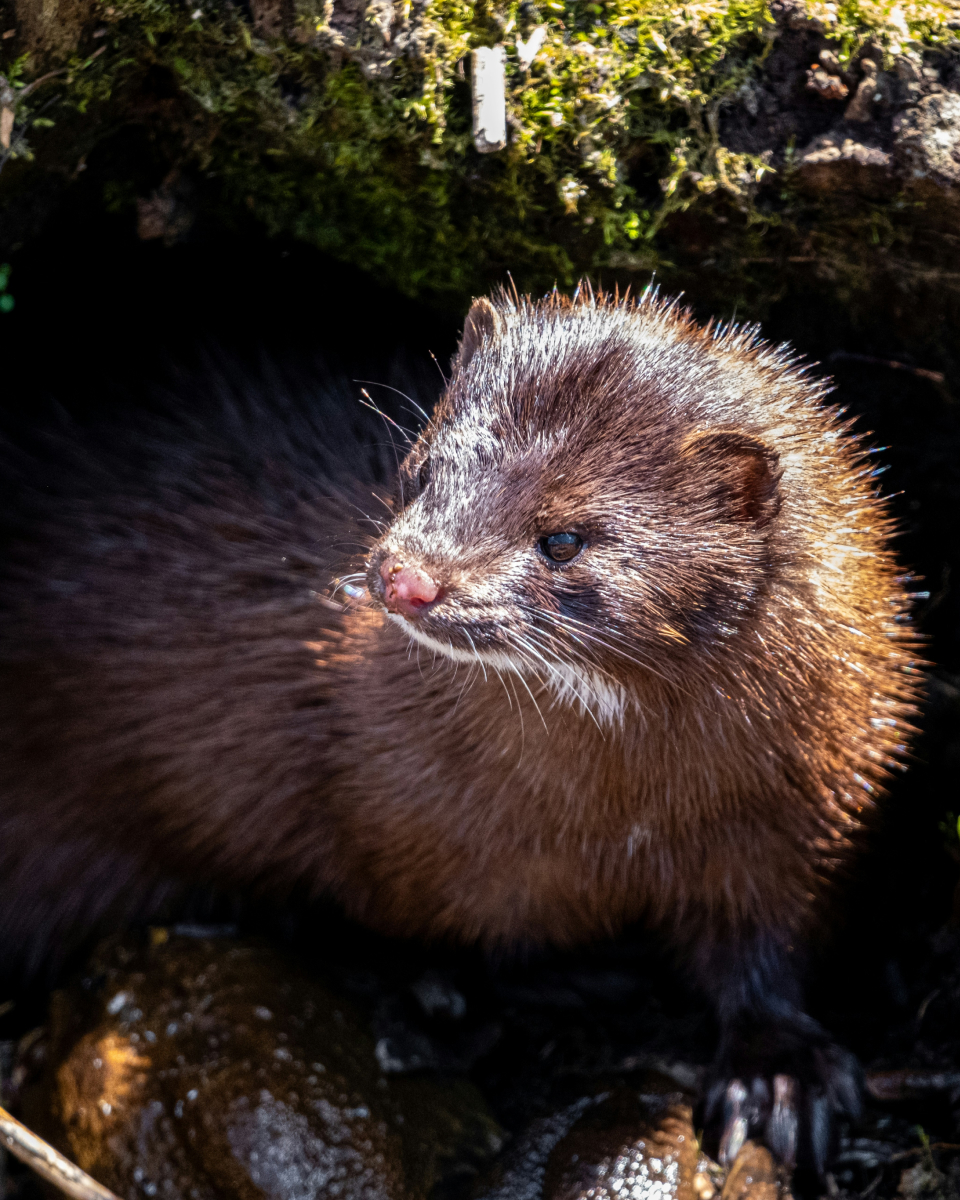
Photo by Alexandre Daoust
Neovison vison is a small semi-aquatic mustelid (body length approximately 60 cm including tail; body mass approximately 0.7–1.6 kg in the wild; farmed animals may be substantially larger through selective breeding). Semi-aquatic adaptations include partially webbed feet; the species is associated with riparian, wetland, and coastal habitats in its native North American range.
Natural behavioural ecology is characterised by extensive solitary ranging along waterways (home ranges typically 1–6 km linear extent along watercourses, or approximately 9 ha in wetland terrain), territorial behaviour with anal-gland secretion marking, use of burrows and dens, active hunting of aquatic and terrestrial prey, and swimming. These behaviours are either entirely suppressed or profoundly restricted in standard wire-cage farming systems.
Social structure is largely solitary; adults are territorial except during breeding season. Mink are not a social species that forms stable groups; housing adults together outside the maternal period produces aggression and injury.
Stress responses in captive conditions are extensively documented. Mink kept in standard cages develop stereotypic behaviours at documented rates: pacing along cage walls, circling, and fur-chewing (self-barbering) are the primary indicators. A peer-reviewed study on the effects of simple environmental enrichment — a ball and a chain suspended in the standard cage — found measurable reductions in stereotypic behaviour and improvements in reproductive success, providing experimental evidence that even minimal enrichment partially addresses unmet behavioural needs. The enrichment evidence also supports the interpretation that stereotypies reflect chronic stress and motivational frustration in an animal evolved for complex locomotion and environmental engagement.
American mink are sentient mammals; scientific consensus on vertebrate sentience applies fully. They demonstrate learning, individual recognition, conditioning to management routines, and the behavioural indicators of negative affective states documented in the enrichment literature.
Lifecycle Summary
Approximately 60 million mink were farmed globally for fur in 2018 (Humane Society International). By 2022, global mink pelt production had fallen to approximately 17 million — roughly halved in two years, according to Fur Free Alliance reporting — driven by national bans across multiple European countries and the consequences of COVID-19 on farm operations and demand. This makes mink fur the most rapidly contracting major animal exploitation sector in this database.
The mink fur system is structurally the simplest of any record in the database: one animal, one output, one kill event. There is no dairy system, no draft system, no by-product harvest from a living animal. Animals are killed at 6–8 months when their first winter coat matures; most never experience a second winter. The system is built around the quality, colour, and density of a coat the animal wears for approximately two months before being killed.
Two features define this record against all others. First, stereotypic pacing, circling, and fur-chewing in caged mink are among the most extensively documented stereotypies of any farmed species, and the enrichment literature demonstrates that a ball and chain suspended in a standard cage measurably reduces these behaviours and improves reproductive outcomes — the minimal effective intervention for a semi-aquatic carnivore whose natural home range spans kilometres. Second, in November 2020, Denmark ordered the emergency culling of its entire national mink population — approximately 17 million animals — following identification of SARS-CoV-2 variants that had emerged on mink farms and spilled back to human farm workers. This remains the largest single-species emergency depopulation event associated with zoonotic disease documented in this database.
Lifespan (Natural vs Exploited)
Wild American mink: potential lifespan approximately 8–11 years; average wild survival approximately 3–4 years due to predation, disease, trapping, and accidents.
Farmed production animals: killed at approximately 6–8 months of age following first winter coat maturation; this is the standard slaughter age for all pelt-production animals and represents less than 10% of the species’ potential lifespan.
Breeding stock: selected females and males are retained for 2–4 years across multiple breeding seasons; culled when fertility declines or fur quality deteriorates.
Primary farm mortality causes: Aleutian mink disease virus (AMDV) — neonatal mortality exceeding 90% from virulent strains, 30–50% from less virulent strains; canine distemper virus; enteric disease; fighting injuries between conspecifics; heat stress; and management decisions including euthanasia of weak or surplus kits.
Exploitation Systems
Mink are exploited through a single primary system with no meaningful secondary systems.
Industrial fur farming. Intensive cage-based production for pelt harvest. Farms consist of long rows of wire-mesh cages under open-sided sheds, housing animals from birth to pelting season. The production cycle is annual: mating in late winter, births in spring, growth through summer and autumn, pelting in late autumn/early winter when the first winter coat is mature. Animals are killed in their first year; a small proportion of females and males are retained as breeding stock for up to 4 years.
The system tracks one output variable: pelt quality — colour morph, fur density, guard hair characteristics, and pelt size. Animals with substandard pelage or reproductive performance are culled from breeding stock.
Downstream material flows from fur farming: pelts enter auction systems (historically dominated by Kopenhagen Fur, now wound down, and Saga Furs) and direct sales to garment manufacturers; processed fur enters fashion garments globally. Carcasses after pelting are rendered for mink oil (used in cosmetics and leather conditioning), fertiliser, and animal feed ingredients. Manure and waste feed are spread or composted as agricultural inputs.
COVID-19 amplification and mass culls. During 2020–2021, mink farms in the Netherlands, Denmark, Spain, Sweden, Italy, and other countries were identified as sites of SARS-CoV-2 amplification; the virus mutated within mink populations and spilled back to humans in documented transmission events. Denmark ordered the emergency depopulation of its entire national mink population (approximately 17 million animals) in November 2020 — the Cluster 5 cull, named for the SARS-CoV-2 variant strain identified. The Netherlands had previously ordered farm-by-farm culls; it had already legislated a phase-out of mink farming by 2024. The COVID-19 experience with mink farms accelerated regulatory action and national bans across several European countries.
Living Conditions Across Systems
Standard industrial cage system. Wire-mesh cages approximately 70 cm (L) × 40 cm (W) × 45 cm (H), giving a floor area of approximately 2,800 cm². The Council of Europe Recommendation concerning fur animals specifies minimum floor area of 2,550 cm² and minimum cage height of 45 cm for a single adult; juveniles after weaning may share cages within specified area allowances (850 cm² per additional animal beyond two). Cages are mounted in elevated rows in open-sided sheds; wire-mesh floors allow droppings to fall to channels below.
Standard provisions include a nest box (the only structural element in the cage) and nipple or hose water supply. Environmental enrichment beyond the nest box — tubes, chains, balls — is not mandatory under most national regulations. Feed paste is placed on the cage top for animals to pull through the wire mesh.
The contrast between standard cage dimensions and natural home range — 2,800 cm² versus 1–6 km of linear waterway — is the most extreme gap between captive space and natural ranging documented for any species in the database. No water access for swimming is provided in standard commercial systems; mink are semi-aquatic animals for which swimming is a species-typical behaviour not expressed under commercial conditions.
Sensory conditions: animals experience continuous olfactory stimulation from anal gland secretions and manure accumulation; visual and auditory stimulation from adjacent cage occupants and farm operations. Adult mink are housed singly outside breeding and maternal periods; they do not encounter conspecifics at a distance as they would in natural ranging territory.
Some European countries impose requirements above Council of Europe minima, including increased cage heights and mandatory enrichment provision; Denmark had implemented enhanced requirements before its mink industry was terminated by the COVID-19 cull. Chinese and North American standards are generally lower or less comprehensively enforced.
Lifecycle Under Exploitation
Genetic Selection
Selective Breeding targets pelage colour morphs (pastel, sapphire, black, white, and variants), guard hair length and lustre, underfur density, body size, litter size, and reproductive performance. Colour morphs are maintained as distinct breeding lines; crossings between lines are managed to produce commercial hybrid coloration where market demand dictates. Culling of animals with substandard fur traits, low fertility, or disease susceptibility is the primary selection mechanism; performance recording systems are maintained by breeding associations in major producing countries.
Reproduction
Mating occurs in late winter (February–March in the Northern Hemisphere); females are brought to male cages or males to female cages for controlled mating sessions. Natural mating is standard; artificial insemination has been explored but is not commercially dominant. Delayed implantation following mating produces variable gestation length of approximately 40–75 days depending on when implantation occurs. Breeding season management is the primary point of Reproductive Cycle Manipulation — controlled photoperiod is used in some systems to manage timing.
Birth & Early Life
Females give birth in nest boxes in spring; litter sizes typically 4–6 kits. Kits are altricial at birth and depend on maternal care for approximately 6–8 weeks. Farm interventions in early life include nest inspections, fostering of kits between females to equalise litter size, and euthanasia of kits judged too weak to survive or surplus to requirements. Premature Weaning and Separation at 6–8 weeks removes kits from dams; after weaning, juveniles may be housed in pairs within standard cages until pelting.
Growth & Rearing
Post-weaning juveniles are fed a high-protein paste diet based on by-products from the fish, poultry, and meat processing industries, supplemented with vitamins and minerals. Feed formulation is managed to support rapid growth and fur development through the summer and autumn months. Animals are managed as a single cohort from birth to pelting — all are killed in their first year.
Production
Pelt maturation is the endpoint the system is organised around rather than a recurring harvest — the animal is killed once, when the coat is ready. First winter coat development occurs between September and November in Northern Hemisphere farms; pelting is timed to when the winter coat is fully mature (guard hairs at full length, underfur dense) to maximise pelt quality. There is no production output from the living animal; the animal is the product.
Transport
Many farms maintain on-site killing facilities, avoiding the need for transport to slaughter; animals may be moved within farm infrastructure to killing areas in their cages or in crates. Where centralised pelting facilities serve multiple farms, transport occurs by truck over short to medium distances, typically within national boundaries.
End of Life
All production animals are killed at pelting season — typically late October through December for Northern Hemisphere farms — using gas chambers. Breeding stock are culled over the same period or retained to the following breeding season. Emergency depopulation of entire farms or national populations (as in Denmark 2020) uses the same gas methods at accelerated throughput.
Processing
Post-killing: carcasses are hung on processing lines; pelting involves skinning along the ventral midline, fleshing (removal of fat and tissue from the skin), stretching on boards or frames to standard dimensions, and drying. Grading of dried pelts for quality, colour, and size occurs before auction submission. Skinned carcasses move to rendering for oil extraction, fertiliser production, or animal feed manufacturing.
Chemical Medical Interventions
Aleutian mink disease virus (AMDV) is the primary disease management challenge on mink farms and lacks an effective commercial vaccine. Despite decades of research and experimental vaccine development, field vaccines have not been successfully deployed; a peer-reviewed study (PubMed 9682374) found that certain VP1/2 capsid protein vaccine constructs experimentally exacerbated disease severity rather than conferring protection, illustrating the immunopathological complexity of AMDV. Farm-level control relies on serological testing (counter-immunoelectrophoresis, CIEP) of breeding animals and culling of seropositive individuals to reduce infection pressure; this is costly and operationally intensive and does not eliminate AMDV from affected farms.
Vaccines against canine distemper virus and enteric pathogens are administered in country-specific schedules adapted from companion animal and livestock veterinary products; mink-specific licensed vaccines are not widely available across all jurisdictions.
Antimicrobials are used therapeutically for bacterial infections and enteritis; specific compounds are governed by national antimicrobial stewardship frameworks but are not comprehensively reported in accessible literature.
Euthanasia gases constitute the primary pharmacological intervention at end of life. Carbon monoxide (CO) from bottled cylinders and carbon dioxide (CO₂) are the principal commercial methods. A peer-reviewed experimental study (PubMed 1907876) documented the sequential behavioural phases for each gas — incoordination, loss of righting reflex, loss of consciousness, respiratory arrest — with CO producing faster loss of consciousness than CO₂ at the concentrations studied. Ireland’s Farm Animal Welfare Advisory Council (FAWAC) scientific review recommended against exhaust gas (which contains variable CO concentration) and CO₂ as primary methods, preferring bottled CO. The Federation of Veterinarians of Europe (FVE) stated in a peer-reviewed statement that current gas methods “often fail to ensure a humane death” in mink and canid fur animals. Canada’s National Farm Animal Care Council Code mandates bottled CO as the standard on-farm euthanasia method.
Identification marking via ear tags or tattoos is standard. Routine castration, tail docking, and other mutilations are not standard practices in mink production.
Slaughter Processes
The fur farm kill event has no equivalent structure in any other record in this database: healthy animals at peak physical condition — their first complete winter coat — are killed in gas chambers for the sole purpose of harvesting their skin. Animals are killed at the point the coat reaches commercial target quality.
Gas chamber killing is the commercial standard. Animals are placed in sealed boxes or chambers; gas is introduced at specified concentrations. CO from bottled cylinders kills through displacement of oxygen and carbon monoxide poisoning; animals progress through incoordination, loss of consciousness, and respiratory arrest. CO₂ kills through hypercapnia; some research and welfare assessments identify the aversive nature of high CO₂ concentrations during the period before loss of consciousness, interpreting nasal and oral irritation effects as welfare-significant distress. Nitrogen has been studied experimentally as an alternative but is not commercially widespread.
The FVE statement — that gas methods “often fail to ensure a humane death” — indicates that non-trivial proportions of animals experience prolonged or incomplete loss of consciousness under commercial conditions. Quantitative failure rates in commercial settings are not published; most published data are from small experimental studies rather than commercial throughput audit.
Throughput during pelting season is high: large farms kill all production animals within a concentrated period of a few weeks; centralised pelting facilities process thousands of pelts per day during peak season. During the Danish Cluster 5 cull (November 2020), approximately 17 million animals were killed in a period of days to weeks using the same on-farm gas methods deployed routinely for pelting.
No religious slaughter exemption framework applies; pelts rather than meat for human consumption are the product.
Slaughterhouse Labour Impact
Slaughterhouse labour as a category does not apply in the standard sense. Pelting is conducted by farm workers and seasonal processing staff on farm or at pelting facilities. Occupational risks include zoonotic exposure (AMDV, SARS-CoV-2 — documented in COVID-19 farm outbreaks), bite and scratch injury during handling, chemical exposure from euthanasia gases and pelt-processing chemicals, and repetitive motion injuries during pelting. COVID-19 outbreaks on mink farms in the Netherlands, Denmark, and other countries confirmed that farm workers are at elevated exposure risk when the farm population carries a respiratory pathogen.
Mink-specific occupational injury rate and psychological impact data are not published; workforce demographic information is not systematically documented.
Scale & Prevalence
Global peak: approximately 60 million mink farmed in 2018 (HSI compilation). Europe approximately 35 million, China approximately 20.7 million, United States approximately 3.1 million, Canada approximately 1.7 million.
Subsequent decline: global pelt production fell from approximately 33 million in 2020 to approximately 17 million in 2022 — approximately halved in two years (Fur Free Alliance, corroborated by FAO-adjacent production data). EU production fell from approximately 18 million pelts in 2020 to approximately 7.5 million in 2022, driven by national bans and COVID-19 impacts.
By 2022–2023: China was the largest single producing country at approximately 5.8 million pelts (2022, down from 9.3 million in 2020); Poland was the largest remaining EU producer; Russia and the United States continued at reduced levels.
National ban trajectory: the Netherlands legislated a ban on mink fur farming in 2013, implemented by 2024; Belgium, the Czech Republic, France, Italy, Slovenia, and other European countries have enacted bans with varying implementation timelines. Denmark’s mink industry was effectively terminated by the November 2020 COVID-19 depopulation order, with the industry subsequently prohibited. As of the current record date, mink fur farming is banned or being phased out across most of Western Europe.
Directional trend: strongly contracting in Europe; moderately contracting in North America and China. The trajectory is the most clearly declining of any animal exploitation sector in this database, driven by a combination of regulatory bans, consumer demand reduction, and COVID-19 pandemic disruption.
Ecological Impact
Invasive species establishment. American mink escaped from fur farms have established feral populations across Western and Central Europe, South America, and other non-native regions. In Europe, feral American mink function as generalist semi-aquatic predators, preying on ground-nesting birds, water voles, European mink (*Mustela lutreola*), fish, and amphibians. American mink are identified as a primary driver of European mink population decline in Western Europe; *M. lutreola* is now critically endangered across most of its former range in part because American mink outcompetes it ecologically and transmits Aleutian mink disease virus to which European mink are also susceptible.
Research on escaped mink populations distinguishes newly escaped farm mink, established feral mink, and wild-born feral populations, showing differential survival and ecological integration; farm escapes constitute an ongoing input of new individuals to established feral populations wherever fur farming continues.
Disease reservoir dynamics. Farmed and feral American mink serve as reservoirs for AMDV; spillover of AMDV from farmed to feral to native European mink populations has been documented. The SARS-CoV-2 mink farm events of 2020–2021 demonstrated that intensive mink farming creates conditions for inter-species viral evolution: the virus mutated within mink farm populations, generating variants including Cluster 5 (Denmark), and transmitted back to human farm workers in documented events. This is the most consequential documented zoonotic emergence event associated with fur farming.
Local environmental impact. Concentrated mink production generates significant nutrient loads from manure and waste feed. Nitrogen and phosphorus runoff from poorly managed storage and spreading can affect local water quality. Life cycle assessments specific to mink fur production are limited; upstream feed production from fishery and meat processing by-products carries the environmental footprint of those source industries into the mink system.
Land footprint per animal is relatively small compared to grazing livestock given the high-density shed housing, but this spatial concentration amplifies local pollution impacts.
Language & Abstraction
“Euthanasia” is used in regulatory documents, national codes, and veterinary guidance as the standard term for the gas chamber killing of healthy mink at pelting season. The term clinically denotes “a good death” — typically applied to individual animals killed to relieve suffering. Its application to the routine mass killing of healthy production animals at 6–8 months of age for pelt harvest is the most specifically documented terminological inversion in this database. The FVE and FAWAC scientific review use “euthanasia” while simultaneously expressing concern that current methods fail to ensure a humane death — the term is deployed in a context where the underlying welfare standard its etymology implies is openly questioned by the professional bodies using it.
“Pelting season” frames the annual kill event as a scheduled production cycle phase equivalent to a harvest period — a temporal category within production management rather than a mass mortality event. “Harvest” as a direct synonym for killing mink appears in some industry and veterinary texts; the same term is documented in the Cows record for slaughter and in the Salmon record for farming-site kill.
“Fur animals” as a legal classification in European Council of Europe recommendations and national legislation groups mink with foxes, raccoon dogs, and other farmed mustelids and canids into a production category defined by their output rather than by their species-specific characteristics. The regulatory category emerged before the extensive welfare science on mink stereotypies and enrichment needs was developed; the category structures what welfare standards are considered applicable rather than what the animals’ needs require.
“Colour morphs” — pastel, sapphire, black, black cross, lavender, violet — are the nomenclature of selective breeding for market differentiation. These terms name the product by aesthetic quality attributes without reference to the live animal, its age, or the conditions in which it was kept. The transformation from “sapphire mink” (living animal, 6 months old, in a 2,800 cm² wire cage) to “sapphire mink fur” (processed pelt) is absorbed into the single commodity label.
The Cluster 5 Danish cull was described in official communications as a necessary “depopulation” for biosecurity reasons. The term “depopulation” in agricultural contexts denotes emergency mass killing for disease control; its use for 17 million mink applies the same framing to an operation distinguished from routine pelting only by its timing and emergency character, not by its method.
Terminology
Mink farm, fur farm, fur animal, farmed mink, breeding stock, breeder female, breeder male, kits, weaners, juveniles, growers, pelting season, pelting, pelt, mink pelt, pastel mink, sapphire mink, black mink, colour type, ranch mink, cage row, nest box, enrichment, feed paste, feed alley, depopulation, culling, harvest, euthanasia, carbon monoxide killing, CO chamber, CO₂ chamber, euthanasia box, hide processing, stretching, drying, grading, auction lot, live grading.
Within The System
Developments
Fur farming standards & phase-out framework
Ban on terrestrial wild animal consumption
Report a development: contact@systemicexploitation.org
Notice an inaccuracy or omission?
If you believe information on this page is incorrect, incomplete, or missing important context, you may submit a suggested correction for review.