
Foxes
Scientific Name:
Vulpes vulpes / Vulpes lagopus
Scope
Covers two commercially farmed fox species: red fox (Vulpes vulpes), including colour morphs bred for fur production — principally “silver fox” (a melanic colour morph) — farmed primarily in China, Russia, Poland, and other European countries; and arctic fox (Vulpes lagopus), marketed commercially as “blue fox” or “polar fox,” farmed primarily in Finland and other Nordic countries. Geographic focus reflects major fur-producing regions: China (dominant by volume), Finland, Poland, Russia, Canada, and remaining EU producing states.
Excluded: wild-living foxes not subject to farming or trapping exploitation systems; pet or companion foxes; foxes in conservation breeding programmes; foxes killed in pest control contexts unless pelts enter commercial channels. Other farmed fur mustelids and canids (mink, raccoon dogs) are documented in separate records and referenced here only for comparative system context.
Farmed foxes are selectively bred for pelt traits over many generations but are not domesticated in the behavioural sense; they retain wild-type flight responses, stress reactivity, and stereotypic behaviour patterns under confinement. This distinguishes them from the Belyaev silver foxes selected over multiple generations for tameness — a research population, not a commercial fur breeding programme — and from domestic dogs, despite the close taxonomic relationship.
Species Context
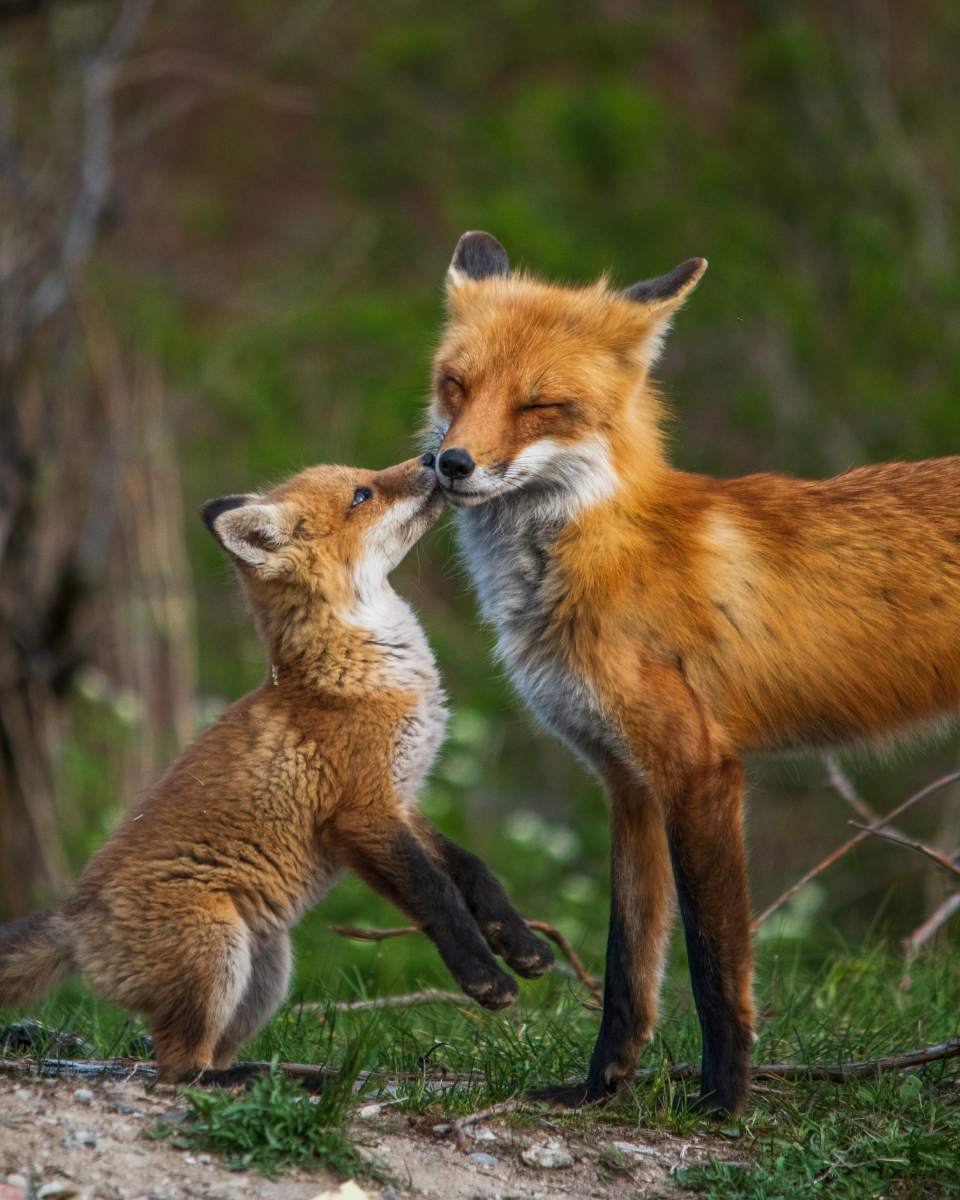
Photo by Jeremy Hynes
Red fox (Vulpes vulpes) is a medium-sized canid (body mass typically 3–7 kg in wild European populations; farmed lines selectively bred for larger body size may exceed this) with wide environmental tolerance across temperate, boreal, and semi-arid habitats. Arctic fox (Vulpes lagopus) is a smaller canid (typically 2.5–4 kg) adapted to tundra and arctic environments, with a thick winter pelage — the primary commercial product — that turns white or blue-grey in winter.
Both species are behaviourally complex canids with high exploratory drive, strong motivation to dig, mark territories, and range over home ranges of approximately 0.5–10 km² for red foxes in European habitats. Wild social organisation is flexible: red foxes range from solitary territorial pairs to groups with subordinate helpers; arctic fox groups vary from simple pairs to complex kin groups with resource-dependent social structure. Both species use multi-entrance dens, forage over diverse terrain, and engage in extended play and investigative behaviour.
Stress responses under captive confinement are extensively documented. Farmed silver foxes show elevated cortisol and altered heart rate profiles in response to human approach; pacing, circling, and self-mutilation are documented behavioural indicators of chronic stress. The EU Scientific Committee on Animal Health and Animal Welfare (SCAHAW) identified systemic behavioural restriction and welfare compromise in foxes kept in standard wire-mesh cages, findings substantiated by EFSA’s 2023 formal opinion.
The Belyaev domestication experiment at Novosibirsk’s Institute of Cytology and Genetics — begun in 1959 under Dmitry Belyaev and continuing under Lyudmila Trut — selectively bred silver foxes for tameness over multiple generations, producing animals with reduced fear responses, altered hormonal profiles, and correlated morphological changes. This programme demonstrates that targeted behavioural selection in foxes can produce measurable domestication-associated traits; it also demonstrates, by contrast, what commercial fur selection for coat colour and body size does not produce: commercial fur foxes are selected for pelt aesthetics, not for reduced reactivity to humans, and retain wild-type stress responses throughout production.
Foxes are sentient mammals; scientific consensus on vertebrate sentience applies fully. Canid cognition literature documents problem-solving, associative learning, spatial memory, and social communication capacities in foxes consistent with other members of the family Canidae.
Lifecycle Summary
Approximately 12 million foxes were farmed for fur globally in 2021, down from approximately 20 million at the 2018 peak (Eurogroup for Animals / industry data compilation). China produced approximately 11 million fox pelts in 2021, making it the overwhelmingly dominant global producer. Finland — the world’s primary arctic/blue fox producer — declined by approximately 68% over five years to 2024, driven by national regulatory pressure and declining demand. At least 22 European countries have enacted bans or phase-outs of fur farming covering foxes alongside other fur species.
In 2023, the European Food Safety Authority (EFSA) issued a formal scientific opinion declaring “systemic animal suffering” in European fur farms, covering foxes and other fur species — the most authoritative regulatory body in Europe formally confirming that the standard fox fur farming system produces welfare outcomes constituting systemic, not incidental, suffering.
The primary kill method for foxes on fur farms is distinct from the gas chamber method used for mink: foxes are killed by electrocution using a bite bar placed in the mouth and a rectal or anal probe, passing current through the brain and body. The Canadian National Farm Animal Care Council (NFACC) Code documents approximately 0.31 amperes for at least 3–4 seconds as the standard parameter, intended to cause rapid loss of consciousness followed by cardiac arrest. This is a dual-purpose stun-kill operation. Documented concerns exist that misplacement of probes or inadequate current delivery produces incomplete loss of consciousness, though quantitative fox-specific failure rates in commercial operations have not been published.
Lifespan (Natural vs Exploited)
Wild red and arctic foxes typically live 2–5 years; some individuals reach 8–10 years under favourable conditions. In well-managed captivity (zoos, research settings), foxes can reach 10–14 years.
Farmed production foxes: killed at 7–10 months of age, in their first winter after coat maturation, representing less than 15% of potential captive lifespan. This is the universal end-point for all non-breeding animals.
Breeding stock: selected vixens and males retained for multiple reproductive seasons, typically 3–5 years, then culled when fertility or pelt quality declines.
Primary farm mortality causes: disease culls (including avian influenza depopulation on farms with confirmed H5N1 — relevant for Finland and other Nordic farms in 2023–2024); injuries from conspecific aggression; stress-related conditions including self-mutilation; and management culls of surplus or low-quality pups.
Exploitation Systems
Commercial fur farming is the sole primary exploitation system for farmed foxes. The structure is identical to the mink system documented in the Mink record: animals are bred, reared, and killed in a single annual production cycle for their pelts. Unlike mink, no equivalent COVID-19 mass cull event has restructured the industry, though avian influenza culls have affected Nordic farms significantly since 2022.
Red fox fur farming. Intensive cage-based production of silver fox and other colour morph red fox lines in China, Russia, Poland, Canada, and other producing countries. China dominates by volume, with provincial clusters concentrated in Liaoning, Heilongjiang, and Jilin provinces. Silver fox pelts — large, long-haired, with a distinctive banded guard hair pattern — are a premium product in the fur trade; other red fox colour morphs include platinum, pearl, and cross fox. Pelt size is a key commercial parameter; farmed red foxes are selectively bred for body size substantially larger than wild populations.
Arctic/blue fox fur farming. Production of Vulpes lagopus in Finland (historically the world’s dominant producer), Norway, Poland, and other Nordic countries. The winter coat — white or blue-grey depending on colour phase — is the commercial product. Finnish “blue fox” production is based on a large-bodied farm line substantially heavier than wild arctic foxes due to multi-generational selection for body mass. Finland’s sharp production decline (~68% over five years to 2024) reflects the combined pressure of national welfare regulations, consumer demand reduction, and avian influenza culls.
Downstream material flows: pelts enter dressing and dyeing facilities, then garment manufacturing. Carcasses after skinning move to rendering for animal feed ingredients, fertiliser, or fat recovery. Manure and waste feed are managed as agricultural waste.
Secondary systems: foxes have been used as model animals in domestication research (Belyaev programme), in toxicology studies, and occasionally as subjects in behavioural ecology research. These research uses are minor in scale relative to fur production.
Living Conditions Across Systems
Standard intensive cage system. Wire-mesh cages elevated above the ground in rows under simple sheds; typical single-fox cage floor areas approximately 0.8–1.2 m²; height approximately 0.7–1 m. The EU SCAHAW reviewed impacts of cage sizes ranging from 1.21–15 m², finding that increased cage size alone without enrichment did not eliminate welfare problems — stereotypies and fear responses persisted across the tested range when environmental complexity was absent. For group-housed silver foxes, a minimum of approximately 1.2 m² per animal is specified in some guidelines to allow avoidance distance between conspecifics; social housing of adult foxes produces aggression without adequate space for flight responses.
Wire mesh floors allow droppings to fall to channels below; this eliminates substrate for digging and denning — species-typical behaviours fundamental to fox natural history. Nest boxes provide the only structural shelter; minimal enrichment (platforms, objects) is incorporated in some Nordic systems in response to welfare codes. Feed paste is placed on cage tops; nipple water supply is standard.
Sensory conditions: high acoustic stimulation from fox vocalizations and farm operations; visual exposure along cage rows to other foxes and humans; restricted visual horizons compared with natural ranging; olfactory concentration of urine and faeces. The combination of enforced proximity to other animals, inability to flee or avoid approach, and absence of the denning and ranging behaviour that characterises wild fox ecology produces the documented chronic stress profile.
Regional variation: Finnish and Nordic farms operate under enhanced national codes including minimum cage size provisions and enrichment requirements above the Council of Europe minima; the EFSA 2023 opinion applies to European systems. Chinese and Russian farm conditions are less systematically documented in peer-reviewed literature; provincial farm inspections and NGO investigation reports indicate conditions broadly analogous to European standard cage systems.
Lifecycle Under Exploitation
Genetic Selection
Selective Breeding in red fox fur farming targets colour morphs and associated pelt characteristics (guard hair pattern, underfur density), body size, and litter size. In arctic fox farming, blue/white colour phase maintenance and increased body mass are the primary selection objectives. Culling of animals with substandard pelt traits or low reproductive output is the primary selection mechanism. Pedigree recording and cooperative breeding programmes operate in some producing regions; genetic management does not target behavioural traits — docility is not a commercial selection objective in fur production lines.
Reproduction
Breeding is seasonal, aligned with natural reproductive cycles; vixens come into oestrus in late winter (January–March in the Northern Hemisphere). Males are brought to females or females to males for controlled mating sessions; males may be used for multiple females across the breeding season. Artificial insemination is used in some programmes but natural mating remains predominant. Vixens are housed in individual cages with nest boxes for whelping.
Birth & Early Life
Litters are born in nest boxes; typical litter sizes 4–6 pups. Pups remain with the vixen for the initial period; farm interventions include nest inspections, health assessments, and culling of weak or surplus pups. Weaning occurs at approximately 8–10 weeks; pups are moved to rearing cages at weaning — Premature Weaning and Separation from the vixen and littermates at this age constitutes an early-life welfare intervention.
Growth & Rearing
Post-weaning juveniles may be housed as sibling groups or individually depending on farm practice and available space; high-protein diets based on fish and slaughterhouse by-products are fed once or twice daily on cage tops. Diet formulation is managed to support rapid body growth and fur development through spring, summer, and early autumn.
Production
Pelt maturation occurs in autumn; the winter coat for both red fox colour morphs and arctic fox blue/white pelts develops between September and November in Northern Hemisphere farms. Animals are visually assessed for pelt quality and graded; those not selected as breeding replacements are scheduled for killing at pelting season. Pelt maturation is the endpoint the system is organised around — animals are killed once, when the coat reaches target quality. There is no recurring harvest from the living animal.
Transport
Many farms conduct on-site killing, minimising live animal transport; breeding stock transfers between farms and moves of animals to centralised processing stations occur in small crates or transport cages. Documentation of fox-specific transport conditions and journey durations is sparse.
End of Life
All production animals are killed at pelting season by electrocution; breeding stock are culled over the same period or at the end of their productive life. Emergency depopulation culls for disease control (avian influenza, disease outbreaks) use the same electrocution method at accelerated pace.
Processing
After killing: carcasses are bled where required, skinned, pelts stretched on boards, and dried. Pelt grading for colour, size, and quality occurs before sale. Skinned carcasses and offal are rendered for feed ingredients, fertiliser, or fat recovery. Dressing and dyeing of pelts at downstream facilities uses chemical treatments including tanning agents, dyes, and solvents.
Chemical Medical Interventions
Vaccines against canine distemper virus, parvovirus, and rabies are administered on a schedule broadly parallel to mink farms; fox-specific licensed vaccines are not widely available, and vaccination protocols are adapted from carnivore and livestock veterinary products. Region-specific pathogens are addressed with locally approved vaccines.
Anthelmintics and ectoparasiticides control internal and external parasites that can compromise fur quality and health; specific active substances vary by jurisdiction. EU antimicrobial stewardship regulations restrict prophylactic antibiotic use; therapeutic antibiotic use continues for bacterial infections; equivalent restrictions may be absent or less enforced in China and Russia.
Sedation and anaesthesia: routine farm procedures including grading and killing by electrocution use physical restraint rather than chemical sedation; anaesthetics may be deployed for veterinary procedures.
No standard surgical mutilations are documented for fox fur farming; procedures focus on health management and breeding rather than body modification.
Electrocution equipment: the kill method requires functioning electrical devices capable of delivering approximately 0.31 amperes through bite bar and rectal probe; equipment maintenance and correct probe placement are operational prerequisites for consistent unconsciousness induction. The NFACC code specifies that devices must indicate current under load, establishing a baseline verification requirement.
Slaughter Processes
Electrocution is the dominant kill method for foxes on fur farms globally. The procedure involves placing a bite bar in the fox’s mouth and inserting a rectal or anal probe, then delivering electrical current — approximately 0.31 amperes for at least 3–4 seconds according to the NFACC Canada code — intended to produce immediate loss of consciousness followed by ventricular fibrillation and cardiac arrest. This is a dual-purpose stun-kill: the same current event is intended to both render the animal unconscious and cause death, unlike conventional livestock systems where stunning and killing are sequential steps.
The method requires correct anatomical probe placement; misplacement or inadequate current delivery — due to poor contact, equipment malfunction, or animal movement — can produce incomplete or absent loss of consciousness while still delivering painful electric shock. Published quantitative failure rates for commercial fox electrocution in terms of animals not rendered immediately unconscious are not available in peer-reviewed form; the concern is documented qualitatively in welfare literature and regulatory guidance.
Gas killing (CO or CO₂) and lethal injection are described as alternative methods; gassing is less commonly documented for foxes than for mink, and lethal injection is noted as more labour-intensive, requiring individual handling. Shooting is avoided to prevent pelt damage.
Throughput: global fox production approximately 12 million animals in 2021, concentrated in Chinese farms and pelted seasonally over approximately 4–8 weeks per farm. No per-facility throughput figures are published in accessible literature.
No religious slaughter exemption framework applies; pelts rather than meat are the commercial product.
Slaughterhouse Labour Impact
Labour: fox farming and pelting are performed by farm workers and seasonal processing staff. Occupational risks include: bite injuries from foxes during handling and electrocution; zoonotic exposure including avian influenza on farms with confirmed H5N1 outbreaks; chemical exposure during pelt dressing and dyeing (tanning agents, solvents, dyes) with documented respiratory and dermatological risks; and general agricultural machinery hazards. Psychological impact literature for fur farm workers specifically has not been published; general agricultural occupational health literature documents elevated rates of serious injury and associated psychological sequelae (PTSD, depression, anxiety) in farm workers following traumatic incidents, applicable structurally to fur farming contexts.
Scale & Prevalence
Global fox fur production approximately 20 million animals at peak (approximately 2018), declining to approximately 12 million in 2021 (Eurogroup for Animals / industry data compilation; figures corroborated by national production data). China produced approximately 11 million fox pelts in 2021 — approximately 92% of global production. Finland was the world’s largest arctic/blue fox producer historically; Finnish fox farming declined approximately 68% over the five years to 2024 (Eurogroup for Animals), driven by welfare regulations, declining demand, and avian influenza culls.
Chinese provincial distribution: Liaoning Province held over 1.5 million foxes; Heilongjiang and Jilin each held over 500,000, with expanding numbers in some sub-provincial areas. These provincial-level figures are from Chinese government and industry reports; independent verification is limited.
European status: at least 22 European countries have enacted fur farming bans or phase-outs covering foxes. Poland remains a significant EU producer; Finland continues at reduced scale. Denmark, Sweden, and multiple other EU states have exited fox fur farming.
Directional trend: contracting overall — the same direction as mink, driven by the same combination of national bans, consumer demand reduction, and disease events. The rate of contraction is slower than mink given the absence of an equivalent mass COVID-19 cull event for foxes, but the trajectory is unambiguous. China’s production has grown relative to its global share as European production contracts.
Ecological Impact
Fox fur farming shares the ecological impact profile documented for the mink system: high greenhouse gas emissions per kilogram of fur product, driven primarily by feed production from fishery and slaughterhouse by-products and manure management; nutrient loading from manure and waste feed; downstream chemical impacts from pelt dressing and dyeing.
Life cycle assessments of fur farming frequently treat “fur” as a composite category without species-specific disaggregation; fox-specific LCA values are not published separately from mink or other fur animals in the literature. Sector-level analyses consistently identify fur as having high impacts on eutrophication, acidification, and toxicity indicators relative to many textile alternatives, driven by feed supply chain upstream impacts and chemical treatment.
Avian influenza (H5N1 HPAI) has emerged as a significant disease and ecological risk at Finnish fox and mink farms since 2022–2023. Highly pathogenic avian influenza spillover from wild bird populations to intensively farmed fur carnivores — which are susceptible as obligate carnivores — has resulted in farm-level depopulation culls. Farmed foxes can amplify avian influenza; the concentration of susceptible obligate carnivores in close proximity at fur farms creates conditions for viral persistence and evolution. This risk profile is analogous to the SARS-CoV-2 mink farm amplification documented in the Mink record.
Land footprint of fur farms per animal is relatively small given the high-density cage housing; upstream feed supply chains (fisheries, poultry, pork processing by-products) link fox fur production to the ecological footprints of those source industries.
Escaped farmed foxes in non-native regions can establish feral populations; this is documented for American mink but less extensively for farmed fox lines, which are not semi-aquatic and have different ecological competitiveness in European ecosystems.
Language & Abstraction
“Silver fox,” “blue fox,” and “polar fox” are product-line names derived from pelage colour characteristics — market nomenclature that describes the commercial commodity while backgrounding the species identity of the animal. “Saga fox” is a registered brand of Saga Furs auction house for premium Finnish arctic fox pelts; the brand name abstracts the product from both its species and its production conditions. These naming conventions are structurally parallel to the colour morph nomenclature documented for mink (pastel, sapphire, black).
“Euthanasia” appears in regulatory guidance documents and NFACC code language for the electrocution kill procedure, paralleling the same terminological inversion documented in the Mink record. As in the mink context, the term denotes a procedure performed on healthy animals at commercial maturity for pelt harvest, not for relief of suffering. The NFACC use of “euthanasia” in a document that simultaneously specifies probe placement and electrical parameters for the kill operation illustrates how the term functions in this context as a regulatory descriptor rather than a welfare designation.
“Electrical stunning” is used in some contexts for the electrocution procedure; the term imports the livestock slaughter framework — where stunning precedes a separate kill step — into a procedure where the same electrical event is intended to both stun and kill. The terminological borrowing implies a two-step welfare framework (stun first, then kill) applied to a single-step commercial operation.
“Fur-bearing animal” and “furbearer” as legal category terms in Canadian and some US regulatory frameworks classify foxes within a production category defined by their pelt-bearing capacity rather than by species, behavioural, or welfare characteristics. This classification historically structured foxes and mink together under specialised fur regulations rather than livestock welfare laws, determining what welfare standards applied.
“Blue fox” — the dominant commercial designation for farmed arctic fox — is a label based on the winter coat colour phase of *Vulpes lagopus*, naming the product attribute rather than the animal. “Blue fox fur” in retail contexts describes a pelt from a captive-bred, cage-reared animal killed at first winter; the retail label carries none of this information.
EFSA’s 2023 language — “systemic animal suffering” — is notable as regulatory vocabulary from a major scientific authority rather than advocacy language. Its use marks a formal transition from welfare concerns expressed in NGO and research contexts into authoritative regulatory framing, with direct implications for the legislative trajectory of EU fox and fur farming policy.
Terminology
Silver fox, blue fox, polar fox, arctic fox, red fox, fur-bearing animal, furbearer, breeding female, breeding male, sire, dam, vixen, stud male, pup, kit, cub, weaner, growing stock, breeding stock, replacement stock, pelting stock, production cycle, pelting season, harvesting, harvest of pelts, killing, culling, euthanasia, electrocution, electrical stunning, pelt, skin, fox pelt, fox fur, blue fox fur, silver fox fur, fur farm, fox farm, breeding farm, pelt grading, grading station, dressing, dyeing, rendering, offal, by-products.
Within The System
Developments
Report a development: contact@systemicexploitation.org
Notice an inaccuracy or omission?
If you believe information on this page is incorrect, incomplete, or missing important context, you may submit a suggested correction for review.