
Alpacas
Scientific Name:
Vicugna pacos
Scope
Covers domesticated alpaca (Vicugna pacos, syn. Lama pacos), derived from the wild vicuña (Vicugna vicugna), across all exploitation systems: fibre production (dominant global use), meat production (primarily Andean), breeding stock trade, agritourism, and biopharmaceutical production. Includes two domesticated breeds: Huacaya (dense, crimpy, perpendicular fleece — approximately 80–90% of global alpaca population) and Suri (long, lustrous, pendant locks — approximately 10–20%), which are distinct commercial fibre types within the same species. Includes traditional Andean pastoral herds, commercial fibre and breeding farms in export regions (North America, Europe, Oceania, Asia), and hobby/agritourism operations.
Excluded: wild vicuña (Vicugna vicugna), which is protected and not commercially farmed; guanaco (Lama guanicoe); llamas (Lama glama, documented in a separate record); Old World camelids; and purely zoological collections unless used for production or breeding. Experimental paco-vicuña hybrids (alpaca × vicuña crosses for ultra-fine fibre) are within scope where commercial production is documented.
Species Context
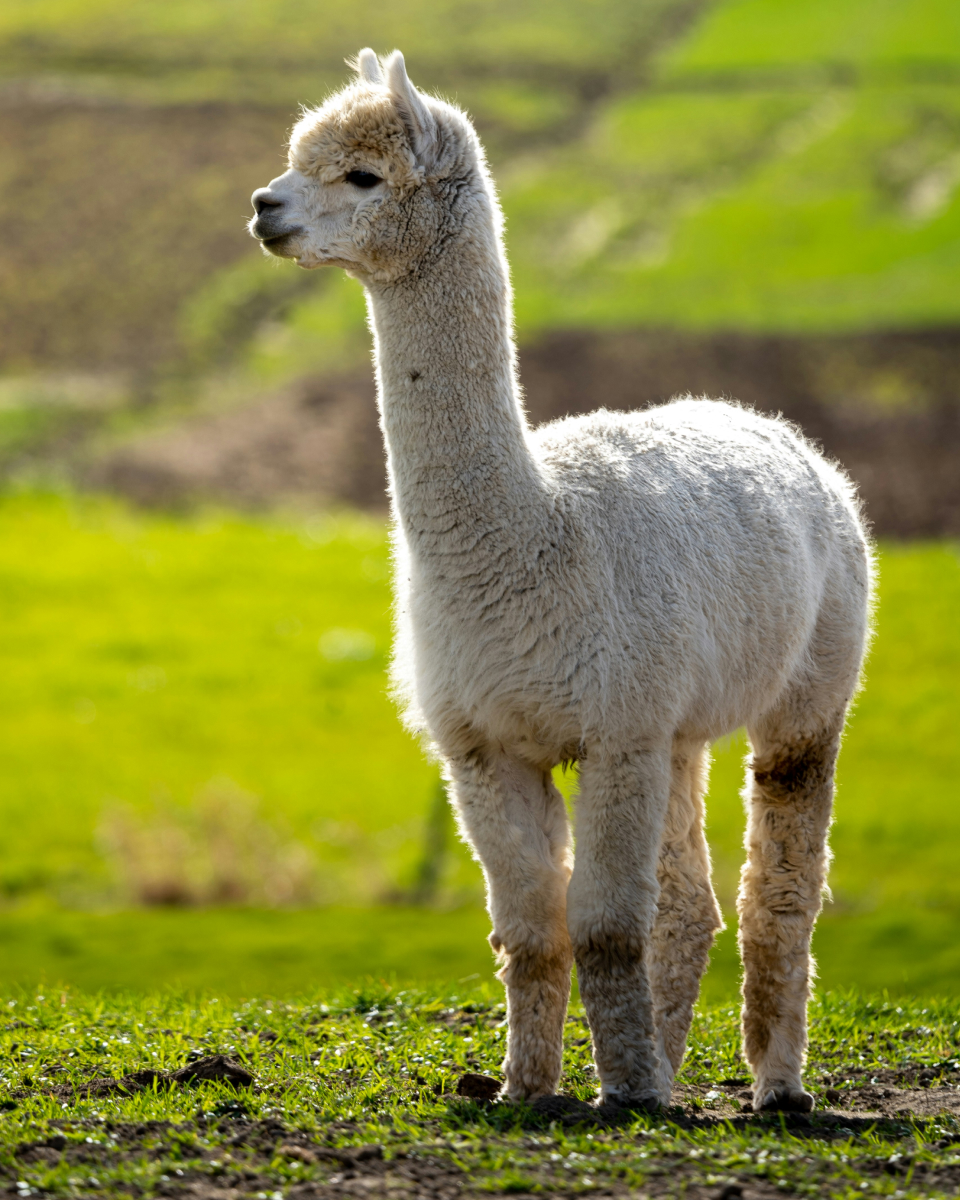
Photo by Arne Verbist
Vicugna pacos is a medium-sized camelid (adult body mass 55–85 kg, 80–100 cm at withers) adapted to high-altitude, cold, semi-arid Andean environments at 3,500–5,000 m. The three-compartment forestomach enables efficient fibre digestion from native puna vegetation; soft padded feet have lower soil compaction impact than hooves. Adaptation to cool, dry climates with large diurnal temperature ranges means alpacas managed in warmer, more humid environments require specific husbandry attention including shade, shelter, and heat stress management.
Social structure is group-living with stable herd organisation: typically a single breeding male with multiple females and juveniles, with strong herd-following and flight responses. Isolation from conspecifics is a documented stressor — welfare guidance consistently identifies that alpacas should not be kept as solitary individuals. Anti-predator strategy relies on vigilance and flight rather than defensive behaviour; this prey-species profile produces the documented neophobia and stress reactivity during handling.
Stress responses under handling and isolation are well-characterised: elevated cortisol, increased heart rate, agitation, and avoidance behaviour in novel object tests and handling assessments. Welfare literature treats these as physiologically calibrated stress responses consistent with the species’ predator-vigilance ecology rather than as abnormal reactions to management.
Cognitive and welfare evidence: peer-reviewed work documents learning capacity, individual variation in fearfulness, memory for handling experiences, and responsiveness to human approach quality. Alpacas are sentient mammals; scientific consensus on vertebrate sentience applies fully.
Two breed types within *V. pacos* have distinct fibre profiles: Huacaya fleece is dense, crimpy, and perpendicular to the skin — the dominant commercial type processed similarly to fine wool. Suri fleece forms long, lustrous, silky locks draping along the body — a premium product in distinct processing streams from Huacaya.
Lifecycle Summary
Approximately 7.5 million alpacas are in South America, with Peru holding the dominant share — approximately 80–88% of the global population across different survey years. Bolivia, Chile, and Argentina hold the remaining South American population. Outside South America, the United States had approximately 99,500 alpacas in the 2022 USDA Census of Agriculture — a decline of approximately half from 2007, reflecting the contraction of a speculative-investment-driven hobby market boom analogous to the US llama population decline documented in the Llamas record. UK, Australian, and New Zealand populations exist at smaller scales.
Alpaca is primarily a fibre animal. The production system is structurally different from all other non-insect fibre records in the database: the animal is not killed to harvest the product. Annual or biennial shearing produces fleece; the same animal may be shorn over a productive life of 10–15 years in fibre systems. Meat and slaughter are secondary outputs — primarily from surplus male culls and end-of-productive-life females in Andean systems, not the primary commercial objective.
The most specific published welfare finding for alpacas is a Meat Science study of captive bolt stunning: of 96 alpacas across 103 stunning shots, 9.8% were incompletely concussed after the first shot, with all failures attributable to incorrect shot placement. Crown (top-of-head) placement maximised effective brainstem damage. This is the only published stun failure rate for alpaca slaughter and applies to a species whose skull geometry requires adjusted technique relative to cattle.
Lifespan (Natural vs Exploited)
Alpacas can reach 15–20 years; maximum recorded lifespan approximately 28 years.
Fibre production animals: breeding females in Andean smallholder systems are commonly culled after approximately 10–15 years following decline in reproductive or fleece performance. In export hobby/fibre herds, many animals approach natural lifespan when not culled. Males not retained for breeding are castrated and may be kept as fibre animals or pets for extended periods; some are culled younger for meat.
Meat-focused systems (primarily Andean): young animals slaughtered at approximately 1–4 years for fresh meat and charque (dried preserved meat).
Primary mortality causes across systems: gastrointestinal parasitism (principally Haemonchus contortus), clostridial diseases, vitamin D deficiency in low-UV environments, high-starch diet complications, dystocia and perinatal losses, predation in extensive systems, and complications from poorly performed veterinary procedures.
Exploitation Systems
Alpaca exploitation is structured around fibre as the primary global commercial product, with meat, breeding stock trade, and biopharmaceutical production as secondary systems.
Fibre production — Andean pastoral systems. Traditional smallholder and community herds on high-altitude puna rangeland in Peru, Bolivia, Chile, and Argentina. FAO estimates that approximately 85% of domesticated South American camelids are managed by smallholders with herds of fewer than 100 animals. Annual or biennial shearing produces fleece sorted by fineness, staple length, and colour. Fibre flows from farm to local collector to regional processor, with Peru’s textile industry — centred in Arequipa — processing the majority of global raw alpaca fibre. Downstream: scouring, carding, combing, spinning, weaving, and knitting into garments, blankets, and home textiles. Coarser fibre and short fibres enter insulation and carpet manufacturing.
Fibre production — export hobby and commercial farms. Smaller herds in North America, Europe (primarily UK), Australia, New Zealand, and parts of Asia oriented to high-value fleece and breeding stock. Intensive genetic selection for micron count, comfort factor, staple length, crimp, and colour. Animals registered with breed associations and shown competitively; pedigree recording and objective fibre measurement are standard. Fibre from these herds may enter specialist small-scale spinning operations or be exported to Peruvian processing chains.
Meat production. Regional Andean consumption as fresh meat and charque (dried preserved product). Alpaca meat is both a direct food source for Andean communities and a by-product of fibre system culling — surplus males and end-of-productive-life females. Dedicated meat herds selecting for growth and carcass traits exist in limited scale. By-products include hides for leather and crafts, offal and bones for local use.
Paco-vicuña breeding. Experimental hybridisation of alpaca females inseminated with vicuña semen to produce paco-vicuña animals with ultra-fine fibre below 12 microns — closer to wild vicuña fibre quality. Research programmes in Peru and Chile are developing assisted reproduction protocols for this purpose; commercial-scale paco-vicuña production is not yet established.
Breeding stock and live animal trade. Export of alpacas from Andean countries to North America, Europe, Australia, New Zealand, and Asia for fibre, agritourism, and companion purposes. International trade in embryos and semen for genetic improvement in export-region herds. Breeding stock transactions at registered auctions constitute a significant commercial activity in export regions.
Agritourism and therapy. Alpacas kept on farms open to visitors, in petting operations, and in therapeutic programmes. Primary commercial output is tourism services and associated merchandise; fibre and breeding stock sales may be secondary outputs.
VHH nanobody biopharmaceutical production. Alpacas, like llamas, produce heavy-chain-only immunoglobulins whose variable domains (VHH fragments, “nanobodies”) are used in research diagnostics and therapeutic development. The system is structurally identical to the VHH pathway documented in the Llamas record: hyperimmunisation with target antigens, blood collection for peripheral blood lymphocyte isolation, and VHH library construction by phage display. Alpaca-derived nanobodies are extensively used in research; both alpacas and llamas are used for this purpose, making the camelid VHH system a shared exploitation pathway across both records.
Living Conditions Across Systems
Extensive Andean rangeland systems. Year-round grazing on high-altitude puna at 3,500–4,800 m; large open areas with seasonal communal or private rangeland; minimal constructed shelter; exposure to cold temperatures, intense solar radiation, and seasonal precipitation. Mixed herds with llamas in some systems. Animals have extensive ranging opportunity consistent with species ecology; welfare challenges relate to variable nutrition, internal parasitism, climatic extremes, and limited veterinary access rather than confinement.
Pasture-based smallholder and hobby farms (export regions). Fenced paddocks with grass or mixed pastures; field shelters or barns in cold or wet climates; recommended rotational grazing. Stocking density guidance varies: a welfare review recommends a maximum of 15 alpacas/ha when grass is the primary feed source; extension sources suggest 2–3 alpacas/ha in static grazing and 3–4/ha in rotational systems on good pasture. Indoor confinement is generally short-term (handling, weather, shearing) rather than continuous.
Social grouping is maintained in small herds; isolation of individuals is discouraged and identified as a welfare risk in published guidance. Routine issues in export-region farms include overstocking, poor drainage causing foot problems, insufficient shade and windbreaks in warm climates, and inadequate vitamin and mineral supplementation.
Semi-intensive and intensive systems. Smaller paddocks and drylots with supplementary feeding; more frequent handling and confinement for management, shearing, and veterinary procedures. Specific indoor space allowances are not standardised in published alpaca-specific regulations; guidelines recommend allowing all animals to lie simultaneously in sternal recumbency and to move without forced contact.
Lifecycle Under Exploitation
Genetic Selection
Selective Breeding targets fibre fineness (mean fibre diameter in microns), comfort factor (percentage of fibres below 30 microns), staple length, fibre uniformity and crimp, colour, body conformation, reproductive performance, and temperament. In export-region registered herds, pedigree recording, objective fibre measurement, and show competition results are the primary selection tools; advanced reproductive technologies (AI, embryo transfer) accelerate genetic gain for elite traits. In Andean smallholder systems, selection is primarily based on fleece assessment and animal condition, with limited individual performance recording. Selection for fibre fineness is the dominant driver in all fibre-focused systems.
Reproduction
Alpacas are induced ovulators — ovulation does not occur spontaneously but is triggered by the mechanical stimulation of mating or by exogenous hormone administration. Natural mating in controlled breeding paddocks is the standard method; males (“herd sires” or “stud males”) are used for multiple females within a season. Artificial insemination using chilled semen requires hormonal induction (chorionic gonadotropin or ovulation-inducing factor protocols); AI with frozen semen remains technically challenging. Pregnancy diagnosis is via behavioural testing (female refusal of male approach — “siteo” behaviour) or ultrasound. Gestation approximately 11–12 months; single offspring (cria) is typical.
Birth & Early Life
Births occur outdoors in Andean systems or in monitored paddocks in export-region farms; crias stand and nurse within hours. Early interventions include navel disinfection, colostrum intake monitoring, identification (ear tagging, microchipping), and vitamin D supplementation in low-UV environments. Crias remain with the dam and herd through early life; no routine separation analogous to dairy cattle early-life management occurs in standard alpaca fibre systems.
Growth & Rearing
Grazing supplemented with hay or concentrates when pasture quality is insufficient; body condition monitoring is a primary management tool. Routine health interventions begin in early life: clostridial vaccination, internal and external parasite control, hoof trimming where needed. Castration of males not selected for breeding is standard in export/hobby systems (see Chemical & Medical Interventions).
Production
Wool Shearing is the defining production event. First shearing typically at 1–2 years of age; thereafter annual or biennial depending on climate, fibre growth rate, and management system. Shearing uses manual or electric clippers with physical restraint on a shearing table or in lateral recumbency on a mat. Post-shearing handling includes skirting (removing stained and short edge fibre), grading and classing, and baling for sale or processing.
Transport
Live Transport for market sale, export, shows, slaughter, and breeding movements by road in trucks or trailers; air transport for international breeding stock. Alpaca-specific stocking density and journey duration standards are not published; recommendations extrapolate from small ruminant guidance. Known transport stressors include mixing unfamiliar animals, loading and unloading, heat or cold exposure, and prolonged journey times.
End of Life
Culling decisions are based on age, reproductive failure, chronic illness, poor fibre production, conformation faults, or surplus male status. Animals may be transported to abattoirs, slaughtered on-farm by a veterinarian, or in some jurisdictions killed by the owner under applicable regulations. On-farm euthanasia methods include veterinary overdose of anaesthetic agents, or captive bolt or firearm with confirmed death.
Processing
Meat: carcass dressing into fresh cuts, charque, offal, and hides following abattoir slaughter. Fibre: post-shearing skirting, grading, baling; industrial processing via scouring, carding, combing, spinning, and weaving concentrated predominantly in Peruvian mills (Arequipa), with smaller processing in export regions.
Chemical Medical Interventions
Clostridial vaccines are the primary preventive intervention: multivalent products (commonly “5-in-1” covering Clostridium perfringens types C and D, C. tetani, C. novyi, and C. septicum) administered twice yearly with boosters, following schedules adapted from sheep and goat practice. Tetanus toxoid is specifically administered prior to surgical procedures including castration. All vaccine protocols are extrapolated from small ruminant data; alpaca-specific licensed products are not widely available.
Anthelmintics are critical for management of Haemonchus contortus (barber’s pole worm), which is the primary parasitic mortality cause. Products used include macrocyclic lactones (ivermectin, moxidectin), benzimidazoles (albendazole, fenbendazole), and amino-acetonitrile derivatives — all off-label in most jurisdictions, with dosing extrapolated from sheep and goats. Anthelmintic resistance of H. contortus in Australian alpaca populations has been documented in peer-reviewed literature, raising management challenges for resistance refugia strategies.
Vitamin D supplementation (injectable or oral) is required in climates with insufficient UV exposure for cutaneous synthesis; selenium and mineral supplementation is indicated in deficient soils and is assessed by blood testing. These interventions reflect the species’ adaptation to high-altitude Andean UV exposure being inadequate for management in temperate, lower-altitude export regions.
Castration of non-breeding males is standard practice in export/hobby systems. The Australian Alpaca Association commissioned a peer-reviewed castration welfare study documenting surgical methods: scrotal and pre-scrotal approaches involving incision, ligation or electrocauterisation, and testes removal. Standard protocols involve sedation with xylazine (alpha-2 agonist), local anaesthesia, systemic analgesia with meloxicam (oral transmucosal formulations have been evaluated for alpacas), and perioperative tetanus prophylaxis. Topical anaesthetic products including Tri-Solfen are used in Australian practice. The study documents reduced pain indicators and altered stress physiology in
animals receiving appropriate sedation and multimodal analgesia compared with those receiving minimal pain management; the study identifies inadequate pain management as associated with elevated post-operative cortisol and altered behaviour.
Hormonal induction for artificial insemination uses chorionic gonadotropin or ovulation-inducing factor (OIF/NGF) protocols adapted to the induced ovulation physiology of camelids.
Analgesics (meloxicam, other NSAIDs), sedatives (xylazine), local anaesthetics, general anaesthesia, and antibiotics (procaine penicillin G and others) are administered as veterinary interventions for surgical procedures, dystocia, and disease treatment. Pharmacokinetic data for these compounds in alpacas are incomplete; most dosing is extrapolated from llamas and small ruminants with acknowledged uncertainty.
Slaughter Processes
Penetrating captive bolt is the documented primary stunning method for commercial alpaca slaughter. A peer-reviewed Meat Science study (PubMed 25460130) of 96 alpacas across 103 stunning applications found a 9.8% incomplete concussion rate on first shot, with all failures attributable to incorrect shot placement. Crown (top-of-head) placement was identified as the optimal position, maximising effective brainstem damage; this differs from the frontal or poll placement standard for cattle and must be specifically trained for alpaca operators. After correct crown placement, all animals were effectively concussed; after a second shot, all incompletely concussed animals were rendered insensible. The study documents that operator training and target site knowledge are the primary determinants of effective stunning in alpacas.
Captive bolt alone does not cause death; exsanguination via carotid and jugular severance following effective stunning is required to complete the kill. Secondary procedures (pithing or verified exsanguination) are necessary to ensure death.
Firearm shooting may be used for on-farm culling; specific calibre and placement guidance is adapted from other camelids and ruminants.
The puntilla traditional slaughter method documented for llamas in the Llamas record has not been specifically studied for alpacas; the welfare concerns identified for llamas (95% of animals sensible before bleeding, 45% requiring repeat stabs) would apply structurally if used, but direct alpaca-specific data are absent.
Non-stun slaughter in religious contexts is not specifically documented for alpacas; halal frameworks apply but alpaca-specific guidance is limited.
Commercial throughput for alpaca slaughter is modest — alpacas represent a small fraction of livestock slaughter volumes in all producing countries; slaughter typically occurs in multipurpose facilities handling mixed species.
Slaughterhouse Labour Impact
Alpaca-specific occupational health data are not published; workers processing alpacas are part of broader abattoir and meat-processing labour forces. General livestock processing occupational health findings apply structurally: musculoskeletal injuries, lacerations, exposure to biological agents, and documented psychosocial stress among slaughterhouse workers. Alpaca slaughter volumes are small relative to major livestock species in all producing countries; no alpaca-specific injury rate or psychological impact study has been conducted.
In Andean producing regions, slaughter occurs in municipal abattoirs handling multiple species; workforce demographics align with broader regional abattoir labour patterns including rural and community workers.
Scale & Prevalence
Global alpaca population approximately 7.5 million in South America (FAO-based estimate, recent years); earlier surveys citing approximately 3 million with 88% in Peru reflect older census data — current populations are higher following documented growth from 2007 to 2022 in Peruvian and regional statistics. Peru holds the dominant share; Bolivia, Chile, and Argentina hold the remaining South American population.
United States: approximately 99,500 alpacas in the 2022 USDA Census of Agriculture, down approximately half from 2007 levels. The US decline reflects the same speculative-investment-boom-and-bust cycle documented for llamas: a period of high breeding stock prices in the 2000s followed by sustained market contraction. Australia, New Zealand, and UK populations exist at smaller scales; European populations (Germany, Netherlands, Belgium, other countries) are growing modestly from low bases.
Andean system distribution: approximately 85% of domesticated South American camelids managed by smallholders with herds under 100 animals (FAO). The Andean smallholder system is the structural centre of global alpaca production; export-region hobby farms serve premium fibre and breeding stock markets but are minor in total animal numbers.
Directional trend: Andean populations are stable to expanding; export-region populations are contracting in the US and stable to modestly growing in Europe and Oceania. Global total is stable to slowly expanding driven by South American growth.
Ecological Impact
In extensive Andean rangeland systems, alpacas are integral components of long-standing puna grassland ecology. Soft padded feet create lower soil compaction pressure than hooves; the grazing style (nibbling rather than uprooting vegetation) is documented as comparatively gentle on turf. FAO and regional Andean documents frame traditional camelid grazing as compatible with conservation of high-altitude wetlands and puna grasslands when stocking is within carrying capacity; overgrazing risk exists where stocking exceeds productivity or where mixed species grazing — particularly with sheep — intensifies pressure.
Water requirements are modest relative to other livestock species: lactating females require approximately 6 litres/day; non-lactating animals less. Alpacas’ semi-arid adaptation produces lower water consumption than cattle or dairy animals managed at equivalent weights.
Life cycle assessments specifically for alpaca fibre or meat are limited and predominantly concentrated on Andean systems; the sustainability framing in policy and marketing documents often draws on FAO framing of camelids as climate-resilient, low-input livestock rather than on published alpaca-specific LCA data. Quantitative greenhouse gas emission factors per kilogram of alpaca fibre are not published in accessible peer-reviewed form. The “sustainable fibre” marketing claim is not independently verified by robust comparative LCA.
Export-region farms occupy converted agricultural land; direct biodiversity impacts depend on local stocking management, fencing, and predator control where applied. Feed supply chains in export regions (hay, concentrates) carry upstream environmental footprints from those production systems.
Language & Abstraction
“Baby alpaca” is the most consequential product label in this record. It does not describe fibre from a young or juvenile alpaca: it is a commercial trade category denoting fibre below approximately 22–23 microns mean diameter, harvested from the neck, chest, and underbelly regions of adult animals where fibre is finest. “Royal alpaca” denotes fibre below approximately 19 microns from equivalent fine body regions. Both terms create a lexical link to youth and softness as consumer values — “baby” connoting gentleness, softness, and a juvenile source — while describing fibre harvested from adult animals by the same shearing procedure applied to the rest of the fleece. The product category names are constructed entirely from quality descriptors that happen to use age language; no regulatory definition of “baby alpaca” requires the animal to be young. This is a more complete mislabelling than the colour-morph naming documented for mink and fox fur, because those names are at least transparently about the product’s appearance; “baby alpaca” misleads about the animal’s age and source.
“Luxury fibre,” “sustainable,” and “natural” are the dominant framing terms for alpaca in consumer-facing marketing and policy documents. These framings co-exist with limited published LCA data, documented anthelmintic resistance challenges, and a meat production pathway that is structurally embedded in the fibre system’s male surplus. The “sustainable” framing in FAO and Andean development documents positions alpaca production as ecologically compatible with high-altitude biodiversity conservation; this framing is accurate for well-managed traditional systems at appropriate stocking densities and functions as an abstraction when applied to all alpaca production globally without system-level specificity.
“High Andean camelid system” and equivalent framings in FAO and regional policy documents position alpaca production within livelihood, food security, cultural heritage, and ecosystem services discourse. Animals appear as “camelid livestock” or “herds” contributing to “200,000 families” and “sustainable mountain livelihoods” — collective framings that aggregate individual animal experiences into system-level welfare and sustainability accounting. The framing is not inaccurate for describing the socioeconomic function of the system; it operates as abstraction by making individual animal interventions (castration, culling, slaughter) invisible in the development-policy register where alpacas appear most prominently.
“Incompletely concussed” in the captive bolt stunning literature describes an alpaca that has received a penetrating bolt to the skull but has not lost consciousness. The term is a clinical welfare assessment descriptor — it measures an outcome relative to the target state (loss of consciousness) rather than describing the animal’s experience. Its clinical precision serves the welfare research function of distinguishing between effective and ineffective stun events; it simultaneously absorbs the experience of a conscious animal struck in the skull into a technical measurement category.
Terminology
Alpaca, Vicugna pacos, huacaya, suri, stud male, herd sire, dam, cria, weanling, yearling, maiden female, breeding female, wether, castrated male, fiber animal, meat animal, breeding stock, replacement stock, cull animal, guard animal, alpaca fleece, alpaca fiber, baby alpaca, royal alpaca, superfine alpaca, huacaya fleece, suri fleece, alpaca yarn, alpaca wool, alpaca meat, charque, carcass, hide, pelt, by-product, live export, breeding program, embryo transfer, artificial insemination, paco-vicuña, shearing, classing, skirting, scouring, carding, spinning, processing, abattoir, captive bolt stunning, exsanguination, culling, euthanasia, husbandry, pasture management, rotational grazing, intensive grazing, smallholder, producer, high Andean camelid system.
Within The System
Developments
Report a development: contact@systemicexploitation.org
Notice an inaccuracy or omission?
If you believe information on this page is incorrect, incomplete, or missing important context, you may submit a suggested correction for review.