
Scope
This record documents how zebrafish are exploited within globally standard animal-use systems. It describes dominant, routine practices across biomedical research, pharmaceutical testing, genetic engineering, breeding and laboratory supply industries, education and training, and aquarium trade contexts, independent of country-specific regulation or scientific framing narratives.
Differences in scale, enforcement, and legal classification are documented in country records. System-specific mechanisms are documented within industry records.
Species context
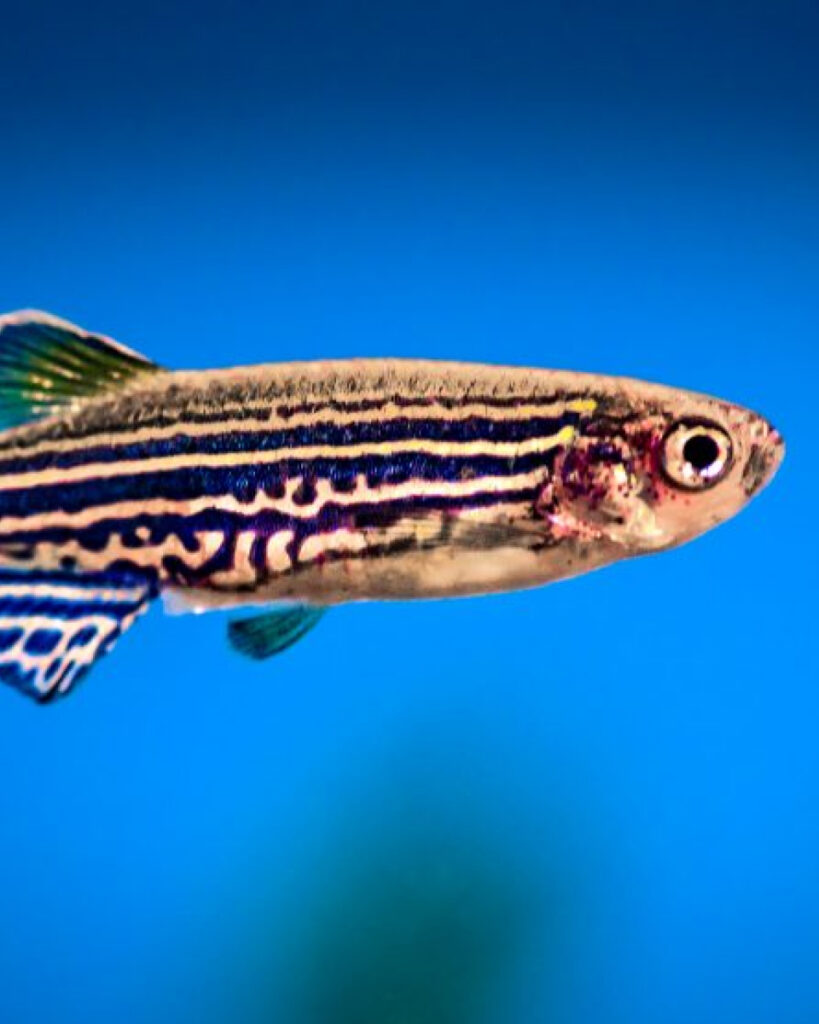
Photo by Powers Scientific
Zebrafish (Danio rerio) are small freshwater fish native to rivers, streams, and floodplains in South Asia. They are schooling animals that live in groups and rely on social interaction, sensory perception, and coordinated swimming behaviour.
Zebrafish demonstrate learning ability, spatial memory, stress responses, and complex behavioural patterns. They communicate through movement patterns and chemical signals and rely on social group dynamics for environmental awareness and predator avoidance.
Under natural conditions, zebrafish inhabit shallow water environments with vegetation, variable flow conditions, and opportunities for exploration and foraging.
These characteristics establish zebrafish as social aquatic animals with behavioural and environmental needs that are systematically constrained within laboratory exploitation systems.
Natural versus exploited lifespan
Natural lifespan
In natural conditions, zebrafish typically live 3–5 years, depending on environmental conditions.
Lifespan under exploitation
Within exploitation systems, zebrafish frequently die far earlier:
- Biomedical research: commonly killed during early developmental stages or after short experimental periods
- Toxicology testing: embryos and larvae may be killed within days or weeks
- Genetic research: fish may be culled if they do not carry desired genetic traits
The divergence between natural lifespan and exploited lifespan is determined by experimental timelines and breeding protocols rather than biological longevity.
Systems of exploitation
Zebrafish are exploited across multiple, overlapping systems:
- Biomedical research
Zebrafish are widely used to study genetics, developmental biology, neuroscience, and disease processes. - Pharmaceutical and chemical testing
Zebrafish embryos and adults are exposed to drugs, environmental toxins, and chemical compounds to evaluate toxicity and biological effects. - Genetic engineering and transgenic research
Zebrafish are genetically modified to express or suppress specific genes used to model human diseases. - Laboratory breeding and supply industries
Breeding facilities produce zebrafish strains for distribution to research laboratories. - Education and training
Zebrafish are used in teaching laboratories for demonstrations of embryonic development, physiology, and genetics. - Aquarium and ornamental fish trade
Zebrafish are bred and sold as ornamental aquarium fish.
These systems rely on controlled breeding infrastructure, aquatic laboratory housing systems, experimental equipment, and international transport networks.
Living conditions across system types
Laboratory housing systems
Zebrafish used in research are typically housed in rack-mounted aquarium systems containing multiple tanks connected to central filtration units. These systems allow high-density fish populations to be maintained in controlled water conditions.
Environmental parameters such as temperature, lighting cycles, pH, and oxygen levels are tightly regulated.
Fish are often housed in relatively small tanks with limited environmental complexity compared to natural habitats. Schools may be restricted in size due to experimental design.
Fish are regularly handled or netted for experimental procedures, breeding, and tank maintenance.
Breeding facilities
Breeding colonies maintain large populations of zebrafish strains used for research. Breeding groups are paired in controlled tanks to produce eggs for experimentation.
Embryos are collected shortly after fertilisation and transferred to experimental environments.
Large numbers of fish may be bred continuously to maintain research supply chains.
Aquarium trade
Zebrafish bred for the aquarium industry are typically raised in commercial breeding facilities. Fish are kept in tanks with high stocking densities and transported to pet stores or distributors.
Across systems, environmental conditions are designed for efficiency rather than ecological complexity.
Standardised lifecycle under exploitation
While practices vary, zebrafish used in laboratory systems typically move through a broadly standardised lifecycle:
- Selective breeding and genetic line maintenance
Fish are bred to maintain specific genetic strains or engineered traits. - Egg collection and embryo development
Fertilised eggs are collected from breeding tanks and transferred to laboratory dishes or tanks. - Experimental exposure
Embryos, larvae, or adult fish are exposed to experimental substances, environmental conditions, or genetic interventions. - Observation and data collection
Researchers monitor physiological, developmental, or behavioural changes. - Culling or euthanasia
Fish are killed after experiments conclude or if they do not meet genetic or experimental requirements.
Embryos not used in experiments are frequently discarded or destroyed.
Chemical and medical interventions
Zebrafish in research systems are subjected to extensive interventions, including:
- Exposure to pharmaceutical compounds and chemical toxins
- Genetic modification through microinjection or gene editing techniques
- Induction of disease models such as cancer, neurological disorders, or metabolic disease
- Surgical or microscopic procedures in some experimental designs
Embryos and larvae are particularly used in toxicology testing due to their transparency and rapid development.
Killing processes
Zebrafish used in research are typically killed using methods considered euthanasia within laboratory protocols, including:
- Anaesthetic overdose (e.g., tricaine methanesulfonate)
- Rapid chilling or ice-water immersion for larvae
- Chemical euthanasia agents
Embryos and larvae may be killed through chemical exposure, freezing, or disposal following experimentation.
In aquarium trade contexts, unwanted fish may be culled through similar methods.
Labour impact
Zebrafish breeding and research industries involve labour associated with:
- Colony management and tank maintenance
- Egg collection and embryo handling
- Experimental procedures and observation
- Cleaning and water filtration system maintenance
Workers may experience repetitive strain injuries and exposure to allergens or chemical agents used in laboratory environments.
Scale and prevalence
Zebrafish are among the most widely used vertebrate models in biomedical research. Millions are used annually in laboratories worldwide.
Large breeding colonies support a continuous supply for research institutions, pharmaceutical companies, and educational laboratories.
The aquarium trade also maintains significant breeding populations.
Ecological impact
Zebrafish exploitation contributes to ecological effects, including:
- Resource consumption for maintaining large aquatic laboratory systems
- Disposal of biological waste and experimental chemicals
- Potential ecological disruption if laboratory or ornamental fish escape into non-native ecosystems
Laboratory systems require constant water filtration, energy use, and chemical treatment.
Language and abstraction
Zebrafish are commonly described as “model organisms,” “experimental subjects,” or “research tools.” These terms emphasise scientific utility rather than the animals themselves.
Embryos are frequently treated as experimental materials rather than individual organisms within research protocols.
Editorial correction notice
Zebrafish are often framed as laboratory models or educational tools. This record documents zebrafish as social aquatic animals systematically bred, confined, genetically manipulated, experimented upon, and killed within integrated biomedical research, pharmaceutical testing, breeding, and aquarium trade systems, independent of scientific framing.