
Scope
This record documents how turkeys are exploited within globally standard animal-use systems. It describes practices that are widely established across industrial and semi-industrial contexts, independent of country-specific regulation or cultural variation.
Differences in scale, enforcement, and legal framing are documented in country records. System-specific mechanisms are documented within industry records.
Species context
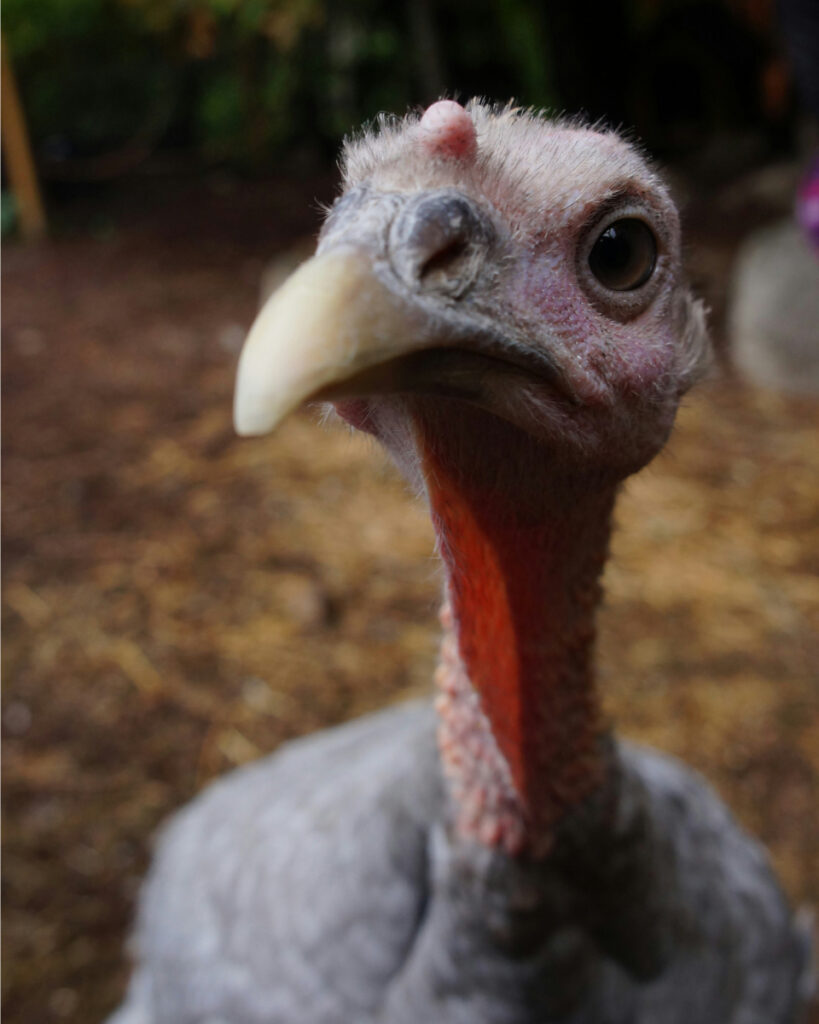
Photo by Mike Hends
Turkeys are large birds native to North America. They are social animals who form group structures, maintain spatial awareness of their environment, and exhibit problem-solving abilities. Turkeys communicate using a range of vocalisations and visual signals and demonstrate social recognition within groups.
Under natural conditions, turkeys forage, roost in trees, move across large territories, and engage in seasonal social and reproductive behaviours. They respond to stress through avoidance, vocalisation, and defensive behaviours.
These characteristics establish turkeys as individual animals with behavioural and social needs that are systematically constrained within exploitation systems.
Natural versus exploited lifespan
Natural lifespan
In the absence of exploitation, turkeys can live approximately 8–10 years, with some individuals living longer.
Lifespan under exploitation
Within exploitation systems, turkeys are typically killed far earlier:
- Meat production systems: commonly within 12–20 weeks
The divergence between natural lifespan and exploited lifespan is determined by productivity targets rather than health or biological longevity.
Systems of exploitation
Turkeys are exploited primarily within meat production systems, with additional exploitation occurring through breeding and byproduct processing:
Meat
Turkeys are bred, raised, and killed for meat production, often for seasonal and processed food markets.
Breeding and genetics
Selective breeding is used to maximise body size, breast muscle growth, and feed efficiency.
Byproducts
Turkey bodies are processed into secondary products following slaughter.
Transport and trade
Turkeys are transported between hatcheries, grow-out facilities, and slaughterhouses, often over long distances and in confined conditions.
These systems rely on shared industrial infrastructures and practices.
Living conditions across system types
Industrial systems
In industrial contexts, turkeys are typically housed in large enclosed sheds containing thousands of birds. Stocking densities are high, and environmental conditions such as lighting, temperature, and feeding are tightly controlled to accelerate growth.
Selective breeding has resulted in turkeys with disproportionately large bodies and limited mobility. Many birds experience difficulty walking, standing, or accessing food and water as they grow.
Semi-industrial and small-scale systems
In smaller operations, turkeys may have limited outdoor access, but remain subject to controlled breeding, confinement, feeding regimes, and slaughter. The underlying exploitation framework remains unchanged regardless of scale.
Confinement and restriction
Across systems, turkeys experience restricted movement, minimal environmental enrichment, and limited opportunity to express natural behaviours such as roosting or foraging.
Standardised lifecycle under exploitation
While specific practices vary, turkeys typically move through a broadly standardised lifecycle:
Breeding and hatching
Turkeys are bred intentionally through controlled breeding programs. Eggs are incubated artificially in hatcheries, where hatching occurs at scale.
Early management
Young turkeys may be subjected to procedures such as beak trimming to reduce injury associated with crowding and stress. Male and female turkeys may be raised separately due to differing growth rates.
Growth and conditioning
Turkeys are fed high-energy diets designed to maximise rapid weight gain. Selective breeding produces birds whose bodies grow faster than their skeletal and cardiovascular systems can support.
Removal and slaughter
Once turkeys reach target weight, they are transported to slaughter facilities and killed.
Chemical and medical interventions
To sustain productivity at scale, turkeys are routinely subjected to chemical and medical interventions, including:
- Antibiotics to manage disease associated with high stocking densities
- Medications to control respiratory and gastrointestinal infections
- Feed additives to support accelerated growth
These interventions function as systemic inputs rather than exceptional measures.
Slaughter processes
Turkeys are transported from farms to slaughter facilities in crates or containers, often involving crowding, rough handling, and exposure to stressors associated with loading, transport, and unloading.
At slaughter facilities, turkeys are typically restrained and rendered unconscious using electrical stunning systems or gas-based methods. These methods do not consistently render all birds unconscious. Following stunning, turkeys are killed through cutting or automated killing processes. Bodies are then processed sequentially within high-speed mechanised lines.
In some production contexts, turkeys are killed using water-based foam systems. Birds are enclosed in confined spaces where high-expansion foam is introduced, obstructing breathing and causing death through hypoxia. This method is used for both routine killing and mass depopulation and is justified as an efficient means of killing large numbers of birds simultaneously.
Slaughterhouse labour impact
Turkey slaughter operations rely on repetitive, high-speed killing and processing labour. Workers are exposed to physically demanding conditions, repetitive strain injuries, and psychological stress associated with routine killing.
Seasonal demand spikes can intensify line speeds and labour pressure, increasing injury risk.
Scale and prevalence
Turkeys are exploited at large scale globally, particularly in countries with industrial poultry production. Hundreds of millions of turkeys are killed annually for meat production.
Their exploitation is closely tied to industrial food systems, seasonal consumption patterns, and processed meat markets.
Ecological impact
The exploitation of turkeys at scale contributes to ecological harm, including:
- High demand for feed crops and associated land use
- Concentrated waste and manure pollution
- Water use and contamination
- Energy consumption associated with intensive housing and processing
These impacts arise from maintaining large populations of turkeys within intensive production systems.
Language and abstraction
Turkeys are commonly referred to using abstract or functional terms such as “poultry,” “meat birds,” or “production units.” Such language emphasises economic role and obscures individual existence.
System-specific terminology fragments a single animal’s experience across breeding, growing, and slaughter categories, contributing to the normalisation of exploitation.