
Scope
This record documents how trout are exploited within globally standard animal-use systems. It describes dominant, routine practices across industrial aquaculture, recreational fisheries, and wild-capture contexts, independent of country-specific regulation or branding narratives.
Differences in scale, enforcement, and legal framing are documented in country records. System-specific mechanisms are documented within industry records.
Species context
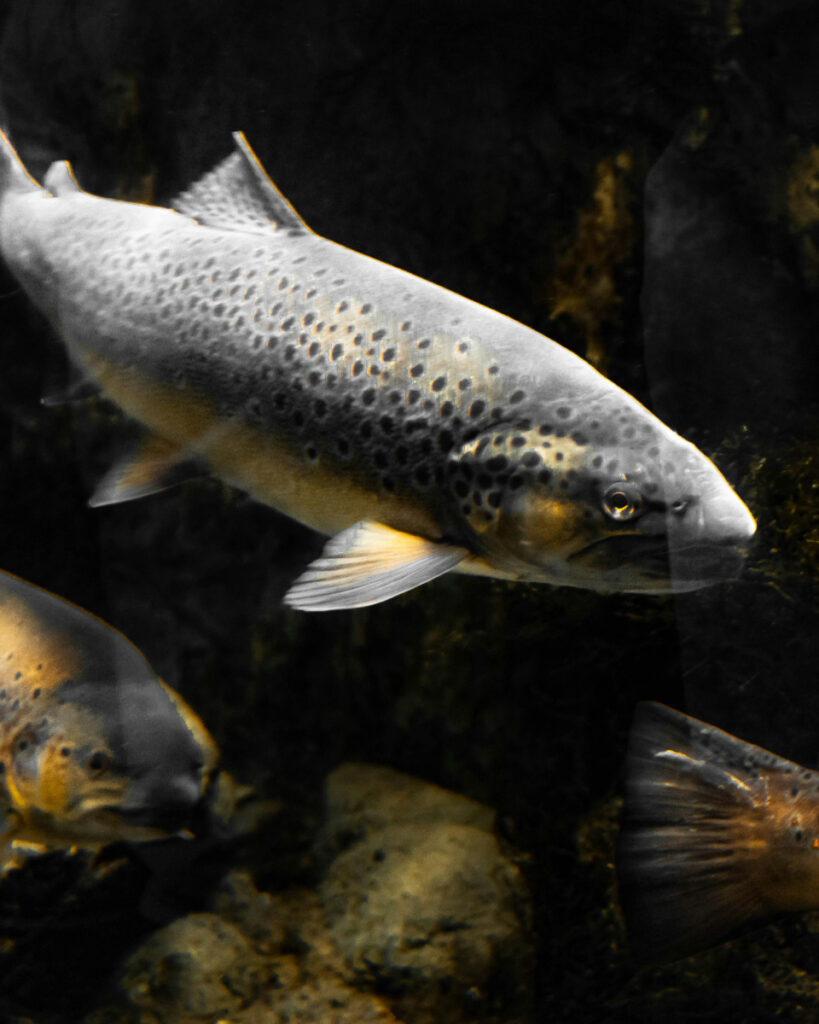
Photo by Sara Kurfeß
Trout are freshwater and anadromous fish primarily belonging to the genera Oncorhynchus, Salmo, and Salvelinus. Many species inhabit cold, oxygen-rich rivers, streams, and lakes, while some migrate between freshwater and marine environments.
Trout rely on acute sensory perception, including vision, lateral line detection of water movement, and chemical sensing. They exhibit territorial behaviour, predator avoidance, schooling (in juvenile stages), and habitat-specific foraging strategies. Wild trout often occupy defined home ranges and respond strongly to changes in water temperature, flow, and oxygen levels.
Under natural conditions, trout move freely within complex aquatic environments, seeking shelter among rocks, vegetation, and current breaks. They regulate stress through mobility, environmental variation, and territorial spacing.
These characteristics establish trout as habitat-sensitive animals whose behavioural and physiological needs are systematically overridden within exploitation systems.
Natural versus exploited lifespan
Natural lifespan
In the absence of exploitation, trout lifespans vary by species, typically ranging from 3–10 years, with some individuals living longer in stable freshwater systems.
Lifespan under exploitation
Within exploitation systems, trout are typically killed far earlier:
- Aquaculture systems: commonly slaughtered at 9–18 months
- Wild-capture fisheries: killed once reaching marketable size, often before full ecological maturity
- Recreational fisheries: killed immediately upon capture or die from post-release stress and injury
The divergence between natural lifespan and exploited lifespan is driven by growth targets, stocking cycles, and harvest quotas rather than ecological longevity.
Systems of exploitation
Trout are exploited across multiple, overlapping systems:
- Industrial aquaculture
Trout are bred, hatched, confined, fed, medicated, and slaughtered in freshwater raceways, ponds, and recirculating aquaculture systems. - Wild-capture fisheries
Trout are caught in rivers, lakes, and coastal environments using nets, traps, and lines. - Recreational and sport fishing
Trout are targeted for leisure fishing, including catch-and-release systems. - Stocking and hatchery programs
Hatcheries breed and release trout into waterways to support commercial and recreational fishing industries. - Byproducts and secondary processing
Trout bodies are processed into fillets, smoked products, fishmeal, oils, and animal feed inputs.
These systems rely on hatcheries, artificial breeding infrastructure, feed production, transport logistics, and high-throughput processing facilities.
Living conditions across system types
Industrial aquaculture
In aquaculture systems, trout are commonly raised in long concrete raceways or circular tanks supplied with flowing water. Stocking densities are high, and fish are confined in uniform, barren environments.
Movement is restricted to narrow channels or enclosed tanks. Environmental complexity is absent. Continuous water flow removes waste but does not replicate natural habitat diversity.
Crowding leads to aggression, fin damage, stress-related illness, and increased susceptibility to disease.
Hatchery environments
Eggs are fertilised artificially, incubated in trays, and hatched in controlled facilities. Juvenile trout are raised under artificial lighting and feeding regimes before transfer to grow-out systems or release into wild waterways.
Recreational fishing contexts
Wild and hatchery-stocked trout are captured using hooks, lures, and bait. Capture involves puncture wounds, tissue damage, air exposure, and stress responses. Even when released, trout may die later due to injury, infection, or physiological shock.
Standardised lifecycle under exploitation
While practices vary, farmed trout typically move through a standardised lifecycle:
- Broodstock management and artificial fertilisation
Adult trout are manually stripped of eggs and sperm. Fertilisation occurs under controlled conditions. - Incubation and hatchery rearing
Eggs hatch in trays. Juveniles are raised in tanks or raceways. - Grow-out phase
Trout are transferred to larger raceways or ponds and fed concentrated diets to accelerate growth. - Grading and handling
Fish are crowded, netted, pumped, or mechanically handled during size sorting and transfer. - Harvest and slaughter
Trout are crowded densely, removed from water, stunned inconsistently, and killed.
Wild-caught and recreationally caught trout follow shorter pathways: capture, injury, death, and processing.
Chemical and medical interventions
To maintain high-density production, trout are subjected to systemic interventions, including:
- Antibiotics to manage bacterial diseases common in confined systems
- Antifungal treatments during egg incubation
- Chemical baths to address parasite infestations
- Vaccinations administered by injection in early life stages
- Feed additives to promote growth efficiency
Disease outbreaks are common in high-density raceway systems, requiring routine pharmaceutical management.
Slaughter processes
Trout slaughter methods vary and often fail to ensure rapid unconsciousness. Common practices include:
- Asphyxiation in air
- Ice slurry immersion
- Carbon dioxide exposure
- Electrical stunning with variable effectiveness
- Percussive stunning performed manually
Prior to slaughter, trout are crowded tightly, leading to compression injuries and oxygen depletion. Some fish regain consciousness during bleeding.
In recreational fishing, death may occur through suffocation after landing, blunt force trauma, or prolonged air exposure.
Slaughterhouse labour impact
Trout processing facilities rely on repetitive, high-speed filleting and packing lines. Workers are exposed to:
- Cold, wet environments
- Repetitive strain injuries
- Continuous handling of injured or dying animals
Seasonal stocking and harvest cycles intensify throughput pressures.
Scale and prevalence
Trout are among the most widely farmed freshwater fish globally, with hundreds of millions killed annually through aquaculture alone. Recreational fishing industries add additional millions killed or injured each year.
Stocking programs introduce large numbers of hatchery-raised trout into waterways to sustain ongoing exploitation cycles.
Ecological impact
Trout exploitation contributes to ecological harm, including:
- Nutrient pollution and waste discharge from raceway systems
- Escape of farmed trout into wild ecosystems
- Genetic dilution of wild populations through hatchery stocking
- Transmission of disease and parasites
- Alteration of aquatic ecosystems due to intensive stocking and removal
Feed production for farmed trout also relies on agricultural inputs and fishmeal derived from wild fish capture.
Language and abstraction
Trout are commonly referred to as “stocked fish,” “harvest,” “catch,” or “production biomass.” Recreational framing emphasises sport and yield rather than injury and mortality.
Marketing imagery depicts clean rivers and mountain streams while omitting confinement in raceways and hatcheries.
Editorial correction notice
Trout are frequently framed as renewable freshwater resources or sporting assets. This record documents trout as individual animals systematically bred, confined, captured, injured, and killed across aquaculture, wild-capture, and recreational systems, independent of sustainability narratives or leisure framing.