
Scope
This record documents how silkworms are exploited within globally standard animal-use systems. It describes dominant, routine practices across industrial silk production, breeding programs, and derivative processing industries, independent of country-specific regulation or luxury branding narratives.
Differences in scale, enforcement, and legal framing are documented in country records. System-specific mechanisms are documented within industry records.
Species context
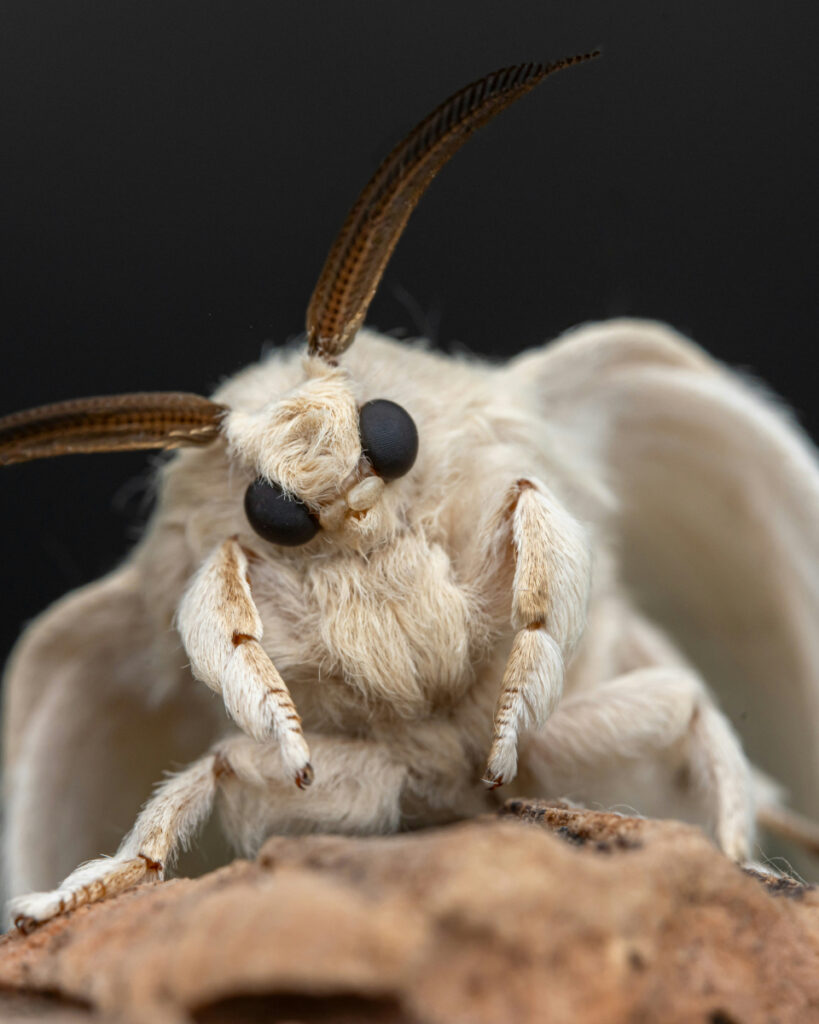
Photo by Jackie Best
Commercial silk production primarily exploits the domesticated silkworm (Bombyx mori), a moth species selectively bred over thousands of years for silk yield.
Silkworms undergo complete metamorphosis: egg, larva (caterpillar), pupa, and adult moth. During the larval stage, silkworms feed continuously on mulberry leaves before spinning a single continuous silk filament to form a cocoon in which they pupate.
Selective breeding has rendered Bombyx mori incapable of surviving independently in the wild. Adults are flightless, with reduced sensory capacity compared to wild ancestors.
Silkworm larvae exhibit feeding behaviour, movement, responsiveness to environmental conditions, and physiological stress responses.
These characteristics establish silkworms as living organisms whose complete lifecycle is controlled and terminated within industrial production systems.
Natural versus exploited lifespan
Natural lifespan
In natural conditions (for wild silk moth relatives), individuals complete metamorphosis, emerge as moths, reproduce, and die within a short adult lifespan.
Lifespan under exploitation
Within silk production systems:
- Silkworms are killed during the pupal stage before metamorphosis is completed.
- The cocoon is boiled, steamed, or heated to prevent the moth from emerging and breaking the silk filament.
The lifecycle is intentionally interrupted to preserve filament continuity. Reproduction is controlled entirely by breeding operations rather than natural mating cycles.
Systems of exploitation
Silkworms are exploited primarily through:
- Industrial silk production (sericulture)
Large-scale breeding, feeding, cocoon harvesting, and silk extraction. - Selective breeding programs
Genetic selection for filament length, cocoon size, colour, and productivity. - Wild silk industries
In some systems (e.g., tasar, eri, muga silk), partially wild silkworm species are cultivated or harvested. - Byproducts and derivative processing
Pupae are processed into animal feed, fertiliser, or human food products in some regions.
These systems rely on egg production facilities, controlled feeding environments, cocoon processing plants, and textile manufacturing infrastructure.
Living conditions across system types
Industrial rearing facilities
Silkworm eggs are incubated in controlled environments. Once hatched, larvae are placed on trays in temperature- and humidity-regulated facilities.
Larvae are densely arranged in stacked trays and fed mulberry leaves multiple times per day. Movement is limited to the tray surface. Environmental conditions are artificially stabilised to maximise feeding and growth rates.
As larvae mature, they are transferred to structures that allow cocoon formation.
Environmental complexity is absent; the lifecycle is reduced to feeding and silk production.
Wild or semi-wild systems
In certain silk types, larvae are placed on host trees and later collected. Even in these systems, cocoon harvesting interrupts natural metamorphosis.
Across systems, reproduction and development are fully controlled.
Standardised lifecycle under exploitation
Silkworm exploitation follows a highly standardised cycle:
- Egg production and incubation
Adult moths are bred under controlled conditions. Eggs are collected and incubated. - Larval feeding phase
Hatched larvae feed intensively on mulberry leaves for several weeks. - Cocoon formation
Mature larvae spin a continuous silk filament around themselves, forming a cocoon. - Cocoon harvesting
Cocoons are collected before adult emergence. - Killing phase
Cocoons are boiled, steamed, baked, or heated to kill the pupae inside. - Reeling and processing
Silk filaments are unwound from softened cocoons and processed into thread.
A small number of silkworms are allowed to complete metamorphosis to maintain breeding stock.
Chemical and medical interventions
To maintain high-output production, silkworm systems involve:
- Disease control measures for viral, bacterial, and fungal infections
- Environmental sterilisation and hygiene protocols
- Selective breeding to reduce vulnerability to disease
High-density rearing increases susceptibility to disease outbreaks, requiring constant management.
Killing processes
The killing of silkworms is integral to silk production. Common methods include:
- Boiling cocoons in hot water
- Steam exposure
- Dry heat baking
These methods kill the pupa inside the cocoon to preserve the continuous silk filament.
In large-scale operations, millions of silkworms are killed simultaneously during each harvest cycle.
If moths are allowed to emerge naturally, they break the silk filament, reducing commercial value. Therefore, intentional killing prior to emergence is standard practice.
Labour impact
Silk production involves:
- Repetitive handling of trays and cocoons
- Exposure to heat and steam during boiling
- High-volume manual and mechanised reeling operations
Labour intensity is often concentrated in rural or low-wage production regions.
Scale and prevalence
Silkworm exploitation occurs at extremely large scale. Billions of silkworms are bred and killed annually for global silk production.
Silk remains a major textile commodity, integrated into luxury fashion, traditional garments, and industrial materials.
Each kilogram of silk requires the killing of thousands of individual silkworms.
Ecological impact
Silkworm exploitation contributes to ecological effects, including:
- Large-scale mulberry cultivation
- Land use dedicated to monoculture feeding systems
- Water and energy use in boiling and processing
- Waste generation from pupae and processing residues
Industrial sericulture integrates agricultural production with textile manufacturing supply chains.
Language and abstraction
Silkworms are rarely described as animals in textile marketing. The process is framed in terms such as “harvesting cocoons” or “reeling silk,” obscuring the killing of the organism inside.
Silk is marketed as natural, sustainable, or heritage material without reference to lifecycle interruption or mass killing.
Terminology such as “peace silk” or “ahimsa silk” refers to alternative methods allowing moth emergence, though such production represents a small fraction of total silk output.
Editorial correction notice
Silk is frequently framed as a natural luxury fibre detached from animal harm. This record documents silkworms as living organisms systematically bred, confined, and killed at the pupal stage within industrial sericulture systems, independent of cultural symbolism or sustainability narratives.