
Scope
This record documents how pigs are exploited within globally standard animal-use systems. It describes dominant, routine practices across meat production, breeding and genetics, industrial farming, biomedical research, pharmaceutical and product testing, leather processing, byproduct industries, and other commercial uses, independent of country-specific regulation or marketing narratives.
Differences in scale, enforcement, and legal framing are documented in country records. System-specific mechanisms are documented within industry records.
Species context
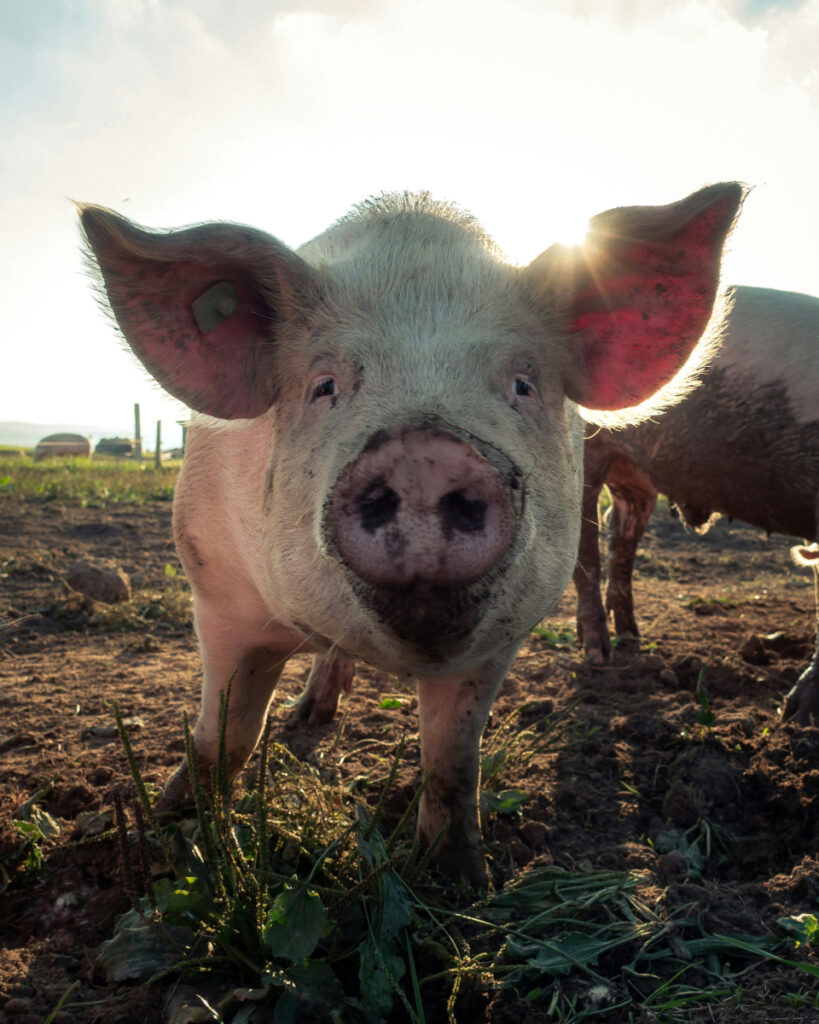
Photo by Pascal Debrunner
Domestic pigs (Sus scrofa domesticus) are domesticated descendants of the wild boar (Sus scrofa). Pigs are highly intelligent mammals with advanced cognitive abilities, social learning, and emotional responses.
Pigs form structured social groups and display complex behaviours including problem-solving, exploration, play, and cooperation. They communicate through vocalisations, body language, and scent. Pigs are naturally curious animals that spend significant time rooting and foraging.
Under natural conditions, pigs form stable social groups, build nests for birthing, and travel across territories to locate food and shelter.
These characteristics establish pigs as socially complex animals whose behavioural and environmental needs are systematically constrained within industrial exploitation systems.
Natural versus exploited lifespan
Natural lifespan
In the absence of exploitation, pigs commonly live 10–15 years, with gradual social development and repeated reproductive cycles.
Lifespan under exploitation
Within exploitation systems, pigs are typically killed far earlier:
- Meat production systems: slaughtered between 5–7 months of age
- Breeding sows: killed once reproductive productivity declines, typically after several years
- Research animals: killed after experimental protocols conclude
- Surplus piglets: killed shortly after birth
The divergence between natural lifespan and exploited lifespan is determined by production efficiency, research timelines, or market demand rather than biological longevity.
Systems of exploitation
Pigs are exploited across multiple, overlapping systems:
- Industrial meat production
Pigs are bred, raised, and slaughtered for pork products. - Breeding and genetics industries
Selective breeding programs prioritise rapid growth, muscle mass, feed efficiency, and reproductive output. - Leather production
Pigskin is processed into leather goods such as gloves, shoes, and garments. - Biomedical and pharmaceutical research
Pigs are used in medical research, surgical training, organ transplantation research, and disease modelling. - Product safety and toxicology testing
Pigs may be used to test pharmaceuticals, chemicals, and medical devices. - Organ and tissue harvesting
Pig organs and tissues are studied for transplantation research and biological material extraction. - Education and training
Pigs may be used in veterinary training, surgical demonstrations, and anatomy studies. - Byproduct and rendering industries
Pig bodies are processed into gelatin, pharmaceuticals, cosmetics, pet food, and industrial materials.
These systems rely on controlled breeding, confinement infrastructure, transport networks, slaughter facilities, and research laboratories.
Living conditions across system types
Industrial farming systems
Most pigs raised for meat are kept in intensive farming systems where animals are housed in enclosed facilities. Conditions may include:
- High-density group pens
- Slatted flooring systems
- Limited environmental enrichment
Pigs have little opportunity to root, forage, or explore.
Breeding females (sows) are often confined in gestation crates during pregnancy and farrowing crates during birth and nursing periods. These enclosures severely restrict movement and prevent natural nesting behaviour.
Piglets are commonly subjected to procedures such as:
- Tail docking
- Teeth clipping
- Castration
These procedures are frequently performed without anaesthesia.
Feedlot and finishing systems
Growing pigs are fed high-energy diets to accelerate growth. Environmental conditions prioritise feed efficiency and weight gain.
Research facilities
Pigs used in laboratories may be housed individually or in small groups, depending on experimental requirements. Housing may involve pens with minimal environmental complexity.
Pigs may undergo repeated handling, restraint, and experimental procedures.
Across systems, behavioural needs such as rooting, exploration, and social interaction are limited.
Standardised lifecycle under exploitation
While practices vary, pigs in commercial production systems typically move through a broadly standardised lifecycle:
- Selective breeding
Breeding stock are chosen based on genetic traits associated with growth and reproduction. - Artificial insemination or controlled mating
Females are impregnated to produce litters. - Birth and early management
Piglets are born in farrowing crates. Early procedures such as castration and tail docking may occur. - Growth phase
Young pigs are raised in group pens or feedlot environments. - Transport to slaughter
Pigs are transported to slaughterhouses once target weight is reached. - Slaughter and processing
Animals are killed and processed into meat and byproducts.
Breeding animals repeat reproductive cycles until productivity declines.
Chemical and medical interventions
To maintain productivity and manage disease risks, pigs may be subjected to:
- Antibiotics to control infections associated with high-density housing
- Vaccinations
- Hormonal treatments linked to reproductive management
- Feed additives to promote growth or feed efficiency
These interventions function as systemic inputs within industrial production systems.
Slaughter processes
Pigs raised for meat are transported to slaughter facilities, often over long distances. Transport conditions may involve crowding, dehydration, and stress.
Common slaughter methods include:
- Carbon dioxide gas stunning followed by throat cutting
- Electrical stunning followed by bleeding
Gas stunning systems may cause distress and respiratory discomfort before unconsciousness occurs.
Following stunning, pigs are shackled and their throats cut to bleed out. Bodies are then processed through mechanised slaughter lines.
Slaughterhouse labour impact
Pig slaughter and processing involve high-speed production lines requiring repetitive tasks such as cutting, evisceration, and carcass handling.
Workers are exposed to:
- Physical injury risks
- Repetitive strain injuries
- Psychological stress associated with routine killing
Large-scale slaughter operations require continuous labour throughput.
Scale and prevalence
Pigs are among the most widely exploited animals globally. Hundreds of millions are slaughtered annually for meat production.
Large breeding populations sustain continuous piglet production within industrial farming systems.
Pigs are also widely used in biomedical research and surgical training.
Ecological impact
Pig exploitation contributes to ecological harm, including:
- Large-scale feed crop production and associated land use
- Methane and other greenhouse gas emissions
- Water consumption and pollution from manure waste
- Environmental contamination from concentrated animal feeding operations
Industrial pig farming generates significant environmental waste streams.
Language and abstraction
Pigs within production systems are commonly referred to using technical terms such as “livestock,” “production units,” or “market hogs.” These terms emphasise economic role rather than individual animals.
Pork products are marketed using terminology that separates the animal from the product.
Research contexts refer to pigs as “models” or “subjects,” emphasising experimental function rather than animal identity.
Editorial correction notice
Pigs are often framed as agricultural commodities or research models. This record documents pigs as highly intelligent social mammals systematically bred, confined, subjected to invasive procedures, transported, experimented upon, and killed within integrated meat production, research, and industrial supply systems, independent of commercial or scientific framing.