
Scope
This record documents how parrots are exploited within globally established animal-use systems. It describes dominant practices across wildlife capture, commercial breeding operations, pet trade supply chains, entertainment industries, research contexts, and illegal wildlife trafficking, independent of country-specific regulation or cultural narratives surrounding companion animals.
Differences in scale, enforcement, and legal classification are documented in country records. System-specific mechanisms are documented within industry records.
Species context
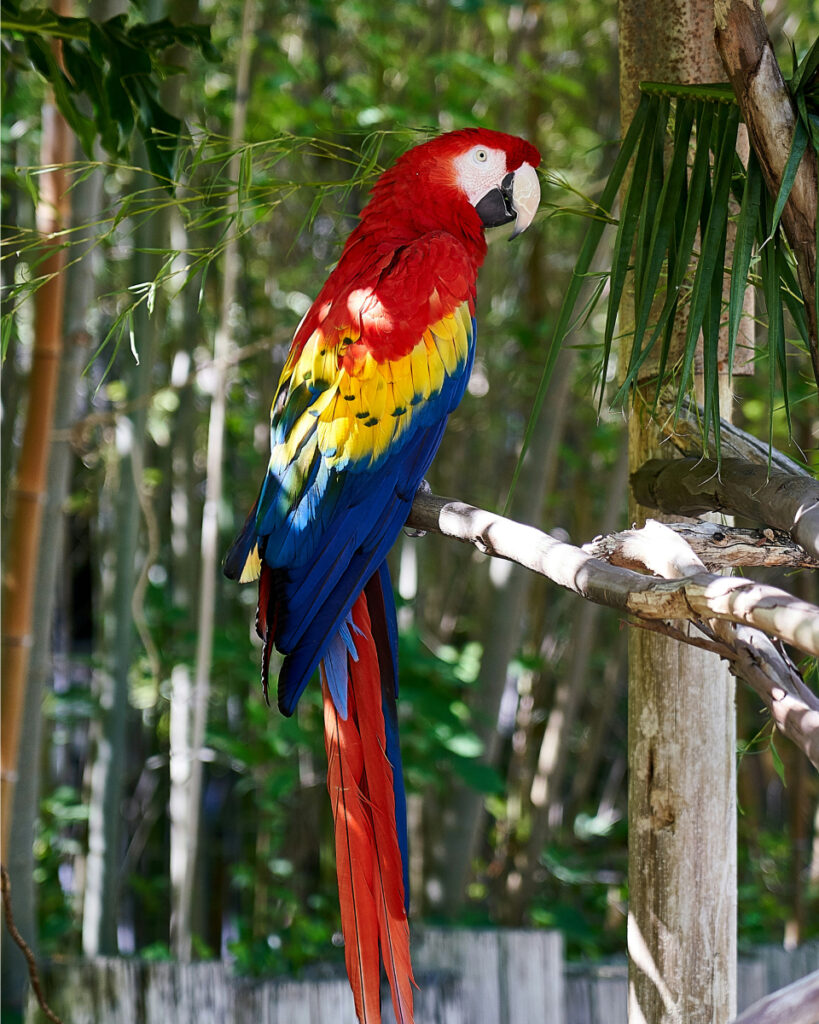
Photo by Nikolay Tchaouchev
Parrots belong to the order Psittaciformes, a diverse group of birds that includes macaws, cockatoos, parakeets, lorikeets, and African grey parrots. These birds inhabit tropical and subtropical regions across South America, Africa, Asia, and Oceania.
Parrots are among the most cognitively complex bird species. Many demonstrate advanced problem-solving abilities, vocal learning, tool use, and long-term social bonding. Some species can live for several decades and form stable pair bonds within flocks.
In natural environments, parrots spend much of their time flying long distances between feeding areas, nesting sites, and social groups. They forage for seeds, fruits, nuts, and vegetation while constantly interacting with other members of their flock.
Many parrot species depend on complex forest ecosystems and tree cavities for nesting. They maintain strong social communication through vocalisations, body posture, and cooperative flock behaviour.
These characteristics establish parrots as highly social and cognitively complex birds whose behavioural and environmental needs are systematically constrained within exploitation systems.
Natural versus exploited lifespan
Natural lifespan
Depending on species, parrots may live 20–80 years in natural environments. Large species such as macaws and cockatoos may live several decades.
Lifespan under exploitation
Within exploitation systems, parrots frequently experience shortened lifespans:
- Wildlife capture and trafficking: many individuals die during capture, transport, or early confinement
- Commercial breeding and pet trade systems: mortality may occur due to stress, disease, or inadequate care
- Entertainment and display contexts: animals may die prematurely due to confinement-related health issues
The divergence between natural lifespan and exploited lifespan is determined by capture stress, trade conditions, and captive management rather than biological longevity.
Systems of exploitation
Parrots are exploited across multiple overlapping systems:
Wildlife capture and trafficking
Wild parrots are captured from natural habitats for sale within international and domestic wildlife markets.
Commercial breeding operations
Parrots are bred in captivity to supply the pet trade and commercial markets.
Pet trade industries
Parrots are sold as companion animals through breeders, pet stores, and wildlife markets.
Entertainment and display industries
Parrots are used in animal shows, tourist attractions, and display facilities.
Scientific research
Some parrots are used in behavioural or cognitive research programs.
Illegal wildlife trade networks
High-value parrot species are trafficked through illegal wildlife markets.
These systems rely on capture networks, breeding facilities, global wildlife markets, and companion animal industries.
Living conditions across system types
Wildlife capture operations
Wild parrots are captured using techniques such as:
- mist nets
- trap cages
- nest removal
Capture operations often target nestlings or juvenile birds taken directly from nesting cavities.
Animals captured in the wild may be transported long distances in confined containers where mortality rates can be high.
Breeding and trade facilities
Commercial breeding operations house parrots in cages or aviaries designed for breeding and sale.
Animals may be kept in breeding pairs or isolated enclosures. Conditions vary widely but often involve limited environmental complexity compared with natural habitats.
Young birds are commonly hand-raised to increase human imprinting and facilitate sale within the pet trade.
Pet trade environments
Parrots sold as companion animals are typically housed in cages within private homes or pet stores. These cages limit flight, exploration, and complex social interactions.
Many parrots remain isolated from other birds despite their natural flock-based social behaviour.
Across systems, natural flight patterns, social structures, and environmental complexity are restricted or absent.
Standardised lifecycle under exploitation
While practices vary, parrots in trade systems typically move through a broadly standardised lifecycle:
Wild capture or captive breeding
Birds are either captured from natural habitats or bred within controlled breeding facilities.
Transport and trade
Animals are transported through wildlife markets, wholesalers, or pet retailers.
Sale to consumers or facilities
Parrots are sold into private ownership, entertainment facilities, or breeding programs.
Captive life
Animals spend their lives within cages or enclosures with limited opportunities for natural behaviour.
Transfer or abandonment
Some parrots are resold, surrendered, or abandoned due to behavioural challenges associated with long-term captivity.
Chemical and medical interventions
Parrots in breeding facilities or captivity may be subjected to:
- veterinary medications to treat infections or parasites
- antibiotics and antifungal treatments
- sedation during transport or veterinary procedures
These interventions are used to maintain captive populations within trade systems.
Killing processes
Parrots are not typically raised for slaughter, but deaths occur through:
- injuries or stress during wildlife capture
- transport mortality in wildlife trade networks
- euthanasia in captivity due to illness or behavioural issues
In some trafficking operations, birds that cannot be sold may be killed or discarded.
Slaughterhouse labour impact
Parrot exploitation does not typically involve conventional slaughterhouse systems. Labour within these industries instead involves:
- wildlife capture crews
- breeding facility workers
- pet trade retailers and distributors
- entertainment facility staff
Workers may face occupational risks associated with handling wildlife, exposure to zoonotic diseases, and illegal trafficking networks.
Scale and prevalence
Millions of parrots are traded globally through legal and illegal wildlife markets. The pet trade represents the largest exploitation system affecting parrots.
Wild capture has historically contributed to population declines for many species, particularly those with high market demand.
Commercial breeding operations continue to supply domestic and international pet markets.
Ecological impact
Parrot exploitation contributes to ecological impacts, including:
- population declines due to wildlife capture
- disruption of breeding populations through nest removal
- habitat disturbance associated with wildlife harvesting
- ecological imbalance resulting from removal of seed-dispersing bird species
Illegal wildlife trade also contributes to broader biodiversity loss.
Language and abstraction
Within the pet trade and entertainment industries, parrots are often described using terms such as “companion birds,” “talking birds,” or “exotic pets.”
These narratives emphasise personality traits or entertainment value while omitting the wildlife capture, confinement, and trade systems that structure many parrots’ lives.
Editorial correction notice
Parrots are frequently framed as companion animals, entertainers, or exotic pets. This record documents parrots as highly social and cognitively complex birds systematically captured, bred, confined, traded, and subjected to captivity within integrated wildlife trade and commercial breeding systems independent of pet industry narratives.