
Scope
This record documents how mink are exploited within globally standard animal-use systems. It describes dominant, routine practices across fur production, breeding and genetics, trade and transport, killing and processing, and secondary byproduct use, independent of country-specific regulation or fashion branding narratives.
Differences in scale, enforcement, and legal framing are documented in country records. System-specific mechanisms are documented within industry records.
Species context
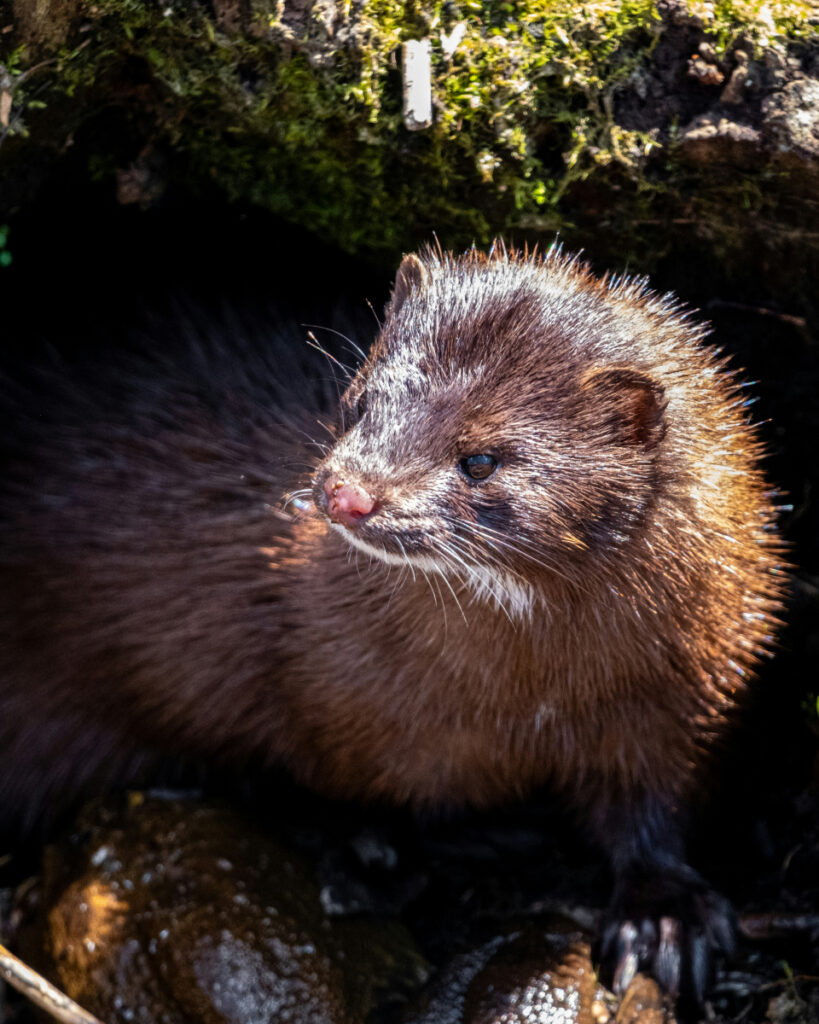
Photo by Alexandre Daoust
Commercial fur production primarily exploits the American mink (Neogale vison, historically Mustela vison), a semi-aquatic carnivorous mammal native to North America but bred globally in captivity. Mink are solitary, territorial animals adapted to large home ranges with access to water, dense cover, and opportunities for hunting, swimming, and exploration.
Mink rely on strong sensory perception, including smell and hearing, and display avoidance and defensive aggression when threatened. They are active animals with high behavioural drive for movement, investigation, and environmental control.
Under natural conditions, mink live alone, patrol territories, hunt small animals, and spend significant time near waterways. Confinement and forced proximity to other mink are incompatible with their behavioural ecology.
These characteristics establish mink as solitary, high-drive carnivores whose environmental and behavioural needs are systematically overridden within exploitation systems.
Natural versus exploited lifespan
Natural lifespan
In the absence of exploitation, wild mink commonly live 3–6 years, with some individuals living longer depending on environmental conditions.
Lifespan under exploitation
Within exploitation systems, mink are typically killed far earlier:
- Fur production systems: commonly killed at 6–8 months once winter coat develops
- Breeding stock: kept longer but killed once reproductive output declines, often within 2–4 years
- Disease control depopulations: killed at any age during outbreaks
The divergence between natural lifespan and exploited lifespan is determined by pelt maturity, colour demand, and production economics rather than biological longevity.
Systems of exploitation
Mink are exploited across multiple, overlapping systems:
- Fur farming (primary system)
Mink are bred, confined, and killed for pelts used in clothing and luxury fashion. - Selective breeding and genetics
Mink are selectively bred for pelt colour, fur density, body size, and “temperament” compatible with confinement. - Pelt processing and fashion supply chains
Skins are removed, treated, dyed, and traded internationally. - Byproducts and rendering
Carcasses and waste are processed into animal feed inputs, fertilisers, and industrial products in some supply chains. - Live transport and trade
Mink are transported between breeding facilities, farms, auction houses, and processing sites.
These systems rely on captive breeding, intensive caging infrastructure, high-throughput killing methods, and global commodity markets.
Living conditions across system types
Fur farm confinement
Mink on fur farms are typically housed in small wire cages arranged in long rows within open-sided sheds or barns. Cages are barren, with minimal enrichment and limited opportunity for swimming, hunting, or territorial movement.
Wire flooring contributes to chronic foot injuries and joint stress. The inability to retreat or establish territory leads to chronic stress responses, stereotypic behaviours, and aggression.
Mink are naturally solitary, yet farms maintain high densities of cages in close proximity, with constant sensory exposure to other mink and humans.
Breeding and reproductive management
Breeding animals are selected and paired by humans. Females are repeatedly impregnated, and kits are born into confinement. Kits may remain with mothers briefly before separation and individual housing.
Unwanted kits and those with undesirable coat traits may be killed or culled early.
Across systems, the environment is designed for pelt output and labour efficiency, not behavioural suitability.
Standardised lifecycle under exploitation
While specific practices vary, farmed mink typically move through a broadly standardised lifecycle:
- Breeding selection
Adults are selected for pelt traits and reproductive output. - Mating season management
Females are paired with males under controlled breeding schedules, often involving forced proximity and stress. - Birth and early confinement
Kits are born in nest boxes attached to cages. Survival is influenced by confinement stress, disease pressure, and management practices. - Growth phase
Young mink are fed high-protein diets to maximise growth and coat development. - Individual caging and conditioning
Mink are housed in isolated cages until slaughter, with minimal environmental stimulation. - Killing and skinning
Once the winter coat is developed, mink are killed, skinned, and processed into pelts.
Breeding animals repeat this cycle annually until culled.
Chemical and medical interventions
To sustain production in high-density confinement, mink are subjected to systemic interventions, including:
- Antibiotics to manage bacterial outbreaks
- Vaccinations where used
- Parasite control treatments
- Chemical disinfectants used in housing areas
Disease outbreaks are common in intensive systems. In outbreak contexts, mass depopulation may be used to eliminate entire farm populations.
Slaughter processes
Mink killing methods are designed to preserve pelt quality and enable high-throughput processing. Common methods include:
- Gas killing (e.g., carbon monoxide or carbon dioxide systems)
- Cervical dislocation in small-scale contexts
- Electrocution in some systems
Killing is frequently performed at industrial scale, with animals removed from cages and killed in batches.
Gas systems do not consistently produce immediate unconsciousness, and animals may experience distress, respiratory distress, and prolonged loss of consciousness depending on concentration and exposure time.
Following killing, mink are skinned. Bodies may be discarded, rendered, or processed into secondary products.
Slaughterhouse labour impact
Fur farm killing and skinning operations involve repetitive, high-speed labour. Workers are exposed to:
- Hazardous gases and chemical exposure
- Repetitive strain injuries from skinning work
- Psychological strain associated with routine killing and mass carcass handling
Seasonal kill periods intensify labour throughput and reduce handling care.
Scale and prevalence
Mink fur farming has operated at industrial scale across multiple regions, producing millions of pelts annually. Production rises and falls with fashion demand, market access, and regulatory changes, but the system remains structured around high-volume confinement and seasonal killing.
Mink are exploited almost exclusively for fur, making killing intrinsic rather than incidental to the system.
Ecological impact
Mink exploitation contributes to ecological harm including:
- Waste runoff from farms contaminating soil and waterways
- Resource use associated with feed production (often using fish or livestock byproducts)
- Escape or release of mink into local ecosystems, where they can become invasive predators
- Mass carcass disposal challenges in depopulation events
Fur farming concentrates pollution and predation risk in local environments.
Language and abstraction
Mink are routinely described using commodity terms such as “pelts,” “stock,” “breeding units,” or “colour lines.” The animal is linguistically replaced by the product.
Fashion marketing frames mink fur as luxury, heritage, or craftsmanship while omitting confinement, killing methods, and disposal of bodies.
Editorial correction notice
Mink are often framed as materials rather than animals within fashion supply chains. This record documents mink as solitary carnivores systematically bred, confined in barren cages, killed at juvenile age, and processed into fur commodities within industrial exploitation systems, independent of luxury branding or market framing.