
Scope
This record documents how llamas are exploited within globally standard animal-use systems. It describes dominant, routine practices across fibre production, meat processing, breeding, pack labour, tourism, guarding services, and land-management contexts, independent of cultural symbolism or regional identity.
Differences in scale, enforcement, and legal framing are documented in country records. System-specific mechanisms are documented within industry records.
Species context
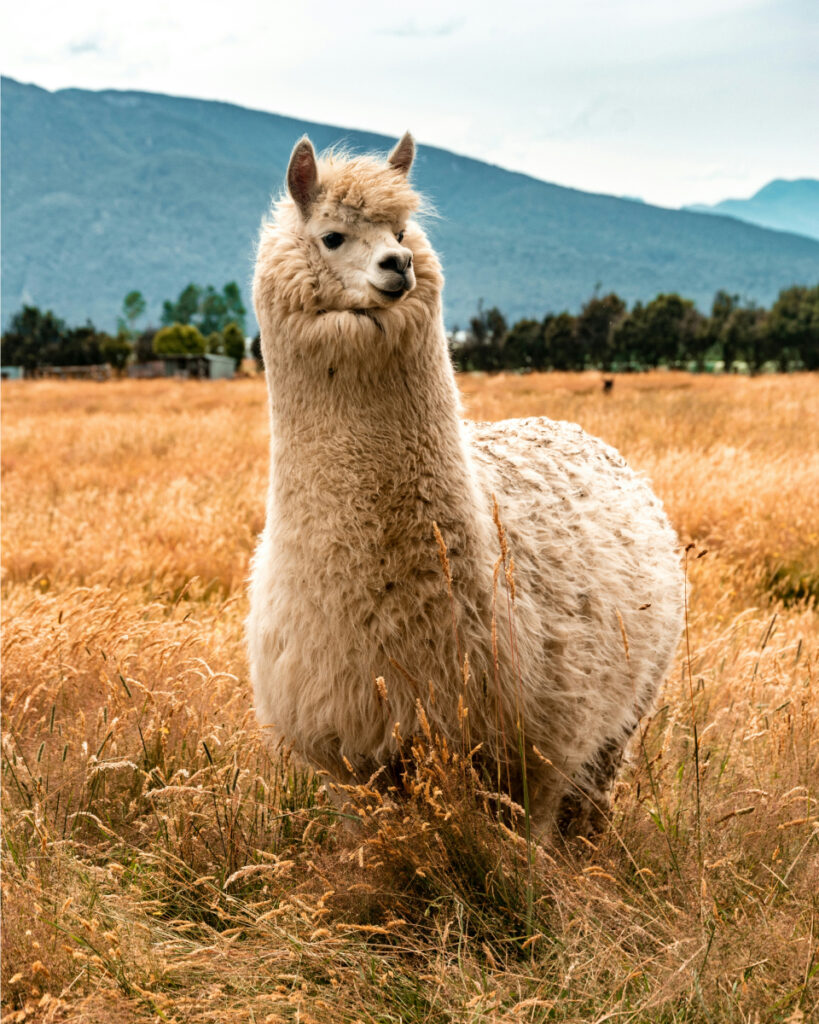
Photo by Sébastien Goldberg
Llamas (Lama glama) are domesticated South American camelids adapted to high-altitude and arid environments. They are social herd animals that rely on group cohesion, spatial awareness, and collective vigilance.
Llamas communicate through posture, ear positioning, vocalisations, and scent. They form stable social hierarchies and display stress responses when isolated, restrained, or removed from herd structures. As grazing herbivores, they are adapted for sustained movement across varied terrain.
Under natural or low-intervention conditions, llamas live in social groups, forage continuously, and maintain maternal bonds with offspring for extended periods.
These characteristics establish llamas as socially structured, stress-sensitive animals whose behavioural and environmental needs are systematically constrained within exploitation systems.
Natural versus exploited lifespan
Natural lifespan
In the absence of exploitation, llamas commonly live 15–25 years, with some individuals living longer under stable herd conditions.
Lifespan under exploitation
Within exploitation systems, llamas are frequently killed far earlier:
- Meat production systems: commonly slaughtered between 1–5 years
- Fibre production systems: killed once fleece quality or yield declines
- Pack and labour systems: killed or discarded following injury or reduced utility
- Breeding stock: culled when reproductive performance declines
The divergence between natural and exploited lifespans is determined by fibre output, labour capacity, reproductive value, and market demand rather than by biological longevity.
Systems of exploitation
Llamas are exploited across multiple, overlapping systems:
- Meat production
Llamas are bred, raised, transported, and slaughtered for meat. - Fibre production
Llamas are shorn for fibre used in textiles and garments. - Pack and transport labour
Llamas are used to carry loads across mountainous terrain and in trekking industries. - Tourism and exhibition
Llamas are used in farm tourism, trekking experiences, shows, and display contexts. - Guarding services
Llamas are deployed to guard sheep and other livestock, often in isolation. - Selective breeding and genetics
Breeding programs prioritise fibre characteristics, size, temperament, and conformation. - Byproducts and processing
Skins and body parts are processed into leather goods and secondary products.
These systems rely on controlled breeding, fencing, shearing infrastructure, labour training, transport networks, and slaughter facilities.
Living conditions across system types
Fibre-focused herd systems
In fibre-producing contexts, llamas are maintained in fenced grazing areas. While pasture-based, movement remains restricted to managed land. Annual shearing involves physical restraint, often tying legs and neck to immobilise the animal during fleece removal.
Selective breeding for fleece traits can alter coat characteristics and thermoregulation, increasing vulnerability to weather extremes after shearing.
Pack and labour systems
Llamas used for pack work are trained for load-bearing and obedience. Training involves conditioning for compliance and exposure to equipment and restraint. During labour, llamas may carry heavy loads across extended distances.
In guarding contexts, individual llamas are sometimes kept isolated from conspecifics to perform predator deterrence roles, disrupting herd-based social structure.
Meat production systems
Llamas raised primarily for meat may be kept in similar grazing systems but slaughtered at younger ages. Animals that do not meet fibre or breeding standards may enter meat supply chains.
Across systems, herd composition and breeding are controlled for productivity rather than social stability.
Standardised lifecycle under exploitation
While practices vary, llamas typically move through a broadly standardised lifecycle:
- Controlled breeding
Mating is managed to optimise fibre traits, temperament, or size. - Birth and early development
Crías remain with mothers initially but are integrated into managed herd structures. - Utilisation phase
Llamas are used for fibre extraction, meat production, labour, tourism, or guarding roles. - Selective retention or culling
Animals with lower productivity, behavioural non-compliance, injury, or ageing are sold or slaughtered. - Slaughter and processing
Llamas are transported and killed once deemed economically surplus.
Male llamas not selected for breeding are frequently directed toward meat production.
Chemical and medical interventions
To maintain herd productivity, llamas are subjected to systemic interventions, including:
- Vaccinations and antiparasitic treatments
- Hormonal management for breeding control
- Antibiotics to manage infection
In intensified systems, pharmaceutical inputs are used to maintain fleece quality and reproductive stability.
Slaughter processes
Llama slaughter methods vary by region and infrastructure. Common practices include:
- Electrical stunning followed by throat cutting
- Captive bolt stunning
- Throat-cutting in small-scale or informal settings
Transport to slaughter facilities involves crowding, stress, and unfamiliar handling. Stunning effectiveness may vary, resulting in prolonged consciousness during bleeding in some contexts.
Slaughter frequently occurs when fibre yield declines or when labour utility decreases rather than at the end of their natural lifespan.
Slaughterhouse labour impact
Llama slaughter and processing involve repetitive killing, skinning, and carcass handling. Workers are exposed to:
- Physical injury risks
- Handling of distressed animals
- Psychological stress associated with routine killing
Labour conditions vary widely depending on integration with broader livestock systems.
Scale and prevalence
Llamas are primarily exploited in South America but are also bred in other regions for fibre, guarding, and agritourism. Millions of llamas are maintained within fibre and meat systems globally.
Although smaller in scale than major livestock industries, llama exploitation supports textile markets, meat supply chains, and tourism industries.
Ecological impact
Llama exploitation contributes to ecological effects, including:
- Grazing pressure on fragile high-altitude and arid ecosystems
- Land-use change associated with herd management
- Soil compaction and vegetation alteration
- Resource use linked to fibre processing and transport
Intensified herd management can alter ecosystem balance in sensitive environments.
Language and abstraction
Llamas are frequently described using fibre metrics, breeding classifications, or labour roles such as “pack animal” or “guardian.” Marketing narratives emphasise heritage, sustainability, or companionship while omitting breeding control and slaughter integration.
Animals are reframed as “fleece producers,” “breeding stock,” or “working animals,” reducing individuals to functional categories.
Editorial correction notice
Llamas are often portrayed as low-impact heritage animals or tourism assets. This record documents llamas as social herd animals systematically bred, shorn, trained, confined, transported, and killed within integrated fibre, meat, labour, and tourism systems, independent of cultural symbolism or marketing narratives.