
Scope
This record documents how kangaroos are exploited within globally standard animal-use systems. It describes dominant, routine practices across commercial, industrial, and state-administered contexts, independent of cultural symbolism or national identity.
Differences in scale, enforcement, and legal framing are documented in country records. System-specific mechanisms are documented within industry records.
Species context
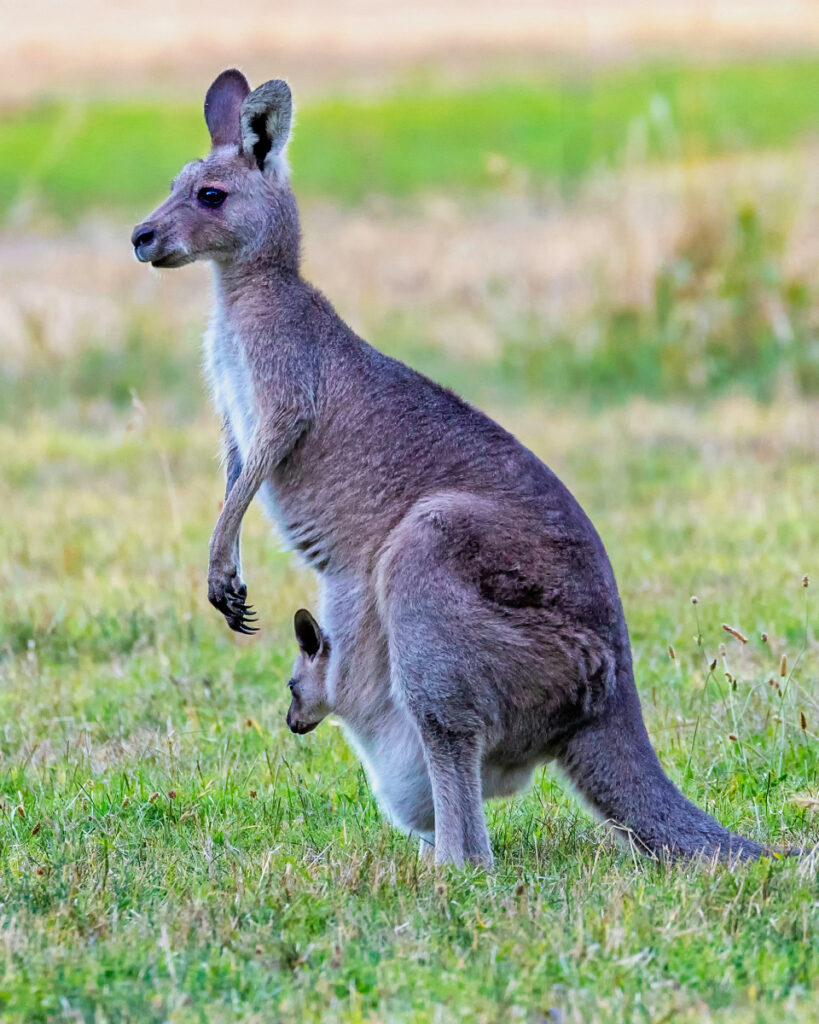
Photo by John Torcasio
Kangaroos are large marsupial herbivores adapted for long-distance movement, grazing, and complex social organisation. They rely on powerful hind limbs for locomotion, strong tails for balance, and acute sensory awareness to detect threats across open landscapes.
Kangaroos live in fluid social groups, communicate through posture and movement, and regulate stress through freedom of movement and spatial awareness. Females carry developing young (joeys) in pouches for extended periods, with prolonged dependency after birth.
These characteristics establish kangaroos as individual animals with specific behavioural, reproductive, and environmental needs that are systematically overridden within exploitation systems.
Natural versus exploited lifespan
Natural lifespan
In the absence of exploitation, kangaroos commonly live approximately 15–25 years, depending on species and environmental conditions.
Lifespan under exploitation
Within exploitation systems, kangaroos are frequently killed far earlier:
- Commercial meat and skin harvesting: commonly within 2–8 years
- Population control programs: killed at any age
- Joeys dependent on killed adults: killed immediately or left to die
The divergence between natural lifespan and exploited lifespan is driven by market demand, population quotas, and administrative classification rather than biological longevity.
Systems of exploitation
Kangaroos are exploited across multiple, overlapping systems:
- Commercial meat production
Kangaroos are killed and processed for human consumption, both domestically and for export. - Pet food and animal feed
Kangaroo bodies are processed into pet food and rendered products. - Skin and leather production
Kangaroo skins are used to produce leather for footwear, sports equipment, and industrial goods. - Population control and wildlife management
Kangaroos are killed under state-authorised culling programs framed as population management or environmental control. - Recreational and commercial shooting
Licensed shooters kill kangaroos under quota-based systems supplying commercial markets. - Byproducts and secondary processing
Kangaroo bodies are rendered into fats, proteins, fertilisers, and industrial inputs.
These systems operate independently yet rely on shared infrastructures of authorisation, killing, transport, and processing.
Living conditions across system types
Wild populations under exploitation
Unlike farmed animals, kangaroos are typically exploited while free-living. However, exploitation systems exert control through quotas, designated killing zones, night-time shooting, and carcass collection.
Kangaroos are pursued, targeted, and killed within their natural habitats, disrupting social structures and group stability.
Holding and processing contexts
Following shooting, carcasses are transported to field chillers or processing facilities. Injured or non-fatally shot animals may escape and die later from untreated wounds.
Across systems, conditions prioritise extraction efficiency and quota fulfilment over individual survival or welfare.
Standardised lifecycle under exploitation
While pathways vary, kangaroos typically move through a broadly standardised exploitation lifecycle:
- Free-living existence
Kangaroos live in the wild until targeted for killing. - Selection and shooting
Individuals are selected based on size, accessibility, and quota requirements rather than age or health. - Immediate or delayed death
Some kangaroos die instantly; others are wounded and die later from blood loss, infection, or predation. - Secondary killing of dependents
Joeys dependent on killed females are killed manually or abandoned, resulting in death from exposure or starvation. - Processing and disposal
Bodies are processed into meat, skins, and secondary products.
Chemical and medical interventions
Kangaroos are not subjected to routine medical care within exploitation systems. Instead, they are exposed to:
- Ballistic trauma from firearm use
- Stress responses induced by pursuit and shooting
- Untreated injuries resulting from non-fatal shots
Unlike farmed animals, chemical interventions are absent, replaced by lethal force as the primary management tool.
Slaughter processes
Kangaroos are typically killed through gunshot, most commonly at night. Killing practices include:
- Head shots intended to cause immediate death
- Body shots resulting in prolonged suffering when accuracy fails
- Follow-up killing of wounded animals when located
There is no pre-slaughter stunning or restraint. Death may be instantaneous or prolonged, depending on shot placement and circumstances.
The killing of dependent joeys involves blunt force trauma, decapitation, or abandonment, depending on age and context.
Slaughterhouse labour impact
Kangaroo exploitation relies on labour exposed to:
- Repetitive killing of free-living animals
- Handling carcasses in remote, night-time conditions
- Psychological stress associated with killing animals in visible family structures
Processing workers handle carcasses at scale under cold, repetitive conditions.
Scale and prevalence
Kangaroos are exploited almost exclusively within specific regions but at very large scale. Millions of kangaroos are killed annually across meat, leather, and population control systems.
Additionally, large numbers of dependent joeys die as a direct but often uncounted consequence of adult killings.
Ecological impact
Kangaroo exploitation contributes to ecological harm, including:
- Disruption of social group structures
- Alteration of population dynamics through selective killing
- Secondary ecological effects linked to carcass removal and population suppression
These impacts arise from the sustained, large-scale killing of free-living animals.
Language and abstraction
Kangaroos are routinely described using administrative and economic terms such as “harvest,” “quota,” “resource,” or “population management.” Such language reframes killing as a neutral management activity.
The classification of kangaroos as wildlife rather than farmed animals obscures the industrial scale and routine nature of their exploitation.
Editorial correction notice
Kangaroos are often excluded from exploitation records due to their classification as wildlife or national symbols. This record documents kangaroos as animals systematically exploited across meat, leather, pet food, and population control systems, independent of symbolic status or regulatory framing.