
Scope
This record documents how horses are exploited within globally standard animal-use systems. It describes dominant, routine practices across industrial, commercial, sporting, and administrative contexts, independent of country-specific regulation, cultural framing, or symbolic status.
Differences in scale, enforcement, and legal framing are documented in country records. System-specific mechanisms are documented within industry records.
Species context
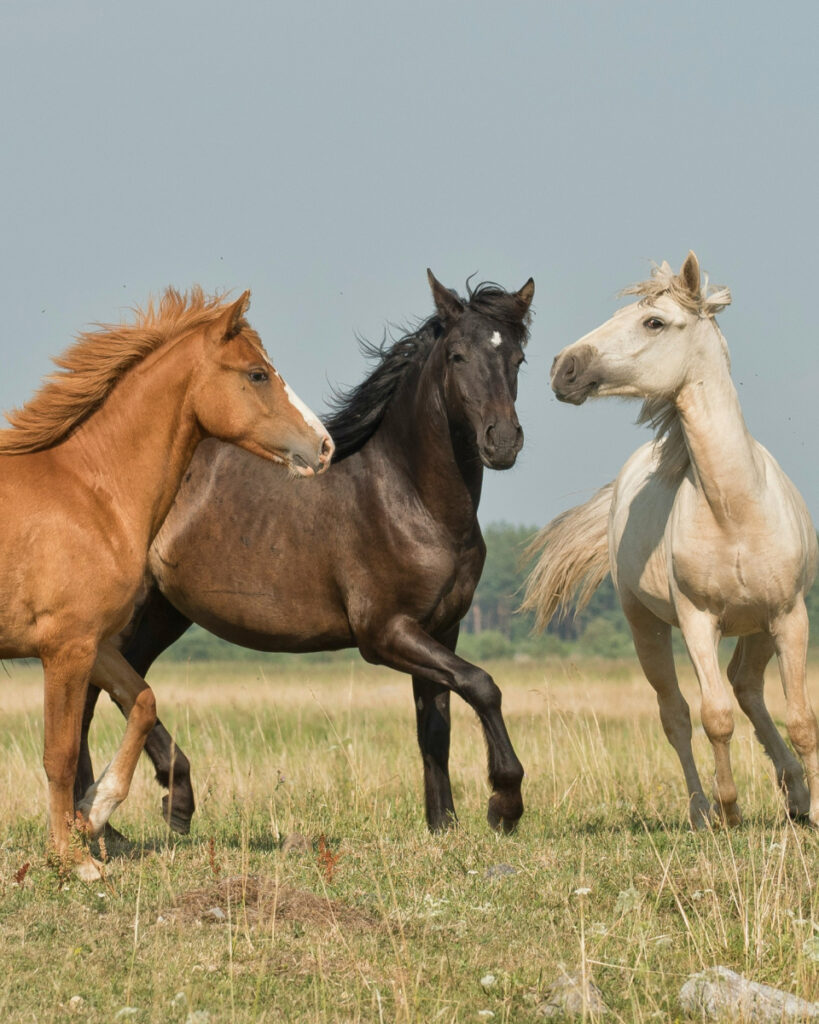
Photo by Annika Treial
Horses are large, social, prey mammals adapted for sustained movement, grazing, and complex social interaction. They form long-term social bonds, communicate through body posture, vocalisation, and subtle behavioural cues, and rely on continuous movement and environmental awareness for physical and psychological regulation.
Under natural conditions, horses spend most of their time moving across open landscapes, grazing for many hours per day, maintaining social hierarchies, and avoiding perceived threats through flight rather than confrontation. They are highly sensitive to confinement, isolation, pain, and stress.
These characteristics establish horses as individual animals with extensive behavioural, social, and environmental needs that are systematically overridden within exploitation systems.
Natural versus exploited lifespan
Natural lifespan
In the absence of exploitation, horses commonly live approximately 25–30 years, with some individuals living beyond 35 years under stable conditions.
Lifespan under exploitation
Within exploitation systems, horses are frequently killed far earlier:
- Racing and sport industries: often killed or discarded within 2–8 years
- Meat production systems: commonly killed between 1–10 years
- Breeding systems: breeding animals killed once fertility or profitability declines
- Work and transport systems: killed following injury, exhaustion, or reduced utility
The divergence between natural lifespan and exploited lifespan is driven by economic performance, injury rates, and disposability rather than biological longevity.
Systems of exploitation
Horses are exploited across multiple, overlapping systems:
- Meat production
Horses are bred, captured, transported, and killed for human consumption and export markets. - Racing and competitive sport
Horses are bred, trained, medicated, raced, and discarded within high-intensity competitive industries. - Breeding and genetics
Selective breeding prioritises speed, size, aesthetics, or temperament, often at the expense of long-term health. - Labour and work
Horses are used for transport, agriculture, tourism, policing, and ceremonial functions. - Entertainment and display
Horses are exploited in shows, performances, film production, and exhibitions. - Research and biomedical use
Horses are used in medical research, pharmaceutical production, and biological extraction. - Byproducts and secondary processing
Horse bodies are processed into meat, leather, glue, pharmaceuticals, and industrial inputs following killing. - Population control and disposal
Surplus, injured, or unwanted horses are killed through culling, slaughter, or abandonment.
These systems operate independently yet rely on shared infrastructures of breeding, confinement, transport, and killing.
Living conditions across system types
Racing and sport
In racing and sport industries, horses are commonly confined to stalls for extended periods, subjected to intensive training schedules, and restricted in social contact and movement. Training prioritises performance output over skeletal maturity, contributing to injury and breakdown.
Meat and holding systems
In meat production systems, horses are often held in feedlots, holding pens, or auction facilities prior to transport and slaughter. Conditions involve crowding, unfamiliar groupings, limited movement, and high stress.
Work and tourism contexts
Working horses may be subjected to prolonged labour, inadequate rest, heavy loads, and exposure to harsh environmental conditions.
Across systems, confinement and management practices prioritise control, predictability, and productivity over species-specific needs.
Standardised lifecycle under exploitation
While specific pathways vary, horses typically move through a broadly standardised lifecycle:
- Breeding or capture
Horses are bred through controlled programs or captured from free-roaming populations. - Early handling and training
Foals are handled early, separated from mothers, and conditioned for compliance. - Utilisation phase
Horses are exploited for racing, labour, breeding, entertainment, research, or meat. - Injury, decline, or reduced profitability
Once performance declines, injury occurs, or costs exceed returns, horses are sold, transferred, or disposed of. - Killing or abandonment
Horses are killed through slaughter, euthanasia, or left to die through neglect.
Chemical and medical interventions
To sustain exploitation at scale, horses are routinely subjected to chemical and medical interventions, including:
- Painkillers and anti-inflammatory drugs to mask injury
- Performance-enhancing substances and stimulants
- Hormonal manipulation for breeding control
- Antibiotics and medications to manage confinement-related illness
These interventions function as systemic inputs rather than exceptional measures.
Slaughter processes
Horse slaughter commonly involves long-distance transport to slaughter facilities, often crossing national borders. Transport conditions include crowding, deprivation of food and water, injury during loading, and prolonged stress.
Slaughter methods typically involve:
- Captive bolt or firearm stunning with inconsistent effectiveness
- Throat-cutting following stunning
- Processing within high-throughput slaughter lines
Failures in stunning result in horses regaining consciousness during bleeding or processing. In some contexts, horses are killed using methods prioritising speed and cost rather than reliability of unconsciousness.
Slaughterhouse labour impact
Horse slaughter and processing rely on labour exposed to:
- Handling large, distressed animals
- High physical injury risk
- Psychological stress associated with killing socially recognisable animals
Labour protections vary widely, particularly in export-oriented or low-regulation contexts.
Scale and prevalence
Horses are exploited globally across meat, sport, labour, research, and entertainment systems. Millions of horses are killed annually, with additional millions cycled through racing, breeding, and work industries with high turnover and injury rates.
Their exploitation persists despite cultural narratives framing horses as companions or symbols rather than commodities.
Ecological impact
Horse exploitation contributes to ecological harm, including:
- Land and water use associated with breeding and feeding
- Waste generation and local environmental degradation
- Resource intensity linked to transport, infrastructure, and processing
These impacts arise from maintaining large horse populations within extractive and performance-driven systems.
Language and abstraction
Horses are frequently referred to using functional or euphemistic terms such as “stock,” “assets,” “athletes,” or “units.” Injury and death are reframed as “retirement,” “breakdown,” or “management decisions.”
Cultural reverence for horses often coexists with industrial exploitation, obscuring systemic harm behind symbolism and tradition.
Editorial correction notice
Horses are often excluded from exploitation records due to their cultural status and emotional visibility. This record documents horses as animals systematically exploited across meat, sport, labour, breeding, research, and disposal systems, independent of symbolism, tradition, or social attachment.