
Scope
This record documents how guinea pigs are exploited within globally standard animal-use systems. It describes dominant, routine practices across biomedical research, breeding industries, laboratory testing, meat production, feeder animal supply chains, education, and pet trade contexts, independent of country-specific regulation or cultural framing narratives.
Differences in scale, enforcement, and legal classification are documented in country records. System-specific mechanisms are documented within industry records.
Species context
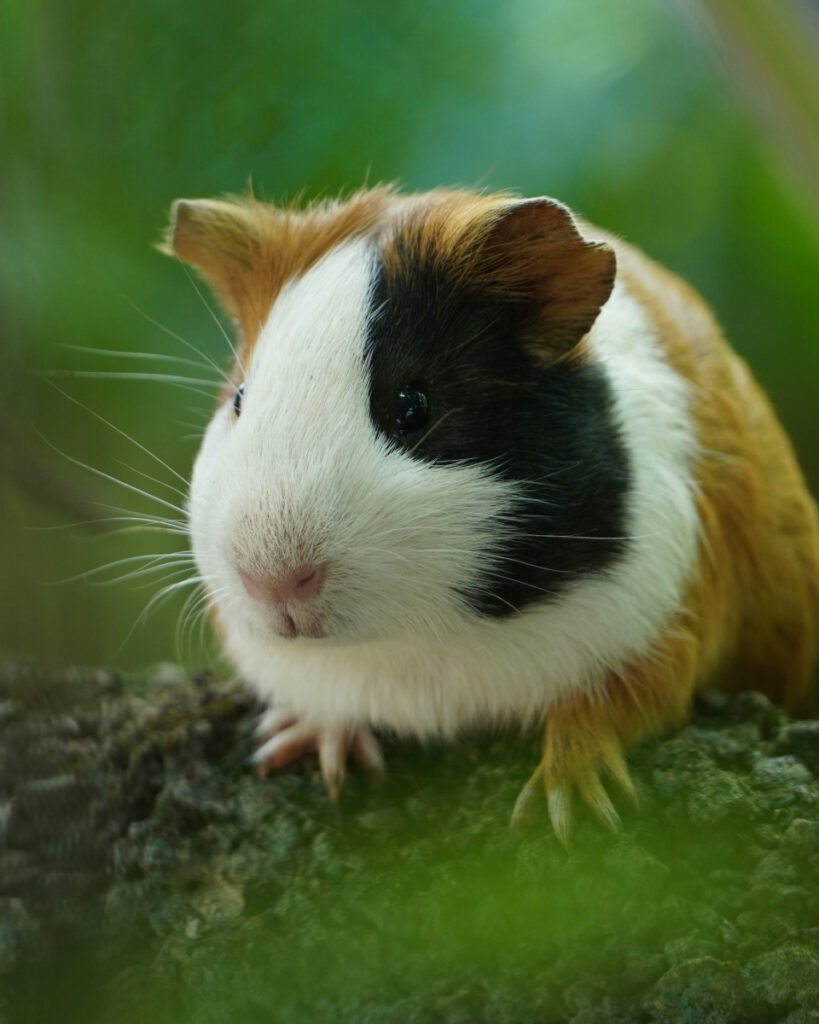
Photo by Amjith S
Guinea pigs (Cavia porcellus), also known as cavies, are small herbivorous mammals native to South America and domesticated thousands of years ago from wild cavy species. They are social animals that naturally live in groups and rely on vocal communication, scent marking, and body language to coordinate behaviour.
Guinea pigs exhibit complex social interactions, including grooming, play, and group hierarchy formation. They require space for movement, nesting, and exploration. They are highly sensitive to environmental changes and display stress responses when isolated, restrained, or exposed to unfamiliar conditions.
Under natural conditions, guinea pigs live in structured social groups, forage continuously, and use sheltered areas for protection and nesting.
These characteristics establish guinea pigs as social mammals with behavioural and environmental needs that are systematically constrained within exploitation systems.
Natural versus exploited lifespan
Natural lifespan
In the absence of exploitation, guinea pigs typically live 5–7 years, with some individuals living longer under stable conditions.
Lifespan under exploitation
Within exploitation systems, guinea pigs frequently die far earlier:
- Biomedical research: commonly killed after weeks or months of experimentation
- Meat production systems: slaughtered between several weeks and a few months of age
- Feeder animal production: killed as juveniles to feed captive predators
- Laboratory breeding colonies: culled if not required for experiments
The divergence between natural lifespan and exploited lifespan is determined by experimental protocols, food production cycles, or market demand rather than biological longevity.
Systems of exploitation
Guinea pigs are exploited across multiple, overlapping systems:
- Biomedical and pharmaceutical research
Guinea pigs are used in experiments involving immunology, infectious diseases, toxicology, and vaccine development. - Chemical and cosmetic testing
Guinea pigs are exposed to substances to evaluate allergic reactions, toxicity, and physiological responses. - Selective breeding and laboratory supply
Breeding colonies produce animals for research laboratories and testing facilities. - Education and training
Guinea pigs may be used in teaching laboratories for demonstrations, dissection, and physiology experiments. - Meat production
Guinea pigs are raised and slaughtered for human consumption in certain regions. - Feeder animal production
Guinea pigs are bred and killed to feed captive reptiles, birds of prey, and carnivorous animals. - Pet trade and hobby breeding
Guinea pigs are bred and sold as companion animals.
These systems rely on controlled breeding, laboratory housing infrastructure, transport logistics, and slaughter or euthanasia processes.
Living conditions across system types
Laboratory housing systems
Guinea pigs used in research are typically housed in cages or plastic tubs within controlled facilities. Housing may involve individual or group cages depending on experimental requirements.
Cages usually contain bedding and limited environmental enrichment. Movement and exploration are restricted compared to natural territory use.
Lighting, temperature, and humidity are tightly controlled. Animals are regularly handled for monitoring, experimentation, and cage maintenance.
Breeding facilities
Breeding colonies maintain large populations of guinea pigs to supply research laboratories. Breeding animals produce repeated litters, and pups are separated for experimental use or sale.
Animals not required for experiments may be culled.
Meat production systems
In regions where guinea pigs are raised for food, animals may be kept in enclosed pens or small-scale household systems. High-density housing is common, and breeding cycles are optimised to produce rapid population growth.
Guinea pigs are slaughtered at relatively young ages once they reach target body weight.
Feeder animal production
Guinea pigs bred as feeder animals may be raised in high-density housing systems where growth rate and reproduction are prioritised.
Animals are killed to feed captive carnivorous animals.
Across systems, natural behaviours such as extensive exploration and complex social interaction are restricted.
Standardised lifecycle under exploitation
While practices vary, guinea pigs in breeding and research systems typically move through a broadly standardised lifecycle:
- Breeding and genetic selection
Animals are paired to produce specific traits or maintain breeding populations. - Birth and early development
Pups are born in cage environments and remain with mothers briefly. - Categorisation for use
Animals are assigned to research experiments, meat production, feeder markets, or pet trade distribution. - Experimental procedures or growth phase
Guinea pigs may undergo testing procedures or be raised for slaughter. - Monitoring and evaluation
Health and growth are monitored depending on system requirements. - Killing or euthanasia
Animals are killed after experiments, slaughtered for meat, or culled if surplus.
Chemical and medical interventions
Guinea pigs in research systems may be subjected to:
- Experimental drug administration
- Exposure to pathogens or disease models
- Skin sensitisation testing for allergic reactions
- Surgical procedures or implantation of devices
- Chemical toxicity testing
Pain management practices vary depending on experimental design and regulatory oversight.
Slaughter and killing processes
Guinea pigs are killed through different methods depending on the system:
Research and laboratory contexts
- Carbon dioxide exposure
- Anaesthetic overdose
- Cervical dislocation
Meat production
- Blunt force trauma
- Throat cutting
- Decapitation
Feeder animal production
- Cervical dislocation
- Direct feeding to predators
Effectiveness and speed of killing methods vary depending on operator skill and facility conditions.
Labour impact
Guinea pig breeding, research, and meat production involve labour associated with:
- Colony management and breeding oversight
- Experimental procedures and monitoring
- Cage cleaning and animal handling
- Slaughter or euthanasia processes
Workers may experience repetitive strain injuries, allergen exposure, and psychological strain associated with high-volume animal handling and killing.
Scale and prevalence
Guinea pigs are widely used in laboratory research worldwide and remain common in toxicology and immunology studies.
Large numbers are also raised for meat in certain regions and bred as feeder animals or pets.
Continuous breeding cycles sustain large populations within research and commercial systems.
Ecological impact
Guinea pig exploitation contributes to ecological impacts, including:
- Resource use in maintaining breeding colonies
- Waste production from laboratory and farming operations
- Environmental contamination from experimental waste and carcass disposal
In regions where guinea pigs are farmed for meat, concentrated populations may contribute to local waste and resource pressures.
Language and abstraction
Guinea pigs are frequently described using terms such as “test animals,” “laboratory subjects,” or “model organisms,” emphasising experimental function rather than the animals themselves.
In food contexts, guinea pigs may be framed as traditional cuisine, masking the breeding and slaughter systems involved.
Pet trade marketing frames guinea pigs as companion animals while often omitting the broader breeding and feeder supply chains.
Editorial correction notice
Guinea pigs are commonly portrayed as laboratory tools, traditional food animals, or companion pets. This record documents guinea pigs as social mammals systematically bred, confined, experimented upon, slaughtered, and killed within integrated research, food production, feeder animal, and commercial systems, independent of scientific, cultural, or pet industry framing.