
Scope
This record documents how goats are exploited within globally standard animal-use systems. It describes dominant, routine practices across meat, dairy, fibre, skin, research, and land-management contexts, independent of country-specific regulation or cultural framing.
Differences in scale, enforcement, and legal framing are documented in country records. System-specific mechanisms are documented within industry records.
Species context
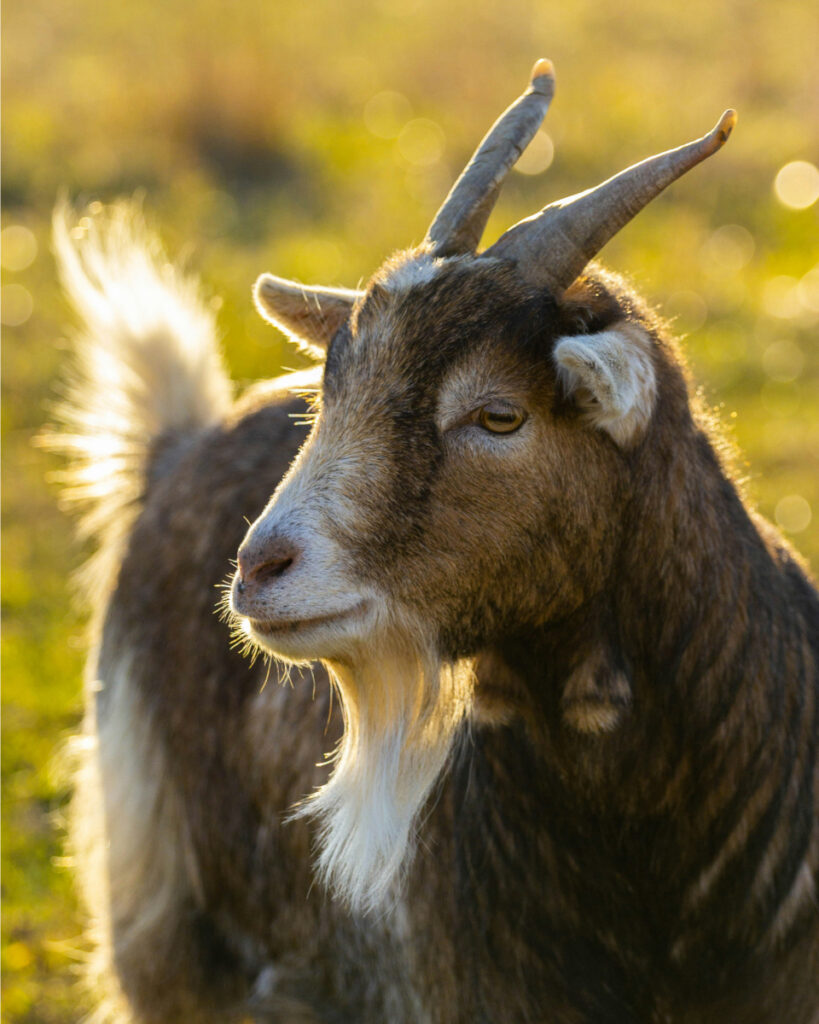
Photo by Maxime Agnelli
Goats (Capra hircus) are social, browsing ruminants adapted to varied terrains, including mountains, grasslands, and arid environments. They are agile climbers with strong spatial awareness and exploratory behaviour. Goats form social hierarchies, maintain group bonds, and communicate through vocalisations, scent marking, posture, and physical interaction.
Under natural conditions, goats spend much of their time moving across diverse landscapes, browsing on shrubs and vegetation, engaging in social grooming, play, and maternal care. Kids remain closely bonded to their mothers during early development.
These characteristics establish goats as mobile, socially complex animals with environmental and relational needs that are systematically constrained within exploitation systems.
Natural versus exploited lifespan
Natural lifespan
In the absence of exploitation, goats commonly live 12–18 years, with some individuals living longer under stable conditions.
Lifespan under exploitation
Within exploitation systems, goats are typically killed far earlier:
- Meat production systems: commonly within 3–12 months
- Dairy systems: killed once milk yield declines, often within 4–7 years
- Fibre systems (e.g., cashmere, mohair): killed when productivity decreases
- Male offspring in dairy systems: often killed shortly after birth or within months
The divergence between natural lifespan and exploited lifespan is determined by productivity targets and market demand rather than biological longevity.
Systems of exploitation
Goats are exploited across multiple, overlapping systems:
- Meat production
Goats are bred, raised, and killed for meat in industrial, semi-industrial, and small-scale systems. - Dairy production
Female goats are bred and milked for cheese, milk, yoghurt, and powdered products. - Fibre production
Goats are exploited for cashmere and mohair, requiring regular shearing and selective breeding for fibre traits. - Skin and leather production
Goat skins are processed into leather goods and industrial materials. - Land management and vegetation control
Goats are used in targeted grazing programs to clear vegetation. - Research and biomedical use
Goats are used in agricultural research, genetic modification, and pharmaceutical production. - Byproducts and rendering
Goat bodies are processed into fats, proteins, and secondary products following slaughter.
These systems operate independently yet rely on shared infrastructures of breeding, confinement, transport, and killing.
Fibre production (cashmere and mohair systems)
Certain goat populations are selectively bred for fibre traits rather than meat or milk. Cashmere is produced from the soft undercoat of specific goats, while mohair is produced from Angora goats. Both systems prioritise fibre yield, fineness, and growth rate.
Selective breeding for high fibre output alters coat density and thermal regulation. In harsh climates, particularly in cashmere-producing regions, goats bred for excessive undercoat growth may experience increased vulnerability when shorn prematurely or under extreme weather conditions.
Fibre harvesting typically occurs annually and involves:
- Physical restraint for shearing or combing
- Mechanical or manual removal of coat
- Handling at scale within flock systems
In large operations, speed and output take priority over careful handling. Injuries during shearing and restraint are common in high-throughput systems.
Goats remain confined within managed grazing systems or fenced rangelands. Reproductive cycles are controlled to maintain herd size and fibre yield. Once fibre quality or quantity declines, goats are routinely sold into meat supply chains and killed.
Fibre systems therefore operate as integrated extraction models: animals are used for coat production and ultimately slaughtered when productivity decreases.
Living conditions across system types
Industrial meat and dairy systems
In industrial contexts, goats are housed in barns, feedlots, or fenced enclosures at moderate to high densities. Movement is restricted compared to natural roaming behaviour. Flooring may cause joint stress and hoof problems.
Dairy goats are subjected to repeated reproductive cycles and mechanical milking. Kids are commonly separated from mothers shortly after birth to divert milk for commercial use.
Fibre production systems
Cashmere and mohair goats are often kept in large flocks in semi-arid regions. Shearing may involve physical restraint. Selective breeding prioritises fibre yield, sometimes at the expense of health and climate tolerance.
Extensive and small-scale systems
Even in pasture-based systems, goats remain subject to controlled breeding, ownership, confinement within fencing, and eventual slaughter.
Across systems, management prioritises output, fibre quality, or land utility over autonomy and social stability.
Standardised lifecycle under exploitation
While practices vary, goats typically move through a broadly standardised lifecycle:
- Controlled breeding
Does are bred intentionally, often through managed mating schedules. - Birth and early separation
Kids may be removed from mothers shortly after birth in dairy systems. - Growth and utilisation phase
Goats are raised for meat, milk, fibre, or grazing services. - Decline in productivity
Once milk yield, fibre quality, or growth rate declines, goats are sold or sent to slaughter. - Slaughter and processing
Goats are transported and killed once reaching target weight or after productive decline.
Male kids in dairy systems may be killed early due to lack of economic value.
Chemical and medical interventions
To sustain productivity, goats are subjected to systemic interventions, including:
- Hormonal treatments to regulate breeding cycles
- Antibiotics to manage infections associated with confinement
- Antiparasitic treatments
- Vaccinations and feed additives
High-density housing increases disease transmission risk, requiring routine pharmaceutical management.
Slaughter processes
Goat slaughter methods vary by region and system. Common practices include:
- Electrical stunning followed by throat cutting
- Throat cutting without effective stunning
- Captive bolt stunning
- Halal and other ritual slaughter practices
Transport to slaughter facilities often involves crowding, dehydration, and stress. Stunning effectiveness is inconsistent in some contexts, resulting in prolonged consciousness during bleeding.
In small-scale or informal settings, slaughter may occur without mechanised stunning equipment.
Slaughterhouse labour impact
Goat slaughter and processing involve repetitive killing, skinning, and evisceration tasks. Workers are exposed to:
- Physical strain and injury risk
- Handling distressed animals
- Psychological stress associated with routine killing
Labour protections vary widely across industrial and informal sectors.
Scale and prevalence
Goats are exploited globally across diverse climatic and economic regions. Hundreds of millions of goats are killed annually for meat. Dairy and fibre industries affect additional millions.
Goat exploitation is embedded in subsistence farming, export-oriented meat markets, luxury fibre supply chains, and agricultural land management programs.
Ecological impact
Goat exploitation contributes to ecological harm, including:
- Land degradation and overgrazing in high-density grazing systems
- Water use associated with dairy production
- Waste accumulation and methane emissions
- Resource use for feed production in intensive systems
Large-scale grazing can alter vegetation patterns and contribute to soil erosion.
Language and abstraction
Goats are frequently described using terms such as “livestock,” “head count,” “production units,” or “fibre yield.” Dairy language reframes reproductive exploitation as “milking cycles” and “replacement stock.”
Fibre marketing emphasises softness and luxury while omitting the breeding and slaughter systems underlying production.
Editorial correction notice
Goats are often framed as resilient or low-impact livestock. This record documents goats as individual animals systematically bred, confined, milked, shorn, transported, and killed across meat, dairy, fibre, and land-management systems, independent of cultural familiarity or perceived sustainability.