
Scope
This record documents how civets are exploited within globally standard animal-use systems. It describes dominant, routine practices across coffee production, wildlife trade, meat consumption, fur use, and captivity-based display contexts, independent of country-specific regulation or luxury branding narratives.
Differences in scale, enforcement, and legal framing are documented in country records. System-specific mechanisms are documented within industry records.
Species context
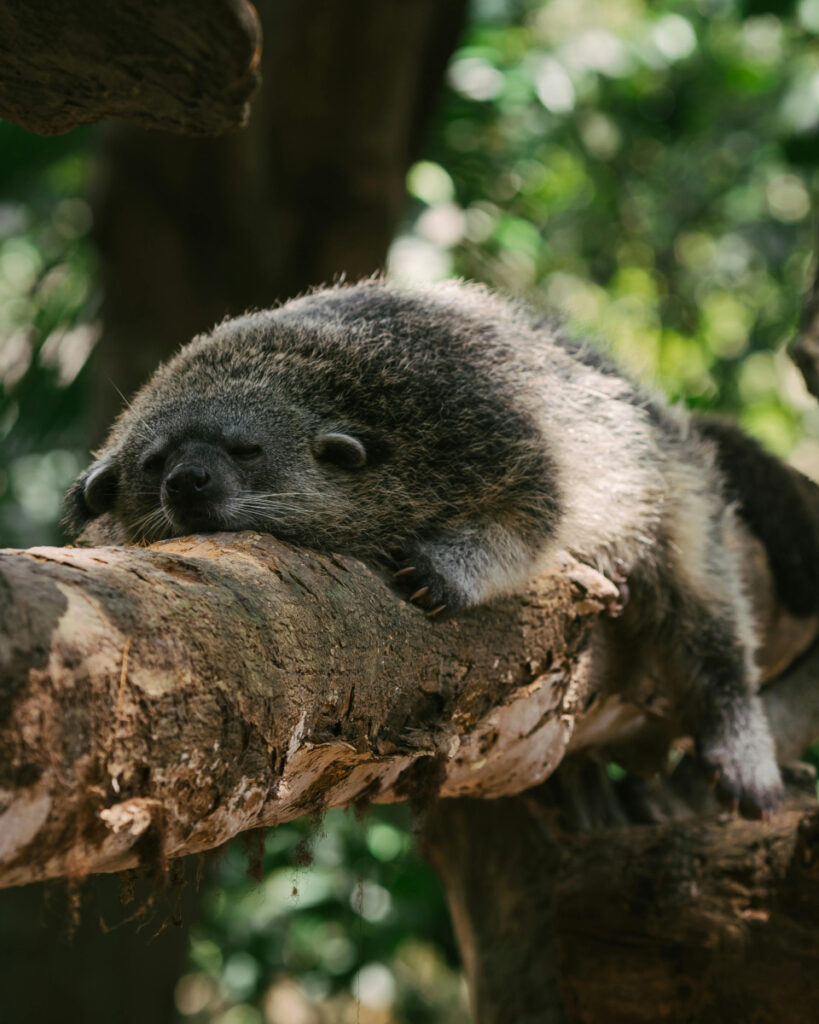
Photo by Mikhail Nilov
“Civet” refers to several small carnivorous mammals within the family Viverridae, including species such as the Asian palm civet (Paradoxurus hermaphroditus), African civet (Civettictis civetta), and related species.
Civets are primarily nocturnal, solitary animals with strong territorial behaviour. They rely on acute olfactory senses, climbing ability, and access to forested or dense habitats. In natural conditions, civets forage independently across large territories, feeding on fruits, insects, and small animals.
They avoid sustained close proximity to other adults except during mating. Confinement, crowding, and constant exposure to humans disrupt species-typical behaviour and induce chronic stress responses.
These characteristics establish civets as solitary, territory-dependent animals whose behavioural and ecological needs are systematically overridden within exploitation systems.
Natural versus exploited lifespan
Natural lifespan
In the absence of exploitation, civets commonly live 15–20 years depending on species and environmental conditions.
Lifespan under exploitation
Within exploitation systems, civets frequently die far earlier:
- Coffee production systems: often survive only a few years in confinement before death from stress, malnutrition, or disease
- Wildlife trade and display contexts: mortality may occur during capture, transport, or shortly after confinement
- Meat and fur systems: killed at any age once captured
The divergence between natural lifespan and exploited lifespan is driven by extraction efficiency, market demand, and captivity-related mortality rather than biological longevity.
Systems of exploitation
Civets are exploited across multiple, overlapping systems:
- Civet coffee production (kopi luwak and similar products)
Civets are confined and fed coffee cherries to produce excreted beans marketed as luxury coffee. - Wild capture and wildlife trade
Civets are captured from forests for sale into coffee production, pet trade, or display facilities. - Meat consumption
Civets are hunted or farmed for human consumption in some regions. - Fur and scent extraction
Civets have historically been exploited for fur and for civet musk used in perfumery. - Tourism and display
Civets are kept in enclosures for viewing, photography, and promotional use linked to coffee branding.
These systems rely on trapping, cage confinement, forced feeding, transport logistics, and marketing networks centred on rarity and novelty.
Living conditions across system types
Coffee production systems
In many commercial civet coffee operations, civets are held in small wire or wooden cages, often in rows. Animals are frequently confined individually or in unnatural proximity to others.
Diet is restricted primarily to coffee cherries to increase production yield, replacing natural dietary diversity. This forced feeding disrupts nutritional balance and digestion.
Cages limit climbing, foraging, and territorial behaviour. Lack of environmental enrichment and continuous human disturbance contribute to stereotypic behaviours and visible stress indicators.
Wildlife trade and display contexts
Captured civets may be transported long distances in cramped containers. Mortality during capture and transit is common.
Display facilities often maintain civets in small enclosures exposed to daylight and constant human presence, disrupting nocturnal cycles.
Meat and fur contexts
Civets hunted or farmed for meat may be trapped or confined prior to slaughter. Fur and musk extraction systems historically involved capture and killing, though commercial perfume use has largely shifted to synthetic alternatives.
Across systems, captivity overrides solitary territorial behaviour and natural habitat access.
Standardised lifecycle under exploitation
While pathways vary, civets typically move through a broadly standardised exploitation cycle:
- Capture from wild populations
Civets are trapped using cages or snares. - Transport to holding or production facilities
Animals are moved to coffee farms, wildlife markets, or display sites. - Confinement and forced feeding (coffee systems)
Civets are fed coffee cherries to produce excreted beans. - Decline in health or productivity
Chronic stress, malnutrition, and disease reduce lifespan. - Killing or replacement
Civets are killed, die prematurely, or are replaced with newly captured individuals.
In coffee production systems, wild capture continues to replenish captive populations due to high mortality and low captive breeding rates.
Chemical and medical interventions
In confined systems, civets may receive:
- Antibiotics to manage infection
- Anti-parasitic treatments
- Sedatives during handling or transport
However, veterinary care is often minimal or inconsistent, particularly in informal or unregulated operations.
Disease transmission risk increases in high-density or poorly sanitised conditions.
Slaughter processes
Civets exploited for meat or fur are typically killed through:
- Blunt force trauma
- Throat cutting
- Shooting
- Trapping-related injury leading to death
In coffee production systems, death may result indirectly from prolonged stress, malnutrition, or untreated illness rather than formal slaughter.
Killing methods vary widely depending on local infrastructure and regulation.
Slaughterhouse and labour impact
Civet exploitation involves:
- Handling of stressed wild animals
- Risk of bites and scratches
- Exposure to zoonotic disease
Processing labour may occur in informal or minimally regulated contexts.
Scale and prevalence
Civet exploitation is geographically concentrated but globally marketed, particularly through luxury coffee supply chains.
Tens of thousands of civets are estimated to be held in captivity for coffee production, with additional individuals captured or killed in hunting and trade systems.
While smaller in scale than major livestock industries, civet exploitation is driven by high per-unit market value.
Ecological impact
Civet exploitation contributes to ecological disruption, including:
- Depletion of wild populations through trapping
- Disruption of seed dispersal roles in forest ecosystems
- Incentivised capture of wildlife for luxury markets
- Habitat disturbance associated with wildlife trade networks
Sustained removal of civets from forest ecosystems alters local ecological balance.
Language and abstraction
Civet exploitation is commonly framed through luxury branding narratives such as “rare,” “wild-sourced,” or “natural fermentation.” Marketing emphasises novelty and exclusivity while omitting confinement conditions and mortality rates.
Terms such as “production civets” or “coffee processing” obscure the role of forced feeding and captivity.
Editorial correction notice
Civets are frequently portrayed as incidental participants in specialty coffee production. This record documents civets as solitary wild animals systematically captured, confined, force-fed, transported, and killed within luxury commodity systems, independent of branding narratives or perceived rarity.