
Scope
This record documents how chickens are exploited within globally standard animal-use systems. It describes dominant, routine practices across meat production, egg production, breeding and genetics industries, hatchery systems, biomedical and agricultural research, live animal trade, backyard and small-scale farming, cockfighting, and byproduct processing industries, independent of country-specific regulation or marketing narratives.
Differences in scale, enforcement, and legal classification are documented in country records. System-specific mechanisms are documented within industry records.
Species context
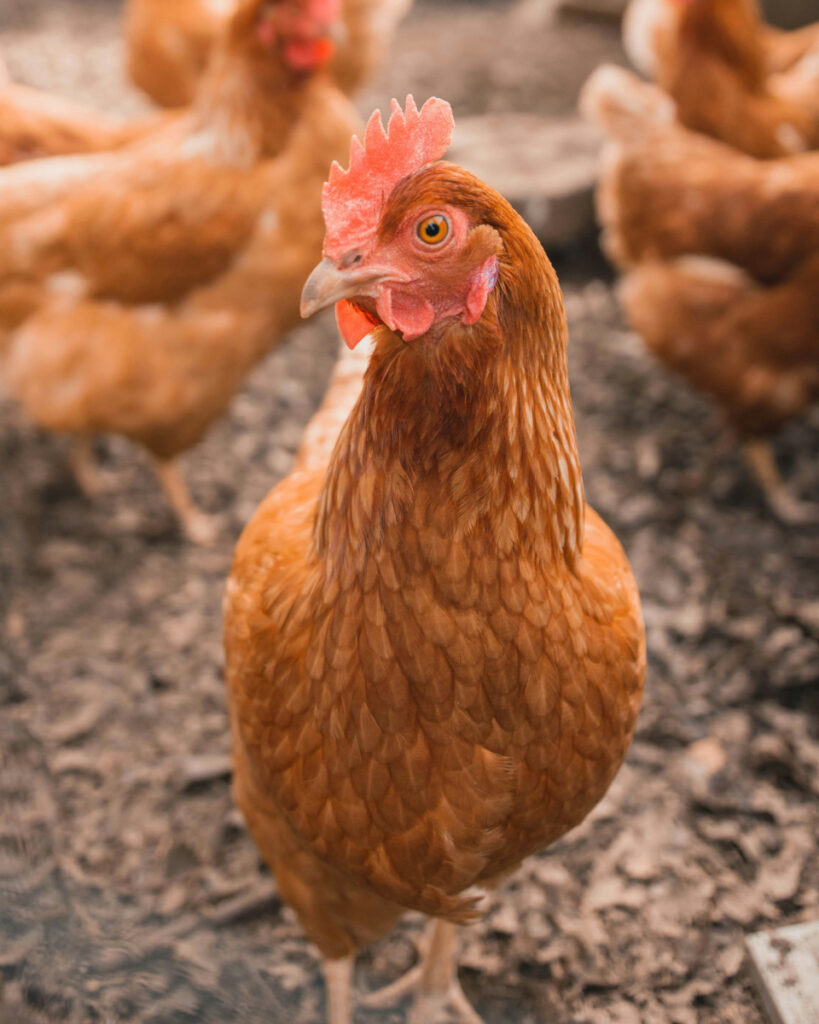
Photo by Ben Moreland
Domestic chickens (Gallus gallus domesticus) are descendants of the red junglefowl (Gallus gallus) native to Southeast Asia. Chickens are social birds that form complex social hierarchies known as pecking orders and communicate through vocalisations, visual displays, and body language.
Chickens demonstrate learning ability, memory, problem-solving behaviour, and maternal care. They recognise individual flock members, maintain social bonds, and respond to environmental changes and threats.
Under natural conditions, chickens spend significant time foraging, scratching in soil, dust bathing, perching, nesting, and maintaining social relationships within small groups.
These characteristics establish chickens as socially complex birds with behavioural and environmental needs that are systematically constrained within industrial exploitation systems.
Natural versus exploited lifespan
Natural lifespan
In the absence of exploitation, chickens commonly live 5–10 years depending on environmental conditions and predation risks.
Lifespan under exploitation
Within commercial production systems, chickens are typically killed far earlier:
- Broiler (meat) chickens: slaughtered at approximately 5–7 weeks of age
- Layer hens (egg production): killed around 18–24 months once egg productivity declines
- Breeding chickens: killed once reproductive output decreases
- Male chicks in egg systems: killed shortly after hatching
The divergence between natural lifespan and exploited lifespan is determined by production efficiency rather than biological longevity.
Systems of exploitation
Chickens are exploited across multiple, overlapping systems:
- Meat production (broiler systems)
Chickens are bred, raised, and slaughtered for poultry meat. - Egg production (layer systems)
Chickens are kept for egg production and killed when egg-laying declines. - Breeding and genetics industries
Selective breeding programs produce chicken strains optimised for rapid growth or egg production. - Hatchery systems
Large-scale hatcheries produce chicks for both meat and egg industries. - Live animal trade
Chickens are transported and sold in markets or through agricultural supply chains. - Biomedical and agricultural research
Chickens are used in studies related to disease, genetics, nutrition, and vaccine development. - Cockfighting and entertainment
Chickens may be bred and used in organised fighting events. - Byproduct industries
Chicken bodies and parts are processed into feathers, rendered fats, gelatin, pet food ingredients, and industrial materials.
These systems rely on hatcheries, intensive farming facilities, transport networks, slaughterhouses, and processing plants.
Living conditions across system types
Broiler production systems
Broiler chickens are typically raised in large enclosed sheds housing thousands to tens of thousands of birds. Stocking densities are high, and birds are raised on litter-covered floors.
Selective breeding for rapid growth leads to accelerated weight gain. Chickens may experience skeletal strain and reduced mobility due to rapid body mass development.
Environmental conditions such as lighting, temperature, and feeding schedules are controlled to optimise growth rates.
Natural behaviours such as foraging, dust bathing, and perching are limited by stocking density and facility design.
Egg production systems
Layer hens are commonly housed in:
- Battery cage systems
- Enriched cages
- Aviary or barn systems
Battery cages confine hens in small wire enclosures that restrict movement, wing extension, and natural nesting behaviour.
Even in cage-free systems, high stocking densities and artificial environments limit natural behaviours.
Breeding and hatchery facilities
Breeding chickens are maintained to produce fertile eggs used in hatcheries.
Hatcheries incubate eggs in large machines. Newly hatched chicks are sorted by sex. Male chicks in egg production systems are typically killed because they do not produce eggs and are unsuitable for meat production.
Killing methods may include:
- Maceration (mechanical shredding)
- Carbon dioxide exposure
Female chicks are transported to egg production facilities.
Standardised lifecycle under exploitation
While practices vary, chickens within industrial systems typically move through a broadly standardised lifecycle:
- Selective breeding
Parent flocks produce fertilised eggs. - Egg incubation
Eggs are incubated in large hatchery machines. - Hatching and sorting
Chicks hatch and are sorted by sex. - Culling of male chicks (egg systems)
Male chicks are killed shortly after hatching. - Distribution to farms
Chicks are transported to broiler farms or egg production facilities. - Growth or egg production phase
Broiler chickens are raised to slaughter weight. Layer hens produce eggs for commercial markets. - Transport to slaughter
Chickens are transported to slaughterhouses once productivity targets are reached. - Slaughter and processing
Chickens are killed and processed into meat or byproducts.
Chemical and medical interventions
To sustain productivity at scale, chickens are often subjected to:
- Vaccinations to control infectious diseases
- Antibiotics to manage disease outbreaks
- Feed additives to enhance growth or egg production
- Nutritional supplements to support high production rates
These interventions function as systemic components of industrial poultry systems.
Slaughter processes
Chickens raised for meat are transported to slaughterhouses, often in crates stacked in transport vehicles.
Common slaughter processes include:
- Electrical stunning followed by throat cutting
- Controlled atmosphere stunning using gases
Birds are typically shackled upside down on mechanised slaughter lines before stunning.
Following stunning, chickens are killed by cutting the carotid arteries and bled before entering scalding and processing stages.
Large slaughter facilities process thousands of chickens per hour.
Slaughterhouse labour impact
Poultry processing plants require high-speed repetitive labour tasks, including cutting, defeathering, and evisceration.
Workers may experience:
- Repetitive strain injuries
- Exposure to biological hazards
- Psychological stress associated with high-volume animal killing
Industrial poultry slaughter is among the fastest-paced animal processing industries.
Scale and prevalence
Chickens are the most widely exploited land animals globally. Tens of billions are slaughtered annually for meat production, with additional large populations maintained for egg production.
Industrial poultry farming operates in most countries and represents one of the largest sectors of global animal agriculture.
Ecological impact
Chicken exploitation contributes to environmental impacts, including:
- Large-scale feed crop production
- Land use associated with soy and grain cultivation
- Waste generation from poultry farms
- Water and soil contamination from manure and runoff
Industrial poultry systems rely heavily on feed inputs produced through intensive agriculture.
Language and abstraction
Chickens are commonly referred to using terms such as “poultry,” “broilers,” or “layers.” These terms emphasise production roles rather than individual animals.
Food marketing often uses terms such as “chicken meat,” “poultry products,” or brand-specific product names that obscure the animal origin.
Editorial correction notice
Chickens are frequently framed as poultry commodities or agricultural products. This record documents chickens as social birds systematically bred, confined, subjected to high-density farming conditions, transported, slaughtered, and processed within integrated meat production, egg production, and industrial supply systems independent of commercial framing.