
Scope
This record documents how cephalopods—particularly squid and octopus—are exploited within globally established animal-use systems. It describes dominant practices across industrial fisheries, seafood processing industries, emerging aquaculture development, biomedical research, bait and feed supply chains, and byproduct processing industries, independent of country-specific regulation or seafood marketing narratives.
Differences in scale, enforcement, and legal classification are documented in country records. System-specific mechanisms are documented within industry records.
Species context
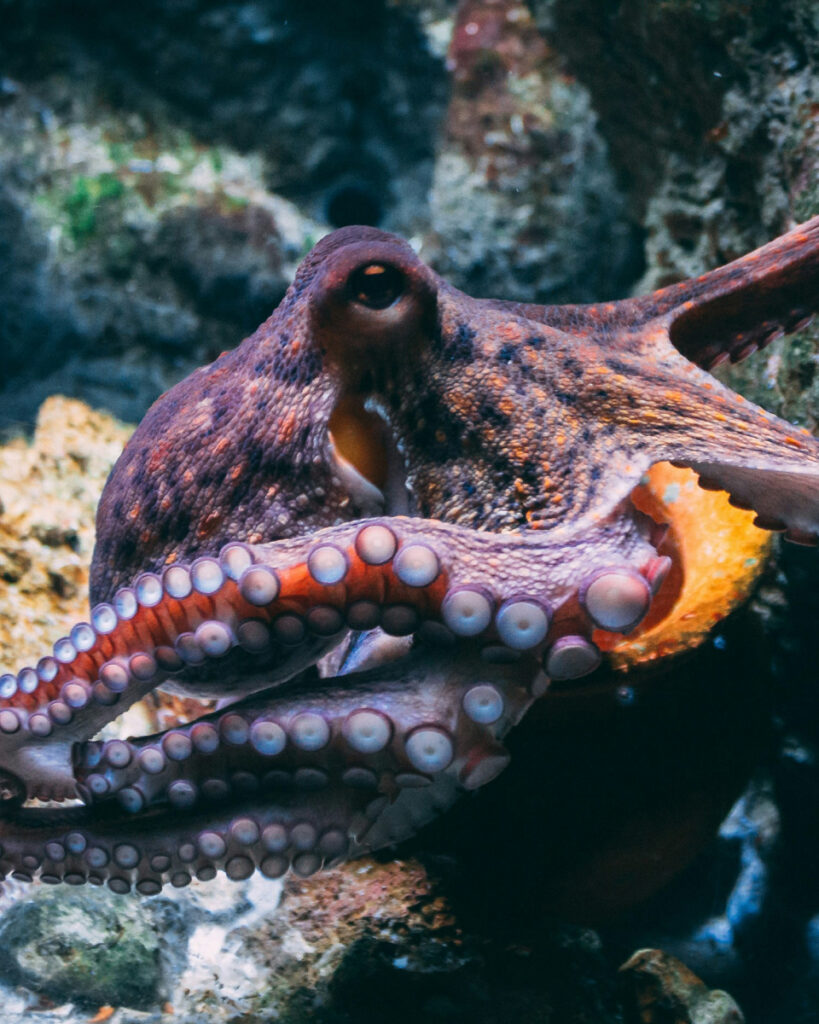
Photo by Diane Picchiottino
Cephalopods include several groups of marine invertebrates, most prominently squid (order Teuthida) and octopus (order Octopoda). These animals inhabit marine environments worldwide, ranging from shallow coastal waters to deep ocean ecosystems.
Cephalopods possess highly developed nervous systems and complex sensory organs. Octopus and squid have advanced eyes comparable in complexity to vertebrate vision, sophisticated motor coordination, and the ability to rapidly change colour and texture through specialised skin cells.
Octopuses in particular demonstrate behaviours associated with advanced cognition, including:
- problem-solving
- exploration and manipulation of objects
- learning and memory
- use of shelters and environmental structures
Squid are fast-swimming predators that rely on coordinated movement, camouflage, and rapid escape responses to avoid predators and capture prey.
Under natural conditions, cephalopods actively hunt crustaceans, fish, and other marine animals while navigating complex ocean habitats.
These characteristics establish cephalopods as highly responsive marine animals whose behavioural and environmental needs are systematically overridden within commercial exploitation systems.
Natural versus exploited lifespan
Natural lifespan
Cephalopod lifespan varies by species:
- Many squid species: 1–2 years
- Some octopus species: 1–5 years
Despite relatively short lifespans compared with many vertebrates, these animals undergo complex developmental stages and display advanced behavioural capabilities during their lives.
Lifespan under exploitation
Within commercial systems, cephalopods are typically killed immediately following capture.
In experimental aquaculture systems, animals may be raised in captivity until market size is reached before slaughter.
The divergence between natural lifespan and exploited lifespan is determined by fishing pressure and seafood market demand rather than biological development.
Systems of exploitation
Cephalopods are exploited across multiple overlapping systems:
Industrial fisheries
Squid and octopus are harvested in large quantities using commercial fishing fleets.
Seafood processing industries
Captured animals are processed into fresh, frozen, dried, or prepared seafood products.
Bait and feed supply chains
Cephalopods are used as bait in fisheries targeting other species and as feed for captive marine animals.
Emerging aquaculture development
Research institutions and private companies are developing methods for farming octopus and other cephalopods.
Biomedical and neurological research
Cephalopods have historically been used in neuroscience research due to their complex nervous systems.
Byproduct processing
Cephalopod remains may be processed into fish meal, animal feed ingredients, or industrial materials.
These systems rely on fishing fleets, processing plants, international seafood markets, and research institutions.
Living conditions across system types
Industrial capture fisheries
Squid and octopus are primarily harvested through fishing methods including:
- jigging vessels using lights to attract squid
- trawling nets
- traps and pots
- longline fisheries
Fishing vessels may capture large numbers of animals simultaneously.
Captured animals may remain alive on deck or in holding containers for extended periods before processing.
Emerging aquaculture systems
Experimental octopus farming systems involve:
- tank or enclosure housing
- controlled feeding regimes
- high-density captive populations
Because octopus are solitary animals in natural environments, confinement with other individuals may increase aggression and stress.
Research into commercial octopus farming remains controversial due to animal welfare and environmental concerns.
Research facilities
Cephalopods used in research may be housed in laboratory aquaria where environmental conditions such as lighting, temperature, and feeding are controlled.
Handling, experimental procedures, and confinement alter natural behaviours.
Across systems, natural hunting behaviour, habitat exploration, and complex environmental interactions are restricted.
Standardised lifecycle under exploitation
Cephalopods in commercial fisheries typically move through a simplified lifecycle under exploitation:
Wild growth phase
Animals grow in natural marine environments.
Capture
Fishing vessels harvest animals during feeding or migration periods.
Onboard storage
Captured animals are stored in containers or on ice.
Transport
Animals are transported to processing facilities or markets.
Processing
Bodies are cleaned, frozen, dried, or otherwise processed for sale.
In experimental aquaculture systems, animals may be bred or captured as juveniles and raised in captivity until slaughter.
Chemical and medical interventions
Cephalopods in aquaculture or laboratory environments may be subjected to:
- water treatment chemicals
- antibiotics or disease control agents
- experimental substances in research settings
Such interventions are typically linked to aquaculture development or experimental protocols.
Killing processes
Cephalopods are commonly killed through methods including:
- exposure to ice slurry
- asphyxiation outside water
- decapitation or dismemberment during processing
In fishing operations, animals may die slowly from suffocation or injury after capture.
Processing operations frequently involve killing large numbers of animals simultaneously.
Labour impact
Cephalopod exploitation industries involve labour associated with:
- fishing vessel operations
- net or jigging equipment handling
- seafood processing and packaging
- distribution and export logistics
Workers may face hazardous marine conditions, heavy equipment risks, and long working hours during fishing seasons.
Scale and prevalence
Squid and octopus are widely consumed seafood products across global markets.
Commercial fisheries harvest millions of tonnes of cephalopods annually, representing billions of individual animals.
Demand for cephalopods has increased in many regions, contributing to intensified fishing pressure.
Ecological impact
Cephalopod exploitation contributes to ecological impacts, including:
- disruption of marine food webs
- bycatch associated with trawling operations
- seabed disturbance from fishing gear
- potential environmental risks associated with proposed cephalopod aquaculture systems
Because cephalopods are both predators and prey in marine ecosystems, large-scale harvesting can affect broader ecological dynamics.
Language and abstraction
Cephalopods are typically described using culinary terminology such as:
- “calamari”
- “octopus seafood”
- “squid products”
These terms frame the animals primarily as food commodities rather than complex marine animals.
Marketing narratives emphasise taste, freshness, or cultural cuisine while omitting fishing and killing practices.
Editorial correction notice
Squid and octopus are frequently framed as seafood commodities or culinary products. This record documents cephalopods as complex marine animals systematically captured, confined in emerging aquaculture systems, processed, and killed within integrated fisheries, seafood processing, and global seafood markets, independent of culinary or commercial framing.