
Scope
This record documents how carp are exploited within globally standard animal-use systems. It describes dominant, routine practices across industrial aquaculture, polyculture pond systems, wild-capture fisheries, and stocking programs, independent of country-specific regulation or cultural framing.
Differences in scale, enforcement, and legal framing are documented in country records. System-specific mechanisms are documented within industry records.
Species context
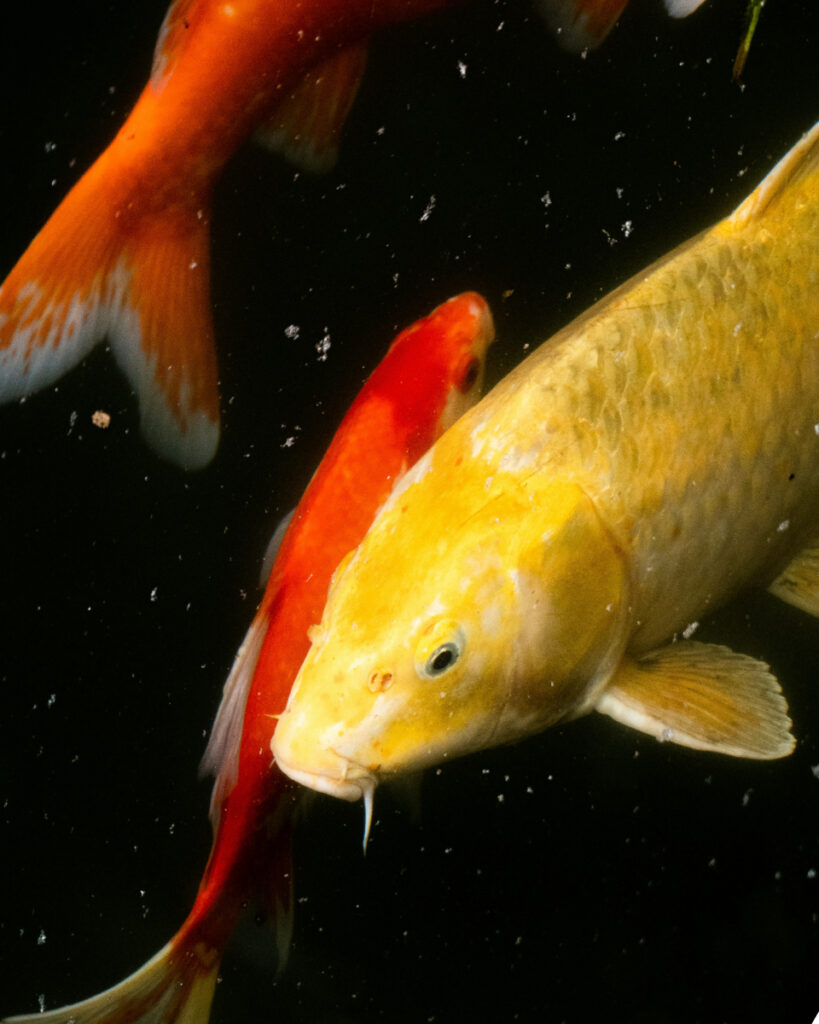
Photo by Sergio Li
Carp are freshwater fish primarily belonging to the family Cyprinidae, including species such as common carp (Cyprinus carpio), grass carp, silver carp, and bighead carp. They are adaptable, long-lived fish capable of tolerating a wide range of environmental conditions, including low oxygen levels and high turbidity.
Carp exhibit social schooling behaviour, benthic foraging patterns, and strong sensory perception through barbels and lateral line systems. They are capable of spatial learning, memory formation, and environmental recognition. In natural ecosystems, carp move across lakes, rivers, and floodplains, foraging on plant material, invertebrates, and detritus.
Under natural conditions, carp occupy structurally complex freshwater habitats and regulate stress through mobility, depth variation, and environmental choice.
These characteristics establish carp as resilient but behaviourally responsive animals whose environmental and physiological needs are systematically overridden within exploitation systems.
Natural versus exploited lifespan
Natural lifespan
In the absence of exploitation, carp can live 20–40 years depending on species and environmental conditions. Some individuals may live even longer in stable freshwater systems.
Lifespan under exploitation
Within exploitation systems, carp are typically killed far earlier:
- Aquaculture systems: commonly slaughtered within 1–3 years
- Polyculture pond systems: harvested seasonally once reaching market size
- Wild-capture fisheries: killed upon capture at commercially viable size
- Population control programs: killed at any age
The divergence between natural lifespan and exploited lifespan is determined by growth targets, harvest cycles, and management quotas rather than biological longevity.
Systems of exploitation
Carp are exploited across multiple, overlapping systems:
- Industrial and semi-industrial aquaculture
Carp are bred, hatched, confined, fed, and harvested in freshwater ponds, lakes, cages, and reservoirs. - Polyculture farming systems
Carp are raised alongside other fish species in multi-species pond systems designed to maximise biomass yield. - Wild-capture fisheries
Carp are captured from rivers, lakes, and reservoirs for commercial sale. - Stocking and enhancement programs
Hatcheries breed and release carp into waterways to support fisheries or aquaculture operations. - Population control and invasive species management
Carp are targeted in eradication and suppression programs in regions where they are classified as invasive. - Byproducts and reduction processing
Carp bodies are processed into food products, fishmeal, fertiliser, and animal feed inputs.
These systems rely on hatchery infrastructure, pond construction, feed production, water management systems, and large-scale harvesting operations.
Living conditions across system types
Pond and reservoir aquaculture
Carp are commonly raised in earthen ponds or enclosed freshwater bodies at moderate to high stocking densities. Water quality fluctuates due to waste accumulation, feed residues, and seasonal temperature shifts.
Environmental complexity is limited. Movement is confined to fixed water bodies. Seasonal draining of ponds for harvest disrupts the entire population simultaneously.
Cage systems
In some contexts, carp are confined in floating cages within lakes or reservoirs. Confinement restricts natural ranging behaviour while concentrating waste in surrounding waters.
Polyculture systems
Carp are integrated with other species to optimise feed utilisation. Inter-species competition and density pressures increase stress and injury risk.
Across systems, production efficiency and biomass yield are prioritised over behavioural autonomy.
Standardised lifecycle under exploitation
While production models vary, carp typically move through a broadly standardised lifecycle:
- Broodstock management and artificial reproduction
Adult carp are hormonally induced to spawn. Eggs are fertilised and incubated in controlled environments. - Larval and nursery phase
Fry are raised in hatcheries or small ponds until transfer size. - Grow-out phase
Carp are stocked in larger ponds or reservoirs and fed supplemental feed to accelerate growth. - Harvest operations
Ponds are partially or fully drained, and fish are crowded into confined areas for netting. - Slaughter and processing
Carp are transported, stunned inconsistently, and killed for processing.
In invasive control contexts, carp are removed using nets, electrofishing, poisoning, or mechanical barriers.
Chemical and medical interventions
To sustain production, carp are subjected to systemic interventions, including:
- Hormonal induction agents to trigger spawning
- Antibiotics to control bacterial outbreaks
- Antiparasitic treatments
- Water treatments and disinfectants
High-density and seasonal production cycles increase disease transmission risk, requiring pharmaceutical inputs.
Slaughter processes
Carp slaughter methods vary and often fail to ensure rapid unconsciousness. Common practices include:
- Asphyxiation in air
- Ice slurry immersion
- Blunt force trauma
- Electrical stunning with variable effectiveness
- Decapitation or gill cutting
Harvest often involves draining ponds, causing fish to experience prolonged crowding, oxygen depletion, and physical injury before killing.
In population control programs, carp may be killed through chemical poisoning (e.g., piscicides), electrofishing followed by disposal, or mass removal operations.
Slaughterhouse labour impact
Carp processing facilities rely on repetitive gutting, scaling, and filleting work. Workers are exposed to:
- Cold, wet, and physically demanding environments
- Repetitive strain injuries
- Continuous handling of live or dying fish
Seasonal harvest cycles create periods of intensified labour demand.
Scale and prevalence
Carp are among the most widely farmed fish globally by volume. Billions of individual carp are killed annually across aquaculture and fisheries systems.
They represent a major component of freshwater aquaculture production in multiple regions and are integral to large-scale pond-based farming systems.
Ecological impact
Carp exploitation contributes to ecological harm, including:
- Nutrient pollution and eutrophication from pond systems
- Escape of farmed carp into wild ecosystems
- Habitat alteration due to pond construction and water diversion
- Large-scale removal or poisoning in invasive management programs
In regions where carp are classified as invasive, mass killing programs alter aquatic ecosystems while creating additional waste disposal challenges.
Language and abstraction
Carp are frequently described using terms such as “biomass,” “yield,” “stocking density,” or “harvest weight.” In invasive management contexts, they are labelled “pest species” or “target biomass.”
These classifications reduce individual animals to production units or ecological problems, obscuring individual experience within extraction and control systems.
Editorial correction notice
Carp are often framed either as efficient aquaculture species or as invasive ecological threats. This record documents carp as individual animals systematically bred, confined, harvested, and killed across industrial aquaculture, fisheries, and control systems, independent of productivity narratives or environmental classification.