
Scope
This record documents how bees are exploited within globally standard animal-use systems. It describes dominant, routine practices across commercial honey production, pollination services, breeding operations, and derivative product industries, independent of country-specific regulation or cultural symbolism.
Differences in scale, enforcement, and legal framing are documented in country records. System-specific mechanisms are documented within industry records.
Species context
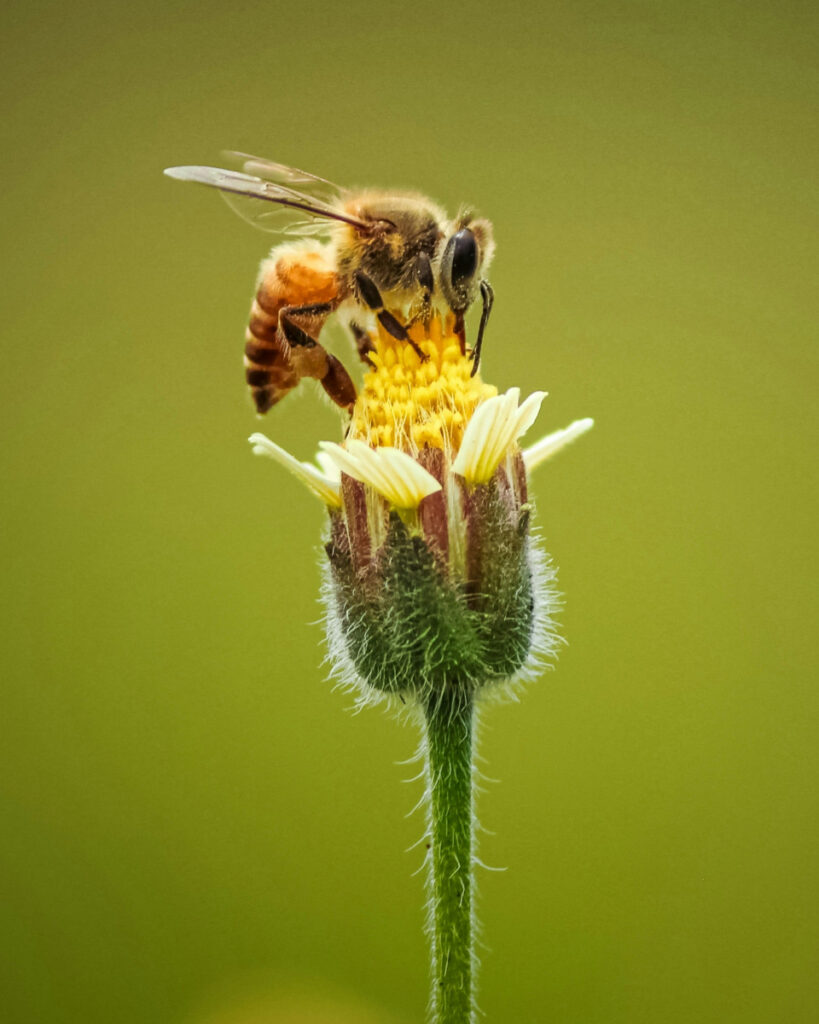
Photo by Ankith Choudhary
Commercial exploitation primarily targets the western honey bee (Apis mellifera), although other bee species are also used in pollination systems.
Honey bees are eusocial insects living in highly organised colonies structured around a single reproductive queen, thousands of female worker bees, and seasonal male drones. Colonies regulate temperature, humidity, food storage, and defence through coordinated collective behaviour.
Worker bees forage for nectar and pollen, communicate resource locations through waggle dances, construct wax comb, care for larvae, and defend the hive. Individual bees demonstrate learning ability, memory, navigation across kilometres, and stress responses to environmental disruption.
Under natural conditions, colonies select nesting sites, regulate reproduction through swarming, and maintain seasonal cycles aligned with floral availability.
These characteristics establish bees as complex social animals whose colony integrity, reproductive autonomy, and lifecycle rhythms are systematically overridden within exploitation systems.
Natural versus exploited lifespan
Natural lifespan
Worker bees naturally live approximately 4–6 weeks during active seasons and longer during winter cycles. Queens can live 3–5 years under stable colony conditions.
Colony survival depends on multi-season continuity and self-directed reproduction.
Lifespan under exploitation
Within exploitation systems:
- Queens are commonly replaced annually or every two years to maintain productivity.
- Worker bees die in large numbers during transport, pollination stress, honey extraction cycles, and seasonal culling.
- Entire colonies may be destroyed after pollination contracts or when honey yield declines.
The divergence between natural colony cycles and exploited lifespan is driven by productivity, transport demands, and disease management rather than colony stability.
Systems of exploitation
Bees are exploited across multiple, overlapping systems:
- Honey production
Bees are managed for continuous honey extraction at a commercial scale. - Pollination services
Colonies are transported to agricultural sites to pollinate monoculture crops. - Queen breeding and genetic selection
Controlled breeding programs prioritise docility, honey yield, and productivity. - Beeswax and derivative products
Wax, propolis, royal jelly, and bee venom are harvested for commercial use. - Package bee and nucleus colony trade
Live bees are sold and shipped domestically and internationally.
These systems rely on managed hives, migratory transport infrastructure, breeding facilities, and industrial extraction equipment.
Living conditions across system types
Managed hive systems
Bees are confined within artificial hives designed for human access and honey removal. Hive structures replace natural nesting cavities and are manipulated regularly for inspection and extraction.
Beekeepers control:
- Hive location
- Swarming behaviour
- Queen reproduction
- Food supply
Swarming, a natural reproductive process, is often prevented to maintain workforce numbers.
Migratory pollination
In pollination systems, hives are transported across long distances on trucks, often multiple times per year. Colonies are exposed to:
- Vibration and confinement during transport
- Sudden climate shifts
- Monoculture forage with limited nutritional diversity
- Pesticide exposure
Large-scale pollination events can involve millions of bees concentrated in single crop regions.
Intensive production contexts
Commercial honey operations may involve high-density apiaries where disease transmission risk increases.
Across systems, colony autonomy is subordinated to human scheduling and agricultural demand.
Standardised lifecycle under exploitation
While practices vary, managed honey bee colonies typically move through a broadly standardised exploitation cycle:
- Queen selection and artificial breeding
Queens are artificially inseminated or selectively bred. Unwanted queens are killed and replaced. - Colony establishment
Colonies are assembled or divided for expansion. - Honey flow management
Bees collect nectar, which is stored in comb. Honey supers are added to increase storage capacity. - Honey extraction
Honey-filled frames are removed. Bees are often cleared from frames using smoke, forced air, or mechanical devices. - Supplemental feeding
Extracted honey is replaced with sugar syrup or artificial feed. - Pollination deployment
Colonies are transported to crop sites for pollination services. - Seasonal reduction or culling
Weakened colonies may be merged, replaced, or destroyed.
Chemical and medical interventions
To sustain colony productivity, bees are subjected to systemic interventions, including:
- Miticides to control varroa mite infestations
- Antibiotics to manage bacterial diseases
- Fumigants and chemical treatments within hives
- Sugar syrup feeding to replace removed honey
Parasite infestations, particularly varroa destructor, are widespread in commercial systems, requiring repeated chemical treatment cycles.
Honey extraction processes
Honey extraction involves:
- Opening hives using smoke to suppress defensive responses
- Removing frames filled with stored honey
- Mechanically spinning frames in extractors to remove honey
- Scraping or melting wax comb
During extraction, bees may be:
- Crushed between hive components
- Injured during frame removal
- Killed during mechanical clearing processes
Honey removed from hives is replaced with lower-nutrient sugar solutions, altering colony diet composition.
Slaughter and colony destruction
Bees are not typically slaughtered individually but die in large numbers as part of routine operations:
- Winter culling of unproductive colonies
- Destruction of hives following disease outbreaks
- Mass mortality during transport and pesticide exposure
- Intentional killing of queens during replacement cycles
Entire colonies may be destroyed when deemed economically unviable.
Labour impact
Commercial beekeeping and pollination industries involve:
- Repetitive hive inspection and manipulation
- Exposure to stings and physical strain
- High seasonal labour intensity
- Transport logistics across agricultural regions
In large-scale operations, colony numbers can reach thousands per operator.
Scale and prevalence
Honey bees are managed globally, with tens of millions of hives maintained for honey and pollination services. Pollination industries support large segments of industrial agriculture, particularly monoculture crops.
Colony losses occur annually at high rates, requiring continual breeding and replacement.
Ecological impact
Bee exploitation contributes to ecological disruption through:
- Genetic homogenisation from selective breeding
- Spread of parasites and disease through migratory pollination
- Competition between managed honey bees and wild pollinators
- Dependence of monoculture agriculture on mass-managed pollination
- Pesticide exposure linked to large-scale crop systems
Managed honey bee populations can alter local pollinator dynamics and ecosystem balance.
Language and abstraction
Bees are frequently described using collective economic terms such as “hives,” “colonies,” “units,” or “pollination services.” Honey is framed as surplus or excess production, despite being the primary winter food for the colony.
The framing of bees as agricultural inputs obscures individual and colony-level disruption.
Editorial correction notice
Bees are often portrayed solely as essential pollinators or honey producers within agricultural narratives. This record documents bees as eusocial animals systematically managed, transported, manipulated, and subjected to large-scale mortality within commercial honey and pollination industries, independent of symbolic environmental value.