
Scope
This record documents how Angora rabbits are exploited within globally established animal-use systems. It describes dominant practices across fibre production, breeding industries, textile supply chains, fur production, pet trade industries, and laboratory research contexts, independent of country-specific regulation or textile marketing narratives.
Differences in scale, enforcement, and legal classification are documented in country records. System-specific mechanisms are documented within industry records.
Species context
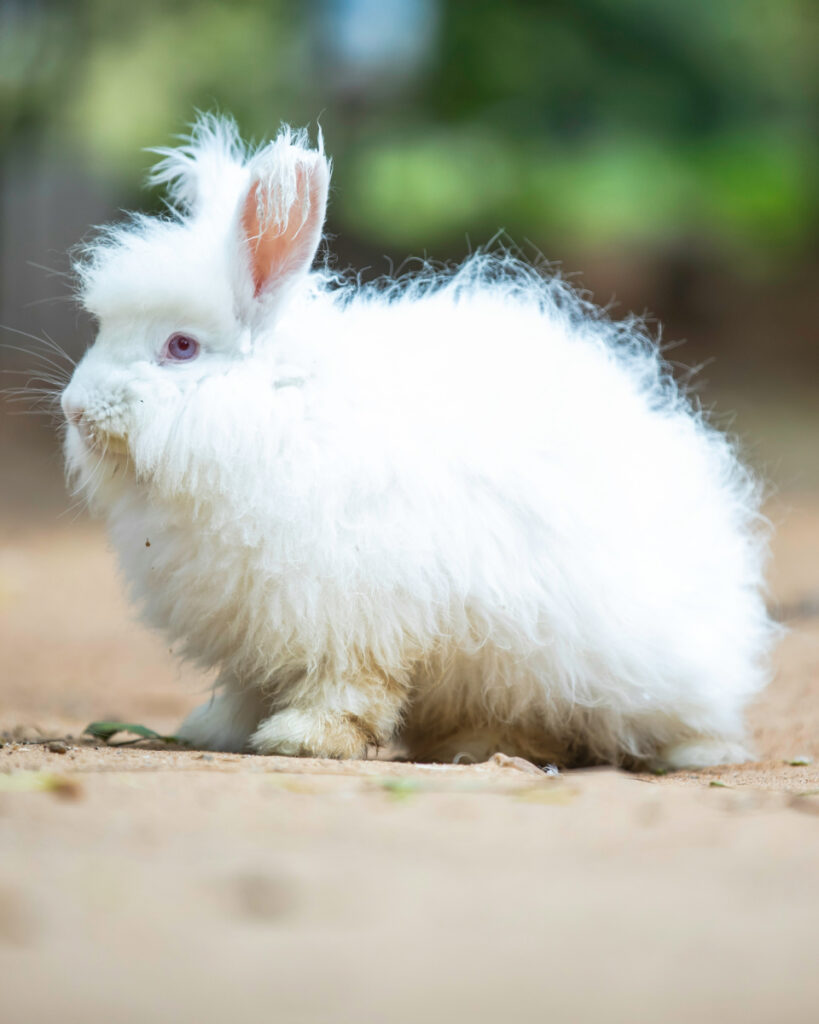
Photo by Anil Sharma
Angora rabbits are domesticated rabbit breeds selectively developed for extremely long, soft fibre growth. Several breeds are commonly associated with fibre production, including the English Angora, French Angora, Satin Angora, and Giant Angora.
These rabbits are descendants of the European rabbit (Oryctolagus cuniculus). Domestic rabbits are social mammals that naturally live in groups within complex burrow systems. They rely on alert sensory systems, including hearing and smell, to detect predators and navigate their environment.
Under natural conditions, rabbits spend much of their time foraging, digging, grooming, and interacting with other rabbits within social groups.
Angora rabbits have been selectively bred for continuous hair growth far exceeding that of wild rabbits. Their coats require regular removal to prevent matting and overheating.
These characteristics establish Angora rabbits as domesticated mammals whose biological traits have been heavily modified to support fibre extraction within commercial production systems.
Natural versus exploited lifespan
Natural lifespan
In the absence of exploitation, domestic rabbits commonly live 8–12 years.
Lifespan under exploitation
Within fibre production systems, Angora rabbits may be killed far earlier:
- Fibre farming systems: commonly killed once fibre productivity declines, often after 2–5 years
- Fur production systems: killed earlier once coat quality reaches commercial standards
- Laboratory research: killed after experimental protocols conclude
The divergence between natural lifespan and exploited lifespan is determined by fibre yield, coat quality, and commercial considerations rather than biological longevity.
Systems of exploitation
Angora rabbits are exploited across multiple, overlapping systems:
- Fibre production (Angora wool)
Angora rabbits are bred and maintained for the extraction of long, soft fibres used in textile production. - Textile and fashion supply chains
Angora fibre is processed into yarn and fabrics used in clothing and luxury garments. - Breeding industries
Rabbits are selectively bred for traits such as fibre length, density, and colour. - Fur production
Rabbit pelts may be used for fur garments or trim after animals are killed. - Pet trade industries
Angora rabbits are also bred and sold as companion animals. - Laboratory research
Rabbits, including Angora breeds, may be used in biomedical research and product testing.
These systems rely on breeding facilities, fibre processing operations, textile manufacturing industries, and international fashion markets.
Living conditions across system types
Fibre farming systems
Angora rabbits raised for fibre production are typically housed in individual wire cages within indoor farming facilities.
Cages restrict natural behaviours such as digging, running, and social interaction. Flooring composed of wire mesh may contribute to foot injuries and discomfort.
Because Angora rabbits produce continuously growing fibre, animals must be regularly groomed and shorn to prevent matting and overheating.
Environmental enrichment is minimal or absent. Rabbits are fed pellet diets, hay, and supplemental feed to support fibre growth.
Breeding facilities
Breeding rabbits are maintained to produce offspring with desirable fibre traits. Selective breeding emphasises coat length, softness, and yield.
Young rabbits may be separated from their mothers early to be raised for fibre production or sale.
Pet trade environments
Angora rabbits bred for the pet trade may be housed in cages or enclosures prior to sale. Care conditions vary widely depending on breeder practices.
Across systems, natural burrowing behaviour, complex social interactions, and large movement ranges are absent.
Standardised lifecycle under exploitation
While practices vary, Angora rabbits in fibre production systems typically move through a broadly standardised lifecycle:
- Selective breeding
Adult rabbits are chosen to produce offspring with desirable fibre characteristics. - Birth and early development
Kits are born within breeding cages and remain with their mothers for a limited period. - Fibre growth phase
Rabbits are maintained in cages while their coats grow continuously. - Fibre harvesting
Hair is removed at regular intervals through plucking, shearing, or clipping. - Decline in fibre productivity
Once fibre yield or quality decreases, rabbits may be killed for pelts or replaced by younger animals. - Processing
Fibre is cleaned, processed into yarn, and incorporated into textile production.
Chemical and medical interventions
Fibre farming operations may involve:
- parasite control treatments
- antibiotics used to treat infections
- vaccinations in some breeding operations
These interventions are used to maintain animal health within confined farming environments.
Killing processes
Angora rabbits may be killed through methods including:
- cervical dislocation
- blunt force trauma
- gassing
- slaughter following transport to processing facilities
After killing, pelts may be removed for use in fur production.
Labour impact
Angora rabbit exploitation industries involve labour associated with:
- breeding and cage maintenance
- feeding and health monitoring
- grooming and fibre harvesting
- pelt processing and textile production
Workers may experience repetitive strain injuries and exposure to animal waste, dust from fibre processing, and other occupational hazards.
Scale and prevalence
Angora fibre production occurs in several regions globally and supplies textile industries producing luxury garments and blended fabrics.
Large breeding populations are maintained in fibre farming systems to sustain continuous fibre supply.
Angora rabbits are also widely bred for the pet trade.
Ecological impact
Angora rabbit farming contributes to environmental impacts, including:
- waste generation from concentrated breeding facilities
- feed production and associated agricultural resource use
- textile processing impacts, including chemical treatments used in fibre preparation
Escaped domestic rabbits may affect ecosystems in regions where they become invasive species.
Language and abstraction
Within the textile industry, Angora fibre is marketed using terms such as “Angora wool” or “Angora blend.” These terms emphasise softness and luxury qualities while omitting the breeding, confinement, and fibre extraction processes involved in production.
Editorial correction notice
Angora rabbits are frequently framed as sources of luxury fibre or companion animals. This record documents Angora rabbits as domesticated mammals selectively bred, confined, repeatedly subjected to fibre extraction, and ultimately killed within integrated textile, breeding, and commercial supply systems independent of fashion or pet industry framing.