
Scope
This record documents how calves (young cattle) are exploited within globally standard animal-use systems. It describes dominant, routine practices across dairy, meat, veal, leather, breeding, and byproduct industries, independent of country-specific regulation or marketing narratives.
Differences in scale, enforcement, and legal framing are documented in country records. System-specific mechanisms are documented within industry records.
Species context
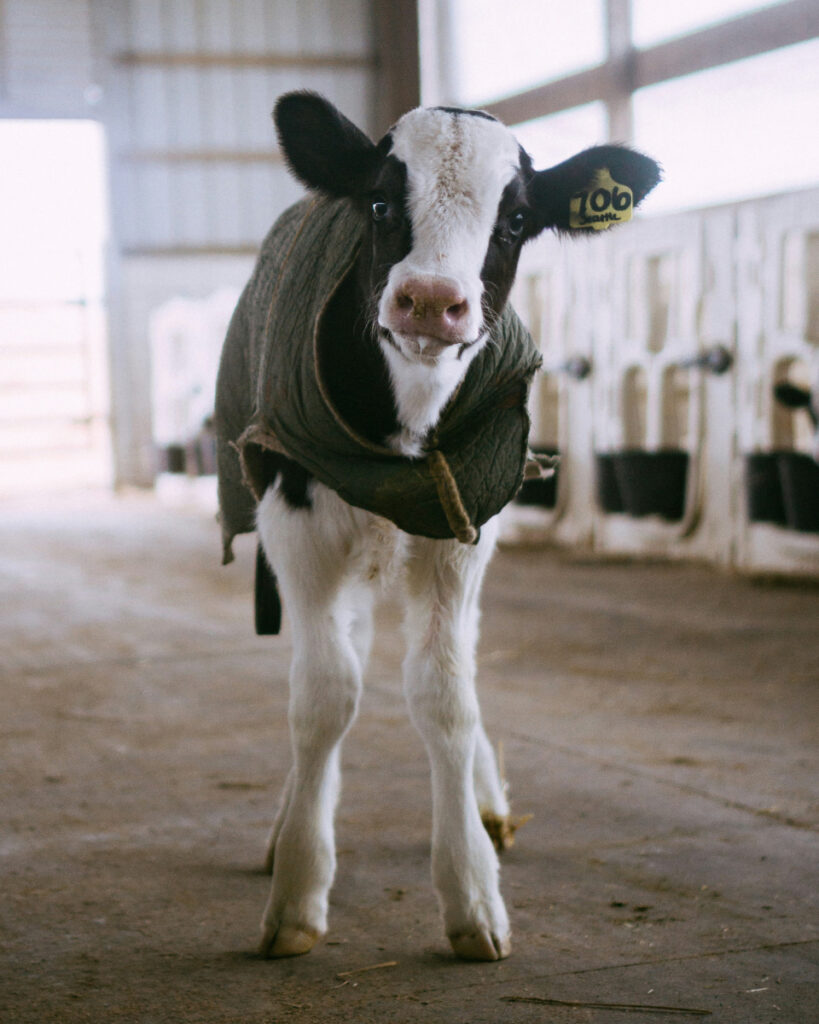
Photo by Amber Kipp
A calf is a juvenile cow or bull (Bos taurus or Bos indicus), typically from birth to approximately one year of age. Calves are precocial mammals capable of standing and walking shortly after birth. They form strong maternal bonds within hours and engage in play, exploration, and social learning.
Under natural conditions, calves remain with their mothers for many months, nursing regularly and integrating gradually into herd structure. They learn grazing behaviour, social hierarchy, and threat responses through close maternal and herd interaction.
Calves display distress vocalisations and agitation when separated from their mothers. They rely on consistent nursing, warmth, and social bonding for physiological and behavioural development.
These characteristics establish calves as dependent, socially responsive animals whose early development is systematically disrupted within exploitation systems.
Natural versus exploited lifespan
Natural lifespan
In the absence of exploitation, cattle commonly live 15–20 years, with extended maternal care and gradual maturation into adulthood.
Lifespan under exploitation
Within exploitation systems, calves are frequently killed very early in life:
- Veal production systems: commonly slaughtered between 16–32 weeks
- Dairy industry male calves: often killed within days to months
- Surplus or low-value calves: sometimes killed shortly after birth
- Beef systems: raised and slaughtered between 12–24 months
The divergence between natural lifespan and exploited lifespan is determined by economic utility—milk production, meat yield, or breeding value—rather than biological development.
Systems of exploitation
Calves are exploited across multiple, overlapping systems:
- Dairy production
Calves are born as a consequence of forced or controlled breeding to initiate lactation in cows. - Veal production
Calves, often males from dairy systems, are confined and fattened for tender meat. - Beef production
Calves are raised for meat following separation from their mothers. - Leather production
Calfskin is processed into leather goods, often marketed as a high-quality or luxury material. - Byproducts and rendering
Calf bodies and organs are processed into pet food, pharmaceuticals, gelatin, and industrial products. - Breeding stock development
Selected female calves are raised as replacement dairy cows.
These systems rely on controlled reproduction, early separation, confinement infrastructure, transport networks, and slaughter facilities.
Living conditions across system types
Dairy systems
Calves in dairy operations are typically separated from their mothers within hours or days of birth to divert milk for commercial use. Separation disrupts maternal bonding and triggers distress responses in both cow and calf.
Calves are commonly housed:
- Individually in hutches or pens
- In small group enclosures
- In confined indoor facilities
Individual housing restricts social interaction during early development.
Male calves, considered low economic value in dairy systems, may be sold for veal, raised briefly for beef, or killed shortly after birth.
Veal production
Veal calves are often confined in restricted spaces designed to limit movement and control muscle development. Diets are formulated to produce pale meat, sometimes involving limited iron intake.
Beef systems
Calves raised for beef may experience pasture-based phases but remain subject to branding, castration, dehorning, and eventual feedlot confinement prior to slaughter.
Across systems, early-life management prioritises economic categorisation over developmental needs.
Standardised lifecycle under exploitation
While pathways vary, calves typically move through a broadly standardised exploitation cycle:
- Controlled breeding of cows
Cows are impregnated through artificial insemination or controlled mating to produce calves. - Birth and immediate separation (dairy systems)
Calves are removed shortly after birth. - Categorisation by sex and perceived value
Female calves may be retained as future dairy cows. Male calves are often diverted to veal or beef systems. - Growth or confinement phase
Calves are raised under milk replacer feeding or high-energy diets. - Transport and slaughter
Calves are transported to slaughterhouses once target age or weight is reached.
For some male dairy calves, the lifecycle may end within days of birth.
Chemical and medical interventions
To sustain productivity, calves are subjected to systemic interventions including:
- Vaccinations
- Antibiotics to manage disease in high-density housing
- Hormonal treatments linked to reproductive scheduling (indirectly through maternal systems)
- Castration without anaesthesia in some contexts
- Dehorning or disbudding procedures
High-density housing increases disease transmission risk, necessitating pharmaceutical management.
Slaughter processes
Calves are transported to slaughter facilities, often at very young ages. Transport stress includes crowding, dehydration, and unfamiliar handling.
Common slaughter methods include:
- Captive bolt stunning followed by throat cutting
- Electrical stunning
- Ritual slaughter practices
Stunning effectiveness varies. Inconsistent application can result in prolonged consciousness during bleeding.
Veal calves may be slaughtered at only a few months of age.
Slaughterhouse labour impact
Calf slaughter and processing involve:
- High-speed line work
- Repetitive cutting and evisceration
- Handling of young, distressed animals
Workers are exposed to physical injury risk and psychological strain associated with repetitive killing.
Scale and prevalence
Calves are produced globally as a structural requirement of dairy production. Hundreds of millions of calves are born annually in connection with milk supply chains.
Large numbers of male calves are classified as surplus within dairy systems.
Veal production and calfskin leather industries integrate directly with dairy and beef supply chains.
Ecological impact
Calf exploitation contributes to ecological harm, including:
- Methane emissions linked to cattle systems
- Land use for feed production
- Water consumption
- Manure waste and nutrient runoff
- Resource inputs associated with dairy and beef integration
Calves represent the reproductive foundation of cattle-based agriculture, sustaining long-term herd expansion.
Language and abstraction
Calves are often referred to using economic terminology such as “byproduct,” “replacement stock,” or “veal units.” Male dairy calves are described as “surplus” or “non-viable,” framing killing as logistical necessity.
Calfskin leather is marketed under terms such as “premium leather” or “fine hide,” obscuring the age at which animals are killed.
Editorial correction notice
Calves are frequently framed as secondary outputs of dairy and beef systems. This record documents calves as dependent young animals systematically separated, categorised, confined, transported, and killed as structural components of integrated milk, meat, and leather industries, independent of marketing language or byproduct framing.