
Scope
This record documents how goats bred for fibre—primarily cashmere and mohair—are exploited within globally standard animal-use systems. It describes dominant, routine practices across fibre production, breeding and genetics, herd management, meat and leather supply chains, transport, and slaughter, independent of country-specific regulation or luxury textile branding narratives.
Differences in scale, enforcement, and legal framing are documented in country records. System-specific mechanisms are documented within industry records.
Species context
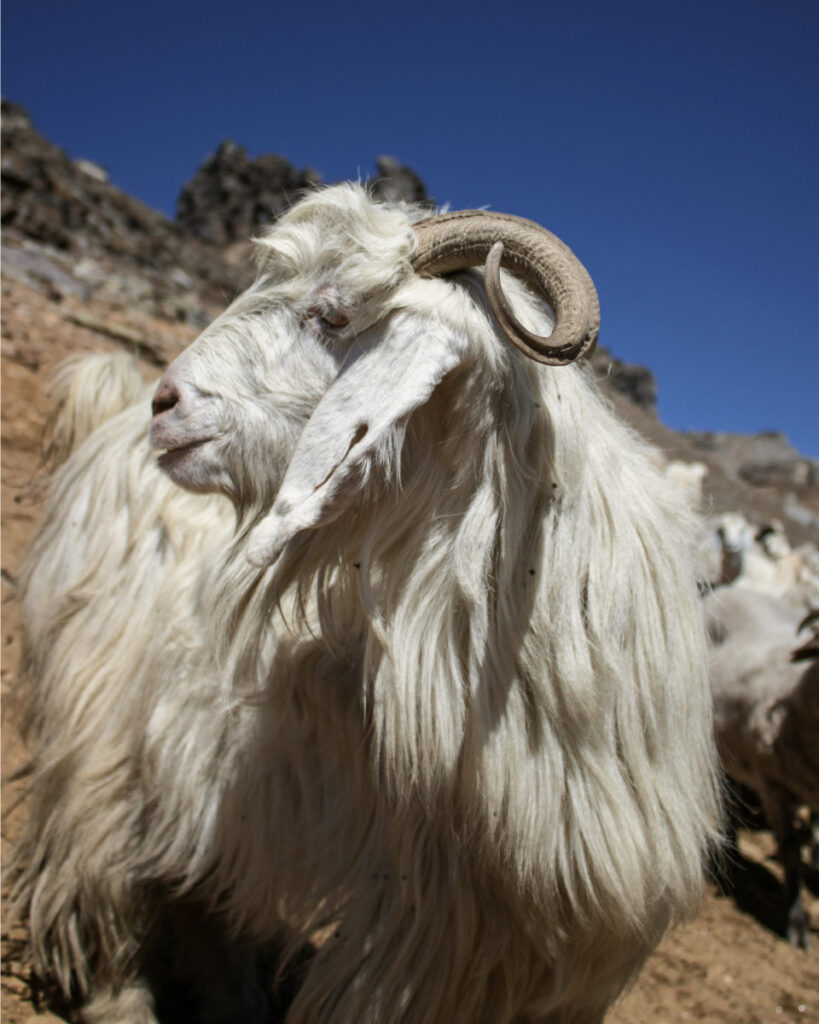
Photo by Lay Naik
Cashmere fibre is produced from the fine undercoat of certain goat populations, while mohair is produced from Angora goats (Capra hircus). These goats are domesticated herbivorous mammals that naturally live in social groups, forming herd structures with strong maternal bonds and social hierarchies.
Goats are agile browsers adapted to varied landscapes. They spend large portions of their day foraging, exploring, and interacting with herd members. They display learning ability, memory, and stress responses when threatened or restrained.
Goats regulate body temperature through their coats, behavioural adjustments, and environmental shelter. Removal of fibre alters thermoregulation and increases vulnerability to temperature extremes.
These characteristics establish goats as social animals with environmental and behavioural needs that are systematically constrained within industrial fibre extraction systems.
Natural versus exploited lifespan
Natural lifespan
In the absence of exploitation, goats commonly live 15–18 years, with stable herd structures and multi-year reproductive cycles.
Lifespan under exploitation
Within fibre production systems, goats are frequently killed far earlier:
- Fibre production herds: typically slaughtered once fibre quality or yield declines, often within 5–10 years
- Surplus animals: culled earlier if they do not meet fibre standards
- Male goats not used for breeding: commonly slaughtered at younger ages
The divergence between natural lifespan and exploited lifespan is determined by fibre yield, breeding value, and market demand rather than biological longevity.
Systems of exploitation
Goats bred for cashmere and mohair are exploited across multiple, overlapping systems:
- Fibre production (cashmere and mohair)
Goats are bred and maintained for coat growth, which is harvested annually. - Selective breeding and genetics
Breeding programs prioritise fibre fineness, length, density, colour, and yield. - Meat production
Goats removed from fibre systems frequently enter meat supply chains. - Leather production
Goat skins are processed into leather goods and textiles. - Byproducts and rendering
Bones, fats, and organs are processed into industrial products.
These systems rely on controlled breeding, large herd management, shearing infrastructure, transport networks, and slaughter facilities.
Living conditions across system types
Fibre production herds
Cashmere and Angora goats are commonly raised in large herds in rangeland or fenced grazing environments. Although pasture-based, herd movement is controlled through fencing and management practices.
Goats are subjected to annual fibre harvesting through:
- Shearing with mechanical clippers
- Combing to remove undercoat fibres (common in cashmere production)
During fibre harvesting, goats are restrained to immobilise them. High-throughput shearing environments prioritise speed and efficiency, increasing the likelihood of cuts and injuries.
Removal of fibre reduces insulation, leaving goats vulnerable to cold exposure or extreme weather following shearing.
Intensive or semi-intensive systems
In some regions, goats may be housed in confined facilities with limited grazing access. High-density herd conditions increase disease transmission risk.
Across systems, herd management prioritises fibre yield and reproductive output rather than behavioural needs.
Standardised lifecycle under exploitation
While practices vary, goats in fibre systems typically move through a broadly standardised lifecycle:
- Selective breeding
Animals with desirable fibre characteristics are selected as breeding stock. - Birth and herd integration
Kids remain with mothers initially before integration into herd structures. - Annual fibre extraction
Goats undergo shearing or combing cycles. - Productivity monitoring
Fibre yield and quality are evaluated annually. - Culling and slaughter
Goats with declining fibre output or undesirable traits are sold for meat or slaughtered.
Male goats not used for breeding may be culled early or directed to meat supply chains.
Chemical and medical interventions
To sustain herd productivity, goats are subjected to systemic interventions including:
- Vaccinations to manage disease outbreaks
- Antiparasitic treatments
- Antibiotics to treat infections
- Hormonal management in breeding programs
High-density herd management increases disease pressure, requiring ongoing veterinary intervention.
Slaughter processes
Goats removed from fibre systems are transported to slaughter facilities. Transport may involve long distances, crowding, dehydration, and stress.
Common slaughter methods include:
- Electrical stunning followed by throat cutting
- Captive bolt stunning
- Throat cutting without effective stunning in some contexts
Stunning effectiveness varies depending on equipment and operator skill, and animals may remain conscious during bleeding in some cases.
Goats killed from fibre systems may enter meat supply chains, while skins are processed for leather production.
Slaughterhouse labour impact
Processing goats involves repetitive tasks including:
- Handling distressed animals
- Skinning and carcass processing
- High-throughput slaughter line operations
Workers may experience physical injuries and psychological strain associated with routine killing.
Scale and prevalence
Cashmere and mohair industries operate globally, supplying textile markets for clothing, luxury garments, and blended fabrics. Millions of goats are maintained within fibre production systems worldwide.
Cashmere production alone requires large herds due to the small quantity of fibre produced per animal annually.
The fibre industry is structurally linked to meat and leather supply chains.
Ecological impact
Goat fibre production contributes to ecological impacts including:
- Overgrazing and land degradation in fragile rangeland ecosystems
- Desertification pressures linked to large cashmere-producing herds
- Water and energy use in textile processing
- Waste generation from fibre cleaning and manufacturing
Large-scale herd expansion for cashmere production has been associated with vegetation loss and soil erosion in some regions.
Language and abstraction
Cashmere and mohair are frequently marketed as luxury fibres associated with softness, warmth, and natural origins. Marketing narratives focus on material qualities while omitting breeding control, shearing practices, and slaughter integration.
Goats are described in commodity terms such as “fibre producers,” “stock,” or “yield units,” obscuring individual animals within textile supply chains.
Editorial correction notice
Cashmere and mohair are often framed as natural luxury fibres detached from animal harm. This record documents goats bred for these fibres as social mammals systematically bred, restrained, shorn, managed in large herds, transported, and ultimately killed within integrated fibre, meat, and leather industries, independent of fashion branding or luxury narratives.